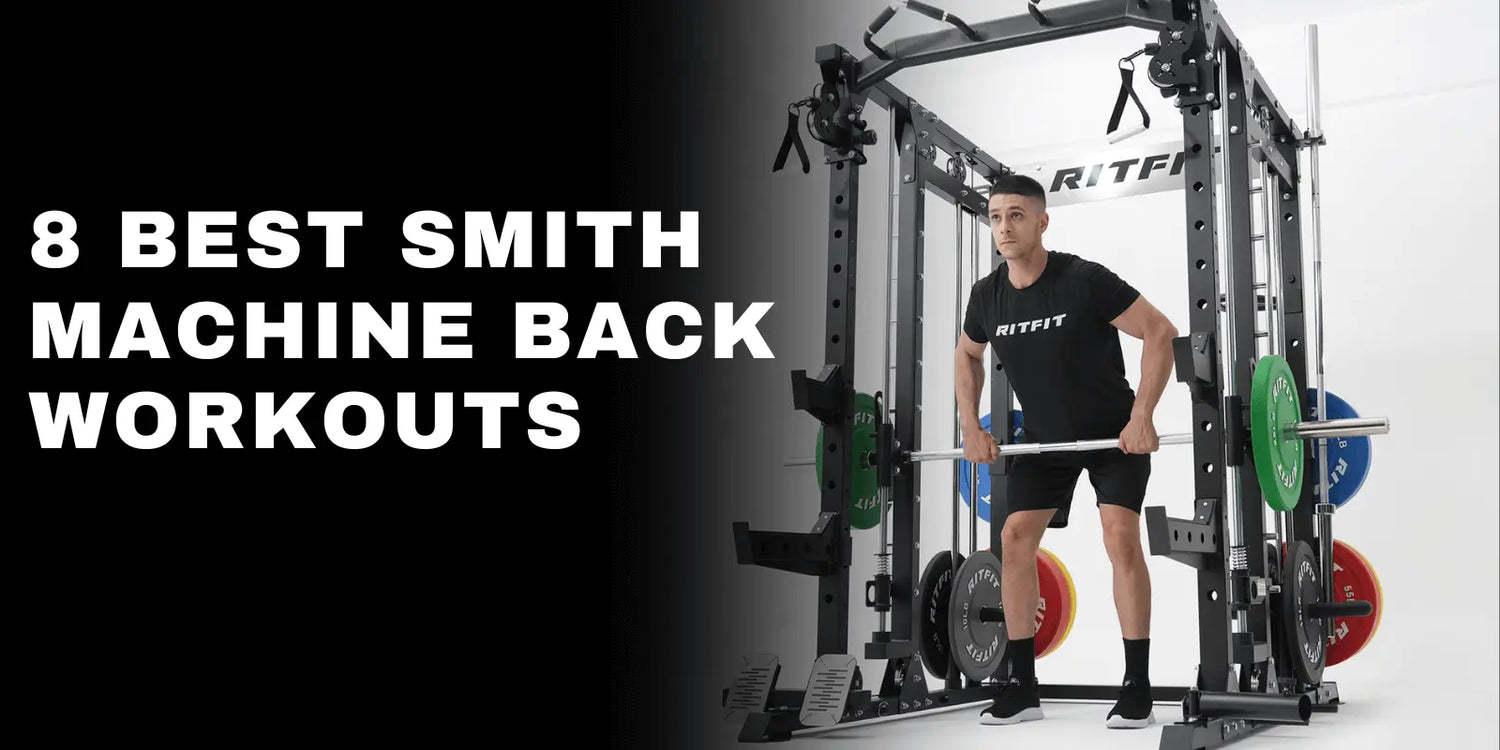
A Smith machine back workout can build strength and muscle when you combine controlled rows, hip hinges, vertical pulls, and trap focused movements. The guided bar path reduces balance demands, but effective training still depends on proper alignment, bracing, range of motion, and progressive overload.
Table of Contents
Key Takeaways
- Cover the main movement patterns: Combine a horizontal row, a hip hinge, a vertical pull, and an upper trap accessory.
- Use the rails correctly: The fixed bar path improves repeatability, but your foot position and torso angle must match the machine.
- Start with three or four exercises: More exercises are not automatically better when your working sets already cover the full back.
- Progress only with consistent form: Add weight after reaching the top of the rep range without changing your bar path or torso position.
- Respect pain signals: Stop for sharp pain, radiating pain, numbness, tingling, or sudden weakness.
Who This Guide Is For
This guide is for beginner through intermediate lifters who want a structured and repeatable Smith machine back workout. Anyone returning from a back, shoulder, neck, elbow, or wrist injury should seek qualified professional guidance before loading these movements.
How This Guide Was Built
This workout follows a patterns first approach with horizontal pulling, hip hinging, vertical pulling, and upper trap training. Each exercise retains the established setup, coaching tips, beginner routine, video, and related RitFit resource while correcting unclear or overly certain safety claims.
Smith Machine Back Workout Benefits
The Smith machine makes many back exercises easier to set up and repeat because the bar follows a guided path. It does not correct poor technique automatically, so your stance, brace, loading, and range of motion still matter.
- Extra Stability for Better Control: The rails reduce the need to control forward and backward bar movement. This can help you concentrate on your torso angle, elbow path, and target muscles.
- Repeatable Exercise Setup: Bar height, safety stop position, stance, and grip can be recorded and repeated. This makes it easier to compare performance from one workout to the next.
- Convenient Reracking: Hooks and safety stops can make it easier to end a set without walking the bar back to a rack. They remain backup systems and should not be treated as permission to exceed your technical limits.
- Effective Muscle Building: Smith machine rows, inverted rows, shrugs, and hip hinges can train the lats, rhomboids, trapezius, rear shoulders, glutes, hamstrings, and spinal erectors. Research comparing machine and free weight training indicates that both approaches can support muscle growth when the training stimulus is appropriate.[1]
- Controlled Range of Motion: The stable bar path can help you repeat a pain free range without unnecessary bar drift. Training through an appropriately controlled range may support muscular development, although the best range depends on the exercise and the individual.[2]
- Simple Progressive Overload: You can increase repetitions or add small amounts of weight while keeping the same setup. Progress should be earned through consistent technique rather than forced by momentum.
- Versatility for Different Goals: Rows support back thickness, inverted rows provide scalable bodyweight pulling, shrugs train the upper traps, and hinge movements strengthen the posterior chain. Choose movements based on your goal instead of trying to perform every exercise in one session.
8 Best Smith Machine Back Workouts
These eight Smith machine back exercises cover rows, trap training, bodyweight pulling, and posterior chain work. Most lifters should choose three or four movements per session rather than completing all eight together.
Quick setup checklist before you start:
- Bar path: Test several repetitions with the empty bar and confirm that it travels close to your body.
- Foot position: Stand far enough from the rails to prevent the bar from striking your knees.
- Spine: Brace your abdomen and maintain a stable torso position throughout the working range.
- Range: Stop before your shoulders collapse forward or your lower back begins to round.
- Safety stops: Set them before loading the bar and test them with an empty bar.
1. Smith Machine Bent Over Row
How to do:
- Set the bar at roughly mid thigh height on the Smith machine.
- Stand with your feet about shoulder width apart, soften your knees, and hinge forward from the hips.
- Take an overhand grip just outside shoulder width.
- Pull the bar toward your lower chest or upper abdomen while keeping your torso angle stable.
- Bring your elbows behind your torso and squeeze your shoulder blades without forcing them together.
- Lower the bar under control and maintain a neutral head and spinal position.
Pro Tips:
- Keep your elbows closer to your torso and pull toward the upper abdomen when you want greater lat emphasis.
- Brace through your abdomen and sides instead of overextending your lower back.
- Use a controlled lifting and lowering speed rather than jerking the bar. Research does not support one perfect tempo, but controlled repetitions help maintain a repeatable movement pattern.[3]
- Keep a slight bend in your knees to reduce unnecessary hamstring tension.
Workout Routine for Beginners:
- Sets: 3 to 4
- Reps: 8 to 12
- Rest: 60 to 90 seconds
RELATED: How to Do the Smith Machine Bent Over Row
2. Smith Machine Barbell Row
The Smith machine barbell row allows you to adjust grip orientation and touch point while keeping the bar path consistent. Use a load that lets your torso remain stable from the first repetition to the last.
How to do:
- Place the bar at thigh level and stand with your feet about shoulder width apart.
- Use an underhand grip for the reverse grip variation or an overhand grip for a traditional row.
- Hinge at the hips until your torso reaches a stable angle that you can maintain.
- Row the bar toward your upper abdomen while keeping your elbows close to your sides.
- Pause briefly, then lower the bar without allowing your shoulders or lower back to collapse.
Pro Tips:
- Keep your head aligned with your spine instead of looking forward excessively.
- Reduce the load if you need to raise your torso or drive your hips forward to complete a repetition.
- Use the grip that feels most comfortable for your wrists and elbows.
Workout Routine for Beginners:
- Sets: 3
- Reps: 10 to 12
- Rest: 60 seconds
3. Smith Machine Upright Row
How to do:
- Stand with your feet about hip width apart and take an overhand grip near shoulder width.
- Allow the bar to hang at arm length in front of your thighs.
- Pull the bar upward while leading with your elbows and keeping it close to your torso.
- Stop at a comfortable height before your shoulders feel pinched or restricted.
- Lower the bar under control and avoid dropping it between repetitions.
Pro Tips:
- Do not force the bar to chin height when a lower position feels better for your shoulders.
- Keep your core engaged and avoid leaning backward to complete the repetition.
- Treat this as an optional trap and shoulder accessory rather than a primary lat exercise.
- Replace it with shrugs when upright rows cause shoulder discomfort.
Workout Routine for Beginners:
- Sets: 3
- Reps: 10 to 15
- Rest: 60 seconds
4. Smith Machine Inverted Row
How to do:
- Set the bar around chest or waist height and lock it securely.
- Position yourself under the bar and take a grip slightly wider than shoulder width.
- Keep your body in a straight line from your head to your heels, or bend your knees for an easier variation.
- Pull your chest toward the bar while driving your elbows backward.
- Pause briefly, then lower yourself without allowing your hips to drop.
Pro Tips:
- Bend your knees and move your feet closer to the bar to reduce difficulty.
- Straighten your legs or move the bar lower to increase difficulty.
- Keep your core and glutes engaged throughout the set.
- Confirm that the bar cannot rotate or unlock before placing your body underneath it.
Workout Routine for Beginners:
- Sets: 3
- Reps: 8 to 15
- Rest: 60 to 90 seconds
5. Smith Machine Shrug
How to do:
- Stand facing the bar at thigh height with your feet about shoulder width apart.
- Hold the bar with an overhand grip slightly wider than your hips.
- Keep your arms straight and raise your shoulders upward.
- Pause briefly at the top without pushing your head forward.
- Lower your shoulders under control until you return to the starting position.
Pro Tips:
- Move your shoulders upward and downward instead of rolling them in circles.
- Keep your ribs and pelvis stacked instead of leaning forward or backward.
- Use a manageable load that allows a complete and controlled shrug.
- Focus on shoulder elevation rather than bouncing the bar with your knees.
Workout Routine for Beginners:
- Sets: 3 to 4
- Reps: 12 to 15
- Rest: 60 seconds
6. Smith Machine Romanian Deadlift
How to do:
- Set the bar at thigh height and stand with your feet about shoulder width apart.
- Take an overhand grip near shoulder width and brace your abdomen.
- Keep a slight bend in your knees as you push your hips backward.
- Lower the bar close to your thighs while maintaining a stable spinal position.
- Stop when you feel a strong hamstring stretch or before your lower back begins to round.
- Extend your hips to return to standing without leaning backward at the top.
Pro Tips:
- Move through your hips rather than bending through your lower back.
- Keep the bar close to your body throughout the movement.
- Do not use the floor as a required depth target.
- Keep your ribs controlled instead of lifting your chest into excessive spinal extension.
Workout Routine for Beginners:
- Sets: 3
- Reps: 8 to 12
- Rest: 90 seconds
RELATED: How to Do the Smith Machine Romanian Deadlift
7. Smith Machine Pull Up
How to do:
- Confirm that the manufacturer permits assisted pull ups from the Smith bar and that the bar can be locked securely.
- Take an overhand grip slightly wider than shoulder width.
- Position your feet on the floor for assistance and begin with your arms extended.
- Pull your chest toward the bar while driving your elbows downward and backward.
- Pause briefly, then lower under control until your elbows are extended.
- Avoid swinging, kicking, or allowing the bar to rotate.
Pro Tips:
- Move your feet closer to your body to provide more assistance.
- Keep your shoulders controlled instead of relaxing suddenly at the bottom.
- Use a dedicated pull up bar when your Smith machine instructions do not approve this movement.
- Stop immediately if the bar moves, rotates, or begins to unlock.
Workout Routine for Beginners:
- Sets: 3
- Reps: 6 to 12
- Rest: 90 seconds
8. Smith Machine Good Mornings
How to do:
- Set the bar around shoulder height and position it securely across your upper back.
- Stand with your feet about shoulder width apart and keep your knees slightly bent.
- Brace your torso and push your hips backward while maintaining a stable spinal position.
- Stop when your hamstrings limit further movement or your torso position begins to change.
- Extend your hips to return to standing without forcing your lower back into extension.
Pro Tips:
- Begin with the empty bar and master the hip hinge before adding weight.
- Keep your abdomen braced throughout the complete repetition.
- Use a slow and controlled descent instead of dropping into the bottom position.
- Choose the Romanian deadlift instead when the bar position feels uncomfortable.
- Treat this as an advanced beginner movement and seek coaching when you cannot maintain a stable torso.
Workout Routine for Beginners:
- Sets: 3
- Reps: 10 to 12
- Rest: 90 seconds
RELATED: How to Do the Smith Machine Good Morning
Start with three or four movements that cover different patterns instead of trying to complete all eight exercises. A practical session includes one row, one hinge, one vertical pull or inverted row, and one trap focused accessory.
Simple 2 Day Weekly Plan
Train your back twice per week with at least one non back training day between these sessions. Keep one or two technically clean repetitions in reserve during most working sets.
- Day A: Bent Over Row, Inverted Row, and Shrug.
- Day B: Romanian Deadlift, Assisted Pull Up, and Upright Row when your shoulders feel comfortable.
- Progression: Reach the top of the target rep range for every set before increasing the load.
- Load increase: Add 2.5 to 5 pounds to loaded movements while keeping your setup and torso position unchanged.
- Bodyweight progression: Add repetitions, lower the inverted row bar, straighten your legs, or reduce foot assistance.
- Training block: Repeat the plan for 6 to 8 weeks before changing the exercise selection.
Essential Pre Workout Warm Up
Use a brief general warm up followed by movement specific preparation. The goal is to practice the positions you will use, not to fatigue your back before the working sets.
- Perform 8 to 10 controlled cat camel repetitions.
- Perform 8 thoracic rotations per side.
- Perform 12 band pull aparts or light cable face pulls.
- Perform 8 hip hinges with an empty bar.
- Complete one or two lighter sets of your first exercise.
Increase the warm up load gradually when your first working movement is a heavy row, Romanian deadlift, or good morning. Avoid aggressive stretching that makes your working positions feel less stable.
Safety SOP for Smith Machine Back Training
Safe Smith machine training begins with equipment checks, appropriate loading, and consistent body positioning. The guided bar path reduces one source of movement but does not remove the need for active control.
- Step 1: Choose one row and one hinge, then add a vertical pull and an accessory only when needed.
- Step 2: Set and test the hooks and safety stops before loading the bar.
- Step 3: Brace through your abdomen and sides before every repetition.
- Step 4: Use a pain free range that allows your shoulders and spine to remain controlled.
- Step 5: Lower the bar steadily instead of dropping or bouncing through the eccentric phase.
- Step 6: Stop for sharp pain, radiating pain, numbness, tingling, dizziness, or sudden weakness.
- Step 7: Add load only when every repetition uses the same stance, bar path, and torso position.
Common Mistakes to Avoid in a Smith Machine Back Workout
Most Smith machine back workout mistakes come from choosing too much weight or placing the body incorrectly relative to the rails. Correct the setup before changing grips, adding exercises, or increasing load.
- Rounding the Lower Back: Losing spinal position during rows, Romanian deadlifts, or good mornings changes how the load is distributed. Reduce the range or weight when you cannot maintain control.
- Overextending the Spine: Excessively arching the lower back is not the same as maintaining a neutral position. Keep your ribs controlled over your pelvis.
- Pulling Only With the Arms: Your biceps assist every row, but they should not force the movement while your shoulders remain forward. Drive your elbows backward and keep the bar path controlled.
- Using Too Much Weight: Excessive load often causes torso movement, shortened range, or uncontrolled lowering. Use a weight that allows consistent repetitions.
- Relying on Momentum: Jerking the bar reduces control and makes performance difficult to measure. Keep your torso stable unless the exercise intentionally uses a different technique.
- Using the Wrong Foot Position: The bar should remain close to your body without striking your knees. Adjust your stance before adding weight.
- Forcing a Fixed Path: Different Smith machines use vertical or angled rails. Change your body position when the machine path does not feel natural for a particular exercise.
- Shrugging During Rows: Allowing the shoulders to rise excessively can shift more work toward the upper traps. Keep your neck relaxed and use the elbow path that matches your target area.
- Ignoring Core Engagement: An unbraced torso can make rows and hinges feel unstable. Create abdominal pressure before starting each repetition.
- Stacking Too Many Hinges: Romanian deadlifts and good mornings both create substantial posterior chain fatigue. Most sessions need only one of these movements.
Smith Machine Back Workout FAQs
Is the Smith machine good for back training?
Yes. The Smith machine can support effective back training because its guided bar path reduces balance demands and makes setup easier to repeat. Rows train the lats and mid back, shrugs target the upper traps, while Romanian deadlifts and good mornings train the posterior chain when performed with controlled form.
How should beginners structure a Smith machine back workout?
Start with one row, one hip hinge, and one trap or vertical pulling movement. Perform three sets of each exercise, stay within a controlled rep range, keep one or two clean reps in reserve, and add load only after every set reaches the top of the target range.
Can Smith machine rows build the lats and upper back?
Yes. Smith machine rows can train the lats, rhomboids, trapezius, rear shoulders, and elbow flexors. Pulling toward the upper abdomen with the elbows closer to the torso usually emphasizes the lats, while a slightly wider elbow path and higher touch point shifts more work toward the upper back.
What should I do if Smith machine rows strain my lower back?
Reduce the load, shorten the unsupported torso hold, and check whether your feet allow the bar to remain close to your body. Stop if pain is sharp, radiating, or accompanied by numbness or weakness, and choose an inverted row or chest supported alternative until a qualified professional evaluates the problem.
Can I do pull ups on a Smith machine bar?
Only use a Smith machine bar for assisted pull ups when the manufacturer allows that use and the bar can be locked securely against rotation. A dedicated pull up bar is the safer default, because Smith systems differ in locking mechanisms, load ratings, rail design, and approved exercise use.
Are three Smith machine back exercises enough?
Yes. Three exercises can be enough when they cover different movement patterns and provide sufficient challenging sets. Choose one row, one vertical pull or inverted row, and one hinge or shrug, then track repetitions, load, range of motion, and technique across several weeks before adding more volume.
Final Thoughts
The Smith machine can be a primary back training tool when you use an appropriate stance, controlled repetitions, and measurable progression. Select three or four exercises, repeat them for 6 to 8 weeks, and record your load, repetitions, range, and technique before changing the plan.
Important disclaimer: This article provides general educational information and is not medical advice. Consult a qualified clinician before training if you have pain, a recent injury or surgery, numbness, tingling, unexplained weakness, dizziness, or a diagnosed spinal or joint condition. Stop any exercise that causes sharp pain, radiating symptoms, loss of control, or unusual weakness.
References
- Haugen ME, Vårvik FT, Larsen S, Haugen AS, van den Tillaar R, Bjørnsen T. Effect of free weight vs machine based strength training on maximal strength, hypertrophy and jump performance: a systematic review and meta analysis. BMC Sports Sci Med Rehabil. 2023;15:103. doi:10.1186/s13102-023-00713-4. PMC full text.
- Schoenfeld BJ, Grgic J. Effects of range of motion on muscle development during resistance training interventions: a systematic review. SAGE Open Med. 2020;8:2050312120901559. doi:10.1177/2050312120901559. PMC full text.
- Wilk M, Zajac A, Tufano JJ. The influence of movement tempo during resistance training on muscular strength and hypertrophy responses: a review. Sports Med. 2021;51:1629-1650. doi:10.1007/s40279-021-01465-2. PMC full text.