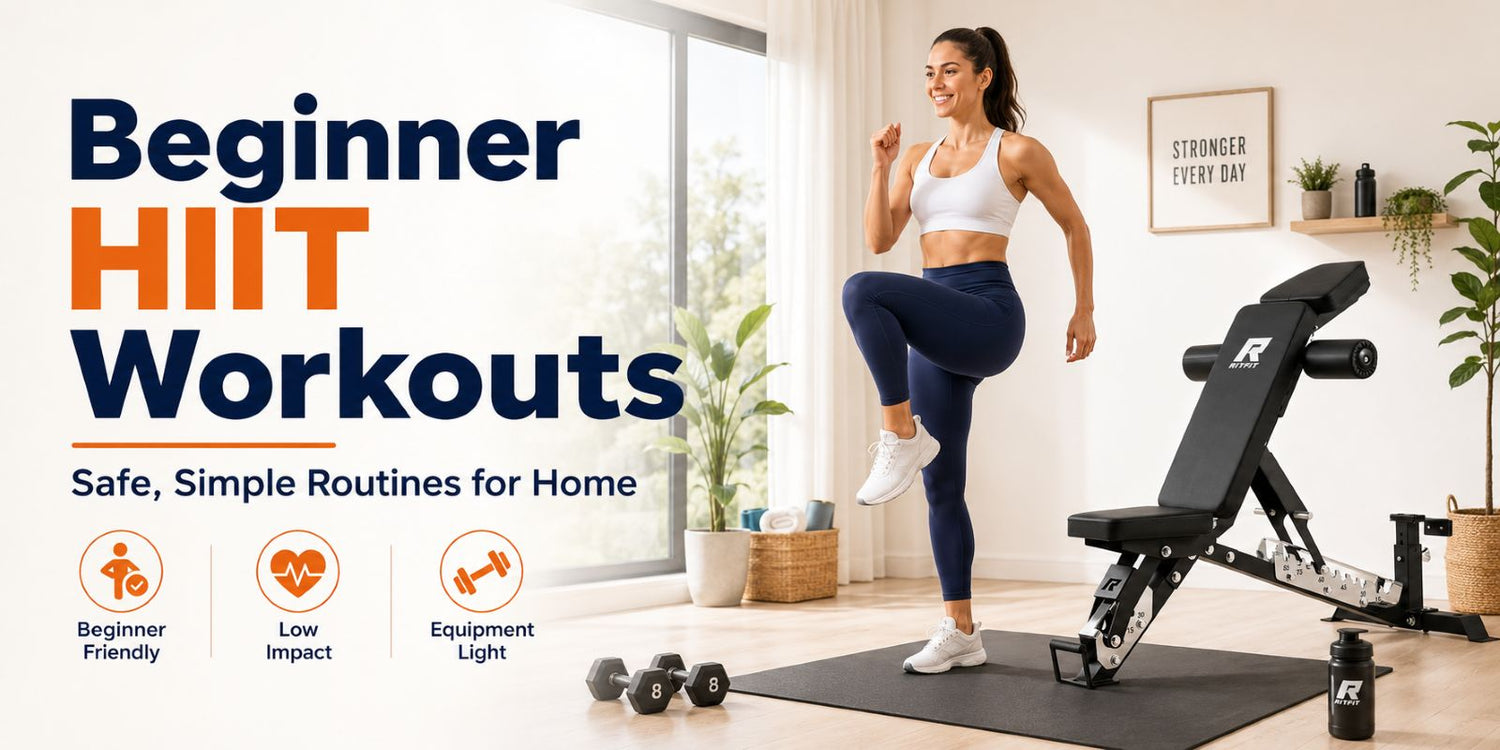
Beginner HIIT workouts should feel challenging, not chaotic. The safest way to start is to use simple exercises, short work periods, longer rest, and low impact movements you can repeat consistently.
This guide shows you how to choose the right intensity, avoid common mistakes, and follow beginner friendly HIIT routines at home. It also explains when to progress, when to scale back, and which simple equipment can make training more comfortable.
Table of Contents
- What Is HIIT and Why Is It Good for Beginners?
- Is HIIT Safe for Beginners?
- How to Start HIIT Safely
- Which Beginner HIIT Workout Should You Choose?
- Best HIIT Exercises for Beginners
- Sample Beginner HIIT Workouts
- How to Progress Your HIIT Workouts
- How to Combine HIIT with Strength Training
- Simple Home Equipment for Beginner HIIT
- Safety Tips and Recovery
Key Takeaways
- Beginner HIIT works best when intensity matches your current fitness level.
- Low impact intervals are usually the safest starting point for new exercisers.
- Ten to fifteen minutes of active work is enough for most first time beginners.
- Good form, controlled breathing, and recovery matter more than speed.
- Walking intervals, chair based intervals, bodyweight circuits, and light dumbbell intervals can all count as beginner HIIT.
What Is HIIT and Why Is It Good for Beginners?
HIIT means alternating short periods of harder effort with planned recovery. For beginners, this format makes exercise easier to manage because each hard effort is brief and followed by a slower interval.
A Simple Definition of HIIT
HIIT uses repeated work and rest cycles to raise and lower your effort in a structured way. Instead of exercising at one steady pace for a long session, you train in short bursts that improve conditioning in less time.
- Time efficient: HIIT helps beginners fit cardio and conditioning into a short training window. That makes it easier to stay consistent on busy weeks.
- Cardio focused: Short hard efforts challenge the heart and lungs. Research reviews show that HIIT can improve exercise capacity and health related fitness when the dose is appropriate.[1]
- Weight management support: HIIT can support calorie burn and conditioning. It works best when paired with daily movement, enough protein, and a sensible eating plan.
- Muscle friendly: Many beginner HIIT routines include squats, bridges, push movements, and core work. These movements train more than your lungs.
- Home friendly: Most beginner routines need little space and no complex equipment. A mat, light dumbbells, a stable bench, or a step platform can add comfort and variety.
Is HIIT Safe for Beginners?
HIIT can be safe for many beginners when intensity, exercise choice, and recovery are scaled correctly. High intensity should mean challenging for you, not painful, maximal, or out of control.
- Use controlled intensity: Aim for an effort level of 7 to 8 out of 10 during work intervals. You should breathe hard, but you should still feel in control.
- Start low impact: Marching, step jacks, sit to stand squats, wall push ups, and walking intervals are better first choices than burpees or sprinting.
- Respect health limits: People with diabetes, heart concerns, or chronic conditions should use medically appropriate guidance before trying intense intervals. Reviews on clinical populations emphasize safety, screening, and supervised progression.[3]
- Avoid all out effort: Most beginners do not need maximal intervals. Cardio benefits can still come from controlled short intervals and gradual overload.
How to Start HIIT Safely
Start HIIT with a warm up, short work periods, simple movement patterns, and enough rest. A small dose done well is better than an intense session that causes poor form or excessive soreness.
- Warm up first: Spend five to ten minutes walking, marching, pedaling lightly, or using gentle mobility drills. This prepares your joints and raises body temperature.
- Use the talk test: During hard intervals, talking should be difficult but not impossible. During rest periods, your breathing should begin to settle.
- Keep the first sessions short: Begin with ten to fifteen minutes of active interval work. This does not include the warm up or cool down.
- Train one to two days per week: Beginners usually recover better with at least two days between HIIT sessions. Walking and easy strength work can fill the other days.
- Track form before speed: Stop an interval early if posture, control, or joint comfort breaks down. Clean movement is the foundation for safe progression.
Beginner HIIT Intensity Guide
Use perceived effort to keep beginner HIIT challenging without turning it into an all out test. Most beginners should spend hard intervals around 7 to 8 out of 10, and avoid 9 to 10 until they have more conditioning.
- RPE 4 to 5: Easy effort, you can talk comfortably.
- RPE 6: Moderate effort, breathing is faster but controlled.
- RPE 7 to 8: Hard effort, talking is difficult but form stays steady.
- RPE 9 to 10: Near maximal effort, usually too aggressive for beginner HIIT workouts.
Which Beginner HIIT Workout Should You Choose?
Choose your beginner HIIT workout based on fitness level, joint comfort, space, and confidence with the exercises. The best routine is the one you can repeat safely next week.
- If you are completely new to exercise: Start with the 10 minute low impact workout. It uses simple movements and equal work to rest timing.
- If you have knee or ankle discomfort: Choose walking intervals or chair based HIIT. Avoid jumping until lower body tolerance improves.
- If you want full body conditioning: Choose the 15 minute full body routine. It combines legs, upper body, core, and cardio movement.
- If you live in an apartment: Use step jacks, standing punches, glute bridges, wall push ups, and low impact skaters. These options reduce noise and landing stress.
- If you want to add light strength work: Use light dumbbells only after bodyweight form feels stable. Start with simple squats, presses, carries, and controlled intervals.
Best HIIT Exercises for Beginners
The best beginner HIIT exercises are simple, scalable, and easy to repeat with good form. Start with low impact bodyweight moves before adding speed, load, or jumping.
Low Impact HIIT Exercises
Low impact HIIT exercises raise your heart rate without repeated jumping. They are ideal for beginners, apartment workouts, and people who want joint friendly conditioning.
- Marching in place with high knees: Stand tall and lift one knee at a time while driving the opposite arm. This builds rhythm and raises heart rate without running.
- Step jacks: Step one foot out while raising both arms, then return and switch sides. This gives you the feel of jumping jacks with less landing stress.
- Sit to stand squats: Sit on a sturdy chair, stand up through your feet, then lower with control. This teaches squat mechanics and helps beginners manage depth.
- Modified mountain climbers: Place your hands on a wall, bench, or stable elevated surface and alternate knee drives. The higher hand position reduces wrist and core demand.
- Low impact skaters: Step side to side and reach lightly across the body. This improves lateral control, balance, and conditioning.
Basic Bodyweight HIIT Exercises
Basic bodyweight exercises build confidence before you add external resistance. They help beginners train the legs, hips, upper body, and core with minimal setup.
- Bodyweight squats: Push the hips back, keep the chest tall, and stand with control. Use a chair target if depth or balance feels uncertain.
- Reverse lunges: Step one foot back and lower with balance before returning to standing. This is often easier on the knees than forward lunges.
- Glute bridges: Lie on your back, press through the feet, and lift the hips by squeezing the glutes. This adds posterior chain work with very low impact.
- Wall or incline push ups: Use a wall, bench, or stable elevated surface to reduce difficulty. A sturdy option such as the RitFit GATOR Adjustable Weight Bench can support incline push up variations in a home gym.
- Standing punches: Keep a soft knee bend, brace the core, and punch quickly with alternating arms. This adds upper body movement without floor work.
- Fast feet: Move quickly in place while staying light and controlled. Keep the range small if you are still building ankle and calf tolerance.
Slightly Higher Impact Options
Higher impact HIIT exercises should come after low impact moves feel controlled. Progressing too early often adds joint stress without improving results.
- Jumping jacks: Use these only when step jacks feel easy and quiet. Keep landings soft and controlled.
- High knees: Jog in place while driving the knees higher. Keep the bounce small if your joints are still adapting.
- Butt kicks: Jog lightly and kick the heels toward the glutes. Use a relaxed rhythm instead of sprinting.
- Modified burpees: Place the hands down, step back to plank, step in, and stand tall. Skip the jump and push up until your form improves.
Sample Beginner HIIT Workouts
These sample beginner HIIT workouts keep the format simple so you can focus on pacing, movement quality, and recovery. Choose one plan that matches your current ability instead of doing every routine in one week.
10 Minute Low Impact HIIT for Absolute Beginners
This workout is best for first time exercisers who need simple movements and clear rest periods. Use 30 seconds of work followed by 30 seconds of rest for 10 rounds.
- Rounds 1 and 2: Marching in place with high knees.
- Rounds 3 and 4: Sit to stand squats.
- Rounds 5 and 6: Step jacks.
- Rounds 7 and 8: Wall push ups.
- Rounds 9 and 10: Standing punches.
15 Minute Full Body Beginner HIIT
This workout is best for beginners who want cardio and basic strength in one short session. Use 40 seconds of work followed by 20 seconds of rest for 3 rounds.
- Exercise 1: Bodyweight squats.
- Exercise 2: Standing punches.
- Exercise 3: Glute bridges.
- Exercise 4: Fast feet.
- Exercise 5: Incline push ups.
20 Minute Walking or Light Jogging HIIT
This workout is best for beginners who prefer outdoor cardio or treadmill intervals. Start with a five minute easy walk, then alternate faster and slower efforts.
- Warm up: Walk at an easy pace for 5 minutes.
- Intervals: Fast walk or light jog for 30 seconds, then easy walk for 60 to 90 seconds, repeated for 8 to 10 rounds.
- Cool down: Walk slowly for 3 to 5 minutes.
Chair Based HIIT for Joint Friendly Training
This workout is best for beginners who need a low impact option with extra support. Use 30 seconds of work followed by 30 seconds of rest for 10 rounds.
- Exercise 1: Seated marches.
- Exercise 2: Seated punches.
- Exercise 3: Seated leg extensions.
- Exercise 4: Seated torso twists.
How to Progress Your HIIT Workouts
Progress beginner HIIT by adding a little more work while keeping the same movement quality. Gradual overload is safer and more sustainable than jumping straight into harder exercises.
- Increase work time: Move from 20 or 30 seconds of work to 40 seconds when pacing feels steady. Do not extend intervals if form breaks down.
- Reduce rest slightly: Shorten recovery by 5 to 10 seconds only after breathing settles well. Rest is part of the workout, not a failure.
- Add one round: Extra total volume is often safer than making every interval much harder. Add volume slowly to manage soreness.
- Choose a harder variation: Progress from step jacks to jumping jacks or from wall push ups to incline push ups. Change only one variable at a time.
- Add light resistance: Use light home workout dumbbells for controlled squats, presses, and carries. The goal is better training density, not maximal strength work.
Four Week Beginner HIIT Progression Plan
This four week plan helps beginners build conditioning without adding too much intensity too quickly. Move to the next week only if soreness, joint comfort, and breathing recovery feel manageable.
- Week 1: Do one low impact HIIT session with 20 to 30 seconds of work and longer rest.
- Week 2: Add a second session only if fatigue and soreness are mild.
- Week 3: Increase one or two intervals by 5 to 10 seconds while keeping form clean.
- Week 4: Add one round or use a slightly harder variation if recovery is good.
How to Combine HIIT with Strength Training
Beginner HIIT works best as part of a balanced week that includes easy movement, strength training, mobility, and rest. Doing HIIT every day is usually less effective than recovering well between sessions.
- HIIT days: Start with 1 to 2 sessions per week. Keep them short and focused.
- Strength days: Add 2 light resistance sessions per week. Exercises with RitFit Hex Rubber Dumbbells can support squats, rows, presses, and carries.
- Easy movement days: Walk, cycle gently, or stretch on most non HIIT days. This builds fitness without extra stress.
- Rest days: Take at least 1 full rest day per week. Recovery helps your body adapt.
HIIT can support cardiometabolic fitness when programmed carefully, but it should not replace all moderate activity or strength training. Evidence reviews on cardiometabolic disease prevention emphasize appropriate dose, population, and progression rather than one universal HIIT formula.[2]
Simple Home Equipment for Beginner HIIT
You do not need much gear to start beginner HIIT, but simple equipment can make workouts safer, quieter, and more versatile. Choose equipment that supports your movement level instead of making the workout more complicated.
- Exercise mat: A mat adds comfort for glute bridges, planks, stretching, and floor based recovery work. It is useful for apartments and shared spaces.
- Light dumbbells: Light dumbbells add resistance to squats, presses, carries, and beginner strength intervals. Start light enough to move with control.
- Resistance bands: Bands add low cost progression for rows, presses, glute work, and warm ups. They are easy to store in small spaces.
- Adjustable bench: A bench helps with incline push ups, step supported movements, seated drills, and dumbbell work. Explore RitFit weight benches if you want a stable surface for home training.
- Plyo box or step platform: A step platform supports step ups, incline push ups, and controlled conditioning drills. The RitFit Classic 3 in 1 Extra Firm Soft Plyo Box can help add height options for step based training.
- Floor protection: Floor mats can reduce noise, protect surfaces, and make movement feel more stable. Consider rubber interlocking gym flooring mats for repeated home workouts.
Low volume functional HIIT can improve fitness outcomes in young adults with overweight or obesity, but the best exercise format depends on comfort, movement skill, and adherence.[4] For beginners, simple home tools should support consistency first.
For more home training upgrades, browse RitFit plyo boxes and home gym accessories. These pages are most relevant after you already know which movements feel safe and repeatable.
Safety Tips and Recovery
Recovery is part of beginner HIIT because your heart, muscles, joints, and nervous system need time to adapt. Good recovery helps you train again without turning soreness into a barrier.
- Cool down: Walk slowly or move easily for 3 to 5 minutes after each session. This helps your heart rate come down gradually.
- Hydrate: Drink water before and after training. More sweat, heat, or longer sessions may increase fluid needs.
- Sleep enough: Poor sleep makes hard intervals feel harder. Recovery quality often determines how well beginners progress.
- Watch joint feedback: Muscle fatigue is normal, but sharp pain is not. Scale back or stop if pain changes your movement.
- Know red flags: Stop immediately for chest pain, dizziness, faintness, severe shortness of breath, or sharp pain. Seek medical advice when symptoms are unusual or severe.
FAQs
How often should I do beginner HIIT workouts?
You should start with one or two beginner HIIT workouts per week. This gives your body time to recover while building cardiovascular fitness, movement control, and confidence. On other days, use walking, light strength training, mobility work, or rest to support progress without overloading your joints.
What is the safest HIIT interval ratio for beginners?
The safest beginner HIIT interval ratio is usually 20 to 30 seconds of work followed by 30 to 60 seconds of rest. Longer rest helps you keep form clean, control breathing, and avoid rushing. Progress only when the same format feels manageable for multiple sessions.
Can beginner HIIT workouts be done without jumping?
Yes. Beginner HIIT workouts can be completely low impact and still effective. Use marching, step jacks, sit to stand squats, wall push ups, standing punches, and walking intervals. These exercises raise heart rate while reducing landing stress, noise, and joint irritation.
Is low impact HIIT enough to improve fitness?
Yes. Low impact HIIT can improve fitness when the intervals feel challenging and are repeated consistently. Beginners do not need jumping or burpees to build conditioning. A routine with controlled pace, short work periods, and steady progression can improve endurance, coordination, and exercise tolerance.
Should beginners do HIIT before or after strength training?
Beginners should usually do HIIT after strength training or on a separate day. This helps protect form during squats, presses, hinges, and loaded movements. If HIIT comes first, keep it short and low impact so fatigue does not reduce strength training quality.
Does beginner HIIT help with weight loss?
Yes. Beginner HIIT can support weight loss by increasing training intensity and improving conditioning. It works best with a calorie aware eating pattern, enough protein, regular daily movement, and recovery. Short workouts alone are not enough if sleep, nutrition, and total activity are inconsistent.
Which beginner HIIT exercises are easiest on the knees?
The easiest beginner HIIT exercises for knees are marching, step jacks, sit to stand squats, glute bridges, wall push ups, and walking intervals. Keep ranges comfortable and avoid jumping at first. If knee pain increases during or after training, scale back and seek professional guidance.
How do I know if beginner HIIT is too hard?
Beginner HIIT is too hard if your form breaks down, breathing does not recover during rest, or soreness lasts several days. It is also too hard if you feel sharp pain, dizziness, chest discomfort, or unusual shortness of breath. Reduce intensity, increase rest, or stop.
Consistency Is Key
The best beginner HIIT workout is the one you can repeat safely next week. Start with one simple low impact routine, keep the pace honest, and progress only when your form, breathing, and recovery stay under control.
Disclaimer: This article is for general educational purposes only and is not medical advice. Consult a qualified healthcare provider before starting a new exercise program, especially if you have medical conditions, injury history, joint pain, heart concerns, or prolonged inactivity. Stop exercising if you feel chest pain, dizziness, severe shortness of breath, or sharp pain.
References
- Atakan MM, Li Y, Koşar ŞN, Turnagöl HH, Yan X. Evidence based effects of high intensity interval training on exercise capacity and health. A review with historical perspective. Int J Environ Res Public Health. 2021;18(13):7201. doi:10.3390/ijerph18137201
- Campbell WW, Kraus WE, Powell KE, Haskell WL, Janz KF, Jakicic JM, et al. High intensity interval training for cardiometabolic disease prevention. Med Sci Sports Exerc. 2019;51(6):1220-1226. doi:10.1249/MSS.0000000000001934
- Francois ME, Little JP. Effectiveness and safety of high intensity interval training in patients with type 2 diabetes. Diabetes Spectr. 2015;28(1):39-44. doi:10.2337/diaspect.28.1.39
- Cao M, Yang B, Tang Y, Wang C, Yin L. Effects of low volume functional and running high intensity interval training on physical fitness in young adults with overweight/obesity. Front Physiol. 2024;15:1325403. doi:10.3389/fphys.2024.1325403