As much as we remind our readers that they should never skip “leg day”, we can understand why you’d want to.
A lot of exercises look more fun than squatting does and people are (usually) much more likely to notice a jacked upper body than the work you’ve been putting in on the hack squat machine.
With that being said, if you’re going to “cheat” on your leg day commitment, you may as well get the most bang for your buck with your upper body substitute exercise.
…and there really isn’t much debate about which lifts you should be picking from.
Chest press vs shoulder press…which is it going to be?
Every serious lifter strives for the classic “barrel chest” although you’d be hard-pressed to find someone who’d turn down “boulder shoulders”.
Let’s take a closer look at each of these movements so you can decide which is the better option for your upper body overload work. We’ll also explore how you can easily get the best of both worlds…
What is the Chest Press?
The “chest press” is in a constant identity crisis.
Many people use the term interchangeably with the bench press while others use it to describe any kind of pressing movement targeting the chest muscles.
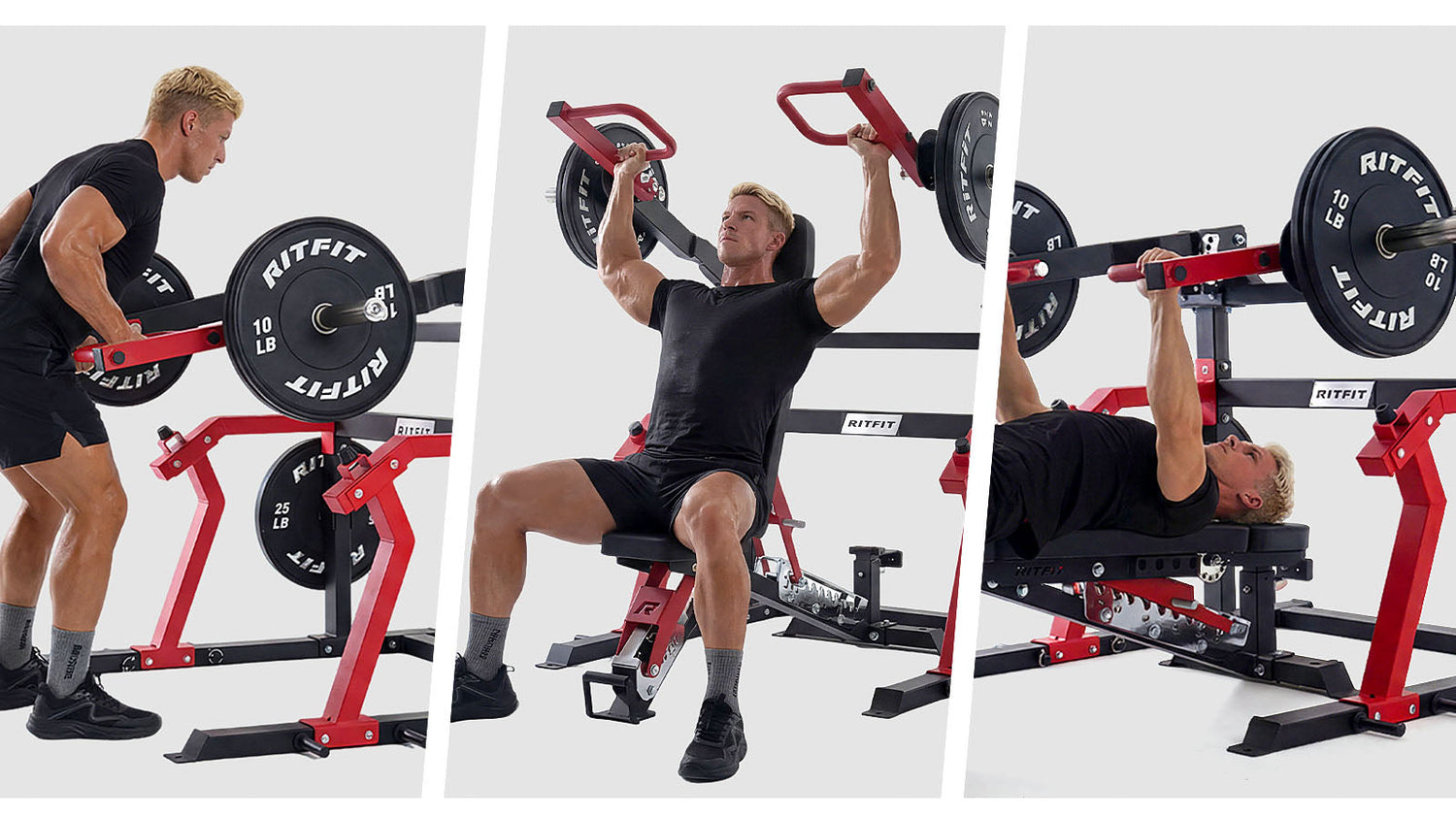
We reject both of these and only use “chest press” when describing the chest press machine exercise. This plate-loaded or weight-stack machine allows lifters to hit their chest at different angles (upper, mid, lower) without having to worry about balancing or stabilizing the weight.
Muscles Worked
As you’d probably expect, the chest press machine primarily works the pec muscles (pectoralis major) with the anterior deltoids and triceps also getting a bit of attention (Saeterbakken & Fimland, 2013).
What is the Shoulder Press?
The shoulder press runs into a lot of the same indecisive terminology as the chest press does. The barbell standing press (also known as the “military press”, “strict press” or simply as the “press”) and seated dumbbell presses are often blanketly referred to as “shoulder press” exercises.
Like the chest press, in a more formal sense the shoulder press refers to the specific pressing exercise performed on a shoulder press machine. Also like the chest press, these machines can be plate-loaded or can utilize a weight stack, although the pressing angle is almost always completely vertical.
Muscles Worked
It should come as no surprise that the deltoids do the (literal) “heavy lifting” when shoulder pressing. The triceps and upper chest muscles assist and receive tertiary benefits from the lift (Behm et al., 2010).
Chest Press vs Shoulder Press
On the surface, differentiating between the chest press and shoulder press doesn’t really seem all that difficult.
One works the chest; one works the shoulders.
However, blurring the lines between these machines is easier than it seems, especially when drifting into upper chest work.
Movement Direction
The pressing direction is by far the biggest clue about the exercise in question.
Chest pressing is always at least mostly horizontal. When working the upper chest, the pressing angle moves slightly vertical, but pressing is still primarily horizontal.
There is much less ambiguity with shoulder pressing as it is always clearly vertical.
Strength Carryover
Chest pressing is an excellent complement to barbell and dumbbell bench pressing. For those especially interested in improving their bench-pressing capacity (ex. bench pressing for max repetitions as opposed to improving 1 RM max strength), there is arguably no better exercise.
The shoulder press machine does wonders for developing shoulder stability. This is a somewhat underrated quality that has direct strength benefits while also promoting more comprehensive “shoulder health” (Launder, Riemann, & Lephart, 2008).
Most lifters who are both familiar with these movements and the advantages of each don’t limit themselves to performing only one of these. Their complementary nature naturally leads to the inclusion of both in many upper-body development programs.
How 2-in-1 Machines Blow Up the Chest Press vs Shoulder Press Debate
The chest press and shoulder press are both solid movements (either as part of a dedicated upper body regimen or when you decide to play “leg day hooky”). However, the hardware needed to perform them can be a little tricky.
A lot of commercial gyms don’t have both machines; some don’t have either of them. If your gym happens to be blessed with both, you’ll probably find that they’re some of the most popular machines and you’ll need to wait in line to get a crack at them.
Thankfully, the 2-in-1 chest and shoulder press machine exists and immediately puts an end to all of these problems.
If you’re a home gym lifter, getting ahold of a combined chest press/shoulder press machine ensures that you always have access to both exercises and never have to wait to execute them.
2-in-1 chest and shoulder press machines are also both space-saving and money-saving machines, cutting out the real estate and funds that multiple machines require.
Most of these machines are easily adjustable, allowing for easy transitions between movements with a quick shift of a pin. This can be especially useful when super-setting these exercises.
Chest Press vs Shoulder Press...the Aftermath
As we finish up, one thing that should be very clear about these lifts is that they do not have to be performed in isolation. The chest press and shoulder press are excellent complementary movements and are even easier to quickly switch between with a 2-in-1 chest and shoulder press machine.
Granted, not every combined shoulder press/chest press machine is as capable at hitting the requisite angles (particularly in relation to the chest) to get a legitimately comprehensive chest and shoulder workout. Those without these capabilities require the supplementation of additional barbell and dumbbell work.
However, machines with dual dial adjustability and multi-grip handles are functional enough to easily allow progression from lower chest to mid-chest, to upper chest, and overhead pressing work…and for truly comprehensive upper body training.
Ultimately, a combined chest and shoulder press machine puts an end to the chest press vs shoulder press debate. When you have access to both, there is no reason not to do both.
References
- Behm, D. G., Drinkwater, E. J., Willardson, J. M., & Cowley, P. M. (2010). The use of instability to train the core musculature. Applied Physiology, Nutrition, and Metabolism, 35(1), 91–108.
- Launder, K. G., Riemann, B. L., & Lephart, S. M. (2008). Influence of exercise on the neuromuscular control of the shoulder. Journal of Strength and Conditioning Research, 22(2), 405–413.
- Saeterbakken, A. H., & Fimland, M. S. (2013). Muscle activity of the core during bilateral, unilateral, seated and standing resistance exercise. European Journal of Applied Physiology, 113(7), 1671–1678.