Table of Contents
- Quick Start: Safe Leg Press Setup
- What Is a Leg Press?
- Benefits of the Leg Press
- What Muscles Does the Leg Press Work?
- Why the Machine Matters
- The Science of Leg Press Foot Placement
- Proper Leg Press Form: Step by Step
- Advanced Training: Goal Based Leg Press Protocols
- Safety and Injury Prevention
- Programming: Where the Leg Press Fits
- Leg Press vs. Squat
The leg press is one of the best lower body machines for building quads and glutes with less spinal demand than a barbell squat. This guide shows you how to set up the machine, choose foot placement, control depth, and train hard without turning the movement into a knee or low back problem.
Whether you train on a commercial sled or the RitFit Gazelle Pro 3-in-1, the same rules apply, keep your hips pinned, keep your feet flat, and use only the depth you can actually control.
Key Takeaways
- Setup controls safety: The right depth is the deepest position where your hips and low back stay pinned to the pad. More sled travel is not automatically better range of motion.
- Foot placement changes emphasis: Small changes in height and stance can shift what you feel most. Treat these as bias tools, not as absolute muscle isolation tricks.
- Full foot pressure matters: Keep heels down and pressure spread across the foot. Pushing through the toes alone often makes the rep less stable.
- Control beats load: A slower descent and cleaner knee tracking usually build more muscle than a sloppy heavy set. If form changes first, the weight is too high.
- The leg press works best inside a full plan: Pair it with hamstring, calf, and unilateral work for more complete leg development. That is especially useful in a home gym.
Quick Start: Safe Leg Press Setup in 60 Seconds
- Set your depth before you load: Do a dry run and stop at the deepest position where your hips stay pinned. That is your usable range, even if the machine allows more.
- Start with a neutral stance: Put feet about shoulder width apart, flat on the platform, with toes slightly turned out. This is the easiest starting point for balanced quad and glute work.
- Lower the sled slowly: Use about 2 to 3 seconds on the way down. A controlled eccentric makes it easier to hold alignment and feel the right muscles.
- Finish without a hard snap lockout: Press near the top without slamming the knees straight. This usually keeps tension on the legs and reduces unnecessary joint stress.
- Use safeties every set: Set safety stops just below your true working depth. That is especially important when you train alone.
What Is a Leg Press?
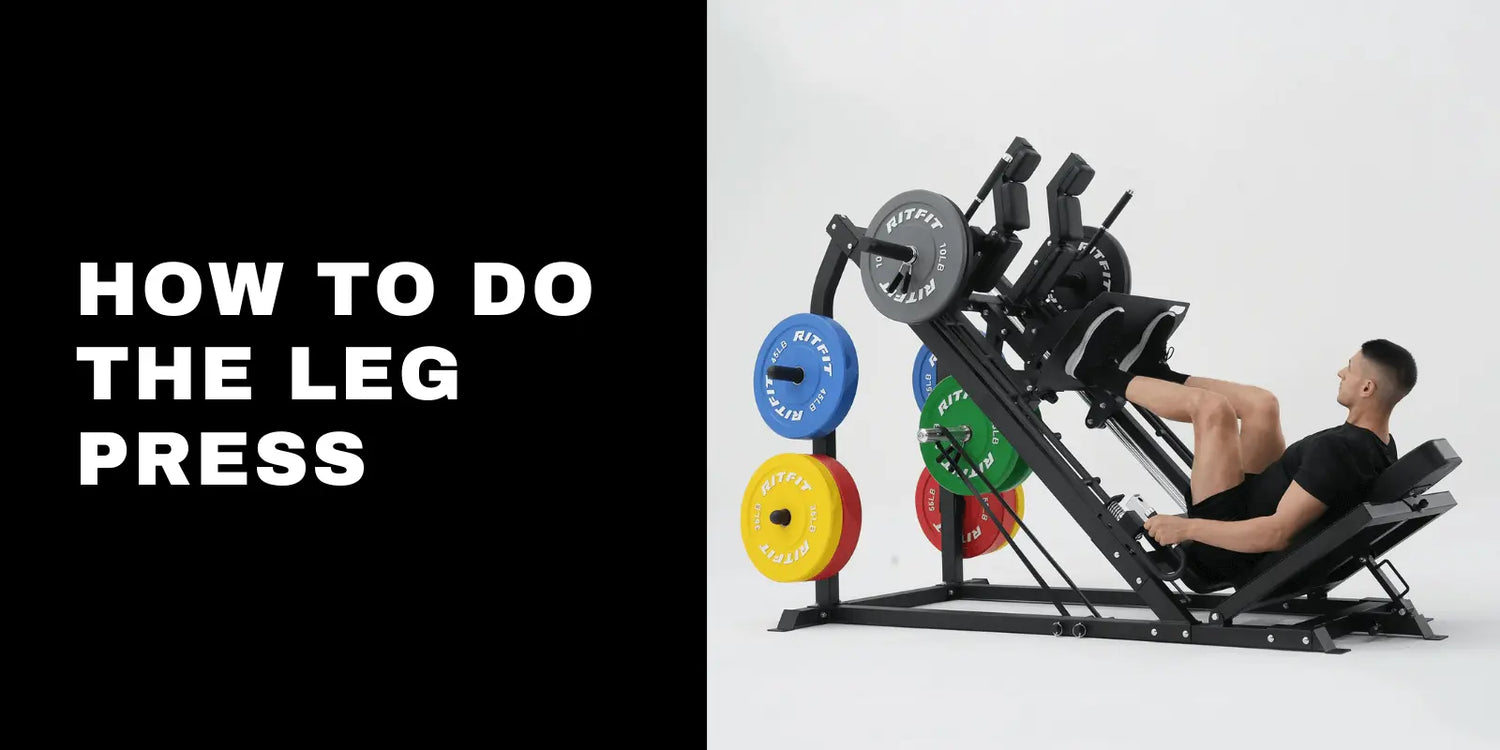
The leg press is a machine based compound lower body exercise where you push a loaded platform away with your legs. It mainly trains the quadriceps, glutes, and adductors while reducing the balance demands that make squats more technical.
Most lifters use a 45 degree sled, but horizontal and seated versions also exist. The machine style changes the feel, yet clean setup and repeatable depth matter more than the exact model.
Benefits of the Leg Press
The leg press is valuable because it lets you train the lower body hard with a guided path and strong external support. That makes it a smart tool for hypertrophy blocks, higher volume work, and lifters who want more leg training with less whole body fatigue.
- High quad stimulus: The leg press gives you a long knee extension pattern that is easy to load progressively. It is often simpler to push close to muscular failure here than on a barbell squat.
- Lower balance demand: The pad and sled guide the path so you can focus on leg drive. That usually makes it easier to improve effort quality from set to set.
- Useful for home gym leg training: A dedicated lower body machine can cover heavy presses, hack squat work, and calf work in one station. You can browse more options in the RitFit strength machines collection.
- Easy to bias by setup: A small change in stance can make the movement feel more knee dominant or more hip dominant. That is one reason lifters use it for both quad growth and glute focused work.
- Great accessory to a bigger plan: The leg press fits well beside glute focused machine work and curl based hamstring work. For more lower body ideas, see best gym machines for glutes.
What Muscles Does the Leg Press Work?
The leg press is primarily a quad exercise, but it is not a quads only movement. Glutes, adductors, calves, and hamstrings all contribute depending on your stance, depth, and machine geometry.
- Quadriceps: These are the primary drivers because the leg press is built around knee extension. Deeper knee bend usually increases how much quad work you feel.
- Gluteus maximus: Glutes contribute more when the hips move through deeper flexion and extension. Higher placements often make the movement feel more hip driven.
- Adductors: The adductor magnus can contribute a lot in deeper positions and wider stances. Many lifters notice more inner thigh contribution when stance width opens slightly.
- Hamstrings: Hamstrings help stabilize the movement but are usually not the main growth target here. If hamstring size is a priority, keep curls and hinge patterns in the program.
- Calves: Calves stabilize the ankle and help transfer force into the platform. They also become a direct target during leg press calf raise variations.
Why the Machine Matters
Machine quality affects comfort, repeatability, and confidence under load. If the sled feels sticky, unstable, or too cramped for your build, your form usually gets worse before your legs get better.
A smoother setup like the RitFit Gazelle Pro leg press set is easier to load consistently, and a larger ecosystem around it makes it easier to build a complete lower body station. If you are still comparing machines, start with this 3 in 1 leg press and hack squat buying guide.
- Footplate size matters: A larger platform gives you more room to test stance width and height. That is especially useful for taller lifters and glute biased setups.
- Safety stops matter: Heavy sets without reliable safeties are not smart in a home gym. Set them from your real working depth, not from your ego depth.
- Smooth travel matters: A carriage that moves consistently makes it easier to control tempo. Jerky starts usually make people rush out of the bottom.
- Accessory ecosystem matters: Many buyers also need a bench and plates nearby for a more complete setup. The RitFit benches collection and barbells and weight plates collection are the most natural pairings.
The Science of Leg Press Foot Placement
Foot placement changes leg press kinematics and muscle activation, but it should be treated as a bias tool rather than a perfect isolation switch.[1] In practice, the best setup is the one that lets you keep heels down, knees tracking cleanly, and hips pinned through the whole rep.
- Mid platform, shoulder width: This is the best default for most lifters. It usually balances quad and glute demand and makes knee tracking easier to repeat.
- Higher placement: This usually feels more hip dominant and more glute focused. It can also feel better for some lifters whose knees dislike very deep knee travel.
- Lower placement: This usually increases knee bend and makes the quads work harder. It also demands more control, because sloppy reps here can irritate the knees faster.
- Wider stance: This often increases adductor contribution and can feel smoother for lifters with longer femurs. Only widen as far as you can still keep full foot pressure.
- Narrower stance: This often increases quad emphasis and can create a stronger outer quad feel. It also makes clean knee tracking more important.
Foot Placement Cheat Sheet
| Foot Placement | Primary Bias | What You Usually Feel | Key Cue | Main Watch Out |
|---|---|---|---|---|
| Mid platform, shoulder width | Balanced | Quads plus glutes | Track knees over toes | Rushing depth |
| Lower placement | Quad bias | More knee bend, stronger quad burn | Lower slowly, keep heels flat | Knee irritation if sloppy |
| Higher placement | Glute bias | More hip drive, more glute stretch | Keep hips pinned | Pelvis tucking under |
| Wider stance | Adductors plus glutes | Inner thigh and glute contribution | Toes slightly out | Forcing range you do not own |
| Narrower stance | Quad dominant | Dense quad tension | Keep knees from collapsing | Loss of foot stability |
Proper Leg Press Form: Step by Step
- Set the machine before the first rep: Adjust the back position, check your foot position, and set the safeties slightly below your deepest controlled depth. Load both sides evenly so the sled does not twist.
- Pin your torso to the pad: Sit deep, brace lightly, and keep glutes and lower back pressed into the support. Grab the handles and keep your feet flat and symmetrical.
- Lower under control: Use about 2 to 3 seconds on the eccentric and let the knees bend in line with the toes. Use the deepest range you can control with hips pinned, because fuller lower body range of motion generally supports better hypertrophy than partial work when technique stays clean.[3]
- Press smoothly through the whole foot: Drive the platform away without bouncing out of the bottom. Keep the rep continuous and stop short of a violent lockout.
- Rack with intent: Finish the last rep in a controlled top position and fully re engage the lock. Do not relax until you know the sled is secure.
Advanced Training: Goal Based Leg Press Protocols
Hypertrophy can be built across a broad rep range, so leg press programming should be driven by setup quality, effort, and repeatable technique, not by one magic number.[4] Choose the variation that keeps tension on the target area without changing your depth or body position to survive the set.
- Quad growth block: Use a lower to mid foot placement, control the eccentric, and stay in the 10 to 15 rep range. This is a strong option when you want more knee dominant work after squats or hack squats.
- Glute focused block: Use a slightly higher stance and drive through the midfoot and heel. Keep reps clean and stop the set when your hips want to roll off the pad.
- Volume finisher: Use moderate load for 15 to 20 reps and keep constant pressure on the platform. This is excellent after heavier lower body work when you want extra hypertrophy without another technically demanding lift.
- Calf raises on the leg press: Put the balls of your feet on the lower edge of the platform and use strict control. Keep the range smooth and use safeties every time.
Safety and Injury Prevention
The biggest leg press mistakes are almost always setup errors, not machine errors. Most problems start when lifters chase more depth, more load, or more reps than their position can support.
- Watch for lower back rounding: If your pelvis tucks under at the bottom, your depth is too deep for that setup. Reduce range or adjust foot position before adding more load.
- Watch for knee cave: Knees should generally track with the toes, not crash inward. If they do, lower the weight and rebuild the rep with better foot pressure.
- Watch for heels lifting: Heels popping off the platform often means your stance is too low or your ankle position is unstable. Move the feet slightly higher and slow the descent.
- Watch for bounce reps: Rebounding out of the bottom turns the hardest position into the least controlled one. The leg press should feel heavy and smooth, not loose and springy.
- Watch for ego loading: The number on a leg press is machine specific and does not compare neatly across gyms. Clean reps on the same machine are the real progress marker.
Programming: Where the Leg Press Fits
The leg press works best as a tool inside a broader lower body plan. It can be your primary heavy machine movement, your high volume accessory after squats, or your joint friendlier option on days when free weights feel less appealing.
- After squats: Use the leg press for controlled hypertrophy volume when your trunk is already tired. This is a common way to keep quad work high without another technically expensive lift.
- As the main movement: In a home gym, the leg press can anchor a full lower body day when paired with curls, calves, and unilateral work. Add a curl station by comparing options in this leg extension and curl machine guide.
- Inside a glute day: A higher stance leg press fits well beside hip thrusts, split squats, and abduction work. For more machine ideas, revisit best gym machines for glutes.
- With your home gym setup: If you own plates already, the easiest upgrade path is often to keep your lower body station close to your main storage and loading area. That is one reason many buyers pair a sled with the barbells and weight plates collection and a support bench from the benches collection.
Leg Press vs. Squat
The leg press and squat are not rivals, they solve different training problems. Squats ask more from the trunk, hips, and coordination, while the leg press usually makes it easier to drive lower body volume and effort with less technical noise.[2]
- Choose squats first if: You want more full body skill, more free weight transfer, and more athletic carryover. Squats are still the better global movement pattern for many lifters.
- Choose leg press first if: You want high effort leg work with less balance demand, less spinal loading, or a more predictable home gym machine pattern. It is also a strong option when you simply recover better from machine work.
- Use both if: Your joints tolerate both and your program can support both. Many lifters squat for strength expression and use the leg press to drive more quad and glute volume.
Leg Press FAQs
Is the leg press better than squats for building legs?
Yes. The leg press can build a lot of quad and glute mass because it lets you push hard with less balance demand and less spinal loading. Squats still train coordination and full body bracing better, so many lifters use both and let goal, mobility, and recovery decide the order.
How should I place my feet on the leg press for balanced form?
Start with your feet around shoulder width, flat on the platform, and slightly turned out. This setup usually gives the cleanest knee tracking and an even mix of quad and glute work, then you can adjust slightly higher, lower, wider, or narrower based on comfort and training goal.
What leg press foot placement hits glutes more?
Higher foot placement usually makes the leg press feel more hip dominant and can shift more work toward the glutes. It still only works well if your hips stay pinned to the pad, because chasing extra depth with a tucked pelvis often turns a glute focused setup into a low back problem.
Can the leg press hurt your knees if your form is wrong?
Yes. Knee pain often shows up when load is too heavy, descent is uncontrolled, or foot position forces poor tracking. Lower placements and hard lockouts can bother some lifters, so reduce load, slow the eccentric, keep heels planted, and choose a setup that stays stable and pain free.
How deep should I go on the leg press?
Go as deep as you can while keeping your glutes and lower back pinned to the pad. The right depth is not the deepest possible sled position, it is the deepest position you can control without your pelvis tucking, your heels lifting, or your knees drifting out of line.
What muscles does the leg press work most?
The leg press mainly trains the quadriceps, with strong help from the glutes and adductors. Hamstrings and calves contribute more as stabilizers than prime movers in most setups, which is why the exercise is excellent for leg size but still pairs well with curls, hinges, and calf work.
Is a leg press machine good for a home gym?
Yes. A leg press machine can be a strong home gym addition when you want heavy lower body training with a more guided path. Buyers usually care most about footprint, smooth travel, ROM for taller users, safety stops, and frame stability, not just the posted maximum weight capacity.
Should I lock out at the top of the leg press?
No. You do not need a hard snap into full lockout to finish a productive rep. Stopping just short of aggressive lockout usually keeps more tension on the target muscles and can help some lifters avoid the joint stress that comes from slamming the knees straight under load.
Conclusion
The leg press is not a lazy squat substitute, it is a serious lower body growth tool when setup and depth are honest. Keep your hips pinned, use foot placement to bias rather than force, and load only what you can control, and the movement becomes far more productive for both size and long term training consistency.
Important disclaimer: This article is for general education only and is not medical advice. If you have current knee or back pain, a recent injury or surgery, numbness, weakness, or symptoms that worsen during pressing, stop training and speak with a qualified clinician before continuing.
References
- Martín-Fuentes I Oliva-Lozano JM Muyor JM. Influence of Feet Position and Execution Velocity on Muscle Activation and Kinematic Parameters During the Inclined Leg Press Exercise. Sports Health. 2022;14(3):317-327. doi:10.1177/19417381211016357
- Straub RK Powers CM. A Biomechanical Review of the Squat Exercise: Implications for Clinical Practice. Int J Sports Phys Ther. 2024;19(4):490-501. doi:10.26603/001c.94600
- Schoenfeld BJ Grgic J. Effects of Range of Motion on Muscle Development During Resistance Training Interventions: A Systematic Review. SAGE Open Med. 2020;8:2050312120901559. doi:10.1177/2050312120901559
- Schoenfeld BJ Grgic J Van Every DW Plotkin DL. Loading Recommendations for Muscle Strength, Hypertrophy, and Local Endurance: A Re-Examination of the Repetition Continuum. Sports. 2021;9(2):32. doi:10.3390/sports9020032