RIR means Reps In Reserve in fitness and strength training. It tells you how many more clean reps you could likely perform before reaching failure at the end of a set.
RIR helps lifters control workout intensity, manage fatigue, and train close enough to failure without pushing every set to the limit.
Key Takeaways
- RIR means Reps In Reserve: It estimates how many more good reps you could complete before failure.
- RIR is not perfectly exact: It is a practical training estimate based on effort, form, and rep speed.
- Lower RIR means harder sets: A set at 0 RIR is near failure, while 3 RIR leaves more room for recovery.
- Most lifters use 1 to 3 RIR often: This range is useful for strength, muscle growth, and fatigue control.
- RIR works well in home gyms: It can guide dumbbell, barbell, bench, Smith machine, and cable workouts.
What Does RIR Mean?
RIR usually means Reps In Reserve when the topic is lifting, bodybuilding, powerlifting, or workout programming. It describes the estimated number of extra reps you could still complete with solid form before failure.
For example, finishing a set with 2 RIR means you believe you could have completed two more clean reps. A newly developed RIR based RPE scale was designed to better match resistance training effort with the number of reps left after a set.[1]
What Does RIR Mean in Fitness?
In fitness, RIR is a self regulation tool for workout intensity. It helps you adjust effort based on daily strength, recovery, sleep, stress, and exercise difficulty.
- 0 RIR: You have no clean reps left and are at or near failure.
- 1 RIR: You could likely complete one more good rep.
- 2 RIR: You could likely complete two more good reps.
- 3 RIR: You stop with three good reps still in reserve.
- 4 or more RIR: The set is relatively easier and usually better for warmups, technique work, or recovery days.
RIR is especially useful when training with dumbbells, barbells, machines, and cable stations because it gives you a simple way to judge effort without testing your max every session.
Simple RIR Examples
The easiest way to understand RIR is to compare the reps you performed with the reps you believe you could have completed. The goal is not perfect prediction, but consistent effort tracking.
- Bench press example: You complete 8 reps and believe rep 9 would still be clean, but rep 10 would fail. That set is about 1 RIR.
- Squat example: You complete 6 reps and feel you could complete 2 more with proper depth and control. That set is about 2 RIR.
- Dumbbell curl example: You complete 12 reps and cannot complete another rep without swinging. That set is about 0 RIR.
For home gym lifters, RIR is useful when progressing exercises on an adjustable weight bench because the same movement can feel different across flat, incline, and seated positions.
RIR vs RPE
RIR measures how many reps you had left, while RPE measures how hard the set felt. In resistance training, the two are closely related because higher effort usually means fewer reps left in reserve.
| RIR | Approximate RPE | Training Meaning |
|---|---|---|
| 0 RIR | RPE 10 | No clean reps left |
| 1 RIR | RPE 9 | One clean rep left |
| 2 RIR | RPE 8 | Two clean reps left |
| 3 RIR | RPE 7 | Three clean reps left |
| 4 RIR | RPE 6 | Moderate effort |
RIR often feels easier to apply than a general effort score because it asks a concrete question. How many more good reps could you have done.
Recommended RIR Ranges by Training Goal
The best RIR depends on your training goal, exercise choice, experience level, and recovery. Most lifters do not need to train every set at 0 RIR to make progress.
- Muscle growth: Use about 0 to 3 RIR on most working sets. Current evidence does not show that reaching momentary failure is clearly superior to stopping short of failure for hypertrophy.[2]
- Strength training: Use about 1 to 3 RIR for heavy compound lifts. This keeps practice quality high while still creating a strong training stimulus.
- Beginner technique work: Use about 3 to 5 RIR. This lets new lifters learn control before pushing sets close to failure.
- Deload weeks: Use about 4 to 6 RIR. The goal is to reduce fatigue while keeping movement patterns familiar.
- Isolation exercises: Use about 0 to 2 RIR when form is stable. Smaller movements are usually easier to take close to failure than heavy squats or deadlifts.
If you are building a full strength setup, pair RIR based programming with stable equipment such as power racks, barbells and weight plates, and a bench that supports your main lifts.
How to Use RIR in Workouts
Use RIR by setting a target effort before the set, then recording how many reps you had left after the set. The more consistently you log it, the more useful it becomes.
- Step 1: Choose the target: Decide the RIR before you start the set. For example, a program may call for 3 sets of 8 at 2 RIR.
- Step 2: Watch your form: Stop when another rep would likely break your technique. RIR should be based on clean reps, not forced reps.
- Step 3: Record the result: Write down the load, reps, and estimated RIR. This makes future progression easier to judge.
- Step 4: Adjust next time: Add weight if the set felt easier than planned. Keep the same load or reduce it if the set was too close to failure.
RIR scales have been studied as a practical way to select resistance training intensity when more objective tools are not available.[3]
How RIR Helps With Home Gym Programming
RIR is helpful in a home gym because it does not require lab testing, a coach beside you, or constant one rep max attempts. You can use it across free weights, machines, and cable training.
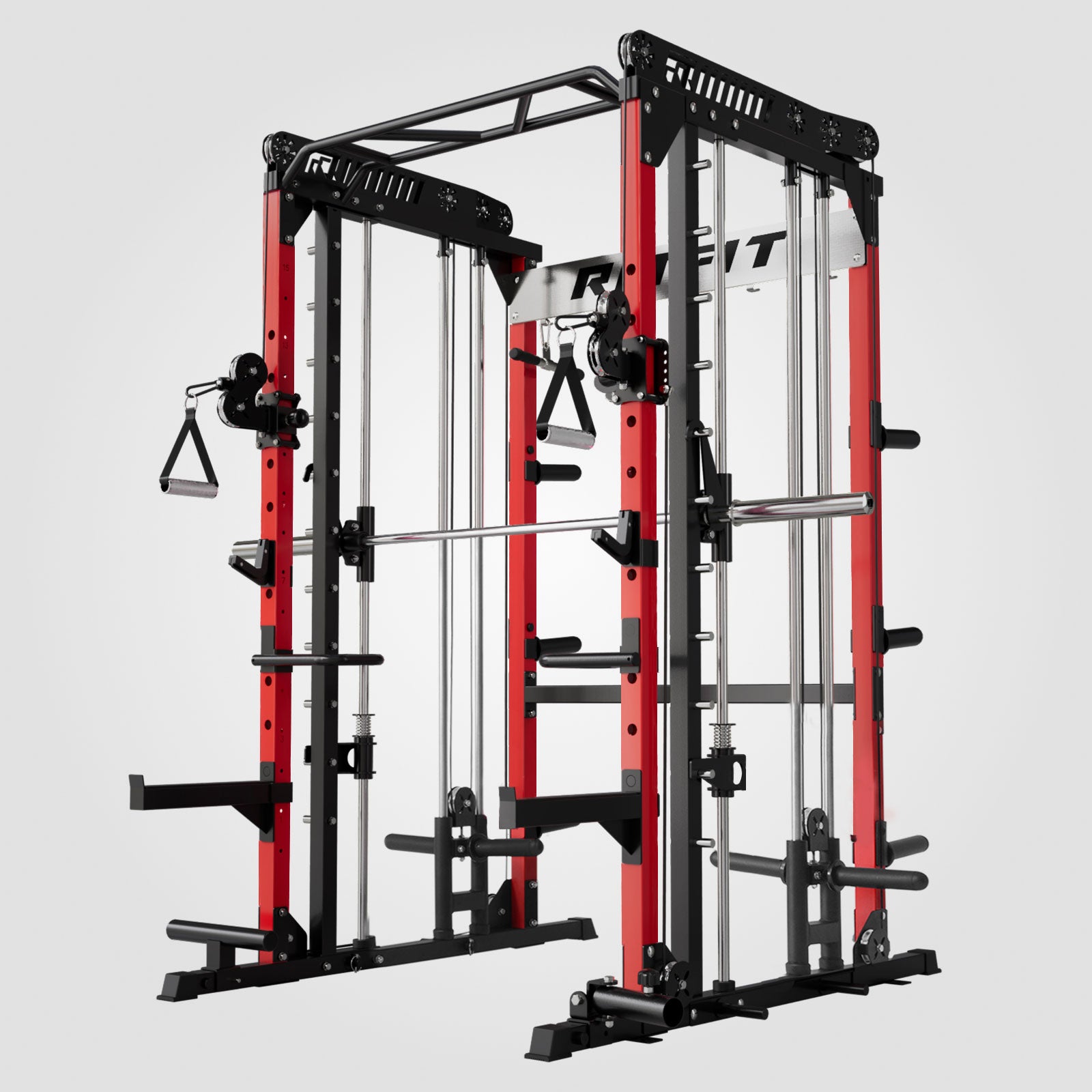
- For Smith machine training: Use 1 to 3 RIR on squats, presses, and rows to keep reps controlled. Explore Smith machine systems if you want guided bar path options for home strength training.
- For cable exercises: Use 0 to 2 RIR on safer isolation movements such as curls, pressdowns, and lateral raises. RitFit strength machines for home gyms can support repeatable cable based workouts.
- For dumbbell training: Use 1 to 3 RIR on presses, rows, lunges, and Romanian deadlifts. This helps you progress without forcing unstable last reps.
Common RIR Mistakes
RIR is useful, but it becomes less reliable when lifters guess randomly or ignore technique. Treat it as a practical estimate that improves with experience.
- Mistake 1: Treating RIR as exact: RIR is an estimate, not a lab measurement. Research suggests lifters are not perfectly accurate when predicting reps to failure, although accuracy can improve with training experience.[4]
- Mistake 2: Taking every set to 0 RIR: Hard sets can be useful, but doing every set to failure may create fatigue that reduces later performance. Save 0 RIR for selected exercises and training phases.
- Mistake 3: Ignoring technical failure: A rep should count only if it keeps the intended form. If you must bounce, twist, shorten range, or lose control, your practical RIR is already lower.
- Mistake 4: Using the same RIR for every lift: Heavy compound lifts usually need more reserve than simple isolation exercises. Squats and deadlifts are more demanding than curls or leg extensions.
- Mistake 5: Never updating the load: If your target is 2 RIR but you keep finishing with 5 RIR, the set is probably too easy. Add weight or reps gradually.
RIR and Rep Speed
As you get closer to failure, reps often slow down even when you try to lift fast. Some research has explored the relationship between lifting velocity and repetitions in reserve as a way to improve training monitoring and fatigue management.[5]
You do not need a velocity tracker to use this idea. Simply notice when your clean rep speed slows sharply and use that as one clue that your RIR is dropping.
Other Meanings of RIR
Although RIR usually means Reps In Reserve in fitness, the acronym can mean different things in other fields. Context determines the correct meaning.
| Context | RIR Meaning | Simple Explanation |
|---|---|---|
| Fitness | Reps In Reserve | Estimated reps left before failure |
| Internet infrastructure | Regional Internet Registry | Organization that manages internet number resources by region |
| Finance | Real Interest Rate | Interest rate adjusted for inflation |
| Business or analysis | Required Internal Return or similar usage | Meaning depends on the document or industry |
If you are reading a workout plan, RIR almost always refers to Reps In Reserve. If you are reading a technical, finance, or business document, check the surrounding terms before assuming the fitness meaning.
FAQs
What does RIR mean in fitness?
RIR means Reps In Reserve in fitness. It estimates how many clean reps you could still perform at the end of a set before reaching failure. A set with 2 RIR means you stop while believing two good reps remain.
How do you calculate RIR during a set?
You calculate RIR by estimating how many more reps you could complete with good form after your final completed rep. The number is subjective, so use rep speed, technique quality, and past training logs to make the estimate more consistent.
Is 0 RIR the same as training to failure?
Yes. In practical gym language, 0 RIR usually means you have no clean reps left. It may refer to technical failure rather than total muscular failure, so form quality should define the stopping point for most lifters during regular training.
What is the difference between RIR and RPE?
RIR counts the estimated reps left before failure, while RPE rates total effort on a scale. In strength training, many lifters connect the two, where 2 RIR often feels like about RPE 8 and 0 RIR feels like RPE 10.
Should beginners use RIR?
Yes. Beginners can use RIR, but they should start with wider margins such as 3 to 5 RIR. This keeps technique cleaner, limits unnecessary fatigue, and helps new lifters learn what hard but controlled sets feel like before pushing closer to failure.
How much RIR is best for muscle growth?
For muscle growth, many lifters use about 0 to 3 RIR on working sets. Heavier compound lifts often work better with 1 to 3 RIR, while safer isolation exercises can occasionally be taken closer to 0 RIR when form stays controlled.
Can RIR help with strength training?
Yes. RIR can help strength training by controlling effort without forcing max attempts every session. A target such as 1 to 3 RIR lets you practice heavy lifts, preserve bar speed, and manage fatigue across multiple sets and training weeks.
Does RIR work for home gym workouts?
Yes. RIR works well for home gym workouts because it does not require advanced testing tools. You can apply it to dumbbells, barbells, Smith machines, benches, and cable exercises as long as you track load, reps, and form quality consistently.
Conclusion
RIR means Reps In Reserve, and it is one of the simplest ways to control training intensity. By tracking how many clean reps you leave in the tank, you can train hard, protect technique, and manage fatigue more intelligently.
For most lifters, RIR works best as a practical guide rather than a perfect number. Start conservatively, log your sets, and refine your estimates over time.
Disclaimer: This article is for general fitness education only and is not medical advice. If you are new to resistance training, recovering from injury, managing pain, or unsure how close to failure you should train, consult a qualified fitness or healthcare professional before changing your workout intensity.
References
- Helms ER Cronin J Storey A Zourdos MC. Application of the repetitions in reserve based rating of perceived exertion scale for resistance training. Strength Cond J. 2016;38(4):42-49. doi:10.1519/SSC.0000000000000218
- Refalo MC Helms ER Trexler ET Hamilton DL Fyfe JJ. Influence of resistance training proximity to failure on skeletal muscle hypertrophy, a systematic review with meta analysis. Sports Med. 2023;53(3):649-665. doi:10.1007/s40279-022-01784-y
- Bastos V Machado S Teixeira DS. Feasibility and usefulness of repetitions in reserve scales for selecting exercise intensity, a scoping review. Percept Mot Skills. 2024;131(3):940-970. doi:10.1177/00315125241241785
- Steele J Endres A Fisher J Gentil P Giessing J. Ability to predict repetitions to momentary failure is not perfectly accurate, though improves with resistance training experience. PeerJ. 2017;5:e4105. doi:10.7717/peerj.4105
- Jukic I Prnjak K Helms ER McGuigan MR. Modeling the repetitions in reserve velocity relationship, a valid method for resistance training monitoring and prescription, and fatigue management. Physiol Rep. 2024;12(5):e15955. doi:10.14814/phy2.15955