Table of Contents
A Smith machine bar usually matters less by its physical mass and more by its starting resistance on the rails. Most Smith machines do not have one standard bar weight, so the number that matters most for training is the takeoff load you actually feel when the bar starts moving.
Key Takeaways
- There is no single standard Smith machine bar weight: Machine type and counterbalance design change the answer.
- Starting resistance matters most for training: It is the number that changes your real working load.
- Commercial units often feel lighter: Counterbalanced designs can reduce takeoff resistance significantly.
- Home gym systems often feel heavier and truer: Many non counterbalanced units create a more direct bar feel.
- Measure your own machine once: A repeatable number makes programming and progress tracking much more accurate.
What Is a Smith Machine?

A Smith machine is a guided barbell system that moves along fixed rails, which makes the bar path more controlled than a free weight setup. That fixed path can improve setup confidence and solo training safety, especially in a home gym environment.
Different Types of Smith Machines
Smith machines do not all feel the same because their bar systems, counterbalance design, and overall construction vary. If you are shopping instead of just measuring, browsing a RitFit Smith machine collection can help you compare these design differences more clearly.
Counterbalanced Smith Machines

Counterbalanced Smith machines use cables, pulleys, or internal counterweights to reduce the bar’s takeoff resistance. These units often feel much lighter at the start than the bar’s actual physical mass would suggest.
Linear Bearing Smith Machines

Linear bearing Smith machines usually deliver a truer, heavier bar feel because they rely less on counterbalance and more on smooth guided travel. This design is common in home gym systems where users want a more direct strength training feel.
All in One Home Gym Smith Machines

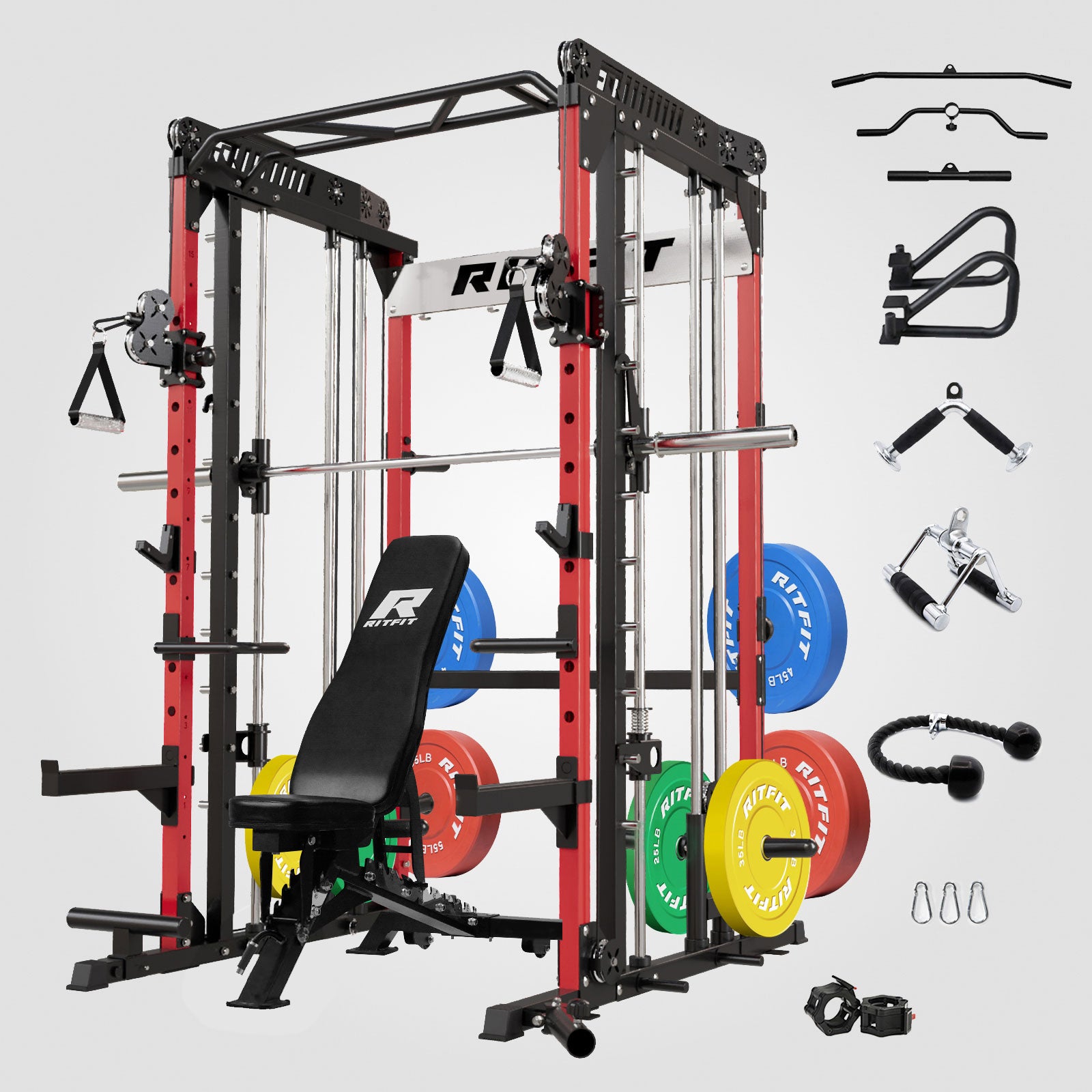
All in one units combine a Smith bar with racks, cable stations, and accessory options, so they are built for broader training variety. Systems such as the RitFit M1 Smith machine for home gym are useful examples of how Smith training, cable work, and rack functions can exist in one footprint.
Selectorized Smith Machines

Selectorized Smith machines connect the guided bar to a weight stack, which changes how resistance is loaded and adjusted. These machines are less common than plate loaded designs, but they can be convenient when fast weight changes matter more than maximum loading flexibility.
What Changes Smith Machine Bar Weight?
The answer depends on more than the bar alone, because a Smith machine’s feel comes from design, mechanics, and maintenance working together. That is why two machines loaded with the same plates can still feel very different on the first rep.
Bar Mass vs. Starting Resistance
Bar mass is the bar’s actual physical weight, while starting resistance is the force you must overcome to make the bar move. For real world training, starting resistance is usually the more useful number because it directly changes your working load.
- Bar mass: This is what the bar itself would weigh off the machine or in a true isolated measurement.
- Starting resistance: This is what you feel at takeoff when the bar begins moving on the rails.
- Why it matters: If you log the wrong number, your progressive overload math becomes less accurate.
Counterbalance Systems
A counterbalance lowers the bar’s effective starting weight, which is why many commercial units feel unusually light at takeoff. A non counterbalanced design usually feels heavier and more direct because you are moving more of the bar’s true load.
Rail Angle
Some Smith machines use a slight incline instead of a perfectly vertical path to create a more natural movement pattern for certain lifts. Rail angle can change exercise feel, but it does not reliably tell you the bar’s true starting resistance.
Friction and Maintenance
Guide rods, bearings, dust, lubricant condition, and wear can all change how heavy a Smith machine feels from rep to rep. On the way up, friction can add resistance, and on the way down, it can make the load feel slightly easier to control.
Why Knowing Smith Machine Bar Weight Matters
Knowing the bar weight helps you train more accurately, compare sessions more honestly, and avoid guessing your total load. It is especially useful when you switch between commercial gyms, home gym systems, and free weight training.
Progressive Overload
You cannot track strength progress well if you do not know your true starting load. A set with two 45 lb plates per side is not the same set on every Smith machine because the bar system itself may feel very different.
Exercise Selection and Setup
Starting resistance changes how pressing, squatting, lunging, and rowing movements feel at the bottom and at takeoff. This matters even more when you pair the machine with a stable bench, such as the RitFit Gator adjustable weight bench, for incline or flat pressing work.
Consistency Across Gyms
Different Smith machines can vary enough that the same plate load does not create the same training effect. Measuring your own machine once gives you a repeatable reference point for future programming.
Common Smith Machine Bar Weight
There is no universal Smith machine bar weight, but most users encounter a practical range that depends on counterbalance and machine style. Commercial units often feel lighter, while many home gym or hybrid systems feel closer to a truer bar load.
| Machine Type | Typical Starting Resistance | What It Usually Feels Like |
|---|---|---|
| Heavily counterbalanced commercial unit | About 6 to 15 lb | Very light at takeoff, often beginner friendly |
| Moderately counterbalanced commercial unit | About 15 to 25 lb | Controlled and lighter than a free bar |
| Home gym or non counterbalanced machine | About 25 to 35 lb | Closer to a truer bar feel |
| Heavy hybrid combo unit | Can approach 45 lb | More substantial takeoff load, often favored by stronger lifters |
Quick Reality Check
If you care about training accuracy, treat these numbers as starting references, not guaranteed specs for every machine. Models such as the RitFit Buffalo multifunctional Smith machine may feel very different from the light counterbalanced units many users first try in a commercial gym.
- Commercial gym feel: Often lighter than expected because counterbalance reduces takeoff effort.
- Home gym feel: Often heavier and more direct because there is less mechanical assistance.
- Programming tip: Measure once, log it, and keep using the same reference number for that machine.
How to Measure a Smith Machine Bar Weight
If your manual or product page does not list a starting weight, you can measure it yourself with simple tools. The goal is not lab perfection, but a repeatable number you can trust in your training log.
Method 1: Floor Scale
A floor scale is one of the easiest ways to estimate the bar’s starting load in a home or gym setting. It works best when the bar is stable, unloaded, and lowered smoothly onto the measuring point.
- Option A: Weigh yourself first, then step on the scale with the unloaded Smith bar resting on your shoulders, and subtract your bodyweight from the combined total.
- Option B: Raise the scale onto a sturdy box so the unloaded bar can rest directly on it at a natural bar height.
- Tip: Take two or three readings and use the average.
Method 2: Hanging Scale
A hanging scale can work well because it isolates the bar more directly than a bodyweight subtraction method. The reading is only useful if the strap is centered and the bar is fully supported by the scale during measurement.
- Center the strap: Place the strap around the middle of the bar to reduce side to side bias.
- Unload the bar: Remove all plates and attachments that could affect the reading.
- Measure carefully: Unrack the bar into the scale and record the stable number.
Method 3: Balance and Plate Approximation
A rope and plate balancing method is less precise, but it can still give you a useful estimate when no scale is available. This method works best as a rough field check rather than a final measurement.
- Create a balance point: Secure a rope to the bar and route it over a top crossmember or stable support.
- Add plates gradually: Increase the opposite side until the bar balances without rising or dropping.
- Use caution: Keep the setup controlled and avoid unstable positions.
Measurement Tips That Improve Accuracy
Good measurement technique matters because friction and bar height can change the reading enough to affect your log. A clean, repeatable setup is more useful than a rushed single attempt.
- Measure at the same height: The feel can vary across the rail path.
- Clean the guide rods first: Dry or dirty rods can distort the result.
- Use the unloaded bar: Remove plates, collars, and loose attachments before testing.
Smith Machine Bar vs. Olympic Barbell
A Smith machine bar and a free weight Olympic bar are not interchangeable just because both can hold plates. The fixed rail path, different takeoff feel, and lower stabilization demand usually make the Smith machine a separate training context.
Key Differences
A free Olympic barbell demands more stabilization because you control both the load and the path of motion yourself. If you want a reference point for a traditional bar feel, compare your machine work against a standard 7 ft Olympic barbell rather than assuming the same plate load means the same exercise difficulty.
- Smith machine: Fixed path, lower stabilization demand, machine specific starting resistance.
- Olympic barbell: Freer movement path, more stabilization, more direct transfer to traditional barbell lifting.
- Programming reality: Similar plate numbers do not always mean similar training stress.
How to Compare Smith and Free Weight Numbers
The best comparison method is to match reps and effort level first, then compare load after a few sessions. That approach is more honest than forcing a single universal conversion formula across every lift and machine style.
- Match the exercise: Compare squat to squat or bench to bench, not unrelated movements.
- Match effort: Use a similar rep target and difficulty level on both setups.
- Track your own ratio: Your personal Smith to free weight gap is more useful than a generic internet rule.
Conclusion
Most people asking about Smith machine bar weight really want to know the bar’s effective starting resistance, because that is the number that changes the difficulty of every rep. Once you measure your own machine and log that number consistently, your plate math, exercise comparisons, and strength progress become much more reliable.
Disclaimer: This article is for general educational purposes only. Always follow your machine’s safety instructions, load limits, and setup guidance, and stop any exercise that causes sharp pain, dizziness, numbness, or loss of control.
FAQs
What changes the Smith machine bar weight?
Machine type and counterbalance design change the starting resistance. A counterbalanced commercial unit feels much lighter because internal pulleys reduce the takeoff effort. Home gym systems without these cables feel heavier and more direct. You must overcome this specific resistance to start your exercise.
How much does a standard Smith machine bar weigh?
There is no universal standard weight for these guided bars. Heavy commercial units usually offer 6 to 15 pounds of starting resistance. Standard home gym frames feel heavier and often provide 25 to 35 pounds of resistance. You should measure your specific equipment to track your progressive overload accurately.
Is a Smith machine bar the same as an Olympic barbell?
No. It is a completely different training tool with a fixed movement path. A free weight Olympic barbell demands much more physical stabilization because you control the load entirely. A guided system reduces balance requirements and features a unique starting resistance that changes your actual working load.
How to measure the starting resistance of your equipment?
You can easily measure the takeoff load using a standard floor scale. You step on the scale with the unloaded bar resting on your shoulders. You simply subtract your own bodyweight from the total combined number. This simple process gives you a highly accurate reference for your daily workout logs.
Does knowing the exact bar resistance improve your workout results?
Yes. It helps you track your strength progress with much greater accuracy. Different systems vary enough that identical plate loads create entirely different stress levels. Logging the true starting resistance ensures you maintain consistent progressive overload when switching between commercial facilities and your personal garage gym.