








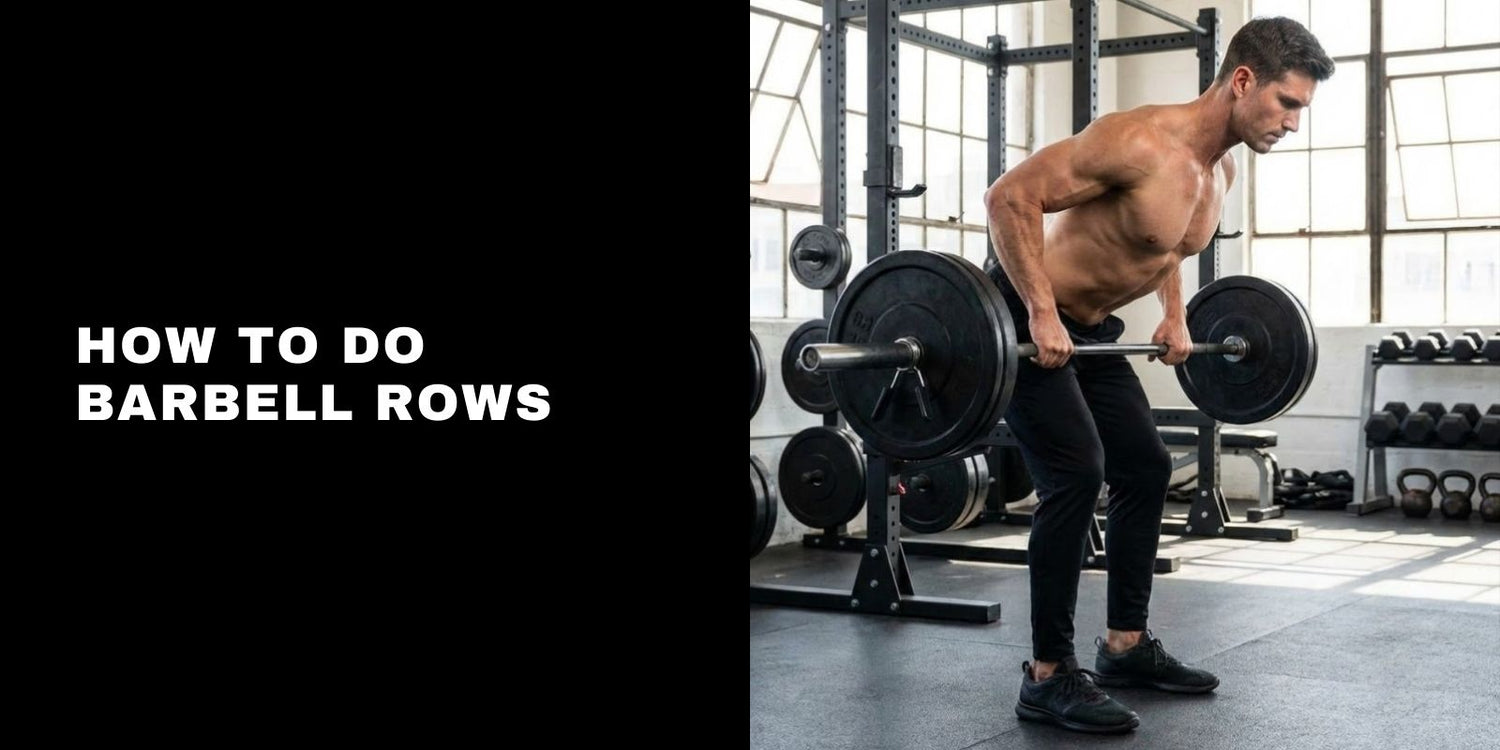
Learning how to build a huge back with the barbell row comes down to a flat-backed hinge you can hold under load plus enough weekly volume to force growth. The barbell row trains the lats, traps, and rhomboids together, which is why it adds width and thickness faster than most single-joint moves.
This guide covers proper barbell row form, the muscles that create a wide back, how to program sets and reps, which variation fits your body, and how to add weight without irritating your lower back.
Quick Answer: The barbell row builds a huge back when you hinge to about 45 degrees with a flat spine, brace hard, and pull the bar to your lower ribs for 3 sets of 8-10 reps twice a week. Add a small amount of weight or one rep per session while your form holds.
Key Takeaways
- Setup beats load: A hip hinge to roughly 45 degrees, a flat back, a hard brace, and a controlled pull are the four things that grow the back.
- Width and thickness: The lats give you the V-taper, while the traps and rhomboids add the upper back thickness that makes a back look huge in a shirt.
- Simple programming works: 3 sets of 8-10 reps twice a week with small weekly jumps in weight or reps builds more back than random heavy sets.
- Fix the arm pull: If you only feel rows in your arms, lighten the load, pull with your elbows, and pause and squeeze at the top.
- Stop on sharp pain: Muscle soreness is normal, but a sharp or shooting lower back pain means you stop, reduce the load, raise the start position, or switch to a chest-supported row.
How to Do a Barbell Row With Proper Form
A proper barbell row starts with a hinge to about 45 degrees, a braced torso, and a pull that drives your elbows back toward your hips. The bar travels to your lower ribs, your shoulder blades squeeze together, and you lower the bar under control until your arms are straight.
Set the Bar at a Height You Can Hold
Most beginners lose their flat back before the first rep, so start with the bar on safety pins set near knee height. That height lets you pick up the weight with a neutral spine, and you can move to the floor once your hamstrings allow it.
- Power rack pins: Set the pins so the bar sits just below your knees, then hinge down to it instead of bending over.
- Knee height is a starting point: If your lower back rounds at knee height, raise the pins another notch.
- Collars on: Lock the plates with RitFit Olympic barbell clamps before the first pull so the load never shifts.
Set Your Grip, Feet, and Wrists
Walk up so the bar sits over the middle of your foot, with your feet about hip width apart and your knees slightly unlocked. A shoulder-width overhand grip keeps the load on your upper back rather than your arms, and your wrists stay straight instead of curling under the bar.
- Overhand grip: An overhand grip shifts more of the work to the upper back and rear delts instead of the biceps.
- Bar over mid-foot: A bar that drifts toward your toes pulls you forward, which is the fastest way to irritate a lower back.
- Straight wrists: Keep your knuckles pointing down and squeeze the bar hard, because a tight grip keeps the shoulders switched on.
The Five Steps of Every Rep
- Hinge: Push your hips back with a slight knee bend until your chest is angled toward the floor, keeping your spine long instead of rounding.
- Brace: Take a breath into your belly and tighten your abs, because that internal pressure is what protects the spine while you pull.
- Pull: Drive your elbows back toward your hips instead of thinking about your hands, and keep your elbows at about 45 degrees from your ribs.
- Squeeze: Touch the bar to your lower ribs or belly button, then squeeze your shoulder blades together hard for a beat before lowering.
- Return: Lower the bar slowly until your arms are straight and you feel a stretch in your lats, then reset your brace for the next rep.
Run two or three light sets before your working weight, and make the first set an empty bar. If you want a deeper breakdown of the same movement, this guide on how to barbell row properly walks through the same setup cues from a different angle.
Why the Barbell Row Builds a Huge Back
The barbell row is one of the most efficient back builders because it loads the lats for width and the upper back for thickness in the same rep. It also forces the spinal erectors to work isometrically, which is why a heavy row feels like a full-body exercise rather than an arm exercise.
A review of erector spinae activation during forward-bent movements reports that the spinal erectors must contract isometrically to counter shear forces on the spine[1]. In practice that means every strict row also trains the muscles that hold your posture upright for the rest of the day.
Width Comes From the Lats
The lats are the large muscles on the sides of your back, and they do most of the pulling work in a row. Building them wide is what creates the V-taper that makes your waist look smaller, and rows train them through a longer range of motion than most machine options.
Thickness Comes From the Upper Back
The traps and rhomboids sit between and around your shoulder blades, and they pull your shoulders back into place. Rowing to the lower ribs with a hard squeeze at the top is what adds the upper back thickness that makes a back look huge from behind.
Which Muscles the Barbell Row Trains
| Muscle Group | Where It Is | What It Does in the Row |
|---|---|---|
| Lats | The large muscles on the sides of the back | Do most of the pulling work and give the back its width |
| Traps | The muscles across the upper back and neck | Squeeze the shoulder blades together and add thickness |
| Rhomboids | Smaller muscles between the shoulder blades | Help the traps pull the shoulders back and improve posture |
| Biceps | The front of the upper arm | Bend the elbows to bring the bar up |
| Core | The abs and lower back | Act like a belt that keeps the spine straight under load |
Muscle roles are described for a standard overhand barbell row.
How Should You Program Barbell Rows Each Week?
Program barbell rows twice a week for 3 sets of 8-10 reps with a load that leaves one or two clean reps in the tank. That gives you 6 hard rowing sets plus accessory work, which is enough volume to grow a back without wrecking your recovery for squats and deadlifts.
Find Your Working Weight
Start with an empty bar, which is 45 lbs on a standard Olympic bar, and check that you can do 12 controlled reps with a flat back. Add 10 pounds to each side at a time, which takes you to 65 lbs total, and keep adding small jumps until the last few reps feel hard but your form holds.
- Working weight: The load where the final two reps are hard but your back stays flat and your squeeze stays strong.
- Weekly progression: Add 2.5 to 5 pounds per week, or add one rep when the weight will not move up.
- Example: If you rowed 135 lbs for 8 reps last week, aim for 135 lbs for 9 reps this week before adding weight.
A Twice-a-Week Back Session
Run the session below twice a week with at least two days between back days. Keep the row first while you are fresh, and treat the last two movements as accessory work that supports the row rather than replaces it.
| Exercise | Sets | Reps | Rest | Notes |
|---|---|---|---|---|
| Barbell Row | 3 | 8-10 | 2 mins | Go heavy but keep form strict |
| Pull-Ups | 3 | As many as you can | 2 mins | If you cannot do pull-ups, use the lat pulldown machine |
| Dumbbell Row | 3 | 10-12 | 90 secs | Use a bench for support and focus on the stretch |
| Face Pulls | 3 | 15-20 | 1 min | Use a cable machine, great for shoulder health |
Rest times are minimums; add 30 seconds if your form breaks down on the next set.
Can You Train Back and Biceps Together?
Back and biceps pair well because every strict row already trains the biceps as a secondary mover. Do your rows first while you are fresh, then finish with 2 or 3 sets of curls for 10-12 reps, and your arms get stimulus without stealing energy from the back work.
Yates Row vs Pendlay Row vs Dumbbell Row
All three row variations build the back, but they differ in grip, starting position, and how much your lower back has to hold. Pick the variation that matches your flexibility and your lower back tolerance, then keep the same hinge and brace cues you use on the standard row.
| Variation | Grip | Best For | Main Tradeoff |
|---|---|---|---|
| Standard Barbell Row | Overhand, shoulder width | Overall back width and thickness | Grip can fail before the back does |
| Yates Row | Underhand, shoulder width | Lower lats and biceps | More stress on the biceps tendon |
| Pendlay Row | Overhand, from the floor each rep | Explosive power and honest reps | Needs flexible hamstrings and suits low reps only |
| Dumbbell Row | Neutral, one arm at a time | Lifters with a sensitive lower back | Trains one side at a time |
Grip and start position are the two variables that change how each variation feels.
The Yates Row and Your Biceps
The Yates row flips your hands so your palms face forward, which lets most lifters handle more weight but shifts stress toward the biceps tendon. Biceps involvement also changes with arm position and angle, and one EMG study compared traditional dumbbell curls with Bayesian cable curls to measure biceps brachii activity[2].
When to Use Dumbbell Rows Instead
If your lower back aches every time you hinge under a barbell, switch to a one-arm dumbbell row with your free hand and knee on a bench. The bench takes the isometric load off your lower back while you keep rowing with the same elbow path, and you can add the bar back in once the pain settles.
Adding a chest-supported or seal row to your rotation is another way to keep training the same muscles while your back recovers, and the older write-up on the bent over barbell row covers how the strict version differs from a Yates row.
Which Accessory Moves Build Upper Back Thickness?
Face pulls, pull-ups or lat pulldowns, and back extensions are the accessory moves that pair best with rows for upper back thickness. They add volume to the middle back and rear shoulders without loading the lower back the way a heavy row does, which is why they belong at the end of a back session.
- Face pulls: 3 sets of 15-20 reps with a rope on a cable stack to train the rear delts and the muscles that hold your shoulders back.
- Pull-ups or lat pulldowns: 3 sets taken close to failure to train the lats in a vertical path that rows cannot replicate.
- Back extensions: 2 or 3 sets of 12-15 controlled reps to build the erectors that keep your hinge strong.
Home gym lifters can cover the vertical pulling slot with a lat pulldown attachment instead of a pull-up bar, and a dedicated high row and lat pulldown attachment keeps the movement in the same rack space. If your lower back needs extra work without heavy hinging, a RitFit adjustable back extension machine lets you train the erectors through a controlled range.
Posture is where this accessory work pays off outside the gym as well, and face pulls are one of the most direct ways to train it.
"Not only is the face pull an excellent movement to grow your upper back muscles, it can also improve poor posture. The rear shoulder muscles play a big role in preventing the bad posture so many people get from time spent sitting at desks jobs and hunched over their electronics."
Jeff Cavaliere, MSPT, CSCS, Physical Therapist and Strength Coach, Athlean-X, Upper Back Workout (Athlean-X)
"I can't think of anything better than pink leopard! I love this bar! Quality is awesome and it's so cute!"
Katharine B. Verified Buyer, RitFit 15kg Pink Leopard Olympic Training Barbell
What Equipment Do You Need for Barbell Rows?
You need a bar you can load, plates you can add in small jumps, collars, and a rack with adjustable safety pins set near knee height. Straps and a belt are optional tools that help once your back can outwork your grip or your brace, and neither is needed while you are learning the movement.
Choose a Bar You Can Control
A standard Olympic bar weighs 45 lbs and is the load most lifters learn on, while a lighter training bar helps if 45 lbs is too heavy for 12 clean reps. Whichever you pick, check that the sleeves spin freely and that the knurling gives you a grip without tearing your hands, and browse RitFit barbells and Olympic barbells if you are building a home setup.
Plates, Collars, and Rack Height
Small jumps in load matter more than big ones, because the goal is to add 2.5 to 5 pounds per week instead of chasing a heavy single. A pair of 2.5 pound plates and a pair of 5 pound plates covers most of your early progress, and a deadlift jack saves your back when you change plates on a loaded bar.
- Plates: Build a set from barbells and weight plates so you always have a small jump available.
- Straps: Use them when your back is strong but your grip gives out first, and skip them on warm-up sets.
- Belt: A belt gives your abs something to push against, and it becomes useful once you row near or above body weight.
What Are the Most Common Barbell Row Mistakes?
The four mistakes that stall back growth are using momentum, curling the wrists, letting the neck drift, and standing up as the set gets hard. Each one moves the work away from the lats and upper back, so fixing them usually adds muscle before it adds weight.
- Ego lifting: If your hips heave the bar up, the load is too heavy, so take 20 pounds off and let your back do the lifting.
- Curled wrists: Bending the wrists at the top takes work from the back and hands it to the forearms, and it can irritate the elbows over time.
- Head position: Staring at the ceiling or tucking your chin strains the neck, so pick a spot on the floor about 10 feet ahead and hold it.
- Standing too tall: Rising out of the hinge as you fatigue shifts the work to the traps and off the lats, which usually means the weight is too heavy.
Quick Fixes When a Rep Feels Wrong
If you only feel rows in your arms, think of your hands as hooks and pull with your elbows instead of your hands. If your lower back hurts, lighten the load, raise the start position, and squeeze your abs harder before switching to a dumbbell row for a few weeks.
- Bar hitting your knees: Push your hips back further and let the bar travel in a straight line instead of around your knees.
- Cannot reach the bent-over position: Work on hamstring flexibility and row from a higher pin height in the meantime.
- Sharp or shooting pain: Stop the set, because training through nerve pain is how a small irritation becomes a long layoff.
FAQs About Barbell Rows for a Bigger Back
Are barbell rows good for building a bigger back?
Yes. The barbell row loads the lats, traps, and rhomboids through a long range of motion, so it builds both the width and the thickness that make a back look huge. It also trains the erectors and core isometrically, which carries over to squats and deadlifts.
Which back exercises can I do with a barbell?
A barbell covers rows, Pendlay rows, Yates rows, shrugs, and stiff leg deadlifts from one rack position. Most lifters can build a complete back with barbell rows as the main lift, plus pull-ups or lat pulldowns for the lats and face pulls for the upper back.
How many sets and reps should a back workout have?
Start with 3 sets of 8-10 reps on the barbell row and add 3 sets of 10-12 reps on a dumbbell row or pulldown. Training the back twice a week at that volume gives you roughly 12 hard sets per week, which is enough for steady growth.
Can I train back and biceps on the same day?
Yes. Every strict row already trains the biceps as a secondary mover, so back and biceps fit well in one session. Do your rows first while you are fresh, then finish with 2 or 3 sets of curls for 10-12 reps.
How much weight should I use for dumbbell rows?
Pick a dumbbell you can row 10-12 times with strict form, which for most beginners lands between 25 and 40 pounds per hand. When you hit 12 clean reps on both arms, move up about 5 pounds and rebuild from 10 reps.
Do I need a belt or straps for barbell rows?
No. A belt gives your abs something to push against once you row near body weight, and straps help when your grip fails before your back does. While you are learning, build your own brace and grip strength first, then add tools only when a specific weakness shows up.
Conclusion
The barbell row is the fastest way to build a huge back because it trains the lats, traps, and rhomboids in one hinged movement. Keep the bar over mid-foot, brace hard, pull with your elbows, and squeeze your shoulder blades on every rep.
Start with 3 sets of 8-10 reps twice a week and add a little weight or one rep whenever your form holds. Before you buy your first bar and plates, check the RitFit discount guide for a home setup that fits your space.
Disclaimer
This article is general fitness information and is not medical advice for any individual condition, injury, or treatment plan. Stop training and consult a qualified healthcare professional if you feel sharp or persistent back pain.
References
1. Taylor EW, Ugbolue UC, Gao Y, Gu Y, Baker JS, Dutheil F. Erector Spinae Muscle Activation During Forward Movement in Individuals With or Without Chronic Lower Back Pain: A Systematic Review and Meta-analysis. Arch Rehabil Res Clin Transl. 2023;5(3):100280. Published 2023 Jul 14. doi:10.1016/j.arrct.2023.100280
2. Parpa K, Vasiliou A, Michaelides M, Govindasamy K, Chernov A, Intziegianni K. An Exploratory Study of Biceps Brachii Electromyographic Activity During Traditional Dumbbell Versus Bayesian Cable Curls. Muscles. 2025;4(4):45. Published 2025 Oct 13. doi:10.3390/muscles4040045





