The 2026 FIFA World Cup qualified teams list is complete, with 48 nations confirmed for the largest tournament in FIFA World Cup history. This guide breaks down every team by confederation, every group, the debut nations, the biggest returns, key dates, and the main storylines to watch.
The tournament runs from June 11 to July 19, 2026, across the United States, Mexico, and Canada. Mexico faces South Africa in the opening match at Estadio Azteca, while the final will be played at MetLife Stadium in New York New Jersey.
Fact checked update: This article was updated on May 26, 2026, using official FIFA tournament, schedule, group and ranking information available before publication.
Key Takeaways
- 48 teams are confirmed: The 2026 FIFA World Cup is the first edition with a 48 team field.
- Three nations qualified as hosts: Canada, Mexico and the United States entered automatically.
- Four nations make their World Cup debut: Cape Verde, Curaçao, Jordan and Uzbekistan will appear for the first time.
- The format has changed: The tournament has 12 groups of four teams, followed by a new Round of 32.
- Fitness inspiration is part of the story: World Cup athletes combine sprint speed, endurance, strength and recovery, which also applies to smart home training.
Table of Contents
- 2026 FIFA World Cup Overview
- 2026 World Cup Format
- All 48 Qualified Teams by Confederation
- Host Nations
- AFC Qualified Teams
- CAF Qualified Teams
- CONCACAF Qualified Teams
- CONMEBOL Qualified Teams
- OFC Qualified Team
- UEFA Qualified Teams
- 2026 World Cup Group Stage Draw
- Debut and Returning Teams
- Biggest Storylines to Watch
- Training Like a World Cup Athlete
2026 FIFA World Cup Overview
The 2026 FIFA World Cup is different because it is the first men’s World Cup with 48 teams and three host nations. The United States, Mexico and Canada will stage 104 matches across 16 host cities.
- Opening match: Mexico vs South Africa, June 11, 2026, Estadio Azteca, Mexico City.
- Final: July 19, 2026, MetLife Stadium, New York New Jersey.
- Total teams: 48 national teams.
- Total matches: 104 matches.
- Host nations: Canada, Mexico and the United States.
2026 World Cup Format
The 2026 World Cup format uses 12 groups of four teams. The top two teams in each group and the eight best third placed teams advance to the Round of 32.
- Group stage: 12 groups, four teams per group.
- Knockout entry: 24 top two teams plus eight best third placed teams.
- New knockout round: The Round of 32 adds one more elimination stage.
- Final path: Teams may need to play eight matches to win the tournament.
All 48 Qualified Teams by Confederation
The full 2026 FIFA World Cup qualified teams list includes countries from all six confederations. The expanded format gives Asia, Africa, North America and Oceania broader representation than previous tournaments.
| Confederation | Qualified Teams | Total |
|---|---|---|
| AFC | Japan, Iran, Korea Republic, Australia, Uzbekistan, Jordan, Qatar, Saudi Arabia, Iraq | 9 |
| CAF | Morocco, Senegal, Egypt, Tunisia, Algeria, South Africa, Côte d'Ivoire, Ghana, Cape Verde, DR Congo | 10 |
| CONCACAF | United States, Mexico, Canada, Panama, Haiti, Curaçao | 6 |
| CONMEBOL | Argentina, Brazil, Colombia, Ecuador, Uruguay, Paraguay | 6 |
| OFC | New Zealand | 1 |
| UEFA | France, Spain, England, Portugal, Germany, Netherlands, Belgium, Croatia, Switzerland, Austria, Scotland, Norway, Sweden, Türkiye, Czechia, Bosnia and Herzegovina | 16 |
Host Nations
Canada, Mexico and the United States qualified automatically as 2026 World Cup hosts. Each host nation also carries a different football storyline into the tournament.
United States
The United States hosts its first men’s World Cup since 1994 and enters with one of its most globally experienced player pools. Home matches and deep squad familiarity could help the USMNT compete beyond the group stage.
Mexico
Mexico opens the tournament at Estadio Azteca and becomes central to one of the most historic World Cup hosting moments. El Tri will rely on home support, tournament experience and the pressure of playing in front of one of football’s most passionate fan bases.
Canada
Canada enters its third men’s World Cup and aims to advance beyond the group stage for the first time. The Alphonso Davies generation has changed expectations for Canadian football.
AFC Qualified Teams
Asia sends nine teams to the 2026 FIFA World Cup. The group combines long time regulars with two true debut nations, Jordan and Uzbekistan.
| Team | 2026 Status | Main Storyline |
|---|---|---|
| Japan | Qualified | Japan remains Asia’s most consistent modern World Cup program. |
| Iran | Qualified | Iran returns with experience but still seeks a first knockout stage appearance. |
| Korea Republic | Qualified | Korea Republic brings elite World Cup continuity and attacking star power. |
| Australia | Qualified | Australia has recent knockout experience and a physically resilient tournament identity. |
| Uzbekistan | World Cup debut | Uzbekistan becomes the first Central Asian nation to reach the World Cup. |
| Jordan | World Cup debut | Jordan’s debut reflects the rising competitive depth of Asian football. |
| Qatar | Qualified | Qatar returns after hosting the 2022 tournament. |
| Saudi Arabia | Qualified | Saudi Arabia brings World Cup history and strong regional tournament experience. |
| Iraq | Returning team | Iraq returns to the World Cup after its previous appearance in 1986. |
CAF Qualified Teams
Africa sends ten teams to the 2026 World Cup, its largest ever representation. Morocco leads the group after its historic 2022 semi final run.
| Team | 2026 Status | Main Storyline |
|---|---|---|
| Morocco | Qualified | Morocco enters as Africa’s strongest recent World Cup performer. |
| Senegal | Qualified | Senegal remains one of Africa’s deepest and most athletic squads. |
| Egypt | Qualified | Egypt returns with Mohamed Salah as its global headline player. |
| Tunisia | Qualified | Tunisia brings defensive structure and tournament experience. |
| Algeria | Qualified | Algeria returns with a squad capable of troubling stronger opponents. |
| South Africa | Qualified | South Africa plays the opening match against Mexico. |
| Côte d'Ivoire | Qualified | The reigning African champion returns to the World Cup stage. |
| Ghana | Qualified | Ghana brings one of Africa’s most memorable World Cup histories. |
| Cape Verde | World Cup debut | Cape Verde becomes one of the tournament’s most compelling underdog stories. |
| DR Congo | Returning team | DR Congo returns to the World Cup after appearing as Zaire in 1974. |
CONCACAF Qualified Teams
CONCACAF has six teams in the 2026 World Cup, including all three hosts. Panama, Haiti and Curaçao add regional depth beyond the automatic qualifiers.
| Team | 2026 Status | Main Storyline |
|---|---|---|
| United States | Host | The USMNT aims to turn home advantage into a deep tournament run. |
| Mexico | Host | Mexico carries the emotional weight of opening the tournament at home. |
| Canada | Host | Canada aims for its first knockout stage appearance. |
| Panama | Qualified | Panama returns after its 2018 World Cup debut. |
| Haiti | Qualified | Haiti’s return is one of the most emotional stories in the region. |
| Curaçao | World Cup debut | Curaçao becomes one of the smallest nations ever to qualify. |
CONMEBOL Qualified Teams
South America sends six teams to the 2026 World Cup. Argentina arrives as defending champion, while Brazil keeps its record of appearing at every men’s World Cup.
| Team | 2026 Status | Main Storyline |
|---|---|---|
| Argentina | Qualified | Argentina enters as the defending World Cup champion. |
| Brazil | Qualified | Brazil remains the only nation to play in every men’s World Cup. |
| Colombia | Qualified | Colombia returns after missing the 2022 tournament. |
| Ecuador | Qualified | Ecuador brings one of South America’s most disciplined modern squads. |
| Uruguay | Qualified | Uruguay blends World Cup tradition with a dangerous new generation. |
| Paraguay | Returning team | Paraguay returns after missing the last three World Cups. |
OFC Qualified Team
New Zealand is Oceania’s direct representative at the 2026 World Cup. The All Whites return with a reputation for disciplined defending and tournament resilience.
| Team | 2026 Status | Main Storyline |
|---|---|---|
| New Zealand | Qualified | New Zealand aims to repeat the competitive spirit it showed in 2010. |
UEFA Qualified Teams
Europe sends 16 teams to the 2026 World Cup. France, Spain, England, Portugal and Germany enter as major contenders, while Bosnia and Herzegovina returns after its 2014 debut.
| Team | 2026 Status | Main Storyline |
|---|---|---|
| France | Qualified | France enters with elite squad depth and top ranking strength. |
| Spain | Qualified | Spain brings a technically dominant system and an exciting new generation. |
| England | Qualified | England has the talent to compete for its first title since 1966. |
| Portugal | Qualified | Portugal combines elite attacking talent with experienced leadership. |
| Germany | Qualified | Germany seeks redemption after disappointing recent World Cup campaigns. |
| Netherlands | Qualified | The Netherlands remains one of football’s strongest nations without a World Cup title. |
| Belgium | Qualified | Belgium aims to extend its relevance beyond its golden generation era. |
| Croatia | Qualified | Croatia remains a proven tournament overachiever. |
| Switzerland | Qualified | Switzerland is one of Europe’s most reliable group stage performers. |
| Austria | Qualified | Austria returns with a tactically organized and physically intense squad. |
| Scotland | Qualified | Scotland brings passionate support and a long awaited return to the world stage. |
| Norway | Qualified | Norway enters with rare superstar power led by Erling Haaland and Martin Ødegaard. |
| Sweden | Qualified | Sweden returns with a history of strong international tournament results. |
| Türkiye | Qualified | Türkiye brings intensity, technical quality and a history of tournament surprises. |
| Czechia | Qualified | Czechia returns under its current national identity after a long World Cup absence. |
| Bosnia and Herzegovina | Returning team | Bosnia and Herzegovina returns after making its World Cup debut in 2014. |
2026 World Cup Group Stage Draw
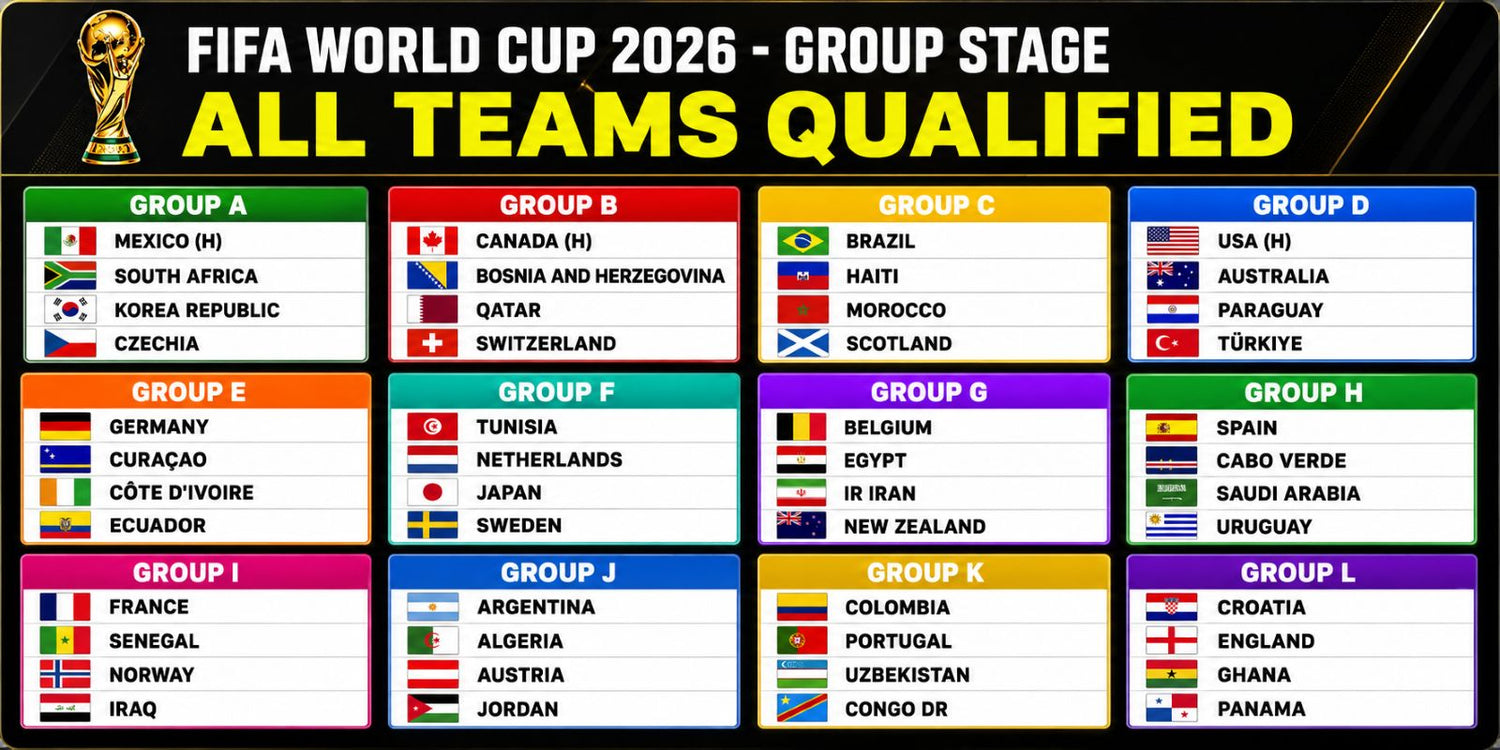
The 48 qualified teams are divided into 12 groups of four. The group stage gives every team three matches before the expanded knockout round begins.
| Group | Teams |
|---|---|
| Group A | Mexico, South Africa, Korea Republic, Czechia |
| Group B | Canada, Bosnia and Herzegovina, Qatar, Switzerland |
| Group C | Brazil, Morocco, Scotland, Haiti |
| Group D | United States, Australia, Paraguay, Türkiye |
| Group E | Germany, Ecuador, Côte d'Ivoire, Curaçao |
| Group F | Netherlands, Japan, Tunisia, Sweden |
| Group G | Belgium, Iran, Egypt, New Zealand |
| Group H | Spain, Uruguay, Saudi Arabia, Cape Verde |
| Group I | France, Norway, Senegal, Iraq |
| Group J | Argentina, Austria, Algeria, Jordan |
| Group K | Portugal, Colombia, Uzbekistan, DR Congo |
| Group L | England, Croatia, Ghana, Panama |
Debut and Returning Teams
Four countries will make their first men’s World Cup appearance in 2026. Several other nations are returning after long gaps, which adds more emotional weight to the expanded field.
- Cape Verde: The island nation makes its World Cup debut and becomes one of the tournament’s biggest underdog stories.
- Curaçao: Curaçao reaches the World Cup for the first time and represents one of the smallest populations in the field.
- Jordan: Jordan makes its debut after a breakthrough Asian qualifying campaign.
- Uzbekistan: Uzbekistan becomes the first Central Asian country to reach the men’s World Cup.
- Iraq: Iraq is a returning team, not a debut nation, because it previously appeared in 1986.
- Bosnia and Herzegovina: Bosnia and Herzegovina is also a returning team, because it made its debut in 2014.
Biggest Storylines to Watch
The 2026 World Cup has more storylines than any previous edition because of the expanded field and tri nation hosting model. The biggest themes include legacy, redemption, debut nations, host pressure and tactical depth.
- Argentina’s title defense: The defending champions will try to repeat after their 2022 triumph.
- France and Spain as elite contenders: Both teams combine world class talent with strong current FIFA ranking positions.
- Germany’s redemption arc: Germany needs a strong tournament after early exits in recent World Cups.
- Morocco’s next step: Morocco will try to build on its historic 2022 semi final run.
- Host nation pressure: The United States, Mexico and Canada will all face major expectations from home fans.
- Small nation breakthrough: Cape Verde, Curaçao, Jordan and Uzbekistan show how the 48 team format has changed opportunity.
Training Like a World Cup Athlete
World Cup footballers need speed, repeat sprint ability, lower body power, core control and recovery capacity. Research on elite soccer shows that match demands vary by position and that transition moments require high physical output, which explains why smart training combines strength, sprinting, conditioning and injury prevention.[1]
High speed running and sprinting are central to modern soccer performance, so athletes train both straight line acceleration and repeated high intensity exposure.[2] Home gym users can apply the same principles at a safe recreational level by combining strength work, interval conditioning and mobility.
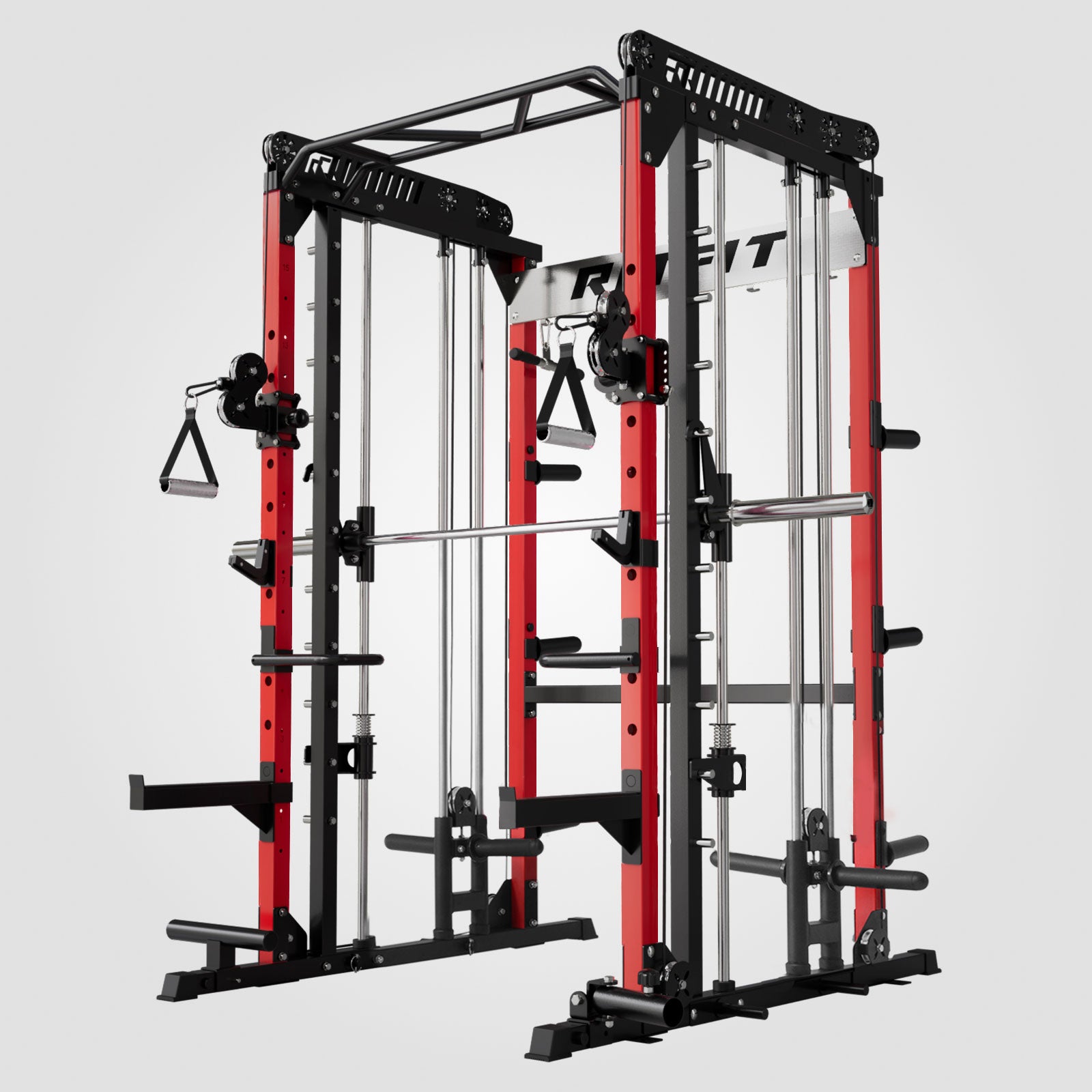
- Lower body strength: Squats, split squats, lunges and hip thrusts build force production for sprinting and cutting. A compact Smith machine for home strength training can support controlled lower body sessions.
- Unilateral control: Single leg work improves balance, deceleration and side to side control. Dumbbells for unilateral strength training are useful for step ups, split squats and single leg Romanian deadlifts.
- Power development: Jump training and loaded lower body movements can support explosive ability when programmed safely. Barbells and weight plates for power training help build progressive overload.
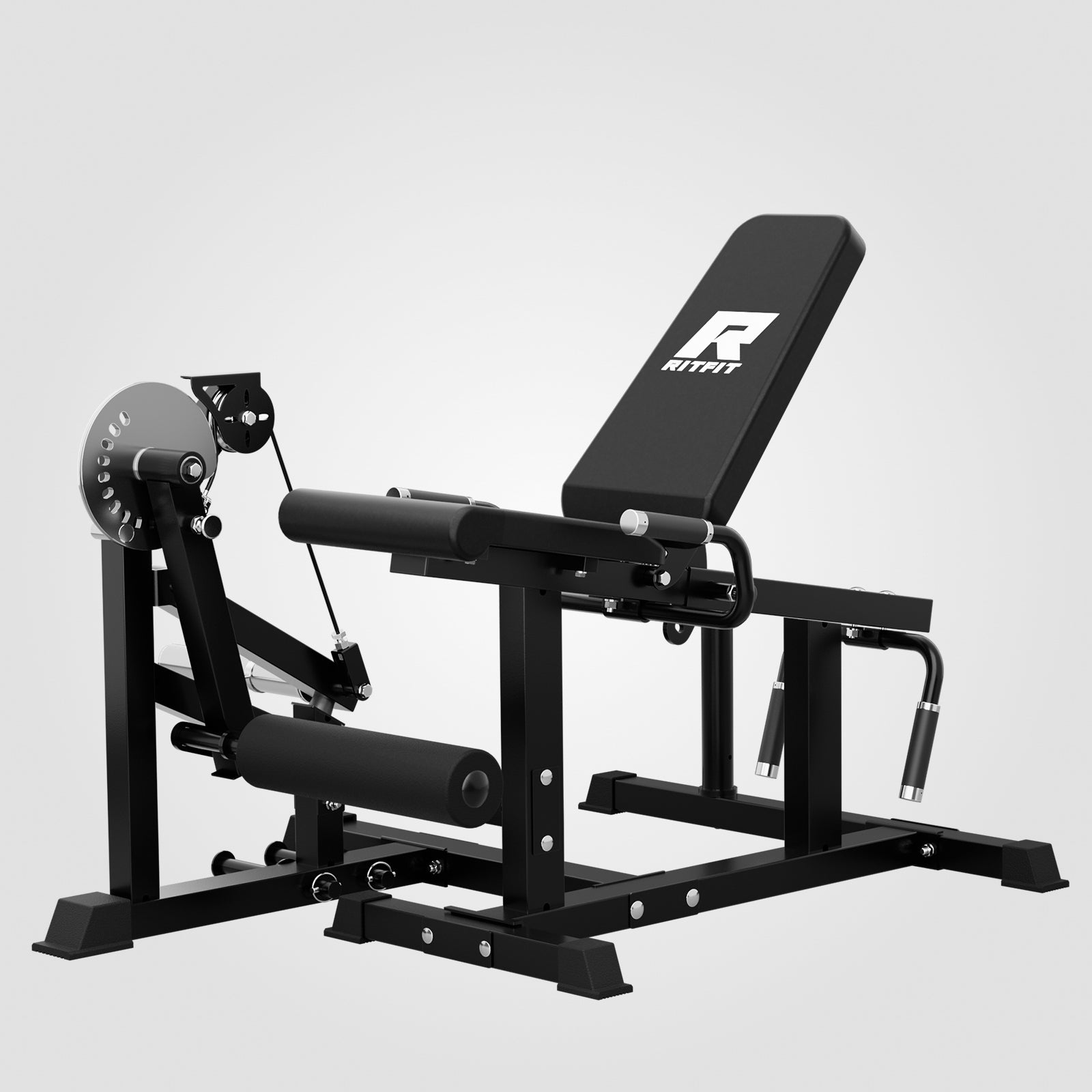
- Strength machine support: Leg press, hack squat and calf raise patterns can help build lower body volume without relying only on free weight lifts. The RitFit GAZELLE PRO 3 in 1 leg press and hack squat machine fits this lower body training role.
- Upper body and core support: Pressing, rowing, planks and anti rotation work help maintain contact strength and posture. A stable adjustable bench for home gym workouts can support pressing and core exercises.
- Conditioning: High intensity interval training can improve soccer related endurance markers, although it should be scaled to the athlete’s level.[3] Beginners should start with low volume intervals and gradually increase intensity.
- Injury prevention: Evidence supports neuromuscular warm up and focused strength training as part of soccer injury reduction strategies.[4] Strength, balance, landing control and mobility should be treated as part of the program, not optional extras.
If the World Cup motivates you to train at home, start with practical equipment that supports repeatable strength and conditioning. RitFit options such as the RitFit GATOR adjustable weight bench, RitFit hex rubber dumbbells and strength machines for home gyms can help build a balanced training setup.
Frequently Asked Questions
How many teams qualified for the 2026 FIFA World Cup?
48 teams qualified for the 2026 FIFA World Cup. This is the largest field in tournament history, with 12 groups of four teams and a new Round of 32 that gives more nations a path into the knockout stage.
Which teams are making their World Cup debut in 2026?
Four teams are making their World Cup debut in 2026. Cape Verde, Curaçao, Jordan and Uzbekistan will appear for the first time, while Iraq and Bosnia and Herzegovina are returning teams because they played in earlier tournaments.
Is Iraq a debut team at the 2026 FIFA World Cup?
No. Iraq is not a debut team at the 2026 FIFA World Cup. Iraq previously appeared in the 1986 tournament, so its 2026 qualification is best described as a long awaited return rather than a first appearance.
Did Bosnia and Herzegovina qualify for a World Cup before 2026?
Yes. Bosnia and Herzegovina qualified for the World Cup before 2026. The national team made its World Cup debut in 2014, which means its 2026 appearance is a return to the tournament rather than a first qualification.
When does the 2026 FIFA World Cup start?
The 2026 FIFA World Cup starts on June 11, 2026. The opening match is Mexico against South Africa at Estadio Azteca in Mexico City, and the final is scheduled for July 19, 2026, at MetLife Stadium.
What is the 2026 FIFA World Cup format?
The 2026 FIFA World Cup format has 12 groups of four teams. The top two teams from each group and the eight best third placed teams advance to the Round of 32, creating one extra knockout stage.
Which countries are hosting the 2026 FIFA World Cup?
The 2026 FIFA World Cup is hosted by the United States, Mexico and Canada. It is the first men’s World Cup shared by three host nations, with matches spread across 16 cities in North America.
Can World Cup inspired training be done at home?
Yes. World Cup inspired training can be adapted for home workouts. Recreational users can focus on lower body strength, unilateral balance, sprint style intervals, core stability and recovery using safe progressions and suitable home gym equipment.
The Bottom Line
The 2026 FIFA World Cup qualified teams list is the most diverse field the tournament has ever seen. With 48 teams, four debut nations, three hosts and a new Round of 32, the tournament offers more global storylines and more opportunities for surprise than any previous edition.
For fans, the best way to follow the tournament is to understand the full team list, the group draw and the key format changes before the opening match. If the World Cup also inspires you to train, start with safe strength, conditioning and recovery habits that match your current ability.
Disclaimer: This article is for general sports information and educational fitness inspiration only. It is not medical advice, coaching advice or a substitute for guidance from a qualified professional. Always check current FIFA information before making travel or ticket decisions, and consult a qualified trainer or healthcare professional before starting a new exercise program.
References
- Bortnik L, Bruce Low S, Burger J, et al. Physical match demands across different playing positions during transitional play and high pressure activities in elite soccer. Biol Sport. 2024;41(2):73-82. doi:10.5114/biolsport.2024.131815.
- Gualtieri A, Rampinini E, Dello Iacono A, Beato M. High speed running and sprinting in professional adult soccer: Current thresholds definition, match demands and training strategies. A systematic review. Front Sports Act Living. 2023;5:1116293. doi:10.3389/fspor.2023.1116293.
- Kunz P, Engel FA, Holmberg HC, Sperlich B. A meta comparison of the effects of high intensity interval training to those of small sided games and other training protocols on parameters related to the physiology and performance of youth soccer players. Sports Med Open. 2019;5(1):7. doi:10.1186/s40798-019-0180-5.
- Owoeye OBA, VanderWey MJ, Pike I. Reducing injuries in soccer football: An umbrella review of best evidence across the epidemiological framework for prevention. Sports Med Open. 2020;6(1):46. doi:10.1186/s40798-020-00274-7.