The complete 2026 qualified teams list contains 48 national sides arranged across 12 groups in Canada, Mexico and the United States. This guide organizes every team by confederation and group, then explains the format, debut nations, notable returns and major tournament dates.
The competition began on June 11, 2026, and the final is scheduled for July 19, 2026. All details below were checked against official organizer pages covering qualification, the final draw, format and match scheduling through June 15, 2026.
Published: May 26, 2026
Last Updated: June 15, 2026
Information Checked Through: June 15, 2026
Author: RitFit Editorial Team
Primary Sources: Official organizer pages covering qualified teams, the final draw, tournament format and match scheduling
Status: All 48 teams and 12 groups are confirmed. This page does not provide live scores, ticket sales, product promotions or official visual assets.
Table of Contents
Key Takeaways
- Complete field: Forty eight national teams are participating in the 2026 competition.
- Expanded format: Twelve groups of four feed into a new Round of 32.
- Automatic hosts: Canada, Mexico and the United States qualified as the three host nations.
- Four debutants: Cabo Verde, Curaçao, Jordan and Uzbekistan are appearing for the first time.
- Long tournament path: A team may need to play eight matches to win the title.
2026 Tournament Overview
The 2026 edition is the first men’s global football competition to feature 48 teams and three host countries. A total of 104 matches are scheduled across 16 host cities.
| Tournament Detail | Confirmed Information |
|---|---|
| Participating teams | 48 national teams |
| Groups | 12 groups of four teams |
| Total matches | 104 matches |
| Host countries | Canada, Mexico and the United States |
| Opening date | June 11, 2026 |
| Opening venue | Mexico City Stadium |
| Final date | July 19, 2026 |
| Final venue | New York New Jersey Stadium |
The opening match was staged in Mexico City, while the championship match is scheduled for New York New Jersey Stadium. Venue names on this page follow the neutral tournament designations used in current scheduling information.
How the 48 Team Format Works
The expanded structure gives every team three group matches before the first knockout round. Thirty two teams advance from the group stage.
- Group stage: The 48 teams are divided into 12 groups of four.
- Automatic advancement: The top two teams in every group qualify for the Round of 32.
- Third placed advancement: The eight strongest third placed teams also qualify.
- Knockout rounds: The competition continues through the Round of 32, Round of 16, quarterfinals, semifinals and final.
- Maximum matches: A finalist plays eight matches, compared with seven under the previous 32 team format.
The third placed qualification system keeps more teams in contention during the final group matches. Standings can depend on points, goal difference, goals scored and the published tie breaking procedure.
All 48 Qualified Teams by Confederation
The complete field includes teams from all six continental confederations. The totals below include the three automatic host places and the two teams that advanced through the intercontinental playoff tournament.
| Confederation | Qualified Teams | Total |
|---|---|---|
| AFC | Japan, IR Iran, Korea Republic, Australia, Uzbekistan, Jordan, Qatar, Saudi Arabia, Iraq | 9 |
| CAF | Morocco, Senegal, Egypt, Tunisia, Algeria, South Africa, Côte d’Ivoire, Ghana, Cabo Verde, Congo DR | 10 |
| CONCACAF | Canada, Mexico, United States, Panama, Haiti, Curaçao | 6 |
| CONMEBOL | Argentina, Brazil, Colombia, Ecuador, Uruguay, Paraguay | 6 |
| OFC | New Zealand | 1 |
| UEFA | France, Spain, England, Portugal, Germany, Netherlands, Belgium, Croatia, Switzerland, Austria, Scotland, Norway, Sweden, Türkiye, Czechia, Bosnia and Herzegovina | 16 |
AFC Qualified Teams
Asia has nine representatives. Japan, IR Iran, Korea Republic, Australia, Qatar and Saudi Arabia bring recent tournament experience, while Uzbekistan and Jordan make their first appearances and Iraq returns after a long absence.
CAF Qualified Teams
Africa has ten representatives, its largest field in the men’s competition. Morocco returns after its 2022 semifinal run, while Cabo Verde makes its first appearance and Congo DR returns after more than five decades.
CONCACAF Qualified Teams
Canada, Mexico and the United States qualified automatically as hosts. Panama, Haiti and Curaçao earned the other regional places, with Curaçao entering as a debut nation.
CONMEBOL Qualified Teams
Argentina, Brazil, Colombia, Ecuador, Uruguay and Paraguay represent South America. Argentina enters as the defending champion, while Brazil continues its record of appearing in every men’s edition.
OFC Qualified Team
New Zealand is the direct Oceania representative. The expanded allocation gives the confederation a guaranteed place in the final tournament.
UEFA Qualified Teams
Europe has 16 representatives. The field includes former champions, recent finalists and several nations returning after extended absences.
Host Nations and Regional Representation
Canada, Mexico and the United States received automatic places as cohosts. Each host was assigned a fixed position in the final draw.
| Host Nation | Assigned Group | Group Opponents |
|---|---|---|
| Mexico | Group A | South Africa, Korea Republic, Czechia |
| Canada | Group B | Bosnia and Herzegovina, Qatar, Switzerland |
| United States | Group D | Australia, Paraguay, Türkiye |
The host allocation is included as factual tournament information only. It does not indicate any affiliation between RitFit and the organizer, host committees, participating associations, broadcasters or commercial partners.
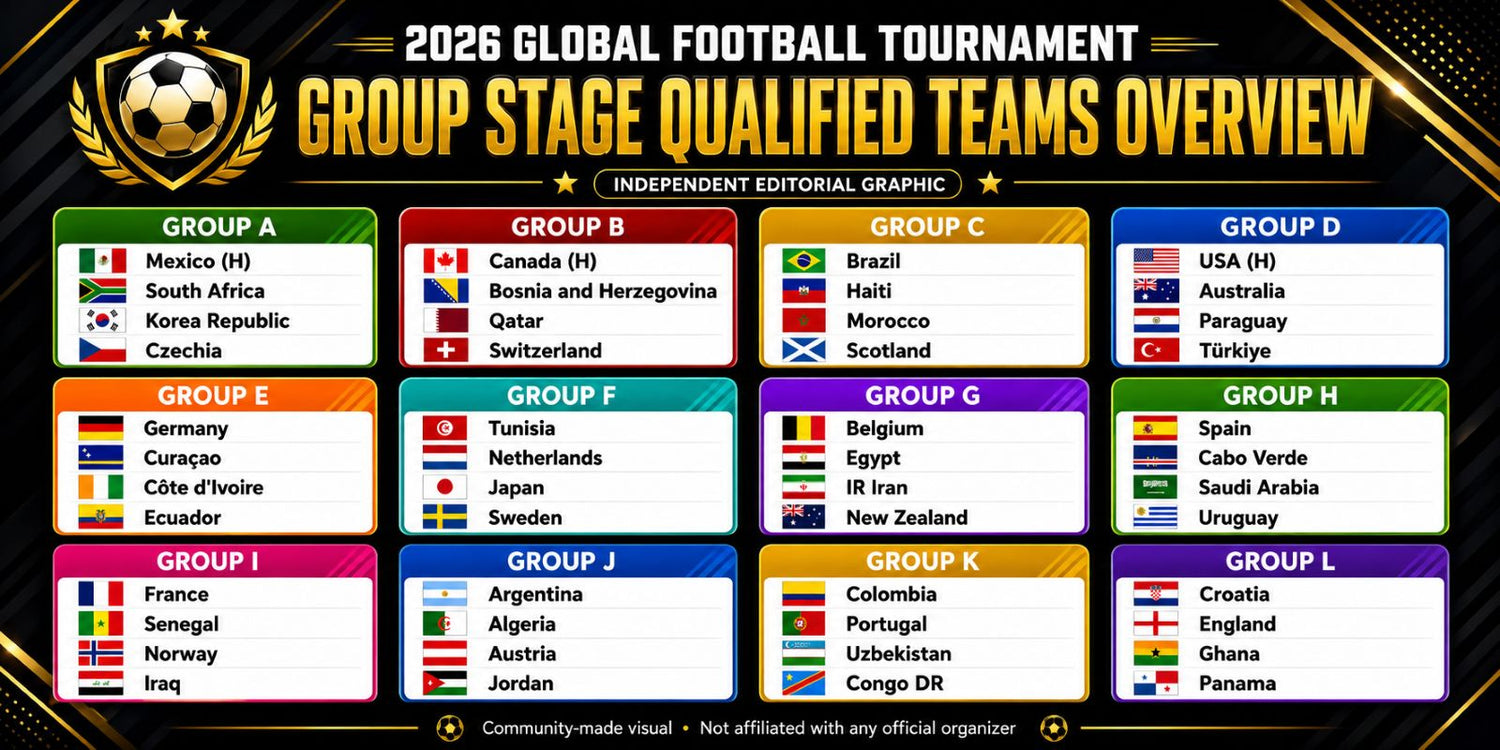
All 12 Groups
The final draw placed the 48 teams into 12 groups. Every team plays the other three teams in its group once.
| Group | Teams |
|---|---|
| Group A | Mexico, South Africa, Korea Republic, Czechia |
| Group B | Canada, Bosnia and Herzegovina, Qatar, Switzerland |
| Group C | Brazil, Morocco, Scotland, Haiti |
| Group D | United States, Australia, Paraguay, Türkiye |
| Group E | Germany, Ecuador, Côte d’Ivoire, Curaçao |
| Group F | Netherlands, Japan, Tunisia, Sweden |
| Group G | Belgium, IR Iran, Egypt, New Zealand |
| Group H | Spain, Uruguay, Saudi Arabia, Cabo Verde |
| Group I | France, Norway, Senegal, Iraq |
| Group J | Argentina, Austria, Algeria, Jordan |
| Group K | Portugal, Colombia, Uzbekistan, Congo DR |
| Group L | England, Croatia, Ghana, Panama |
Group position affects the Round of 32 pathway. Readers following qualification scenarios should use current official standings because points, goal difference and third placed rankings change during the group stage.
Debut Nations and Notable Returns
Four countries are appearing in the men’s tournament for the first time. Several others have returned after absences lasting multiple tournament cycles.
Four Debut Nations
- Cabo Verde: The island nation becomes a first time participant from Africa.
- Curaçao: Curaçao enters its first final tournament after qualifying through CONCACAF.
- Jordan: Jordan makes its first appearance after a breakthrough Asian qualifying campaign.
- Uzbekistan: Uzbekistan becomes the first Central Asian nation to qualify for the men’s tournament.
Notable Returning Nations
| Nation | Previous Appearance Context |
|---|---|
| Congo DR | Returns for the first time since 1974, when the team competed as Zaire. |
| Haiti | Returns for the first time since 1974. |
| Iraq | Returns after its previous appearance in 1986. |
| Norway | Returns for the first time since 1998. |
| Scotland | Returns for the first time since 1998. |
| Türkiye | Returns after its previous appearance in 2002. |
| Czechia | Returns after its previous appearance in 2006. |
| Bosnia and Herzegovina | Returns after making its first appearance in 2014. |
Iraq, Congo DR and Bosnia and Herzegovina should not be classified as debut nations. Each has prior tournament history under its current identity or a recognized predecessor identity.
Main Tournament Storylines
The larger field creates more group combinations and more advancement scenarios than previous editions. Several storylines are especially relevant when following the 48 teams.
- Argentina’s title defense: Argentina enters as the defending champion after winning the 2022 tournament.
- Three host campaigns: Canada, Mexico and the United States face the expectations that come with playing in their home countries.
- Four first appearances: Cabo Verde, Curaçao, Jordan and Uzbekistan provide new national and regional stories.
- Historic returns: Haiti, Congo DR, Iraq, Norway, Scotland and other returning teams end long tournament absences.
- Third placed qualification: Eight third placed teams advance, making every group result potentially important.
- Longer championship route: The eventual champion must navigate eight matches instead of seven.
This article does not rank teams or predict match outcomes. Its purpose is to provide a stable reference for the confirmed field, group draw and tournament structure.
How to Verify Updates
Team qualification and the final draw are complete, but schedules, standings and match information can still change. Readers should verify time sensitive details through the tournament organizer and authorized broadcasters.
- Qualified teams: Use the official organizer’s qualified teams page for the final participant list.
- Groups: Use the official final draw and group pages for confirmed group placement.
- Fixtures: Use the current official match schedule for dates, venues and match status.
- Standings: Use the official standings page during the group stage.
- Tickets: Use authorized ticketing channels and avoid unofficial sellers.
Editorial scope: This page independently summarizes publicly available tournament information. It does not reproduce an official schedule poster, broadcast graphic, match video, tournament logo, trophy image, official font or official visual system.
FAQs About 2026 Qualified Teams and Groups
How many teams qualified for the 2026 tournament?
The 2026 tournament has 48 qualified teams. They are arranged in 12 groups of four, with the top two teams in every group and the eight strongest third placed teams advancing to the Round of 32, creating a 32 team knockout field.
Which countries qualified automatically as 2026 host nations?
Canada, Mexico and the United States qualified automatically as host nations. The remaining places were earned through six confederation qualifying competitions and the intercontinental playoff tournament, producing the complete 48 nation field, with the three hosts assigned to Groups A, B and D.
Which teams are making their tournament debut in 2026?
Cabo Verde, Curaçao, Jordan and Uzbekistan are making their first appearances in the senior mens tournament. Iraq, Bosnia and Herzegovina and Congo DR are returning teams, because each nation or a recognized predecessor appeared in an earlier edition, making their qualification a comeback rather than a debut.
How does the 2026 tournament format work?
The tournament uses 12 groups of four teams. Every nation plays three group matches, then the top two teams from each group and the eight strongest third placed teams advance, followed by the Round of 32 and the remaining knockout rounds.
When did the 2026 tournament begin and when is the final?
The tournament began on June 11, 2026, at Mexico City Stadium. The final is scheduled for July 19, 2026, at New York New Jersey Stadium, with 104 matches staged across 16 host cities in Canada, Mexico and the United States.
How many qualified teams came from each confederation?
Asia has nine teams, Africa has ten, CONCACAF has six including the three hosts, South America has six, Oceania has one and Europe has sixteen. These totals reflect direct qualification and playoff results, together creating the complete 48 team field for the 2026 tournament.
Is Iraq a debut team in the 2026 tournament?
No. Iraq previously appeared in 1986, so its 2026 participation is a return rather than a debut. Bosnia and Herzegovina also appeared in 2014, while Congo DR previously competed as Zaire in 1974, so all three belong among the returning nations.
Where should readers verify schedule and standings changes?
Use the official tournament schedule, group pages and standings for live changes. This article is designed as a stable reference for qualified teams, confederation totals and the group draw, not as a live score or ticketing service, because fixtures and standings can change during the competition.
Conclusion
The 2026 field brings together 48 nations across 12 groups, including four debutants and several teams returning after long absences. The expanded Round of 32 means more teams remain in contention after the group stage.
Use this page for the confirmed team list and draw, then consult current organizer pages for live standings, schedule changes and match results. This article should be updated whenever a material fact changes.
Disclaimer
This article is an independent editorial resource provided for informational purposes. RitFit is not affiliated with, sponsored by, endorsed by, or an official partner of the tournament organizer, host committees, participating associations, broadcasters or commercial partners, and all third party names and trademarks belong to their respective owners.
References
- Official tournament organizer. Qualified teams for the 2026 men’s global football tournament. Updated March 31, 2026. Accessed June 15, 2026.
- Official tournament organizer. Final draw results for the 2026 men’s global football tournament. Updated May 5, 2026. Accessed June 15, 2026.
- Official tournament organizer. Match schedule, fixtures, results, teams and stadiums. Accessed June 15, 2026.