








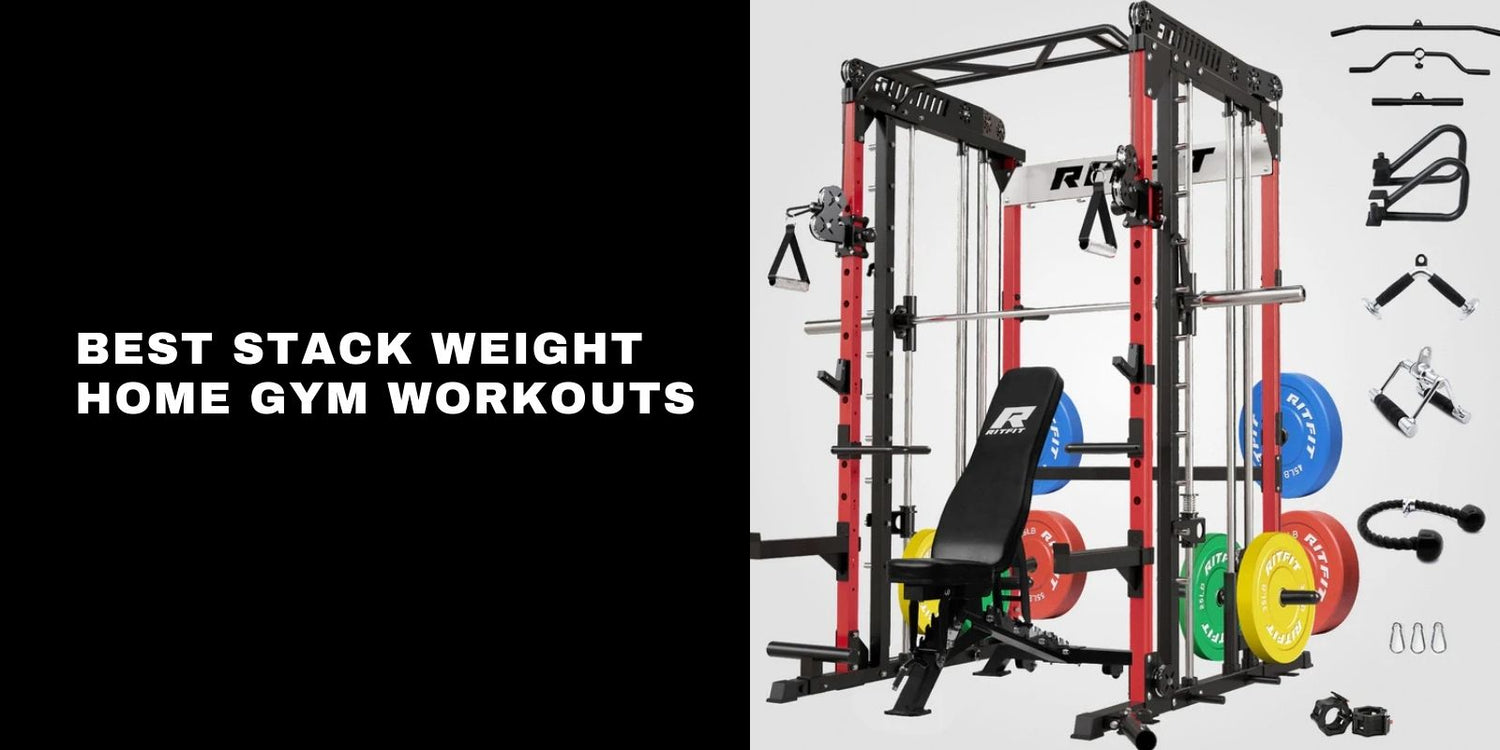
Mastering a stack weight home gym unlocks efficient, commercial-grade strength training within a compact footprint at home.
This comprehensive guide details 30 targeted cable and machine exercises across all major muscle groups, providing structured workout splits and safety principles for consistent gains.
Quick Answer: The best stack weight home gym workouts combine compound machine presses, lat pulldowns, cable rows, leg extensions, and functional core rotations into structured full-body splits. By adjusting the selector pin across targeted 8-to-12 rep sets with controlled eccentric tempos, lifters build balanced muscle mass and functional strength without requiring spotters or plate changes.
Key Takeaways
- Versatile Exercise Library: A single weight stack machine delivers over 30 targeted compound and isolation movements covering every major muscle group.
- Rapid Resistance Adjustment: Selectorized pin-loaded stacks enable instant resistance changes between sets, maximizing workout density and supporting seamless drop sets.
- Enhanced Solo Safety: Guided cable pathways and integrated weight stacks provide built-in safety mechanisms, eliminating the need for spotters during heavy lifting.
- Systematic Progression: Progressive overload is achieved by increasing repetitions and slowing eccentric tempo before advancing to heavier pin increments.
- Balanced Programming: Structuring sessions with one primary compound lift and one accessory isolation movement per muscle group optimizes hypertrophy and recovery.
How do stack weight home gyms optimize full-body workouts?
Stack weight home gyms optimize full-body strength training by combining multi-station pulleys, guided press arms, and selectorized weight stacks into a single space-saving footprint. This setup provides continuous cable tension throughout each repetition while eliminating the clutter and loading time of traditional barbell plates.
Modern all-in-one stations, such as our Smith machine and multi-gym collection, allow users to transition between muscle groups in seconds. The guided movement tracks reduce joint shear stress, making multi-gyms exceptionally accessible for solo training sessions at home.
- Smooth Cable Resistance: High and low pulley systems maintain constant muscular tension throughout both the lifting and lowering phases.
- Instant Pin Adjustments: Changing weight increments takes only seconds, making supersets and drop sets highly effective.
- Compact All-in-One Design: Multiple workout stations integrate into a unified footprint suitable for garage and basement gym spaces.
Investing in a dedicated system like the RitFit Buffalo Smith Machine home gym package with weight stack ensures commercial gym versatility without leaving your home.
"Just gotta put together haven't got to use it yet but so far I'm liking everything and their customer service is top-notch. They communicate with you quickly and efficiently. I can come back and give you more of a review after we've used it for a while."
Jacquelyn W. Verified Buyer, RitFit BUFFALO Smith Machine Home Gym Package with Weight Stack
What are the best upper body weight stack exercises?
The best upper body weight stack exercises target the chest, back, shoulders, and arms through guided compound presses and multi-angle cable pulls. These movements allow lifters to isolate specific muscle fibers safely under constant mechanical tension.
By adjusting handle heights and grip attachments on stations like the RitFit M1 Pro Smith Machine weight stack package, you can thoroughly stimulate every upper body muscle group.
A. Chest Exercises (5 Movements):
- 1. Seated Chest Press: Sit with your back flat against the backrest and press handles forward until arms extend fully without locking elbows.
- 2. Incline Chest Press: Adjust seat height lower or angle handles upward to emphasize clavicular upper chest fibers.
- 3. Cable Chest Fly: Use dual cable handles or the pec deck station, bringing hands together in a wide hugging arc to squeeze inner pecs.
- 4. Single-Arm Chest Press: Press one side independently from a seated position to correct unilateral strength imbalances and brace the core.
- 5. Low-Angle Cable Press: Stand facing away from the low pulley and press handles upward at a 45-degree angle to target upper chest fibers.
B. Back Exercises (6 Movements):
- 6. Lat Pulldown (Wide Grip): Grip the wide lat bar overhand and pull down to upper chest level while driving elbows downward.
- 7. Lat Pulldown (Close/Neutral Grip): Attach a V-handle to emphasize lower lat recruitment and increase bicep involvement.
- 8. Seated Cable Row: Brace feet against footplates with knees slightly bent and row the handle into your midsection while retracting shoulder blades.
- 9. Straight-Arm Pulldown: Keep elbows extended with a slight bend and pull the high cable bar down to your thighs in a sweeping arc.
- 10. Single-Arm Cable Row: Perform low pulley rows one arm at a time to maximize lat stretch and rotation control.
- 11. Face Pull: Pull a rope attachment toward eye level while externally rotating shoulders to strengthen rear delts and rotator cuffs.
C. Shoulder Exercises (4 Movements):
- 12. Seated Shoulder Press: Press overhead handles vertically upward to overload anterior and medial deltoids.
- 13. Cable Lateral Raise: Stand sideways to the low pulley and raise a single D-handle laterally to shoulder height.
- 14. Cable Front Raise: Face away from the low pulley and raise the cable attachment forward to eye level.
- 15. Reverse Cable Fly: Use crossed high pulleys or reverse pec deck arms to isolate posterior deltoids.
D. Arm Exercises (6 Movements):
- 16. Cable Biceps Curl: Stand facing the low pulley and curl a straight bar upward while pinning elbows against your ribs.
- 17. Single-Arm Cable Curl: Isolate each bicep individually using a single D-handle to ensure equal bilateral development.
- 18. Cable Hammer Curl: Attach a rope to the low pulley with neutral palms to target the brachialis and forearm muscles.
- 19. Triceps Pushdown: Push a high pulley bar or rope downward until elbows reach complete extension.
- 20. Overhead Cable Triceps Extension: Extend handles overhead from a high or low pulley to stretch and load the long head of the triceps.
- 21. Single-Arm Reverse Grip Pushdown: Use an underhand grip on the high cable to emphasize the medial triceps head.

Which lower body and core movements work best on a weight stack?
Lower body and core training on a weight stack machine centers around cable squats, Romanian deadlifts, leg extensions, and anti-rotation Pallof presses. Utilizing low and high pulley attachments ensures continuous muscular engagement across the entire range of motion.
These exercises integrate smoothly on versatile multi-gym units like the M1 multi-functional home gym, delivering comprehensive leg and abdominal stimulation.
A. Quads & General Leg Exercises (4 Movements):
- 22. Leg Extension: Sit securely with shins behind roller pads and extend knees fully to isolate quadriceps.
- 23. Cable Squat: Hold a low pulley straight bar at chest height and squat deeply while resisting downward cable pull.
- 24. Cable Split Squat: Hold a low cable handle in one hand and perform stationary lunges to challenge single-leg stability.
- 25. Machine Hack Squat: Lean against the machine support pad and perform deep squats with guided back stability.
B. Hamstrings & Glute Exercises (3 Movements):
- 26. Standing Leg Curl: Hook one ankle behind the lower roller pad and curl heel toward glutes to isolate hamstrings.
- 27. Cable Romanian Deadlift (RDL): Straddle a low pulley rope and hinge backward at hips while maintaining a flat back.
- 28. Cable Pull-Through: Face away from the low pulley and hinge through hips, squeezing glutes hard at lockout.
C. Calf Exercise (1 Movement):
- 29. Standing Cable Calf Raise: Stand on an elevated block holding low pulley handles and elevate onto toes against resistance.
D. Core & Functional Exercises (3 Movements):
- 30. Cable Woodchopper: Rotate torso diagonally from high to low or low to high to build rotational core power.
- 31. Cable Pallof Press: Stand perpendicular to the cable stack and press the handle outward, resisting rotational torque.
- 32. Kneeling Cable Crunch: Kneel facing the high pulley with a rope behind neck and flex abs to curl torso downward.
How should you structure a full-body weight stack workout routine?
Structuring a weight stack routine requires pairing complementary movement patterns across a 3-day full-body or 4-day upper-lower training split. Rotating primary compound presses with targeted isolation work maximizes weekly training frequency while allowing adequate muscular recovery.
Following a structured plan like our full body Smith machine workout routine ensures balanced muscle growth across all major muscle groups.
| Workout Split | Target Experience Level | Weekly Frequency | Sample Exercise Selection |
|---|---|---|---|
| 3-Day Full-Body | Beginner to Intermediate | 3 days / week (Mon/Wed/Fri) | Chest Press, Lat Pulldown, Cable Squat, Triceps Pushdown, Cable Crunch |
| Upper / Lower Split | Intermediate to Advanced | 4 days / week (2 Upper, 2 Lower) | Incline Press, Cable Row, Leg Extension, Cable RDL, Pallof Press |
| Time-Saver Circuit | All Levels (Fast Conditioning) | 2-3 days / week (20-30 mins) | Tri-sets: Press + Row + Squat with minimal rest between stations |
Program parameters based on 8-12 rep hypertrophy ranges with 60-90 seconds rest between working sets.
How do you progress safely on a weight stack home gym?
Safe progression on a weight stack machine relies on mastering strict movement tempo and completing target rep ranges before adding pin weight. Maintaining a neutral spine and keeping 1 to 3 reps in reserve protects connective tissue during intense training cycles.
For advanced trainees requiring greater resistance, upgrading with RitFit weight stack expansion sets provides heavy overloading capacity.
- Master Movement Control: Prioritize a 2-3 second eccentric lowering phase on every rep before increasing load.
- Increase Repetitions First: Reach the upper limit of your rep target across all working sets before moving the selector pin.
- Inspect Cable Hardware: Check pulleys and cables regularly for fraying or tension loss to maintain peak safety.
Documenting your training weights and rep counts each week creates measurable accountability and long-term strength progress.
"The Smith machine is a great tool for hypertrophy training because it allows you to safely push to failure without a spotter. At medium intensities typically employed in hypertrophy training, the counterweighted Smith machine design offers the best choice in terms of high-force development and total external work performed."
Dr. Mike Israetel, PhD in Sport Physiology, Renaissance Periodization, Smith Machine Research / RP Strength
FAQs About Stack Weight Home Gym Workouts
Whether a stack-weight home gym can build real muscle.
Yes, a weight stack multi-gym can build muscle when you train close enough to failure and progress weekly. Use mostly 8 to 12 reps with 1 to 3 reps in reserve; add reps first, then add one pin; log every session; and keep tempo controlled for consistency.
Whether the stack number equals the real resistance at the handle.
No, the stack label often reflects the plates, not always the exact handle load, because pulley ratios and routing change felt resistance. Track progress on the same machine using reps, effort, and tempo; compare your own numbers over time; and treat cross-machine comparisons as unreliable.
What to do when a listed exercise does not fit a specific multi-gym design.
Use a safer alternative that keeps the same movement pattern, not the exact setup. If shoulder press stations feel awkward, do half-kneeling single-arm cable presses. If hack squat setups feel unstable, use cable squats or split squats, then slow the lowering to keep it challenging.
How to choose between weight stacks and plate-loaded systems for home use.
Weight stacks usually win for speed, smoothness, and drop set convenience, which supports consistency at home. Plate loaded can be cheaper but slower to adjust and often less friendly for circuits. If you buy a stack, prioritize enough effective resistance for rows and pulldowns and manageable weight jumps.
How to stay safe and avoid joint pain while training on a multi-gym.
Safety comes from a stable setup and strict form; keep the spine neutral, ribs stacked, and shoulders down on pulls and presses. Stop for sharp pain, numbness, tingling, or joint catching. Use controlled ranges, avoid bouncing, keep 1 to 3 reps in reserve on big moves, and progress gradually.
Conclusion
A stack weight home gym provides a versatile, safe, and efficient platform for building total-body strength and lean muscle mass at home. By mastering these 30 foundational cable and machine exercises, you can consistently challenge every muscle group with optimal mechanical tension.
Upgrade your home training setup today by exploring our RitFit discount guide to find the best deals on multi-gym stations and accessories.
Disclaimer
This article is for general educational and informational purposes only and does not substitute for professional medical or fitness advice. Consult a qualified healthcare provider before beginning any new exercise routine, and immediately discontinue any movement that causes pain or sharp discomfort.





