








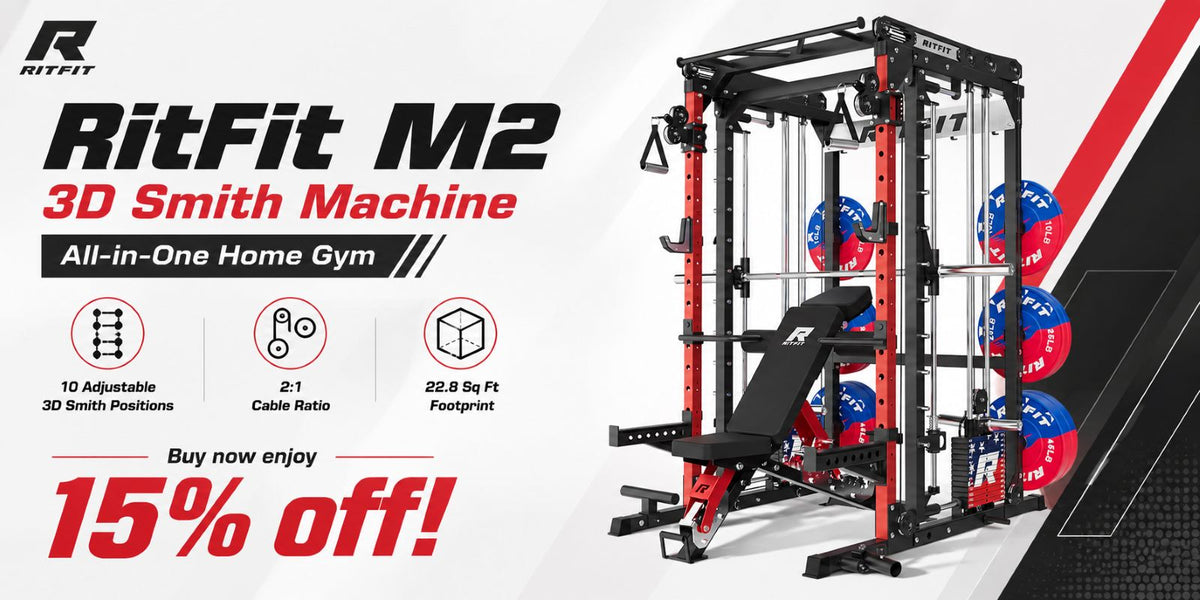
A 3D Smith machine combines guided bar control with controlled front-to-back travel, giving home gym lifters more movement freedom than a traditional fixed-rail Smith machine. This guide explains how the design works, which exercises suit it, and where the RitFit M2 fits into a home setup.
The article is intended for home lifters comparing equipment or building a safer full-body routine. Beginners should master basic squats, hinges, rows, presses, and safety settings before attempting advanced power movements.
Quick Answer: A 3D Smith machine guides the bar vertically while permitting controlled front-to-back travel. The design feels less restrictive than a traditional Smith machine while retaining hooks and safety stops, making it useful for home lifters who want guided strength training without a completely fixed bar path.
Key Takeaways
- More adaptable bar path: A 3D Smith machine adds controlled front-to-back travel to a guided vertical system, making squats, hinges, and presses feel less restrictive.
- Guided solo training: Hooks, rails, and safety stops support controlled training when no spotter is available.
- Broad exercise selection: The format supports squats, hinges, presses, rows, hip thrusts, and selected isolation movements across one station.
- Different from free weights: A 3D Smith machine still reduces some balance and stabilization demands compared with a free barbell.
- Setup remains essential: Correct safety height, bar alignment, clearance, and load progression matter on every exercise.
Why Consider a 3D Smith Machine for a Home Gym?
A 3D Smith machine is worth considering when you want guided solo training without being limited to a strictly vertical bar path. It provides a practical middle ground between a traditional Smith machine and an unrestricted free barbell, combining safety features with more natural movement patterns.
Traditional Smith rails can be useful for stability, but some lifters find a single fixed path restrictive during squats, hinges, rows, and presses. A 3D format adds controlled horizontal movement while retaining the guided features found across the RitFit Smith machine collection.
"The Smith machine is a great tool for hypertrophy training because it allows you to safely push to failure without a spotter. At medium intensities typically employed in hypertrophy training, the counterweighted Smith machine design offers the best choice in terms of high-force development and total external work performed."
Dr. Mike Israetel, PhD, Sport Physiology, Co-founder, Renaissance Periodization
What Is a 3D Smith Machine?
A 3D Smith machine is a guided resistance system that permits vertical movement and controlled front-to-back bar travel. The bar remains attached to rails, so the machine does not provide the unrestricted movement of a free barbell, but it does offer more freedom than a traditional fixed-path Smith.
- Vertical guidance: The rails help control the bar during the lifting and lowering phases.
- Horizontal adjustment: Controlled front-to-back travel allows the bar to follow a less rigid path.
- Integrated reracking: Rotating hooks allow the lifter to secure the bar at available rack positions.
- Adjustable safety stops: Correctly positioned safeties can limit the lowest point of a failed repetition.
- Reduced balance demand: The guided system generally requires less total bar stabilization than a free barbell.
New users should first learn bar alignment, reracking, safety placement, and empty bar movement. The guide on how to use a Smith machine at home provides a practical starting point.
What Sets a 3D Smith Machine Apart?
A 3D Smith machine differs from a traditional Smith by allowing controlled horizontal travel in addition to vertical guidance. Squat mechanics can change with stance, trunk angle, joint mobility, and load, which is one reason a single fixed path may not suit every lifter or variation.[1]
Machine training and free weight training can both support strength and hypertrophy when programs are appropriately designed. Strength improvements remain partly specific to the equipment and movement pattern used during training.[2]
| Feature | Traditional Smith | 3D Smith | Free Barbell |
|---|---|---|---|
| Bar path | Fixed guided path | Vertical guidance with controlled front-to-back travel | Unrestricted movement in multiple planes |
| Balance demand | Lower | Moderate | Higher |
| Reracking | Integrated hooks | Integrated hooks | Requires rack hooks or assistance |
| Safety stops | Usually integrated | Usually integrated | Depends on the rack setup |
| Common use | Guided compound and isolation exercises | Hybrid strength and hypertrophy training | Sport-specific barbell skill and unrestricted lifting |
Comparison of bar path, stability demand, safety features, and common home gym uses across three equipment types.
The best option depends on training experience, available space, exercise selection, and whether you regularly train alone. A broader comparison is available in the guide to Smith machine vs power rack.
What Are the Key Features of the RitFit M2?
The RitFit M2 combines a 3D Smith system, power rack, cable crossover, pull-up station, low row, landmine, and storage in one home gym platform. Its 10 adjustable 3D Smith positions, 2,000 lb listed capacity, and 2:1 cable pulley ratio support a wide range of strength and hypertrophy exercises in a single footprint.
| Specification | RitFit M2 Listed Detail |
|---|---|
| Rack dimensions | 78.7 inches long, 68.75 inches wide, 86.14 inches high |
| Listed footprint | 22.8 square feet |
| Listed maximum weight | 2,000 pounds |
| 3D Smith positions | 10 adjustable positions |
| Cable pulley ratio | 2 to 1 |
| Smith bar weight | 33 pounds |
| Upright construction | 2.36 by 2.36 by 0.08 inch, 13 gauge steel |
| Storage | Six plate storage pegs and four accessory hooks |
Manufacturer-listed RitFit M2 specifications checked on July 15, 2026. Values may vary by configuration or future product revision.
- Compact equipment ecosystem: Multiple strength stations share one frame, reducing the need for separate racks and cable machines.
- Modular configurations: Buyers can choose basic Smith, 3D Smith, weight stack, and combined configurations according to current availability.
- Cable training: Adjustable pulleys support rows, flyes, pulldowns, curls, extensions, and core exercises.
- Rack training: J-hooks and safety arms support conventional rack exercises outside the Smith rails.
- Storage integration: Plate pegs and accessory hooks keep frequently used equipment on the frame.
Buyers comparing complete stations can also review the best multi-function Smith machine for a home gym and the guide to a functional trainer with a Smith machine.
What Are the 5 Best 3D Smith Machine Exercises?
The most practical 3D Smith machine exercises are back squats, split squats, good mornings, incline presses, and hip thrusts. These movements benefit from guided control while allowing the bar to adjust to the lifter's position more naturally than a fully fixed path.
1. 3D Smith Back Squat
The 3D Smith back squat trains the quads, glutes, adductors, and trunk while allowing controlled bar travel over the base of support. Set the safeties just below the lowest controlled squat position before adding working weight.
- Setup: Position the bar across the upper traps and place the feet where the bar remains balanced over the midfoot.
- Execution: Brace the trunk, sit between the hips, maintain foot pressure, and stand without allowing the knees to collapse inward.
- Programming: Use 3 to 4 sets of 5 to 10 repetitions with 1 to 3 repetitions in reserve.
- Common error: Do not force a stance that causes the heels to lift or the lower back to lose control.
2. 3D Smith Split Squat
The 3D Smith split squat trains each leg independently and can reduce the balance limitation that often restricts free weight loading. The horizontal travel lets the bar move with the torso as the rear knee lowers toward the floor.
- Setup: Use a stance long enough to keep the front foot planted and the rear hip comfortable.
- Execution: Lower under control, keep the front knee tracking over the toes, and drive through the full front foot.
- Programming: Use 2 to 4 sets of 8 to 12 repetitions per side.
- Common error: Avoid placing the feet so close together that the front heel rises during the descent.
3. 3D Smith Good Morning
The 3D Smith good morning trains the hamstrings, glutes, spinal erectors, and upper back through a controlled hip hinge. Load affects good morning kinematics and muscle activity, so technique should remain stable before resistance increases.[4]
- Setup: Place the bar securely across the upper traps and set the safeties above the deepest intended hinge position.
- Execution: Keep soft knees, push the hips backward, maintain a controlled spine position, and stop when hamstring tension limits further movement.
- Programming: Use 2 to 4 sets of 6 to 10 repetitions with conservative loading.
- Common error: Do not chase depth by rounding the lower back or allowing the bar to drift away from the body.
4. 3D Smith Incline Press
The 3D Smith incline press trains the upper chest, front deltoids, and triceps while allowing the guided bar to adjust slightly as it approaches the upper torso. A stable bench and correctly positioned safeties are essential before loading the movement.
- Setup: Center the bench, place the bar above the upper chest, and test the path with an unloaded or lightly loaded bar.
- Execution: Keep the shoulder blades supported, lower the bar under control, and press without lifting the hips from the bench.
- Programming: Use 3 to 4 sets of 6 to 12 repetitions.
- Common error: Avoid placing the bench too far forward or backward, which can create an uncomfortable shoulder path.
5. 3D Smith Hip Thrust
The 3D Smith hip thrust is a glute-focused exercise that benefits from a stable bench and guided bar control. Barbell hip thrust research consistently identifies substantial glute involvement, although exercise selection should still reflect the lifter's goals and tolerance.[3]
- Setup: Support the upper back on a stable bench and place a padded bar across the hip crease.
- Execution: Drive through the feet, extend the hips, keep the ribs controlled, and avoid excessive lower back extension.
- Programming: Use 3 to 4 sets of 8 to 15 repetitions.
- Common error: Do not place the feet so far away that the hamstrings dominate every repetition.
New lifters can learn the hinge through the Smith machine Romanian deadlift. More detailed glute setup guidance is available in the Smith machine hip thrust guide.
How Should You Set Up a 3D Smith Machine Safely?
Safe 3D Smith machine training starts with clearance, safety stop placement, empty bar rehearsal, and gradual loading. The added bar travel does not remove the need for stable equipment, controlled technique, and appropriate exercise selection.
- Check the training area: Leave space for plates, a bench, attachments, walking paths, and emergency exit access.
- Inspect the machine: Confirm that bolts, hooks, rails, cables, safeties, and attachments are secure before training.
- Set the safety height: Place safeties just below the lowest controlled position for squats and presses.
- Test the bar path: Perform several unloaded repetitions to confirm that the bench, feet, and bar remain aligned.
- Add load gradually: Increase resistance only when the previous load can be controlled through the intended range of motion.
- Stop when control changes: End the set if the bar path becomes unpredictable, the safeties move, or sharp pain occurs.
- Delay advanced lifts: Cleans and overhead squats require mobility, timing, and technical experience, even on a guided system.
What Is a Practical Full Body 3D Smith Machine Workout?
A practical full-body 3D Smith workout should include a squat, press, row, hip extension movement, and unilateral leg exercise. Perform the session once or twice per week with at least one recovery day between sessions, using controlled repetitions and stopping most working sets with one to three repetitions still available.
Warm Up
The warm-up should increase body temperature and rehearse the exact movement paths used in the session. Avoid turning the warm-up into a separate high-fatigue workout.
- General movement: Complete 3 to 5 minutes of walking, cycling, or rowing.
- Dynamic preparation: Use bodyweight squats, hip hinges, arm circles, and controlled lunges.
- Specific preparation: Perform 2 to 4 progressively heavier warm-up sets before the first squat and press work sets.
Workout Structure
Use controlled repetitions and stop most working sets with 1 to 3 repetitions still available. Rest longer after compound exercises and shorten rest only when technique remains stable.
| Exercise | Sets | Repetitions | Rest |
|---|---|---|---|
| 3D Smith Back Squat | 3 to 4 | 5 to 8 | 2 to 3 minutes |
| 3D Smith Incline Press | 3 | 6 to 10 | 90 to 120 seconds |
| 3D Smith Bent Over Row | 3 | 8 to 12 | 90 to 120 seconds |
| 3D Smith Hip Thrust | 3 | 8 to 12 | 90 seconds |
| 3D Smith Split Squat | 2 | 8 to 10 per side | 60 to 90 seconds |
| Cable Curl or Triceps Extension | 2 | 10 to 15 | 60 seconds |
Sample full-body 3D Smith machine session for general strength and hypertrophy.
Increase repetitions within the listed range before adding weight. Reduce the load or range of motion when the bar path, joint position, or safety setup becomes inconsistent.
FAQs About 3D Smith Machines
What is a 3D Smith machine and how is it different from a regular Smith machine?
A 3D Smith machine guides the bar vertically while allowing controlled front to back travel. A regular Smith machine usually follows one fixed rail path. The additional travel can make squats, hinges, presses, and rows feel less restrictive while retaining hooks, rails, and adjustable safety stops.
Is a 3D Smith machine better than free weights for home workouts?
No. A 3D Smith machine is not automatically better than free weights. It can be more practical for solo training, controlled repetitions, and compact home gyms, while free weights demand more balance and bar control. Many lifters benefit from using both formats for different training goals.
Can beginners use a 3D Smith machine safely?
Yes. Beginners can use a 3D Smith machine safely when they start with light resistance, set the safety stops correctly, and rehearse each movement before adding load. Squats, rows, presses, and hip thrusts are sensible starting options. Technical power movements should wait until basic control is consistent.
Which 3D Smith machine exercises are best for glutes and legs?
Back squats, split squats, hip thrusts, Romanian deadlifts, and good mornings are useful 3D Smith machine exercises for glutes and legs. The guided system adds stability, while controlled front to back travel can help lifters maintain a practical bar position through squatting and hinging patterns.
How much space do you need for a 3D Smith machine at home?
You need room for the listed machine footprint plus clearance for plates, a bench, attachments, and safe movement around the frame. The RitFit M2 product page lists a 22.8 square foot footprint. Measure the full room, ceiling height, doors, and assembly path before ordering.
Should beginners do cleans and overhead squats on a 3D Smith machine?
No. Beginners should not make cleans or overhead squats their first 3D Smith machine exercises. Both movements require mobility, timing, and strong positional control. Start with squats, rows, presses, hinges, and hip thrusts, then consider advanced variations only after qualified coaching and consistent technical practice.
Conclusion
A 3D Smith machine can provide guided safety, controlled horizontal bar travel, and broad exercise variety in one home gym station. The format is most useful when you value solo training and a less restrictive path than a traditional Smith machine.
Start with basic squats, hinges, presses, rows, and hip thrusts, then progress load only after the bar path and safety setup remain consistent. Browse the RitFit Smith machine collection to compare models and find the right fit for your space, or check the current RitFit deals for available discounts.
Disclaimer
This article is for educational purposes and does not replace medical advice or individualized coaching. Stop any exercise that causes sharp pain, numbness, dizziness, or loss of control, and consult a qualified clinician or coach before training if you are recovering from injury or managing a joint, spine, or cardiovascular condition.
References
1. Straub RK, Powers CM. A Biomechanical Review of the Squat Exercise: Implications for Clinical Practice. Int J Sports Phys Ther. 2024;19(4):490-501. doi:10.26603/001c.94600. PMCID: PMC10987311
2. Haugen ME, Varvik FT, Larsen S, Haugen AS, van den Tillaar R, Bjornsen T. Effect of free-weight vs machine-based strength training on maximal strength, hypertrophy and jump performance: a systematic review and meta-analysis. BMC Sports Sci Med Rehabil. 2023;15:103. doi:10.1186/s13102-023-00713-4. PMCID: PMC10426227
3. Krause Neto W, Vieira TL, Gama EF. Barbell Hip Thrust, Muscular Activation and Performance: A Systematic Review. J Sports Sci Med. 2019;18(2):198-206. PMCID: PMC6544005
4. Vigotsky AD, Harper EN, Ryan DR, Contreras B. Effects of load on good morning kinematics and EMG activity. PeerJ. 2015;3:e708. doi:10.7717/peerj.708. PMCID: PMC4304869





