A four day workout split is one of the most practical ways to build muscle because it combines hard training with enough recovery to adapt. This guide gives you a complete weekly routine, progression method, nutrition basics, recovery rules, and home gym setup advice for consistent hypertrophy.
Table of Contents
- What Is a Four Day Workout Split?
- Why Training Four Days a Week Works for Muscle Growth
- How to Organize Your Training Days
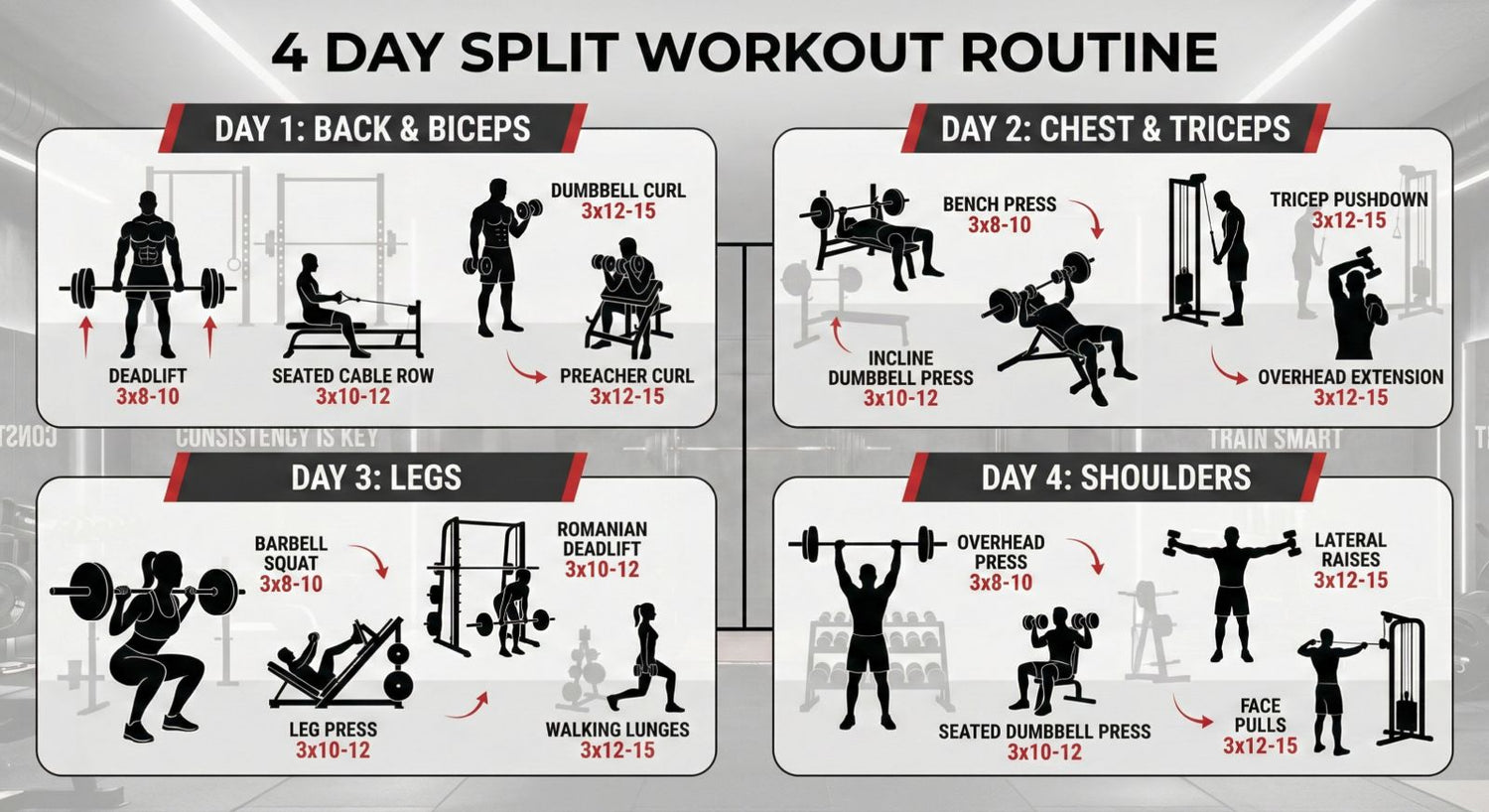
- The Maximum Mass Routine: Day by Day
- Minimum Four Day Split for Busy Weeks
- Who Benefits Most From This Style?
- Who Should Not Use This Four Day Split?
- How to Progress: The Secret to Growth
- Eating for Size
- Recovery: Sleep and Deloads
- Common Mistakes That Kill Gains
- Home Gym Equipment for a Four Day Split
Key Takeaways
- A four day workout split works well for muscle growth because it balances hard training, weekly volume, and recovery.
- The routine is best for lifters who already know basic lifting form and want a repeatable hypertrophy schedule.
- Use 1 to 3 reps in reserve on most sets instead of forcing every set to failure.
- Progress with double progression by adding reps first, then adding weight when all sets reach the top of the range.
- Stop training and seek professional advice if you feel sharp joint pain, chest pain, dizziness, numbness, tingling, or sudden weakness.
What Is a Four Day Workout Split?
A four day workout split is a weekly strength routine that divides your training into four focused sessions. It lets you train each muscle group with enough effort while keeping three days open for recovery, work, family, and life.
The most common setup is Monday, Tuesday, Thursday, and Friday. This rhythm gives you two training days, one rest day, two training days, and two weekend recovery days.
The goal is not to do more work than everyone else. The goal is to do enough high quality work, recover from it, and repeat it long enough to build visible muscle.
Why Training Four Days a Week Works for Muscle Growth
Training four days a week works because it gives most lifters enough weekly volume without turning recovery into the limiting factor. A large review found that resistance training prescriptions can improve both strength and hypertrophy, with load, sets, and frequency all playing important roles in the final result.[1]
The Recovery Advantage
Muscle growth happens when hard training is followed by enough food, sleep, and recovery time. A four day split helps you train hard without stacking heavy fatigue every day of the week.
- Better session quality: You can focus on fewer sessions and push the key lifts with better attention.
- Lower schedule pressure: You do not need to be in the gym six days per week to make progress.
- More recovery windows: Rest days give joints, connective tissue, and the nervous system more time to settle before the next hard session.
Training Volume Without Burnout
Weekly training volume matters for hypertrophy, but more work only helps when you can recover from it. In trained men, higher resistance training volume increased hypertrophy more than lower volume, but the practical takeaway is to increase sets gradually instead of adding junk volume everywhere.[2]
- Start conservative: Use the listed sets first before adding extra exercises.
- Track performance: Add volume only if strength, reps, and recovery are still moving in the right direction.
- Protect recovery: If sleep, appetite, and joints are suffering, reduce accessory work before changing the whole program.
Better Fit for Real Life
A four day split is easier to repeat because it respects work, commuting, family time, and stress. Consistency matters more than creating a perfect plan that collapses after two weeks.
How to Organize Your Training Days
You can organize a four day split as a body part split or an upper lower split. Both can work when total hard sets, exercise selection, progression, and recovery are managed well.
Option A: Body Part Split
A body part split gives each session a narrow focus so you can train a target area with more local volume. It is often easier for lifters who enjoy bodybuilding style training and want clear muscle group priorities.
| Day | Focus | Main Muscles |
|---|---|---|
| Monday | Back and Biceps | Lats, upper back, biceps, forearms |
| Tuesday | Chest and Triceps | Chest, front delts, triceps |
| Wednesday | Rest | Walking, mobility, food, sleep |
| Thursday | Legs | Quads, hamstrings, glutes, calves |
| Friday | Shoulders | Side delts, rear delts, traps, posture muscles |
| Saturday | Rest | Recovery |
| Sunday | Rest | Recovery |
Option B: Upper Lower Split
An upper lower split trains the upper body twice and the lower body twice each week. It is a strong choice for lifters who want more frequent practice on big lifts.
| Day | Focus | Main Muscles |
|---|---|---|
| Monday | Upper Body | Chest, back, shoulders, arms |
| Tuesday | Lower Body | Quads, hamstrings, glutes, calves, core |
| Wednesday | Rest | Recovery |
| Thursday | Upper Body | Chest, back, shoulders, arms |
| Friday | Lower Body | Quads, hamstrings, glutes, calves, core |
| Saturday | Rest | Recovery |
| Sunday | Rest | Recovery |
This guide uses the body part split because it matches the goal of focused hypertrophy, simple scheduling, and strong session identity. If you prefer training each muscle twice weekly, use the upper lower table instead.
The Maximum Mass Routine: Day by Day
This four day routine uses compound lifts first and accessory work second. Start each session with 5 to 8 minutes of movement prep, then use warm up sets before your first heavy working set.
Day 1: Back and Biceps
Back and biceps day builds pulling strength, upper back thickness, lat width, and arm size. Keep the heavy hinge optional if your lower back is still tired from leg training.
| Order | Exercise | Sets | Reps | Purpose |
|---|---|---|---|---|
| 1 | Deadlift or Rack Pull | 2 to 3 | 3 to 6 | Builds full body pulling strength when recovery allows. |
| 2 | Barbell Row | 3 to 4 | 8 to 10 | Builds mid back thickness and pulling strength. |
| 3 | Lat Pulldown | 3 | 10 to 12 | Targets the lats for back width. |
| 4 | Cable Row | 3 | 10 to 15 | Trains the mid back with controlled tension. |
| 5 | Barbell Curl | 3 | 8 to 10 | Builds heavy elbow flexion strength. |
| 6 | Hammer Curl | 2 to 3 | 10 to 12 | Targets the brachialis and forearms. |
- Warm up: Use arm circles, band pull aparts, and two light ramp up sets before heavy rows or pulls.
- Pulling cue: Pull with your elbows and keep your ribs down to reduce lower back swinging.
- Home gym note: A cable station or lat pulldown cable attachment setup can support pulldowns, rows, curls, and face pulls in one training space.
Day 2: Chest and Triceps
Chest and triceps day trains horizontal pressing, upper chest, chest isolation, and elbow extension. Keep shoulder comfort first by using controlled reps and stopping before form breaks.
| Order | Exercise | Sets | Reps | Purpose |
|---|---|---|---|---|
| 1 | Bench Press | 3 to 4 | 6 to 8 | Builds pressing strength and chest size. |
| 2 | Incline Dumbbell Press | 3 | 8 to 10 | Targets the upper chest with a natural arm path. |
| 3 | Chest Flye | 2 to 3 | 12 to 15 | Adds chest isolation with lighter joint stress. |
| 4 | Dips or Assisted Dips | 2 to 3 | 8 to 12 | Trains lower chest and triceps if shoulders feel good. |
| 5 | Skullcrusher | 2 to 3 | 10 to 12 | Builds triceps through loaded elbow extension. |
| 6 | Rope Pushdown | 3 | 12 to 15 | Finishes the triceps with controlled cable tension. |
- Bench cue: Set your shoulder blades, keep your feet planted, and lower the bar under control.
- Incline cue: Use a low to moderate incline so the chest remains the main target instead of the front delts.
- Equipment note: A stable RitFit GATOR adjustable weight bench supports flat and incline pressing variations for this session.
Day 3: Rest
Rest day helps you recover from two demanding upper body sessions. Walk, eat enough protein and carbohydrates, hydrate, and avoid turning rest day into a hidden fifth workout.
Day 4: Legs
Leg day builds lower body size, strength, and balance across the quads, hamstrings, glutes, and calves. Use safe depth, controlled tempo, and equipment that lets you train hard without losing position.
| Order | Exercise | Sets | Reps | Purpose |
|---|---|---|---|---|
| 1 | Squat or Smith Machine Squat | 3 to 4 | 6 to 8 | Builds quads, glutes, and full body bracing strength. |
| 2 | Leg Press | 3 | 10 to 12 | Adds leg volume with more external stability. |
| 3 | Romanian Deadlift | 3 | 8 to 10 | Trains hamstrings and glutes through a hip hinge. |
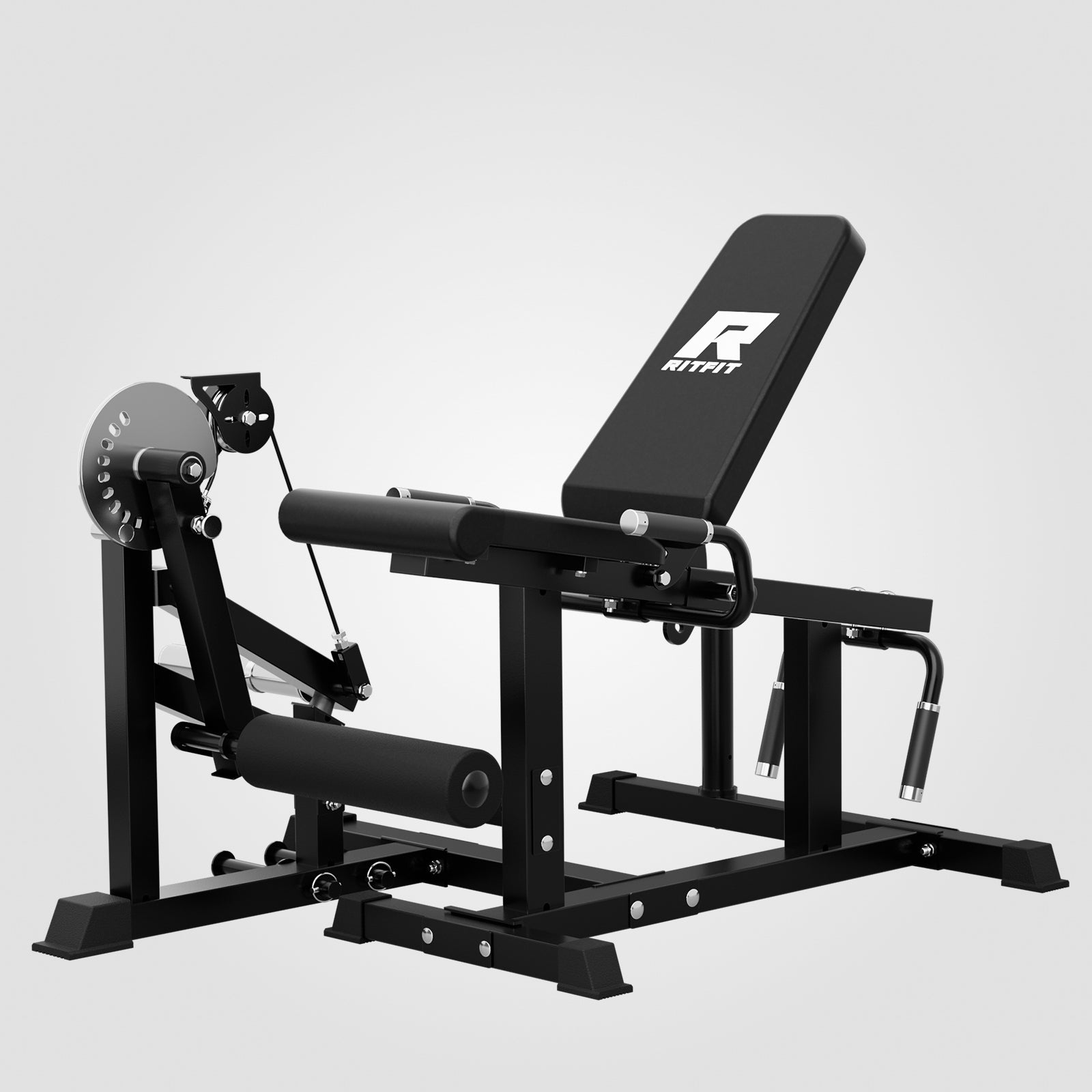
| 4 | Leg Curl | 2 to 3 | 12 to 15 | Adds direct hamstring work. |
| 5 | Calf Raise | 3 to 4 | 10 to 20 | Builds calves with full stretch and controlled reps. |
- Squat cue: Brace before each rep, keep your heels down, and use a depth you can control.
- Leg press cue: Keep your hips down and avoid locking your knees hard at the top.
- Equipment note: A RitFit GAZELLE PRO leg press and hack squat machine can support leg press, hack squat, and calf raise variations for home training.
Day 5: Shoulders
Shoulder day builds width, rear delt balance, trap strength, and posture support. Use clean reps because the shoulder joint does not reward sloppy loading.
| Order | Exercise | Sets | Reps | Purpose |
|---|---|---|---|---|
| 1 | Overhead Press | 3 to 4 | 6 to 8 | Builds shoulder and pressing strength. |
| 2 | Dumbbell Side Raise | 3 to 4 | 12 to 15 | Targets side delts for shoulder width. |
| 3 | Rear Delt Flye | 3 | 15 to 20 | Builds rear delts and shoulder balance. |
| 4 | Dumbbell Shrug | 3 | 10 to 12 | Trains the upper traps. |
| 5 | Face Pull | 3 | 15 to 20 | Supports rear delt strength and shoulder positioning. |
- Press cue: Brace your ribs down and avoid turning the lift into a lower back extension.
- Raise cue: Lead with the elbows and stop when the shoulders reach a comfortable height.
- Dumbbell note: A set of RitFit rubber hex dumbbells supports side raises, rear delt flyes, shrugs, curls, and accessory work.
Minimum Four Day Split for Busy Weeks
The minimum version keeps the main stimulus while cutting nonessential volume. Use it when work, travel, family, or recovery problems make the full routine unrealistic.
| Day | Minimum Workout | Goal |
|---|---|---|
| Back and Biceps | Row, pulldown, curl | Keep pulling volume and arm work. |
| Chest and Triceps | Bench press, incline press, pushdown | Keep pressing volume and triceps work. |
| Legs | Squat or leg press, Romanian deadlift, calf raise | Keep lower body strength and hinge work. |
| Shoulders | Overhead press, side raise, face pull | Keep shoulder strength and joint balance. |
If you only have 35 to 45 minutes, reduce accessory sets before cutting warm ups or technique quality. A shorter completed week beats a perfect plan that never happens.
Who Benefits Most From This Style?
This four day workout split is best for lifters who want muscle growth without training every day. It is especially useful for busy adults, natural lifters, and home gym users who need a repeatable weekly structure.
- Busy professionals: Four sessions are easier to schedule than five or six, especially around work and family.
- Natural lifters: The plan gives more recovery space than high frequency bodybuilding schedules.
- Home gym users: A planned split helps you train consistently without waiting for commercial gym equipment.
- Intermediate lifters: The routine works best after you already understand basic lifting form.
Who Should Not Use This Four Day Split?
This four day split is not ideal for complete beginners who have not learned safe squat, hinge, press, and row mechanics. It is also not appropriate for anyone training through pain, recovering from injury, or lacking safe equipment for heavy lifts.
- Complete beginners: Start with a basic full body plan if you need more practice with core movement patterns.
- Injured lifters: Get medical or coaching guidance before loading painful joints or recently injured areas.
- Solo heavy lifters: Use safeties, spotter arms, a rack, or machine based alternatives when training alone.
How to Progress: The Secret to Growth
Progressive overload is the system that turns the routine into long term muscle growth. The safest path is to add reps first, then add weight only when your form stays consistent.
Use Double Progression
Double progression means you keep the same weight until you can complete the top of the rep range for every working set. Once you reach that target with good form, increase the load slightly and rebuild the reps.
- Pick the rep range: Use 8 to 12 reps for most hypertrophy accessories.
- Choose the weight: Start with a load you can control for the low end of the range.
- Build the reps: Stay with the weight until all working sets reach the top of the range.
- Add load: Increase weight by the smallest practical jump and return to the lower end of the range.
- Repeat: Keep the same cycle as long as technique and recovery stay solid.
Use Reps in Reserve
Most working sets should finish with 1 to 3 reps in reserve. Research on proximity to failure suggests that training close to failure can support hypertrophy, but constantly forcing failure is not required for every lift and may increase fatigue.[3]
- Compound lifts: Stop with about 2 reps in reserve on most sets.
- Isolation lifts: Stop with 1 to 2 reps in reserve when form is stable.
- Failure training: Save it for safer isolation movements, not heavy squats, deadlifts, or bench press.
Eating for Size
Muscle gain requires enough calories, enough protein, and enough consistency. Protein supplementation research shows that higher total protein intake can support resistance training gains in muscle mass and strength, with benefits leveling off around roughly 1.6 grams per kilogram per day for many healthy adults.[4]
The Simple Protein Rule
A practical target is 0.7 to 1 gram of protein per pound of body weight per day. Use the lower end if you prefer kilograms and already eat enough calories, and use the higher end if it helps you plan meals simply.
- 170 pound lifter: Aim for roughly 120 to 170 grams of protein per day.
- 200 pound lifter: Aim for roughly 140 to 200 grams of protein per day.
- Meal rhythm: Spread protein across 3 to 5 meals if that helps digestion and consistency.
Use Hand Portions When Tracking Feels Hard
Hand portions make eating for size easier when calorie tracking feels stressful. They are not perfect, but they give busy lifters a repeatable starting point.
- Protein: Eat 1 to 2 palm sized servings at each meal.
- Carbohydrates: Eat 1 to 2 cupped handfuls around training and main meals.
- Vegetables: Eat at least 1 fist sized serving at most meals.
- Fats: Use 1 thumb sized serving of oils, nuts, nut butter, or similar fat sources.
Pre Workout Meal
Eat protein and carbohydrates 1 to 2 hours before training if your schedule allows. If you train soon after work, a banana, yogurt, rice cake, or small protein shake can be easier than a full meal.
Simple Meal Prep
Simple meal prep works best when it removes friction instead of creating another job. Combine a ready protein, microwave rice, frozen vegetables, and a sauce you enjoy for a fast post workout meal.
Recovery: Sleep and Deloads
Recovery is part of the program because training only works when the body adapts afterward. Sleep, rest days, nutrition, and planned deloads help keep performance moving instead of stalling.
Sleep for Lifters
Aim for 7 to 9 hours of sleep when possible because sleep supports recovery, performance, hormone regulation, and readiness to train. If you cannot increase sleep time, improve sleep consistency first.
- Dark room: Reduce light exposure so falling asleep is easier.
- Cool room: Keep the room comfortable enough to stay asleep.
- Screen cutoff: Reduce phone use before bed if it delays your sleep schedule.
When to Deload
Take a deload when performance drops, joints feel irritated, motivation crashes, or normal weights feel unusually heavy for several sessions. Reduce load, sets, or both for one week, then resume normal training gradually.
- Load reduction: Use about 50 to 70 percent of your usual working weight.
- Set reduction: Cut total sets by 30 to 50 percent.
- Effort reduction: Keep several reps in reserve and avoid grinders.
Common Mistakes That Kill Gains
The biggest mistakes are usually not exotic. Most lifters stall because they lift with poor form, change programs too often, add too much volume, or ignore pain signals.
- Ego lifting: Use loads you can control through the full range of motion. Swinging, bouncing, and grinding every set reduce the quality of the stimulus.
- Program hopping: Stay with the plan for at least 8 to 12 weeks before judging results. Change exercises only when they cause pain, no longer fit your equipment, or stop matching your goal.
- Junk volume: Extra sets are not automatically better. Add sets only when your recovery, performance, and schedule can support them.
- Ignoring pain: Muscle burn is different from sharp joint pain. Stop the exercise if you feel stabbing pain, numbness, tingling, dizziness, or sudden weakness.
- No training log: Track exercises, sets, reps, weight, and effort. Without a log, progressive overload becomes guesswork.
Home Gym Equipment for a Four Day Split
A good home gym setup makes this routine easier to repeat because the main lifts and accessories are always available. Start with the equipment that supports the most movements before adding specialized pieces.
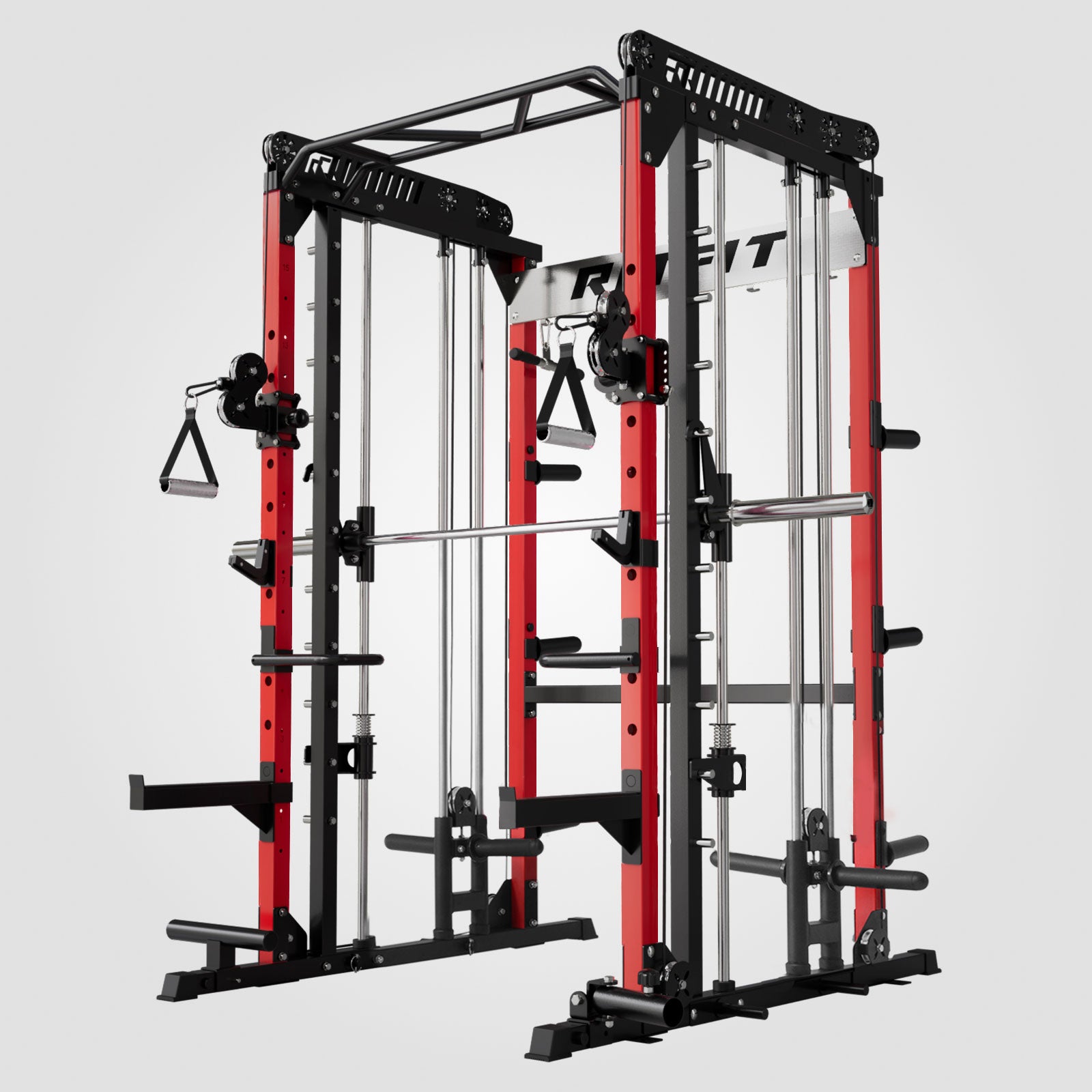
- Rack or Smith machine: A home gym Smith machine system can support pressing, squatting, rowing, and cable based training depending on the model.
- All in one setup: The RitFit M1 PRO Smith Machine with cable crossover and leg press hack squat package fits lifters who want one larger system for strength training variety.
- Bench: The RitFit weight benches collection supports flat press, incline press, dumbbell rows, seated shoulder press, and accessory work.
- Free weights: RitFit dumbbells help cover curls, raises, presses, rows, lunges, and shoulder accessories.
- Plates: RitFit high grade color bumper plates support progressive loading for barbell lifts when paired with a compatible Olympic bar.
FAQs
Is a four day workout split good for muscle growth?
Yes. A four day workout split can build muscle when weekly volume, effort, nutrition, and recovery are managed consistently. It gives most lifters enough training exposure to progress while leaving enough rest days to recover from heavy compound lifts and accessory work.
Can beginners use a four day workout split?
Yes. Beginners can use a four day workout split if they already understand safe lifting form and start with conservative loads. Complete beginners may do better with a simple full body plan first because it gives more practice with squats, presses, hinges, and rows.
What is the best four day workout split for mass?
The best four day workout split for mass is the one you can repeat while progressing safely. A body part split works well for focused hypertrophy, while an upper lower split works well for lifters who prefer training each major muscle group twice weekly.
How long should each four day workout split session take?
Most four day workout split sessions should take about 60 to 75 minutes. If your workouts regularly run longer, reduce accessory sets before cutting warm ups, technique work, or rest periods needed for safe performance on compound lifts.
Should I train to failure on a four day workout split?
No. You should not train every set to failure on a four day workout split. Most sets should stop with 1 to 3 reps in reserve, while failure can be used occasionally on safer isolation exercises when form stays controlled.
How much protein do I need on a four day workout split?
Most lifters can start with 0.7 to 1 gram of protein per pound of body weight per day. The exact target depends on body size, total calories, training history, appetite, and whether you prefer tracking grams or using simple meal portions.
Can I do a four day workout split at home?
Yes. You can do a four day workout split at home with a rack or Smith machine, adjustable bench, dumbbells, barbell, plates, and cable attachments. Choose equipment that supports pressing, pulling, squatting, hinging, and accessory work safely.
When should I deload on a four day workout split?
You should deload when performance drops, joints feel irritated, or normal weights feel unusually heavy for several sessions. A simple deload reduces weight, sets, or effort for one week, then returns gradually to normal training loads.
Conclusion
A four day workout split can build serious muscle when it is simple, repeatable, and supported by recovery. Train hard, stop most sets before form breaks, log your lifts, eat enough protein, and keep the program long enough to measure real progress.
Important disclaimer: This article is for general educational purposes only and is not medical advice. Consult a qualified clinician before starting if you have pain, recent injury, surgery history, medical conditions, dizziness, numbness, tingling, chest pain, or unexplained weakness. Stop any exercise that causes sharp pain or unusual symptoms.
References
- Currier BS, Mcleod JC, Banfield L, Beyene J, Welton NJ, D'Souza AC, et al. Resistance training prescription for muscle strength and hypertrophy in healthy adults: a systematic review and Bayesian network meta-analysis. Br J Sports Med. 2023;57(18):1211-1220. doi:10.1136/bjsports-2023-106807
- Schoenfeld BJ, Contreras B, Krieger J, Grgic J, Delcastillo K, Belliard R, et al. Resistance training volume enhances muscle hypertrophy but not strength in trained men. Med Sci Sports Exerc. 2019;51(1):94-103. doi:10.1249/MSS.0000000000001764
- Refalo MC, Hamilton DL, Paval DR, Gallagher IJ, Feros SA, Fyfe JJ. Influence of resistance training proximity-to-failure on skeletal muscle hypertrophy: a systematic review with meta-analysis. Sports Med. 2023;53(3):649-665. doi:10.1007/s40279-022-01784-y
- Morton RW, Murphy KT, McKellar SR, Schoenfeld BJ, Henselmans M, Helms E, et al. A systematic review, meta-analysis and meta-regression of the effect of protein supplementation on resistance training-induced gains in muscle mass and strength in healthy adults. Br J Sports Med. 2018;52(6):376-384. doi:10.1136/bjsports-2017-097608