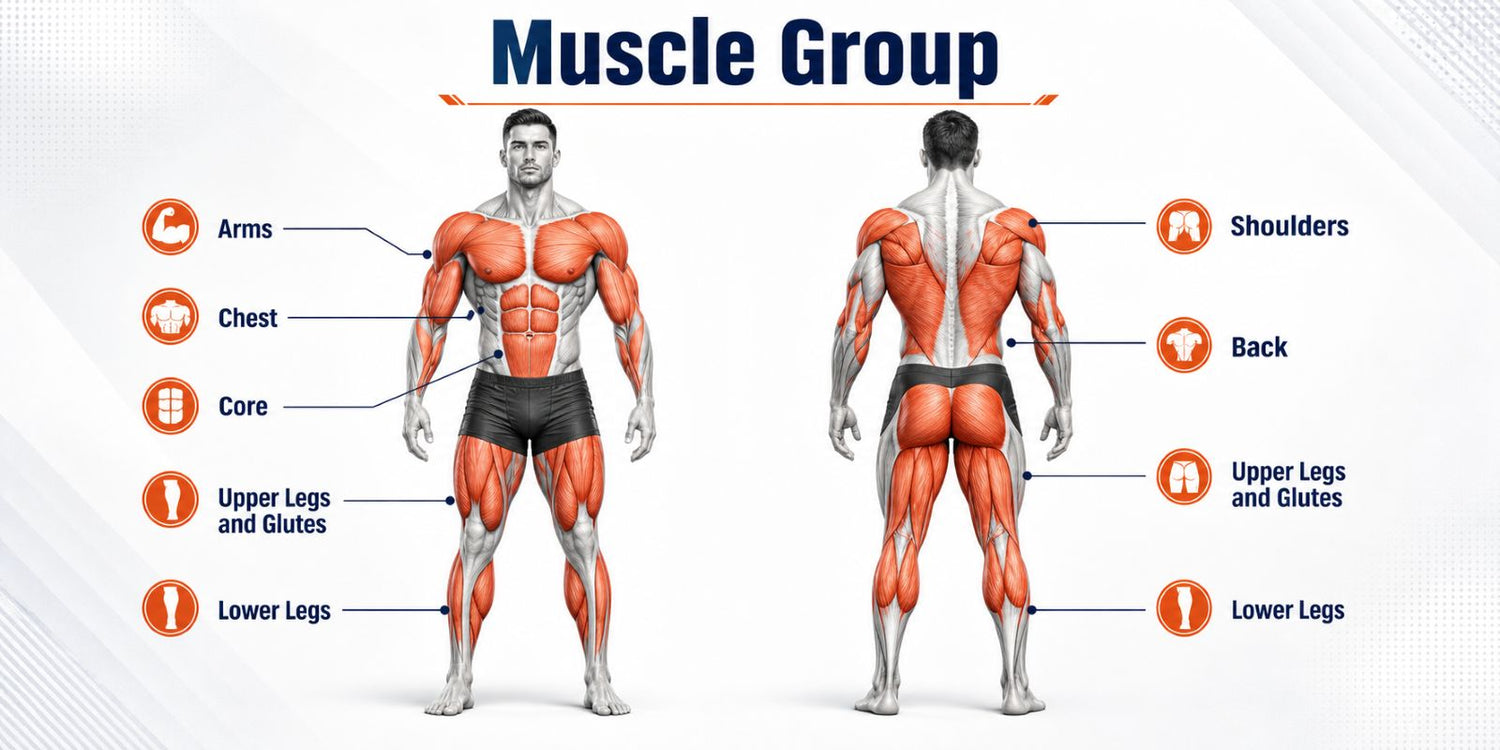
The 7 major muscle groups for workout planning are arms, shoulders, chest, back, core, upper legs and glutes, and lower legs. This guide shows how each group works, which exercises train it, and how to build a balanced home gym routine.
Key Takeaways
- The 7 major muscle groups are a training framework: They help you organize workouts by body region and movement pattern.
- Balanced training means more than training visible muscles: Back, glutes, hamstrings, calves, and core stabilizers need consistent attention.
- Compound movements should lead your program: Presses, rows, squats, hinges, carries, and core work train several muscle groups at once.
- Home gyms can cover every major muscle group: Dumbbells, a bench, a rack, cables, and weight plates can support complete strength training.
- Recovery is part of muscle growth: Good programming includes rest days, progressive overload, and enough time between hard sessions.
What Are the 7 Major Muscle Groups?
The 7 major muscle groups are arms, shoulders, chest, back, core, upper legs and glutes, and lower legs. This is a practical fitness framework, not the only anatomical way to classify the human muscular system.
| Muscle Group | Main Muscles | Primary Movements | Example Exercises |
|---|---|---|---|
| Arms | Biceps, triceps, forearms | Curling, pressing, gripping | Curls, triceps extensions, carries |
| Shoulders | Front, side, and rear deltoids | Pressing, raising, stabilizing | Overhead presses, lateral raises, face pulls |
| Chest | Pectoralis major, pectoralis minor | Horizontal pressing, arm adduction | Bench presses, push ups, chest flyes |
| Back | Lats, traps, rhomboids, spinal erectors | Pulling, rowing, extension | Rows, pulldowns, deadlifts |
| Core | Abs, obliques, transverse abdominis, lower back | Bracing, rotation control, posture | Planks, dead bugs, carries |
| Upper Legs and Glutes | Quads, hamstrings, glutes, adductors | Squatting, hinging, lunging | Squats, lunges, hip thrusts |
| Lower Legs | Calves, tibialis anterior | Plantar flexion, ankle stability | Calf raises, step ups, loaded carries |
Why Understanding Muscle Groups Matters
Understanding muscle groups helps you build a balanced workout instead of randomly choosing exercises. A complete routine should train each major area through several movement patterns, and resistance training can be organized so every major muscle group is addressed across the week.[1]
- Better program design: You can avoid overtraining the same muscles while neglecting others.
- Better movement quality: Balanced training supports pushing, pulling, squatting, hinging, bracing, and carrying.
- Better home gym planning: You can choose equipment that covers many exercises instead of buying machines for only one movement.
- Better recovery control: You can separate hard sessions for the same muscle group and reduce unnecessary fatigue.
How Muscle Groups Work Together in Real Exercises
The best workout plans are built around movement patterns, not only muscle names. This approach helps you train strength, coordination, balance, and real exercise skill.
- Push: Chest, shoulders, and triceps work together during bench presses, overhead presses, and push ups.
- Pull: Back, biceps, rear shoulders, and forearms work together during rows, pulldowns, and pull ups.
- Squat: Quads, glutes, calves, and core work together during squats, lunges, and leg presses.
- Hinge: Hamstrings, glutes, spinal erectors, and core work together during Romanian deadlifts and hip thrusts.
- Brace and carry: Core, traps, forearms, hips, and calves work together during loaded carries and farmer carries.
1. Arms
The arms include the biceps, triceps, brachialis, and forearms. They support curling, pressing, pulling, carrying, and grip strength.
- Best compound support: Rows, pull ups, presses, and dips train the arms while also working larger muscle groups.
- Best isolation choices: Biceps curls, hammer curls, triceps extensions, and cable pressdowns add direct arm volume.
- Home gym tip: A pair of dumbbells can train curls, extensions, carries, and upper body accessory work with minimal space.
- Common mistake: Do not train arms only with isolation moves while ignoring rows and presses.
2. Shoulders
The shoulders are built around the deltoids and shoulder stabilizers. They help move the arms overhead, raise the arms to the side, and stabilize pressing and pulling exercises.
- Best compound support: Overhead presses and incline presses train the front and side shoulders with strong triceps involvement.
- Best isolation choices: Lateral raises, rear delt flyes, and face pulls help balance all three deltoid heads.
- Home gym tip: An adjustable weight bench helps you set incline angles for shoulder friendly pressing and chest support during rear delt work.
- Common mistake: Do not overtrain front delts while neglecting rear delts and upper back control.
3. Chest
The chest is mainly trained through horizontal pressing and arm adduction. The pectoralis major helps drive bench presses, push ups, dips, and fly variations.
- Best compound support: Flat presses, incline presses, push ups, and dips train the chest with help from the shoulders and triceps.
- Best isolation choices: Dumbbell flyes, cable flyes, and squeeze presses add focused chest work.
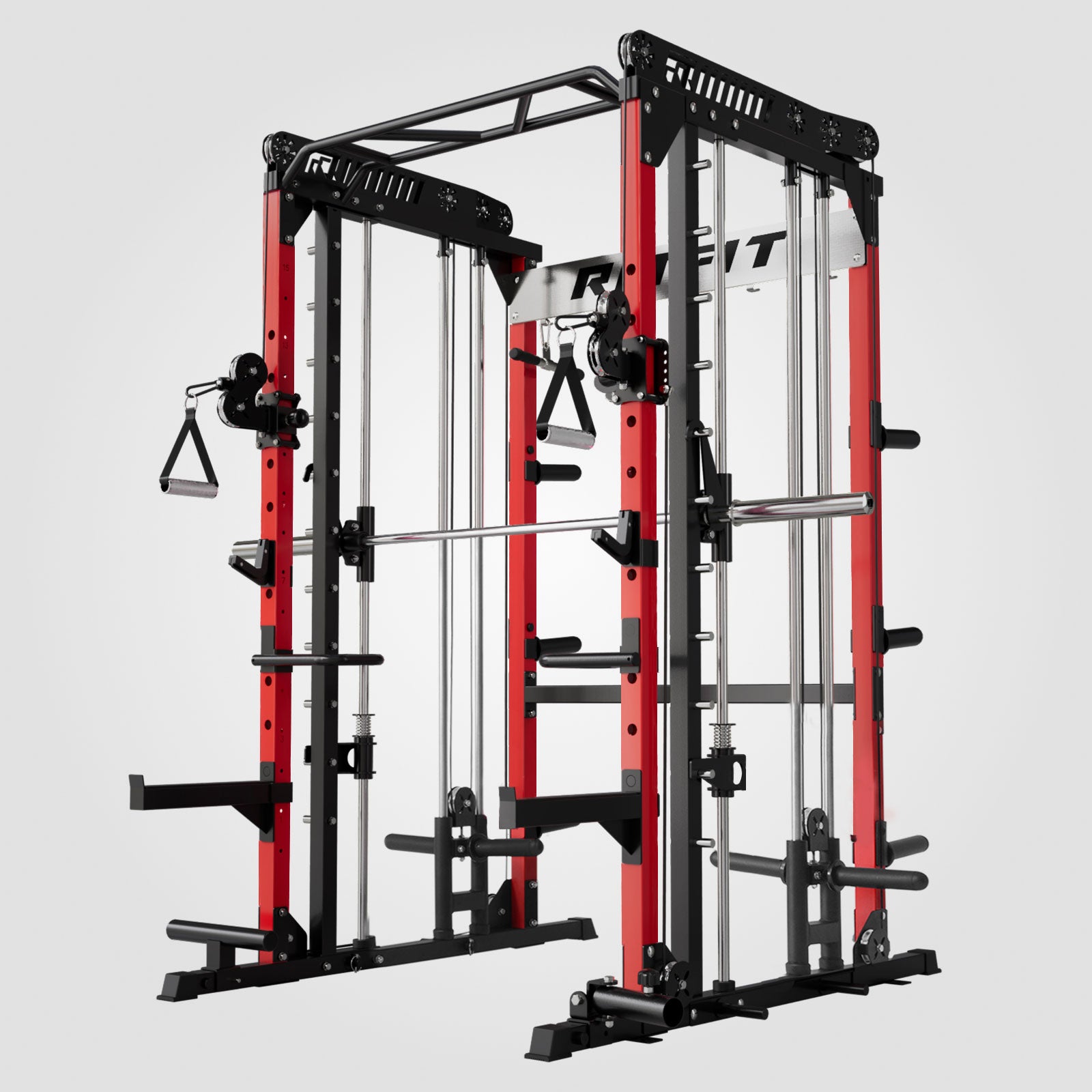
- Home gym tip: A Smith machine can support controlled pressing when the safety stops are set correctly and form stays consistent.
- Common mistake: Do not chase heavier presses if your shoulders lose position or your range of motion becomes unstable.
4. Back
The back includes the lats, traps, rhomboids, rear shoulders, and spinal erectors. It supports pulling strength, posture, bracing, and upper body balance.
- Best compound support: Rows, pulldowns, pull ups, and deadlift patterns train several back muscles at the same time.
- Best isolation choices: Straight arm pulldowns, face pulls, reverse flyes, and back extensions add focused support.
- Home gym tip: A cable crossover machine adds adjustable angles for lat pulldowns, rows, face pulls, and single arm cable work.
- Common mistake: Do not let pressing volume exceed pulling volume for long periods.
5. Core
The core includes the abdominals, obliques, transverse abdominis, spinal stabilizers, and deep trunk muscles. Core training can improve performance variables such as balance, throwing, and jumping when it is programmed consistently.[4]
- Best stability choices: Planks, dead bugs, bird dogs, and loaded carries train the core to resist unwanted motion.
- Best strength choices: Cable chops, hanging knee raises, ab rollouts, and weighted carries add progressive resistance.
- Home gym tip: Use cables, dumbbells, and a rack setup to train anti rotation, flexion control, and loaded bracing.
- Common mistake: Do not rely only on crunches if your goal is whole body strength and spinal control.
6. Upper Legs and Glutes
The upper legs and glutes include the quadriceps, hamstrings, gluteus maximus, gluteus medius, and adductors. These muscles power squats, lunges, hip hinges, step ups, and hip thrusts.
- Best compound support: Squats, Romanian deadlifts, lunges, split squats, and hip thrusts train the lower body through large ranges of motion.
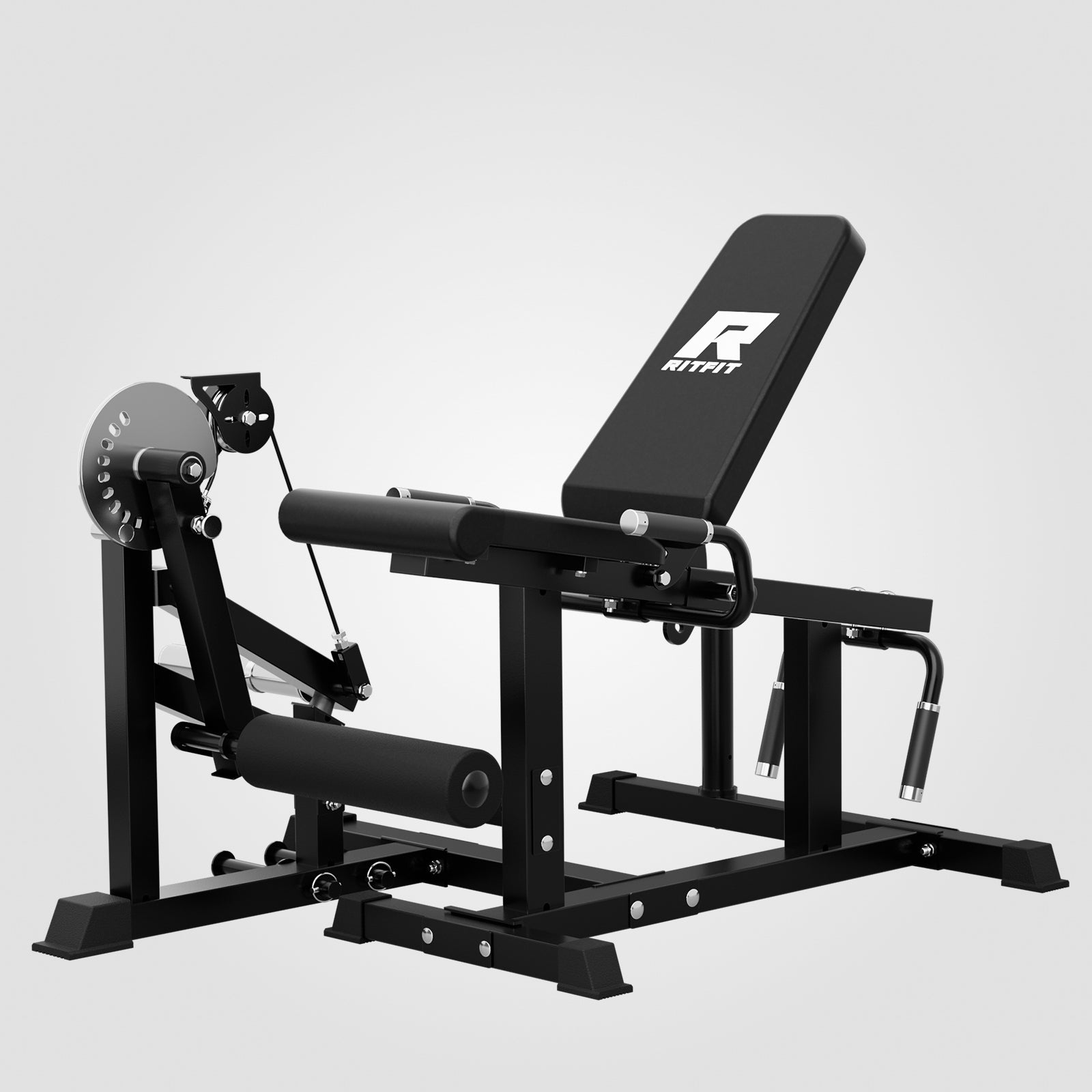
- Best machine choices: Leg presses, hack squats, leg curls, and leg extensions add controlled resistance for focused lower body work.
- Home gym tip: A leg press and hack squat machine can support quad, glute, and lower body training in a dedicated home gym setup.
- Common mistake: Do not train only squats while skipping hip hinge and hamstring work.
7. Lower Legs
The lower legs include the gastrocnemius, soleus, tibialis anterior, and ankle stabilizers. They support ankle strength, walking, running, jumping, squatting, and loaded carries.
- Best direct choices: Standing calf raises, seated calf raises, tibialis raises, and step loaded calf work target the lower legs.
- Best compound support: Squats, lunges, sled style movements, step ups, and carries also challenge ankle and calf stability.
- Home gym tip: Barbells and weight plates make calf raises and loaded carries easier to progress over time.
- Common mistake: Do not assume calves get enough work from walking if your goal is strength or visible muscle development.
What Equipment Do You Need to Train All 7 Major Muscle Groups at Home?
The most efficient home gym setup uses versatile equipment before highly specific machines. This helps you train more muscles with fewer pieces of equipment.
- Dumbbells: Use them for curls, presses, rows, lunges, Romanian deadlifts, carries, and calf raises.
- Adjustable bench: Use it for flat presses, incline presses, chest supported rows, rear delt work, and split squats.
- Rack or Smith machine: Use it for squats, presses, rack pulls, pull ups, and safer solo lifting when safeties are set correctly.
- Cable system: Use it for pulldowns, rows, flyes, face pulls, chops, pressdowns, and curls.
- Strength machines: Use strength machines when you want more controlled resistance for legs, chest, back, or accessory training.
- Rack package: A rack package can simplify setup by pairing the main training station with compatible accessories.
How to Program the 7 Major Muscle Groups
Start with compound lifts, then add isolation work for muscles that need extra attention. Research suggests higher loads are especially useful for strength, while multiple set prescriptions can support hypertrophy across a range of loading strategies.[2]
- For beginners: Train the whole body two to three days per week and learn stable form before adding many exercises.
- For muscle growth: Use enough hard sets to challenge each muscle, while avoiding sudden jumps in total weekly volume.
- For strength: Prioritize heavier compound lifts, longer rest periods, and consistent technique.
- For time efficiency: Pair non competing muscles, such as chest with back or quads with hamstrings.
How Hard Should You Train Each Muscle Group?
Each muscle group should be trained hard enough to challenge the target muscles without losing safe form. Evidence suggests low, moderate, and high loads can all support hypertrophy when effort is sufficient, while heavier loads are more effective for maximal strength gains.[3]
- Use controlled repetitions: Keep the target muscle active through the full range of motion.
- Stop before form breaks: A hard set should not turn into joint strain or uncontrolled momentum.
- Progress gradually: Add reps, sets, load, or range of motion over time rather than changing everything at once.
- Track your lifts: Training logs make it easier to see whether each major muscle group is progressing.
How Much Weekly Volume Does Each Muscle Group Need?
Weekly volume should match your training age, recovery, and goal. For young trained men, one review reported that 12 to 20 weekly sets per muscle group may be a useful hypertrophy range, but beginners often need less volume to progress.[5]
- Beginner range: Start with fewer hard sets and focus on technique, consistency, and recovery.
- Intermediate range: Add more sets for muscles that are recovering well and still need growth.
- Advanced range: Use higher volume carefully, because more work is only useful if performance and recovery stay strong.
- Practical rule: Increase volume only when progress has stalled and sleep, nutrition, and form are already solid.
Sample Weekly Training Plan for All 7 Major Muscle Groups
This sample plan trains every major muscle group while keeping recovery simple. Adjust exercise choice, sets, and intensity based on your experience level and available equipment.
| Day | Focus | Muscle Groups Trained | Example Exercises |
|---|---|---|---|
| Day 1 | Upper body push and pull | Chest, back, shoulders, arms, core | Bench press, row, overhead press, curls, plank |
| Day 2 | Lower body | Quads, hamstrings, glutes, calves, core | Squat, Romanian deadlift, lunge, calf raise, carry |
| Day 3 | Rest or light movement | Recovery | Walking, mobility, stretching |
| Day 4 | Whole body strength | All 7 major muscle groups | Deadlift pattern, incline press, pulldown, split squat, cable chop |
| Day 5 | Accessory and weak points | Arms, shoulders, back, calves, core | Face pull, lateral raise, triceps extension, calf raise, dead bug |
| Day 6 | Optional conditioning | Whole body support | Loaded carries, sled style work, step ups, low impact cardio |
| Day 7 | Rest | Recovery | Sleep, hydration, easy walking |
Common Muscle Group Training Mistakes
Most training mistakes come from doing too much of what feels familiar and too little of what the body actually needs. A balanced program should cover all major regions without turning every workout into maximum effort.
- Only training mirror muscles: Chest, arms, and front shoulders matter, but back, glutes, hamstrings, calves, and core stabilizers also need direct work.
- Skipping pulling exercises: Rows, pulldowns, and rear delt work help balance pressing volume.
- Ignoring lower body training: Strong legs and glutes support strength, posture, daily movement, and athletic performance.
- Doing random workouts: A plan should repeat core movements long enough for measurable progress.
- Changing volume too fast: Sudden increases in hard sets can create soreness and reduce performance.
Recovery Guidelines for Balanced Muscle Growth
Recovery allows the trained muscles to repair, adapt, and perform better in the next session. Your plan should manage training stress instead of pushing every muscle group hard every day.
- Rest between hard sessions: Give a trained muscle group at least one day before another intense session.
- Watch performance: If reps, load, and control drop sharply, recovery may be incomplete.
- Sleep consistently: Poor sleep can reduce training quality and make soreness feel worse.
- Use active recovery: Walking, mobility, and light movement can help you stay consistent without adding heavy fatigue.
- Deload when needed: Reduce volume or intensity when joints feel irritated or progress stalls for several weeks.
FAQs
What are the 7 major muscle groups for strength training?
The 7 major muscle groups are arms, shoulders, chest, back, core, upper legs and glutes, and lower legs. This framework helps you organize workouts by body region and movement pattern, so you can train pushing, pulling, squatting, hinging, bracing, and carrying more evenly.
Can I train all 7 major muscle groups at home?
Yes. You can train all 7 major muscle groups at home with a smart mix of bodyweight movements, dumbbells, a bench, a rack, and cable training options. The key is to cover push, pull, squat, hinge, core stability, and calf work across the week.
Which muscle groups should beginners train first?
Beginners should start with large movement patterns instead of chasing every small muscle in isolation. A simple plan can prioritize squats, presses, rows, hip hinges, carries, and planks, because these exercises teach coordination while training several major muscle groups at once.
How often should I train each major muscle group?
Most people can train each major muscle group two times per week with moderate volume and good recovery. Beginners may start with two or three total body sessions weekly, while advanced lifters can use split routines to add more sets for specific muscles.
Are compound exercises enough for the 7 major muscle groups?
Yes. Compound exercises can cover most of the 7 major muscle groups when your program includes pressing, rowing, squatting, hinging, pulling, and carrying. Isolation exercises are still useful when you want extra arm, shoulder, calf, or glute work after the main lifts.
What equipment do I need to train every major muscle group?
The most useful home gym setup includes dumbbells, an adjustable bench, a barbell, weight plates, and a rack or cable system. This combination supports presses, rows, squats, hip hinges, curls, extensions, pulldowns, core movements, and lower leg training without needing many single use machines.
Which major muscle groups are most often neglected?
The most neglected major muscle groups are usually the back, rear shoulders, core stabilizers, glutes, hamstrings, and calves. These areas receive less attention because many lifters overemphasize mirror muscles, so balanced programming should include rows, hinges, carries, calf raises, and anti rotation core work.
How long should each muscle group recover after training?
Most muscle groups need at least one day of recovery after challenging resistance training. Larger muscles and very hard sessions may need more time, so use soreness, performance, sleep quality, and joint comfort to decide whether to train hard again or reduce intensity.
Conclusion
The 7 major muscle groups give you a simple way to build balanced strength training. Train arms, shoulders, chest, back, core, upper legs and glutes, and lower legs through pushing, pulling, squatting, hinging, bracing, and carrying.
A smart home gym does not need to be complicated. Start with versatile equipment, repeat the main movement patterns, track progress, and recover well between hard sessions.
Disclaimer
This article is for general fitness education only and is not medical advice. If you have pain, injuries, medical conditions, or are new to resistance training, consult a qualified professional before starting a new workout program.
References
- Paluch AE, Boyer WR, Franklin BA, Laddu D, Lobelo F, Lee DC, et al. Resistance Exercise Training in Individuals With and Without Cardiovascular Disease: 2023 Update: A Scientific Statement From the American Heart Association. Circulation. 2024;149(3):e217-e231. doi:10.1161/CIR.0000000000001189
- Currier BS, Mcleod JC, Banfield L, Beyene J, Welton NJ, D'Souza AC, et al. Resistance training prescription for muscle strength and hypertrophy in healthy adults: a systematic review and Bayesian network meta-analysis. Br J Sports Med. 2023;57(18):1211-1220. doi:10.1136/bjsports-2023-106807
- Lopez P, Radaelli R, Taaffe DR, Newton RU, Galvão DA, Trajano GS, et al. Resistance Training Load Effects on Muscle Hypertrophy and Strength Gain: Systematic Review and Network Meta-analysis. Med Sci Sports Exerc. 2021;53(6):1206-1216. doi:10.1249/MSS.0000000000002585
- Rodríguez-Perea Á, Reyes-Ferrada W, Jerez-Mayorga D, Chirosa Ríos L, Van den Tillar R, Chirosa Ríos I, et al. Core training and performance: a systematic review with meta-analysis. Biol Sport. 2023;40(4):975-992. doi:10.5114/biolsport.2023.123319
- Baz-Valle E, Balsalobre-Fernández C, Alix-Fages C, Santos-Concejero J. A systematic review of the effects of different resistance training volumes on muscle hypertrophy. J Hum Kinet. 2022;81:199-210. doi:10.2478/hukin-2022-0017