








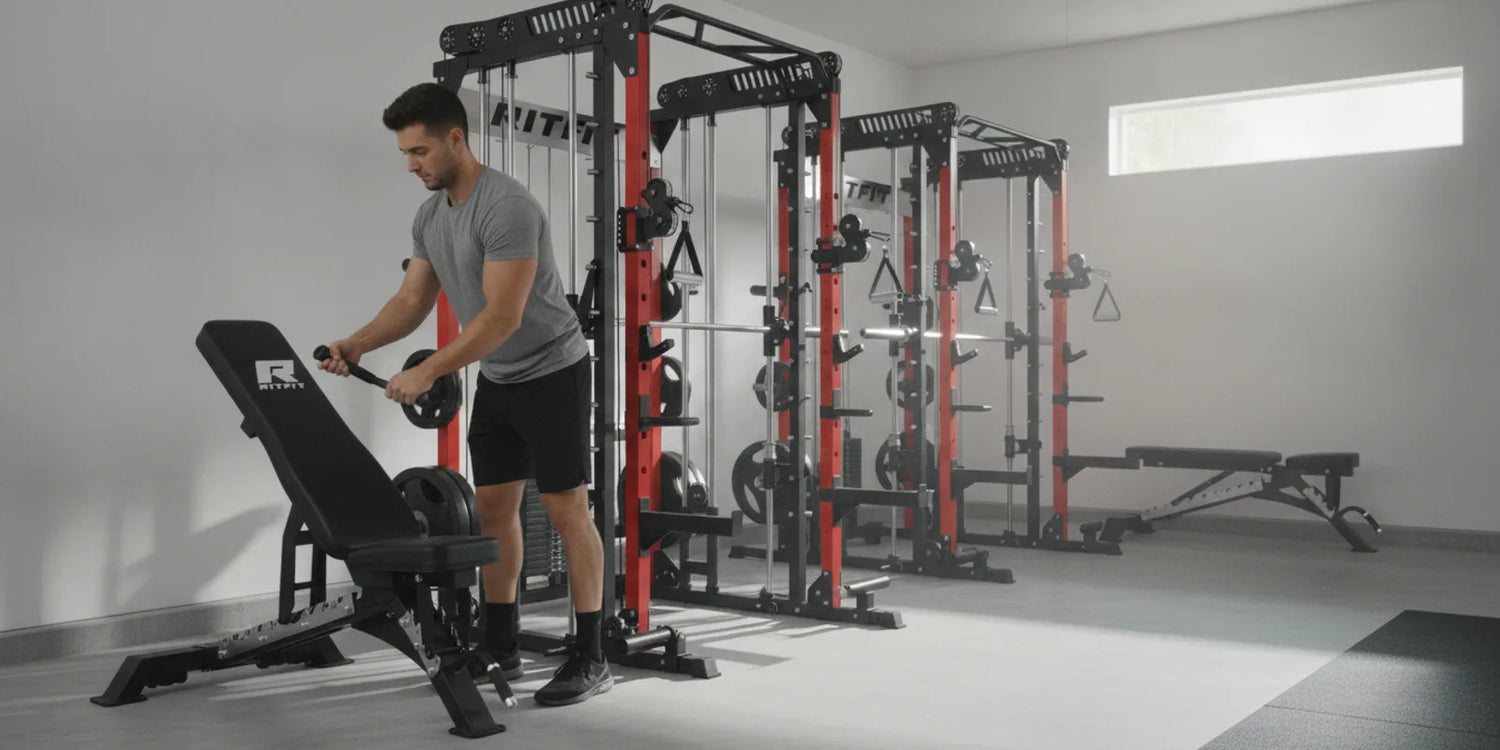
Reliable all-in-one machines worth the investment do exist, but the answer depends far more on build quality than on how many stations a unit advertises. The right one becomes the last piece of gym gear you buy.
This guide shows you the durability signals that separate a long-lasting unit from a flimsy one, the real cost math, and which RitFit option fits your space, budget, and goals.
Quick Answer
Yes, reliable all-in-one machines are worth the investment when you judge them on heavy-gauge steel, quality welds, and durable pulleys rather than station count. A well-built unit replaces several machines, saves space, and lasts over a decade with light maintenance, making it a sound long-term home gym purchase.
Key Takeaways
- Reliability comes from build, not stations: Heavy-gauge steel, clean welds, and quality pulleys matter far more than how many exercises a unit claims.
- One unit replaces many: A solid all-in-one combines a power rack, Smith machine, functional trainer, and cable station in under 20 square feet.
- The math favors it for committed lifters: Buying those machines separately usually costs more and takes more floor space.
- Light maintenance keeps it smooth: Wiping rods, lubricating rails, and checking cables every few weeks prevents most reliability problems.
- It is not for everyone: Cardio-only users, very tight budgets, or single-purpose needs are better served by dedicated equipment.
Are all-in-one machines actually reliable?
All-in-one machines can be highly reliable when they are built with thick steel and quality moving parts, and far less so when corners are cut. Reliability tracks construction quality, not the number of advertised stations.
- The wear points are predictable: Cables, pulleys, and guide rods are the parts that age first, and on quality units they are simple and inexpensive to replace.
- Cheap units fail differently: Thin steel and plastic components develop wobble, friction, and play that compromise both feel and safety over time.
So the question is not whether the category is reliable, but whether a specific unit is built to last. Our best all-in-one home gym equipment guide breaks down what to look for before you buy.
What does reliable mean in an all-in-one machine?
Reliable means the frame stays rigid, the cables run smooth, and the Smith rail tracks cleanly for years of regular training. These mechanical fundamentals, not the exercise count, decide whether a machine holds up.
Steel gauge and frame rigidity
Lower gauge numbers mean thicker, more rigid steel, so 11-gauge uprights flex less than 12 or 14-gauge ones under heavy lifts. A rigid frame is the single biggest reliability signal because it resists the wobble that loosens joints over time.
Pulleys, cables, and the Smith rail
Smooth, durable pulleys and linear ball-bearing Smith rails are what keep day-to-day use reliable and safe. Aluminum pulleys and sealed bearings deliver consistent cable travel for movements from triceps pushdowns to cable flyes.
This cable versatility is exactly why functional-trainer style stations earn high marks from strength coaches, and research in novice lifters confirms machine-based and free-weight training both build real strength.[1] A meta-analysis of 16 studies and 341 subjects also found no significant difference between weight-stack style training and free weights for maximal strength.[2]
"A functional trainer ranks high for its versatility, allowing you to recreate nearly any movement pattern you want, from curls and tricep pushdowns to face pulls and side lateral raises."
Jeff Cavaliere, MSPT, CSCS, Founder of ATHLEAN-X, ATHLEAN-X
Welds and weight capacity
Clean, continuous welds and a generous weight capacity signal a frame engineered for years of heavy loading. Inspect weld seams and published load ratings, since these reveal more about durability than any feature list.
To see how these systems combine stations, read our explainer on the functional trainer with Smith machine setup.
Is an all-in-one worth the investment?
For most committed home lifters, an all-in-one is worth the investment because one frame replaces a power rack, Smith machine, functional trainer, and cable station. The value comes from consolidating equipment cost and floor space into a single durable purchase.
All-in-one versus buying machines separately
Buying a standalone power rack, functional trainer, Smith machine, and cable station separately usually costs more and takes far more room. An all-in-one delivers the same movement variety in under 20 square feet, which is why a single unit often pays for itself.
- Less floor space: Stations stack into one footprint instead of spreading across a room.
- Fewer purchase decisions: One frame, one warranty, and one assembly rather than four separate buys.
All-in-one versus a gym membership
Against a premium membership, an all-in-one can break even within a couple of years of regular training. After that, the cost-per-workout keeps falling because the equipment is already paid for.
An overview of 137 systematic reviews covering tens of thousands of participants found that resistance training reliably improves strength, hypertrophy, power, and endurance, with equipment type not consistently changing those outcomes.[3] Because a well-built all-in-one can deliver the same core results as a room full of separate machines, the value case is strong, as our 7 reasons to add an all-in-one Smith machine explains.
Which RitFit all-in-one fits which buyer?
The right RitFit all-in-one depends on your budget, available space, and training goals. The table below matches each tier to the buyer it suits best, so you can choose without overpaying for capability you will not use.
| Option | Tier | What it combines | Best for |
|---|---|---|---|
| RitFit PSR05 package | Budget and space | Smith machine, rack, and bench combo | Small rooms and first-time buyers |
| M1 multi-functional Smith machine | Mid tier | Smith machine plus functional cable capability | Balanced strength and cable training in a spare room |
| BPC06 all-in-one package | Top tier | Full Smith, functional trainer, and accessories | Committed lifters wanting one do-it-all unit |
Choose the tier that matches your space and goals, not the most stations available.
- Tight on space or budget: Start with the PSR05 package for core barbell and Smith training.
- Want cable work too: Step up to the RitFit M1 Smith machine home gym package for added versatility.
If you are still comparing frame styles, our guide to the best all-in-one power rack for home gym covers rack-focused options.
How much maintenance keeps it reliable?
An all-in-one needs only light, regular maintenance to stay reliable, since the frame and weight stacks have few failure points. A short routine every few weeks keeps the moving parts smooth and safe.
- Lubricate guide rods: Wipe and lightly oil the Smith and guide rods so the bar tracks smoothly.
- Inspect cables: Check for fraying or wear and replace cables before they fail under load.
- Tighten and protect: Confirm bolts stay tight and keep the unit away from damp areas, since dust and humidity affect tightly packed parts faster.
Build this into a quick monthly ritual and the machine stays as smooth as the day it was assembled.
When is an all-in-one not worth it?
An all-in-one is not worth it when your needs are narrow, your budget is very tight, or your space cannot accommodate the frame. In those cases a dedicated piece of equipment is cheaper and a better fit.
- You only do cardio: A treadmill or bike serves you better than a strength station.
- You need one specialised machine: A single dedicated unit costs less than a full system.
- You are very tall: Check internal rack depth and bar clearance before buying, since compact frames can feel tight above six feet.
Browse the full RitFit home gym collection to compare these against simpler single-purpose options.
How long should it last and what warranty to expect?
A well-built all-in-one should last well over a decade with light maintenance, because the frame and weight stacks rarely fail. Cables, pulleys, and guide rods wear first and are usually inexpensive to replace.
- Treat warranty as a durability signal: A longer warranty shows how long the maker expects the unit to perform.
- Plan for wear parts: Budget for occasional cable or pulley replacement rather than a whole new machine.
With quality construction and basic care, the frame outlives the wear parts many times over, which is what makes a good unit a genuine long-term investment.
FAQs About All-in-One Home Gym Machines
Are all-in-one home gym machines reliable?
Yes, when built with heavy-gauge steel, quality welds, and durable pulleys and cables, a good all-in-one machine stays reliable for many years through basic maintenance. Cheap, lightweight units with thin steel and plastic parts are the ones that develop wobble and cable wear over time, because reliability comes from construction quality rather than station count.
Is an all-in-one home gym worth the money?
Yes, for most committed home lifters a single all-in-one machine replaces a power rack, Smith machine, functional trainer, and cable station, usually for less than buying those separately and in far less floor space. Over two to three years it can also cost less than a premium gym membership, so the upfront price often pays for itself.
How long should an all-in-one home gym machine last?
A well-built all-in-one machine should last well over a decade with light maintenance, since the frame and weight stacks have few failure points while cables, pulleys, and guide rods wear first and are usually inexpensive to replace. Always check the warranty length, as it signals how long the maker expects the unit to perform.
How much maintenance does an all-in-one machine need?
Maintenance is light but matters, so wipe and lightly lubricate the Smith and guide rods every few weeks, inspect cables for fraying, check that bolts stay tight, and keep the unit away from damp areas. Because many parts sit in a tight frame, dust and humidity affect them faster, so a quick monthly routine keeps everything safe.
When is an all-in-one home gym not worth it?
An all-in-one is not worth it if you only do cardio, have a very tight budget, or prefer one highly specialised machine, and very tall users should check internal rack depth and bar clearance before buying. If you only need a single function, a dedicated piece of equipment is cheaper and a better fit than a full all-in-one system.
Conclusion
Reliable all-in-one machines worth the investment do exist, and for committed home lifters they are often the smartest long-term buy. Judge them on steel gauge, welds, and pulley quality, then commit to light maintenance and the unit will serve you for years.
Match the tier to your space and goals, not the station count. Choose a unit built to last and an all-in-one becomes a genuine long-term investment rather than a quick compromise.
Disclaimer
This article is for general informational purposes only and does not replace professional fitness, medical, or product safety advice. Consult a qualified professional before starting a new training program or making a significant equipment purchase.
References
1. Aerenhouts D, D'Hondt E. Using Machines or Free Weights for Resistance Training in Novice Males? A Randomized Parallel Trial. Int J Environ Res Public Health. 2020;17(21). doi:10.3390/ijerph17217848 https://pmc.ncbi.nlm.nih.gov/articles/PMC7662789/
2. Hu Z, Liu Y, Huang K, Huang H, Li F, Yuan X. Comparing the Effect of Isoinertial Flywheel Training and Traditional Resistance Training on Maximal Strength and Muscle Power in Healthy People: A Systematic Review and Meta-Analysis. Life (Basel). 2024;14(7). doi:10.3390/life14070908 https://pmc.ncbi.nlm.nih.gov/articles/PMC11277740/
3. Currier BS, D'Souza AC, Singh MAF, et al. American College of Sports Medicine Position Stand. Resistance Training Prescription for Muscle Function, Hypertrophy, and Physical Performance in Healthy Adults: An Overview of Reviews. Med Sci Sports Exerc. 2026;58(4):851-872. doi:10.1249/MSS.0000000000003897 https://pmc.ncbi.nlm.nih.gov/articles/PMC12965823/





