








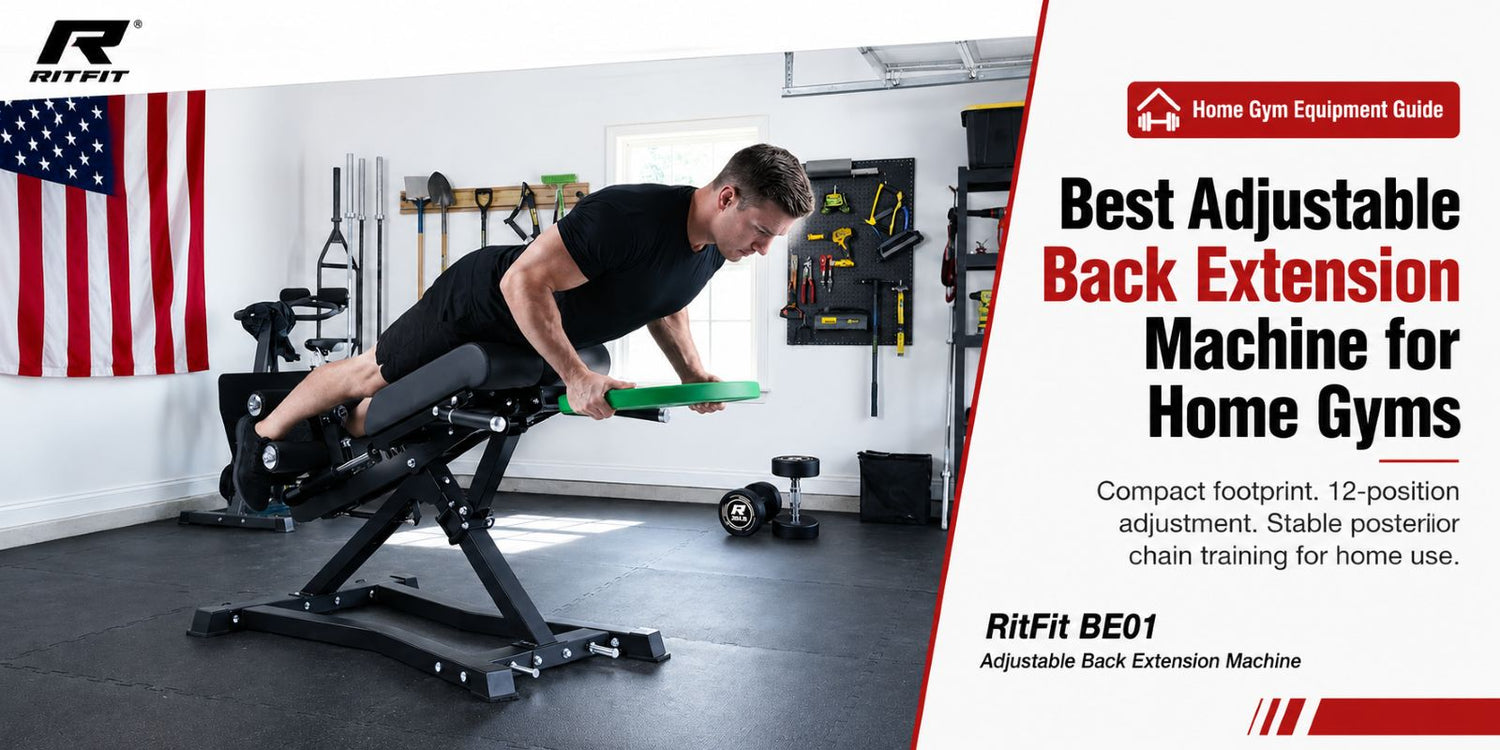
Finding the best adjustable back extension machine for home gyms requires balancing structural stability, angle flexibility, floor footprint, and posterior chain loading capacity. A dedicated hyperextension bench provides targeted lower back, glute, and hamstring conditioning without placing vertical compressive loads on the spine.
This comprehensive buyer guide evaluates the RitFit BE01 adjustable hyperextension bench across mechanical dimensions, training utility, space requirements, and home gym integration.
Quick Answer: The best adjustable back extension machine for home gyms is the RitFit BE01 because it offers 12-level multi-angle positioning from -7° decline to 25° incline, a heavy-duty 116 lb Q235 steel frame with a 660 lb capacity, and a compact 10 sq ft footprint that fits residential spaces perfectly.
Key Takeaways
- Targeted Posterior Training: Dedicated back extension machines strengthen the erector spinae, glutes, and hamstrings without loading the spine like heavy barbells.
- Multi-Angle Versatility: The RitFit BE01 features 12 adjustable settings from -7° decline to 25° incline for scalable training intensity.
- Compact Footprint: Measuring 44.8 by 32.3 inches, the unit occupies roughly 10 square feet while supporting up to 660 lbs.
- Safe Hip Hinging: Proper execution requires setting the split thigh pad below the hip crease to allow natural pelvic rotation without spinal hyperextension.
- Home Gym Integration: Built-in transport wheels and band pegs make it easy to maneuver and integrate with dumbbells, bands, and racks.
Why Add a Back Extension Machine to Your Home Gym?
A back extension machine provides a controlled and isolated method to strengthen the posterior chain without the systemic axial fatigue of heavy deadlifts. This targeted movement pattern reinforces proper hip hinge mechanics while activating the erector spinae, gluteus maximus, and hamstrings.
Clinical exercise research demonstrates that targeted posterior chain resistance training plays a vital role in restoring lumbar endurance, improving movement competence, and relieving non-specific lower back discomfort when programmed correctly.[1] Combining bodyweight hyperextensions with hex rubber dumbbells allows lifters to progressively overload extension strength safely.
- Independent Solo Training: Hyperextensions do not require a spotter, allowing safe failure and controlled volume during solo home workouts.
- Spinal Unloading: Unlike spinal compression from squats or standing good mornings, back extensions create shear loading across the hips with minimal axial compression.
- Versatile Accessory Work: This station effectively bridges the gap between primary compound lifts and targeted postural endurance work.
"It is my opinion that a weak posterior chain and weak glutes in particular are largely responsible for the alarming number of low back pain in the U.S. Anything that strengthens the posterior chain might lead to less low back pain and injury."
Bret Contreras, PhD in Sports Science, Contreras Strength Institute, Industry Rant: Back Extensions and Reverse Hypers
"A great addition to my garage gym, giving me much needed lower back exercise and multiple other exercises."
carlos g., Verified Buyer, RitFit BE01 Adjustable Back Extension Machine for Home and Gym
What Features Make the RitFit BE01 Stand Out?
The RitFit BE01 adjustable back extension machine is engineered as a dedicated, heavy-duty posterior chain station bridging lightweight Roman chairs and commercial GHD units. Available in classic black and custom styling such as the RitFit BE01 pink edition, it pairs high-capacity steel with refined ergonomics.
- Frame Engineering: Constructed from Q235 steel with 50 by 75 mm structural tubing and 16-gauge wall thickness for maximum torsional rigidity.
- High Load Capacity: Stated static load rating of 660 lbs accommodates weighted extensions, holding heavy plates, and intense band tension.
- Curved Split Thigh Pad: 4.3-inch thick dual-density foam pad wrapped in sweat-resistant tech leather eliminates pelvic discomfort during flexion.
- Textured Base Footplate: An oversized 17.3 by 13.4-inch checkered steel platform ensures firm foot grip across various footwear and stance widths.
- Progressive Band Pegs: Integrated base pegs allow athletes to loop resistance bands over their shoulders for accelerating resistance curves.
These industrial design elements ensure the machine remains completely motionless even during explosive hip extensions or loaded unilateral variations.
This back extension is solid and built well. It doesn’t wiggle while using it. I love that it can easily move to different positions so I can do a variety of movements on it. It also adjusts easily and quickly which makes it great for working out with others. Was sold on it when it came in pink :).
Katharine B., Verified Buyer, RitFit BE01 Pink Adjustable Back Extension Machine for Home and Gym
How Much Space Does a Back Extension Machine Require?
The RitFit BE01 requires approximately 10 square feet of floor space with physical dimensions of 44.8 inches long by 32.3 inches wide and 35.7 inches high. To facilitate comfortable mounting, dismounting, and full torso extension, you should allocate an operational footprint of 6 feet by 6 feet.
Protecting your flooring is essential when setting up heavy steel fitness equipment in home settings. Placing the unit over rubber interlocking gym flooring mats dampens vibration, prevents floor scuffs, and eliminates frame slippage during heavy sets.
- Garage Gym Positioning: Position the unit near your primary squat rack or Smith machine home gym package for seamless transition into posterior chain accessory circuits.
- Spare Room Clearance: Maintain at least 24 inches of unobstructed perimeter clearance around the machine to prevent colliding with walls or furniture during full extension.
- Apartment Portability: Integrated front transport wheels and a rear lift handle allow a single person to tilt and roll the 116 lb frame into storage corners after training.
How Do Angle Adjustments Improve Posterior Chain Workouts?
Angle adjustments alter the resistance profile and gravitational load placed across the lumbar extensors and hamstrings throughout each rep. The RitFit BE01 features a gas-assisted 12-level adjustment mechanism that shifts between decline, flat, and inclined trajectories smoothly.
- -7° Gentle Decline: Reduces peak gravitational resistance at the top of the extension, serving as an ideal starting angle for rehabilitation and beginners.
- 0° Flat Horizontal Position: Represents the standard hyperextension orientation, providing consistent muscular recruitment through a full 90-degree hip hinge range.
- 5° to 15° Moderate Incline: Increases peak contraction torque across the gluteal complex and hamstrings as the torso breaks parallel.
- 25° Steep Incline: Maximizes posterior chain tension and time under tension for advanced strength athletes seeking heavy hypertrophy stimulus.
The pneumatic gas spring reduces the effort needed to change angles between workout sets, making rapid adjustments effortless for multiple trainees in one household.
How Durable and Stable Is the RitFit BE01 Frame?
The RitFit BE01 delivers superior durability and frame stability due to its substantial 116 lb net weight and wide-stance stabilizing base. In contrast to lightweight folding benches that wobble under shifting body mass, this heavy steel architecture ensures a completely rigid foundation.
Biomechanical studies on posterior chain activation demonstrate that stable equipment stabilization directly improves prime mover recruitment and reduces compensatory lumbar twisting.[2] Pairing your hyperextension unit with an adjustable weight bench provides a complete foundation for full-body strength workouts.
Machine works great. It feels very stable even for my husband who weighs 250. Easy to transition for different heights and workouts. Build was fairly easy the only con is the tool they send you doesn’t always fit in the spaces bolts are and a normal wrench has to be used.
Kiersten R., Verified Buyer, RitFit BE01 Adjustable Back Extension Machine for Home and Gym
How Does the BE01 Compare to Other Roman Chairs?
The RitFit BE01 occupies the sweet spot between flimsy entry-level Roman chairs and oversized commercial GHD machines. It combines multi-angle functionality and heavy load ratings without demanding the massive floor space of commercial gym rigs.
| Feature / Specification | RitFit BE01 Adjustable Machine | Standard 45° Roman Chair | Commercial GHD Machine |
|---|---|---|---|
| Angle Adjustability | 12 levels (-7° to 25°) | Fixed 45° angle | Fixed 90° / Horizontal |
| Footprint Size | 44.8" L x 32.3" W (~10 sq ft) | 48" L x 24" W (~8 sq ft) | 70" L x 35" W (~17 sq ft) |
| Weight Capacity | 660 lbs static rating | 300 - 400 lbs | 800+ lbs |
| Frame Construction | 116 lbs, Q235 heavy steel | 40 - 60 lbs lightweight steel | 150 - 200 lbs commercial steel |
| Band Pegs Included | Yes (integrated) | Rarely included | Sometimes included |
| Mobility Wheels | Yes (built-in transport wheels) | Usually stationary | Yes |
Comparison reflects standard home gym equipment specifications and manufacturer testing data.
Athletes looking to construct a high-performance home gym can pair this specialized back machine alongside a leg press and hack squat machine or a complete modular Smith machine system for comprehensive muscular development.
I love the piece. Total posterior trainer. I was trying to find something like this for so long but nothing had the functionality or the weight capacity for serious loading. This has it all. Love it! Only thing I did not enjoy was the absolute tediousness of the assembly. If you order this do not tighten everything down until the end and use your own wrench as the one provided is super skinny and slips off easily.
Matt R., Verified Buyer, RitFit BE01 Adjustable Back Extension Machine for Home and Gym
How Do You Perform Back Extensions Safely at Home?
Safe back extension execution requires setting proper pad height, maintaining a neutral spinal column, and executing smooth hip hinge mechanics. The primary goal is hinging deeply from the acetabulofemoral hip joints rather than flexing and hyperextending the lumbar vertebrae.
- Step 1: Set Thigh Pad Height: Adjust the top edge of the split thigh pad to sit just below your anterior superior iliac spine (hip bones), allowing the pelvis to tilt freely without pinching abdominal tissue.
- Step 2: Lock Ankle Rollers: Secure your Achilles tendons firmly against the padded foam rollers with feet flat against the textured footplate.
- Step 3: Establish Neutral Bracing: Cross your arms across your chest or hold your hands behind your ears while keeping your chin tucked and core braced.
- Step 4: Hinge Under Control: Inhale and hinge forward from the hips until your torso reaches roughly 90 degrees of flexion, keeping your back straight.
- Step 5: Contract and Extend: Exhale while driving your hips into the pad, rising smoothly until your body forms a straight line from ankles to shoulders without arching backwards.
Never hyperextend aggressively past neutral alignment, and immediately terminate the exercise if you experience acute, radiating, or sharp pain sensations.[3]
Who Should Choose the RitFit BE01 Adjustable Hyperextension Bench?
The RitFit BE01 is ideal for dedicated home gym lifters who prioritize rock-solid frame stability, multi-angle customization, and progressive posterior chain training. It provides lasting value for garage gym owners, strength enthusiasts, and multi-user households seeking professional-grade equipment.
- Home Gym Lifters: Perfect for lifters wanting commercial-grade back and glute training without sacrificing half a room to a massive GHD.[4]
- Multi-User Households: Accommodates lifters from 4'7" to 6'3" through rapid telescoping pad and roller adjustments.
- Athletes Overcoming Weak Glutes: Excellent for isolating the posterior chain without putting taxing compressive loads on the knees or lower spine.
- Who Should Skip It: Individuals with extremely limited closet-storage requirements or those seeking a 100% fold-flat bench should consider compact alternatives instead.
Definitely a great add on to a home gym very sturdy
Julio A., Verified Buyer, RitFit BE01 Adjustable Back Extension Machine for Home and Gym
FAQs About Back Extension Machines
Is the RitFit BE01 back extension machine worth it for a home gym?
Yes. The RitFit BE01 is worth considering for home gym owners who need a dedicated, stable posterior chain station without consuming excessive floor space. Its heavy steel construction, smooth angle transitions, and 660 lb capacity deliver commercial grade training versatility at an accessible residential footprint.
How much space does a back extension machine need in a home gym?
A back extension machine needs approximately 10 square feet of base footprint, with the RitFit BE01 measuring 44.8 by 32.3 inches. However, you should allocate a total 6 by 6 foot training clearance zone so you can mount, perform full repetitions, and dismount safely.
What specific muscles does an adjustable back extension machine train?
An adjustable back extension machine primarily targets the erector spinae, gluteus maximus, hamstrings, and deep spinal stabilizers. By adjusting the hip pad height and torso angle, lifters can shift the primary muscular emphasis between isolated lumbar strengthening and dynamic glute-hamstring hip hinge mechanics.
Can beginners safely use an adjustable back extension bench?
Yes. Beginners can safely train on an adjustable back extension bench by starting with bodyweight repetitions at flat or slight decline settings. New lifters should focus entirely on neutral spine alignment, controlled tempo, and hip hinging mechanics before introducing external dumbbells, weight plates, or resistance bands.
How does the RitFit BE01 fit users of different heights?
The RitFit BE01 accommodates users ranging from 4 feet 7 inches to 6 feet 3 inches through its 12-level multi-position adjustment system. The customizable thigh pad height, sliding adjustment block, and adjustable ankle foam rollers ensure proper biomechanical alignment for almost any body stature.
Is a back extension machine safe for lower back pain?
Back extension exercises can strengthen stabilizing posterior chain musculature, but individuals with active lumbar pain, disc herniations, or nerve symptoms should proceed with caution. Anyone experiencing chronic back pain should consult a physical therapist or healthcare professional before initiating unsupervised hyperextension bench routines.
Conclusion
An adjustable back extension machine is an essential investment for home gym athletes focused on building resilient lower back strength, powerful glutes, and durable posterior chain stability. The RitFit BE01 provides commercial grade structural integrity and flexible angle settings within a manageable residential footprint.
Upgrade your training setup by exploring the RitFit weight bench and specialty collection today. Check out our exclusive RitFit discount guide to secure the best seasonal savings on your next home gym upgrade.
Disclaimer
This article is provided for general informational, educational, and product research purposes only and does not constitute medical or professional fitness advice. If you experience persistent back discomfort, spinal pathology, or pre-existing injuries, consult a qualified healthcare provider before using any hyperextension equipment or beginning a new exercise regimen.
References
1. Tataryn N, Simas V, Catterall T, Furness J, Keogh JWL. Posterior chain resistance training compared to general exercise and walking programs for the treatment of chronic low back pain in the general population: a systematic review and meta analysis. Sports Med Open. 2021;7(1):17. doi:10.1186/s40798-021-00306-w PMCID: PMC7966779
2. De Ridder EMD, Van Oosterwijck JO, Vleeming A, Vanderstraeten GG, Danneels LA. Posterior muscle chain activity during various extension exercises: an observational study. BMC Musculoskelet Disord. 2013;14:204. doi:10.1186/1471-2474-14-204 PMCID: PMC3711910
3. Yaprak Y. The effects of back extension training on back muscle strength and spinal range of motion in young females. Biol Sport. 2013;30(3):201-206. doi:10.5604/20831862.1047500 PMCID: PMC3944566
4. Peterson MD, Rhea MR, Sen A, Gordon PM. Resistance exercise for muscular strength in older adults: a meta analysis. Ageing Res Rev. 2010;9(3):226-237. doi:10.1016/j.arr.2010.03.004 PMCID: PMC2883836





