








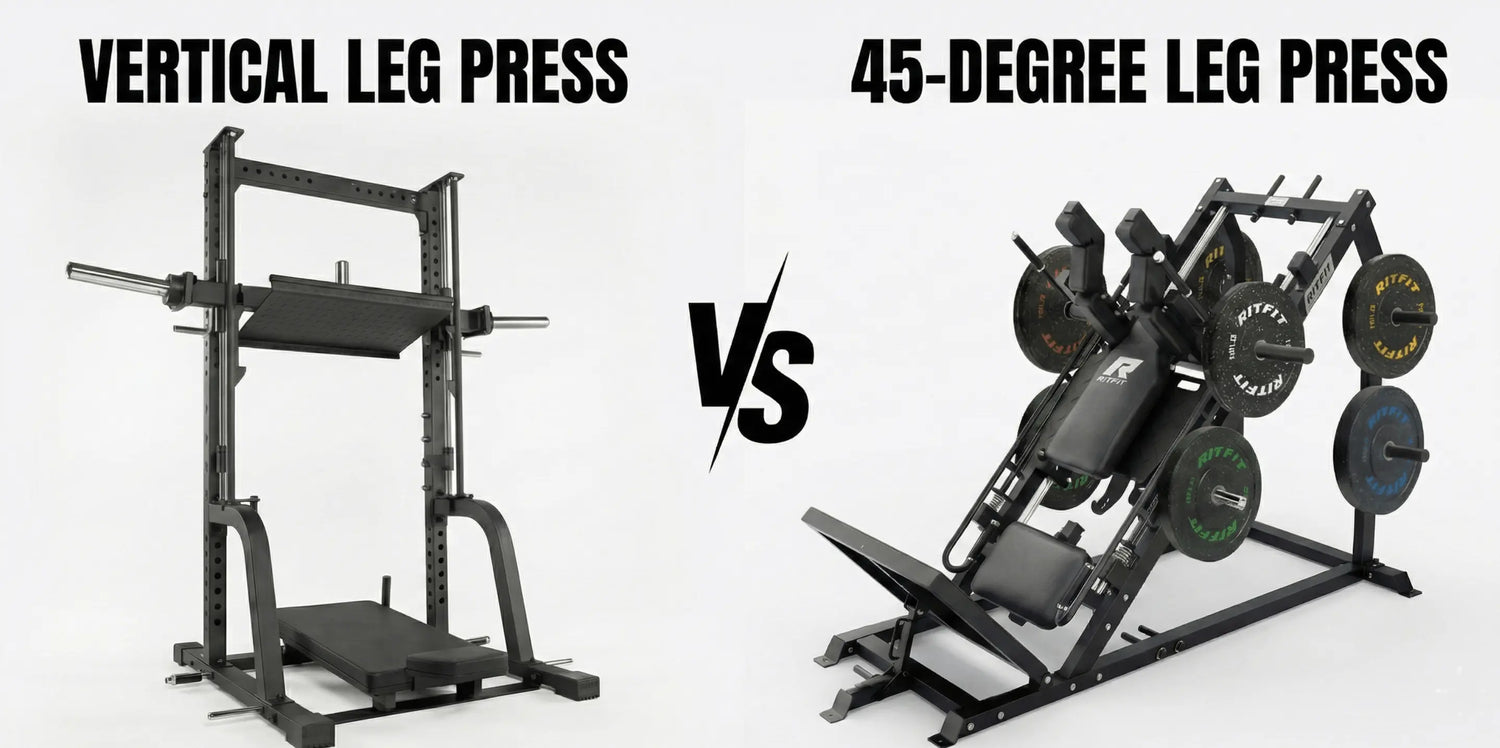
The best compact leg press for small spaces comes down to one trade-off: a vertical press fits a corner, while a 45-degree combo gives you more training options. This guide compares the two styles by footprint, biomechanics, and price so you can pick the machine that fits the floor you actually have.
You will get exact footprints, weight capacities, and a side-by-side comparison table, plus training notes for garages, basements, and apartments. Both styles are covered with real specs so you can measure your space once and buy the right machine.
Quick Answer: The best compact leg press for small spaces is a 45-degree leg press and hack squat combo if you have roughly 20 square feet, because it adds hack squats in one footprint. A vertical leg press wins below 15 square feet, where its vertical rail path removes the need for extra floor depth.
Key Takeaways
- Footprint First: A vertical leg press needs about 10 to 15 square feet of floor, while a compact 45-degree combo needs roughly 20 to 25 square feet.
- Resistance Ratio: A vertical press loads at a 1:1 ratio, and a 45-degree sled moves about 70% of the plate weight, so the same number on the pin feels different on each machine.
- Training Options: A leg press and hack squat combo covers two compound movements in one frame, while a vertical press only does leg press.
- Ceiling Clearance: A vertical press sends the carriage overhead, so it needs more vertical room than an angled sled in a low basement.
- Best Fit: Choose vertical below 15 square feet, and choose a 45-degree combo at 20 square feet or more when you want heavy quad work.
What Is the Difference Between a Vertical and a 45-Degree Leg Press?
A vertical leg press moves the sled straight up against gravity, while a 45-degree leg press moves it along an angled rail. That single change in geometry sets the resistance ratio, the joint angles, and how much floor depth the frame demands.
The Vertical Leg Press Uses a 1:1 Resistance Ratio
In a vertical press you lie flat with your legs extended straight up, and the plate posts sit directly above your hips.
- Resistance ratio: Gravity pulls straight down, so 200 lb on the posts feels like 200 lb at the feet, and you need fewer plates to create a heavy stimulus.
- Spine position: Your whole back stays on the floor pad, which keeps the trunk braced and the load path predictable on every rep.
- Mobility requirement: Tight hamstrings can pull your hips off the pad at the bottom, so you need enough hamstring range to keep the pelvis flat.
- Movement count: Almost every vertical frame does leg press only, so it cannot replace a squat movement.
The 45-Degree Leg Press Uses Mechanical Advantage
The sled travels on rails set at 45 degrees, which reduces the effective load to roughly 70% of the plates you hang on it.
- Resistance ratio: You move about 70% of the actual load, so a 45-degree machine needs more plates than a vertical press to feel equally heavy.
- Joint angles: The seated position is usually easier on the hips and lower back for lifters who do not have deep hip mobility.
- Range of motion: The angled path lets most lifters reach a deeper knee bend without the pelvis curling under.
- Movement count: The same sled accepts hack squat and calf raise work when the back pad and footplate are rearranged.
If you want to see how the two frame types sit side by side in a product lineup, the RitFit leg machines collection lists both styles with their current specs.
"Love this machine, so each to transition between leg press and hack squat. The quality is also very good."
Kayla N. Verified Buyer, RitFit BLP01 3-in-1 Leg Press and Hack Squat Machine
How Much Floor Space Does Each Style Actually Need?
A vertical leg press takes about 40 inches by 40 inches of floor, or roughly 10 to 15 square feet, because the weight travels straight up instead of out into the room. A compact 45-degree combo needs about 6 to 7 feet of length by 4 feet of width, or roughly 20 to 25 square feet.
- Vertical footprint: Most vertical frames occupy 10 to 15 square feet, and you can tuck one into a corner because there is no rail travel extending into the room.
- Combo footprint: Compact sleds condense the 9-foot frame of a commercial leg press down to about 6 to 7 feet long and 4 feet wide.
- Walking room: Add about 2 feet of clearance at the loading end so you can change plates without stepping around the frame.
- Ceiling clearance: A vertical press sends the carriage overhead, so measure the joists before you commit in a low basement.
Getting the tape measure right matters more than the spec sheet, and this breakdown of the best leg press machine for small spaces covers room layouts and doorway widths. You can also browse the full leg press machine collection to compare footprints model by model.
Why Does a Leg Press and Hack Squat Combo Win in a Garage Gym?
A leg press and hack squat combo wins in a garage gym because one frame covers two compound movements and removes the need for a separate squat rack. You can load the sled heavy for overall leg mass, then switch to hack squats for quad-focused work without giving up more floor space.
- Leg press: Use the sled for overall lower body mass with heavy resistance and a controlled lowering phase.
- Hack squat: Flip the back pad and the load sits on your shoulders, which removes the balance demand and lets you drive the quads directly.
- Calf raises: Most combo frames also accept calf work on the same footplate, so a third movement costs no extra square footage.
- Plate loading: Combo sleds accept 1,000 lb or more, which matters if you already own a large plate set.
A combo frame does not replace a full power rack for pressing and pulling, but it does replace the squat movement for bodybuilding-focused training. That single change is what makes the 45-degree style the better long-term buy for a garage bay.
"The best quad exercise in the world is going to be your hack squats. You're always going to get more press on the front thighs. If you can get into a hack squat machine and it does not hurt, this is the ultimate exercise to build those frontal thighs."
Jay Cutler, Four-time Mr. Olympia, Cutler Nutrition, Jay Cutler Shares the Best Quad Exercise in the World to Build Size, Generation Iron
Which RitFit Leg Press Machine Fits a Tight Space?
The RitFit BLP01 is the best compact leg press for most small spaces because it combines leg press, hack squat, and calf raise work in roughly 20 square feet. The RitFit Gazelle Pro is the step up for lifters who want a higher weight capacity and multi-level safety arms.
RitFit BLP01: The Best 3-in-1 Compact Combo
The RitFit BLP01 3-in-1 Leg Press and Hack Squat Machine is built for residential depth, and it converts from leg press to hack squat by flipping the back pad and adjusting the footplate.
- Frame: A triangulated steel frame rated to 1,000 lb keeps the sled planted when you load it heavy for squats and presses.
- Glide: Linear bearings replace the plastic bushings used on cheaper home units, which removes the drag that shows up mid-rep.
- Versatility: Leg press, hack squat, and calf raise all run on one footplate, and the BLP01 full leg workout package adds matching leg extension and curl work.
- Footprint: At roughly 6 to 7 feet long and 4 feet wide, it drops into a single garage bay without blocking the walkway.
RitFit Gazelle Pro: The Heavy-Loading Upgrade
The RitFit Gazelle Pro 3-in-1 Leg Press and Hack Squat Machine raises the load ceiling to 2,000 lb and adds multi-level lockout arms for solo training.
- Weight capacity: The higher rating suits lifters who already press near the top of a 1,000 lb frame and want headroom to keep adding plates.
- Safety arms: Multi-level spotting arms let you set a catch height, so you can push a heavy set alone at night without a partner.
- Footprint: It still stays in the compact class at about 29 square feet, which keeps it inside a dedicated home gym without eating the whole room.
Both frames accept the same 45-degree rail geometry, so the choice between them comes down to capacity and budget rather than training style.
"The Gazelle Pro arrived in two different shipments, took 30minutes to open and place the parts and 3 hours to completely build. It's very helpful to have the manual and the video for confirmation on the steps. I am very happy with the Gazelle Pro as an addition to my small home gym."
Tim J. Verified Buyer, RitFit GAZELLE PRO 3-In-1 Leg Press and Hack Squat Machine
How Do You Choose Between a Vertical Press and a 45-Degree Press?
Match the machine to your floor area and your training goal: pick a vertical press under 15 square feet, and pick a 45-degree combo at 20 square feet or more. Your ceiling height and your plate collection decide the rest.
| Feature | Vertical Leg Press | Compact 45-Degree Combo | RitFit Gazelle Pro |
|---|---|---|---|
| Primary movement | Leg press only | Leg press, hack squat, calf raise | Leg press, hack squat, calf raise |
| Footprint | About 10 to 15 sq ft | About 20 to 25 sq ft | About 29 sq ft |
| Max weight capacity | 400 to 500 lb | 1,000 lb | 2,000 lb |
| Rail path | Vertical, no travel into the room | 45-degree rails, about 70% effective load | 45-degree rails, about 70% effective load |
| Ceiling clearance | Highest of the three | Moderate | Moderate |
| Best for | Apartments and spare rooms | Garages and basements | Dedicated home gyms |
Footprint and capacity values are typical residential figures; confirm the current spec sheet for the exact model before ordering.
- Apartment or spare room: With under 10 square feet of free floor, the vertical press is the only style that fits, and it stays quiet because nothing travels across the room.
- Garage or basement: With 20 to 25 square feet free, a 45-degree combo delivers heavy leg press and hack squat work from one frame.
- Seated pressing preference: The 45-degree seat is easier to get in and out of, and it does not ask for the hamstring range a vertical press requires.
- Shared or styled home gym: The same BLP01 frame also ships in pink, which matters when the gym doubles as a guest room.
How Should You Train Legs in a Small Space?
Small-space leg training works best with tempo control, varied foot placement, and pre-exhaust sets, because a compact machine limits total load long before it limits muscle growth. Three adjustments cover most of the plateaus you will hit in your first year on a leg press.
Control the Tempo on Every Rep
Lower the sled for 3 seconds, pause for 1 second without bouncing, and drive up in 1 second.
- Why it works: The longer lowering phase raises time under tension, so a moderate load creates the same growth stimulus as a much heavier set you cannot control.
- What to avoid: Bouncing out of the bottom shifts the work to the tendons and shortens the range of motion that actually builds the quads.
Change Foot Placement to Shift the Load
Foot position decides which muscle group carries most of the work on the same machine.
- Glutes and hamstrings: Place your feet high and wide on the plate and use 3 sets of 8 to 10 reps.
- Quad sweep: Place your feet low and narrow with heels flat and use 3 sets of 12 to 15 reps.
- Stance width: Widen your stance by a few inches if your knees drift inward on heavy sets.
Add Pre-Exhaust on Low-Load Days
Pre-exhaust lets you train hard on days when you cannot load the sled heavy.
- The superset: Do 15 reps of goblet squats or walking lunges, then move straight into a leg press set to failure.
- Equipment detail: RitFit also lists a foot plate for leg press if you want a wider, grippier platform than a stock plate.
- Progression: Add reps before you add plates, and keep a written log so you can see the trend across weeks.
Conclusion
The best compact leg press for small spaces depends on floor area, not brand loyalty.
Under 15 square feet, a vertical press is the only style that fits.
At 20 square feet or more, a 45-degree leg press and hack squat combo gives you two compound movements in one frame, which is the better long-term buy for most garage gyms.
Measure your space, check the ceiling, and check the current RitFit discount codes before you order so the machine lands at the best available price.
Disclaimer
This article provides general fitness equipment information and is not medical advice. Consult a qualified physician or physical therapist before starting a new training program, especially if you have a history of back, hip, or knee injury.





