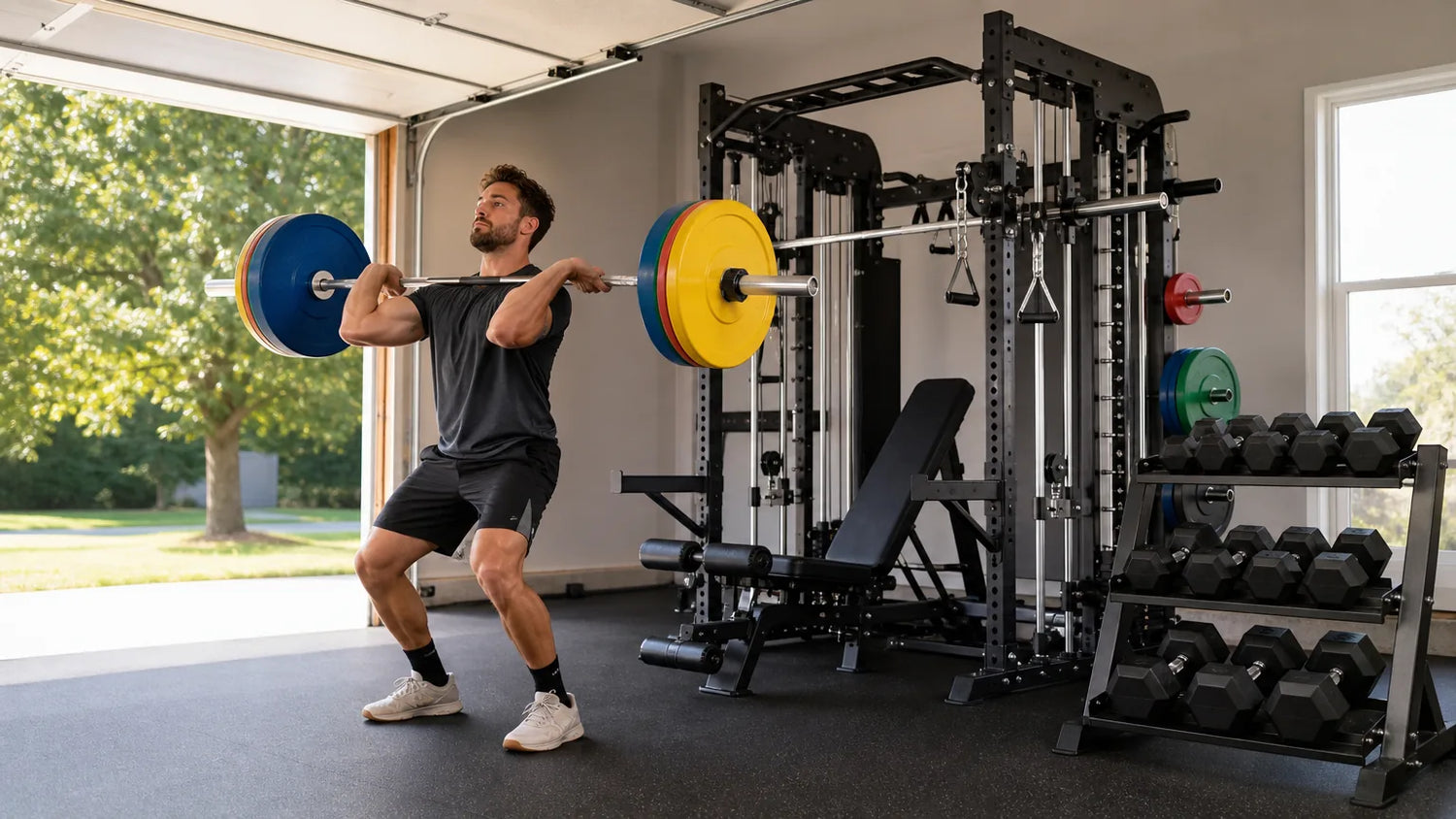
The best CrossFit home gym packages in 2026 bundle a rated power cage, an Olympic barbell, and a full bumper plate set into one purchase. This guide helps you choose the right complete setup for your space and goals.
You will learn what components actually matter, how much weight to start with, where smart tracking fits, and which RitFit package suits your budget and training ambitions.
Quick Answer: The best CrossFit home gym packages combine a rated power cage, a needle-bearing Olympic barbell, and around 250 pounds of bumper plates in a single bundle. Buying the package instead of piecing gear together saves money, guarantees compatible parts, and covers most benchmark WODs from day one.
Key Takeaways
- Buy the bundle: A package guarantees a compatible cage, barbell, and plates while saving money over buying each piece separately.
- Bumper plates are non-negotiable: CrossFit involves dropping loaded barbells, so rubber bumpers protect your bar, floor, and safety.
- Start near 250 pounds: A 45 pound Olympic barbell plus roughly 250 pounds of bumpers covers most benchmark WODs.
- Match the package to your space: Cage packages suit dedicated garages, while modular and all-in-one options fit tighter rooms.
- Tracking is a helpful add-on: Logging volume and recovery matters, but the cage, barbell, and plates come first.
Why a CrossFit Home Gym Package Beats Buying Piece by Piece
A CrossFit home gym package beats piecemeal buying because it delivers a matched cage, Olympic barbell, and bumper plate set in one order, so you avoid mismatched specs and duplicate shipping costs. Structured CrossFit programs have improved maximal strength and squat performance in both untrained and recreationally active people, which makes a complete barbell setup worth the investment.[1]
- Compatibility guaranteed: The barbell sleeve diameter, plate hole size, and cage width are engineered to work together out of the box.
- Lower total cost: Bundles price the cage, bar, and plates below the sum of separate purchases and cut per-item freight.
- Faster to train: One delivery means you can build your garage gym and start hitting WODs in a single weekend.
This approach suits any CrossFit enthusiast building a home or garage gym from scratch. If you want to study one component more deeply, see our guide to the best CrossFit barbell for a home gym.
What Must a CrossFit Package Include?
A CrossFit package must include three non-negotiable pieces: a rated power cage or rack, an Olympic barbell, and a bumper plate set. These three components cover squats, presses, deadlifts, and the Olympic lifts that define most workouts of the day.
The Power Cage or Rack Anchor
The cage is your anchor for squats, presses, and safe bailouts, and for CrossFit it should carry a multi-grip pull-up bar for kipping work. Look for a high weight capacity and safety arms so you can fail a lift without a spotter.
- Weight capacity: Choose a frame rated well above your working loads, ideally 1000 pounds or more for long-term headroom.
- Pull-up options: A multi-grip bar supports kipping and butterfly pull-ups that generate lateral force.
- Safety arms: Adjustable spotter arms or straps let you bail on failed squat cleans safely.
Explore complete cage-based options in the barbells and weight plates category before you commit.
The Olympic Barbell
The Olympic barbell is the backbone of CrossFit lifting and should spin smoothly for cleans and snatches. A 20 kilogram men's bar or 15 kilogram women's bar with needle bearings, high PSI steel, and a medium knurl handles repeated dynamic lifts.
- Needle bearings: They allow fast, smooth sleeve rotation during snatches and clean and jerks.
- Tensile strength: Higher PSI steel resists bending under repeated heavy drops.
- Knurl: A medium knurl grips well without shredding your hands during high-rep WODs.
In one study of twelve recreationally trained men, back squats performed with a traditional Olympic barbell showed no significant peak force difference against a safety squat bar, but the Olympic bar produced greater average bar velocity.[2] Olympic weightlifting movements are also widely studied for developing athletic performance, which supports choosing a true Olympic bar.[3]
The Bumper Plate Set
Bumper plates are essential because CrossFit requires dropping loaded barbells from overhead or shoulder height. Rubber bumpers absorb that impact, protect the bar sleeves and floor, and let you train the Olympic lifts safely at home.
How Do You Pick the Barbell and Bumper Plates?
You pick the barbell and bumper plates by matching spin quality and starting weight to your WOD demands rather than chasing the heaviest set. Most CrossFit enthusiasts start with about 250 pounds of bumpers plus a 45 pound bar, which covers prescribed loads for the majority of benchmark workouts.
- Starting bumper load: Begin with roughly 250 pounds, then add pairs as your lifts climb.
- Change plates: Add small cast iron 5 and 2.5 pound pairs for fine strength-work adjustments.
- Plate quality: Choose dead-bounce rubber bumpers that stay flat on the floor after a drop.
Browse dedicated plate options in the bumper plates collection, or add a pair of RitFit black bumper plates when you are ready to scale up.
Where Does Smart Tracking Fit In?
Smart tracking fits in as a helpful layer that monitors training volume, heart rate, and recovery so you can balance intensity with rest. CrossFit imposes high cardiorespiratory and metabolic demands, and muscle damage and neuromuscular fatigue can persist for up to 48 hours, so balancing intense sessions with recovery is crucial.[1]
- Volume logging: Recording sets and loads shows whether you are progressing or plateauing.
- Recovery cues: Heart rate and readiness data help you decide when to push and when to back off.
- Add-on, not core: Prioritize the cage, barbell, and plates first, then layer tracking on top.
Tracking supports consistency, but it does not replace solid equipment, so treat it as an enhancement to a complete home setup.
Which RitFit Package Is Right for You?
The right RitFit package depends on your space, budget, and training focus rather than a single best pick. Dedicated CrossFit lifters with a medium to large garage suit a cage package, while smaller rooms and mixed-training users lean toward modular or all-in-one setups.
| Package | Best For | Space and Setup |
|---|---|---|
| RitFit P3 Power Cage 1200lbs package | Dedicated CrossFit lifters wanting maximum capacity | 1200 pound rated cage, medium to large garage |
| RitFit M2 Series modular package | Mixed training across strength and functional work | Multi-functional modular frame, moderate space |
| RitFit BPC06 all-in-one package | Beginners wanting guided plus free-weight lifting | Hybrid guided design, compact footprint |
| Standalone plate expansion | Adding load to any existing package over time | Extra bumper pairs, minimal footprint |
Comparison covers RitFit packages only and reflects intended use rather than a ranking.
If your ceiling is low or space is tight, a pink color option like the RitFit P3 Pink Power Cage package offers the same capacity in a different finish.
What Does It Cost and Will You Outgrow It?
A complete CrossFit package is worth the price because a rated cage, Olympic barbell, and solid bumper set anchor your training for years. Rather than replacing the whole setup, you simply add plate pairs, kettlebells, or accessories as you get stronger.
- Upfront value: Bundling lowers cost per component versus buying separately.
- Expansion path: Add bumper pairs and change plates instead of a new rig.
- Long-term anchors: Choose the cage and bar for capacity, not just your current numbers.
Time away from the bar does not erase your progress, which is why a durable package pays off over the long run.
"If you don't train with barbells for a couple months, your maxes on the big barbell lifts may initially be lower when you can get back under the bar. However, that apparent drop in strength should mostly be due to rusty motor patterns, if you built or maintained muscle mass, your barbell strength should return to and exceed previous levels pretty quickly."
Greg Nuckols, MA, Strength Researcher and Coach, Stronger By Science
What Mistakes Should You Avoid?
The biggest mistake is buying too little plate weight or a low-quality bar that cannot handle repeated drops. Planning for expansion and measuring your space up front prevents most costly errors.
- Skipping bumpers: Cast iron plates crack and bounce dangerously when dropped during Olympic lifts.
- Undersizing the frame: A low-capacity cage limits your ceiling for heavy squats and presses.
- Ignoring ceiling height: Measure floor-to-ceiling clearance before buying a cage with a pull-up bar.
- Buying too few plates: Start near 250 pounds so you are not stuck re-ordering after your first month.
Compare related buying advice in our guide to American flag bumper plates for home gyms before finalizing your order.
FAQs About CrossFit Home Gym Packages
Do I really need bumper plates for a CrossFit home gym?
Yes, bumper plates are essential for CrossFit at home. Olympic lifts like cleans, snatches, and thrusters require dropping the loaded barbell from shoulder or overhead height. Rubber bumper plates absorb that impact, protect your barbell sleeves and floor, and let you train safely without a spotter. Cast iron plates crack and bounce dangerously on drops.
How much weight should a starter CrossFit package include?
Most CrossFit enthusiasts start with around 250 pounds of bumper plates plus a 45 pound Olympic barbell. That covers the prescribed loads for the majority of benchmark WODs. You can add cast iron change plates in small increments for strength work, then expand your bumper set later as your lifts get heavier over time.
What barbell specs matter most for CrossFit?
Look for a 20 kilogram men's or 15 kilogram women's Olympic barbell with needle bearings for smooth spin during cleans and snatches, high tensile strength steel measured in PSI, and a medium knurl for grip without tearing your hands. These features let the bar handle repeated dynamic lifts and dropping across years of training.
Is smart tracking worth it in a home gym package?
Smart tracking helps you monitor volume, heart rate, and recovery, which matters because CrossFit sessions create fatigue that can linger for up to 48 hours. Logging your work makes it easier to balance intensity with rest and progress steadily. It is a helpful add-on rather than a core requirement, so prioritize the cage, barbell, and plates first.
Will I outgrow a complete CrossFit package?
A quality package built around a rated power cage, Olympic barbell, and a solid bumper plate set will serve most lifters for years. Rather than replacing the whole setup, you simply add plate pairs, accessories, or kettlebells as you get stronger. The cage and barbell are long term anchors, so choose them for capacity rather than your current numbers.
Conclusion
The best CrossFit home gym packages pair a rated power cage, a needle-bearing Olympic barbell, and around 250 pounds of bumper plates in one bundle. Match the package to your space, budget, and WOD goals, and start with enough plate weight to cover most benchmark workouts.
Measure your space, choose a frame with room to grow, and explore a complete option like the RitFit M1 PRO home gym package to build the setup that fits your training.
Disclaimer
This article is for general informational purposes only and does not replace professional fitness or medical guidance. Consult a qualified trainer or healthcare provider before starting a new training program or lifting heavy loads at home.
Save on your next RitFit order
Tap the button to copy your code, then paste it at checkout.
References
1. Rios M, Pyne DB, Fernandes RJ. The Effects of CrossFit(R) Practice on Physical Fitness and Overall Quality of Life. Int J Environ Res Public Health. 2024;22(1). doi:10.3390/ijerph22010019
2. Staheli N, Cowley JC, Lawrence MM. Comparison of Olympic and Safety Squat Bar Barbells on Force, Velocity, and Rating of Perceived Exertion During Acute High-Intensity Back Squats in Recreationally Trained Men. Int J Exerc Sci. 2024;17(7):1120-1133. doi:10.70252/QTXB6775
3. Crenshaw K, Zeppieri G, Hung CJ, et al. Olympic Weightlifting Training for Sprint Performance in Athletes: A Systematic Review with Meta-analysis. Int J Sports Med. 2024;45(6):411-421. doi:10.1055/a-2161-4867