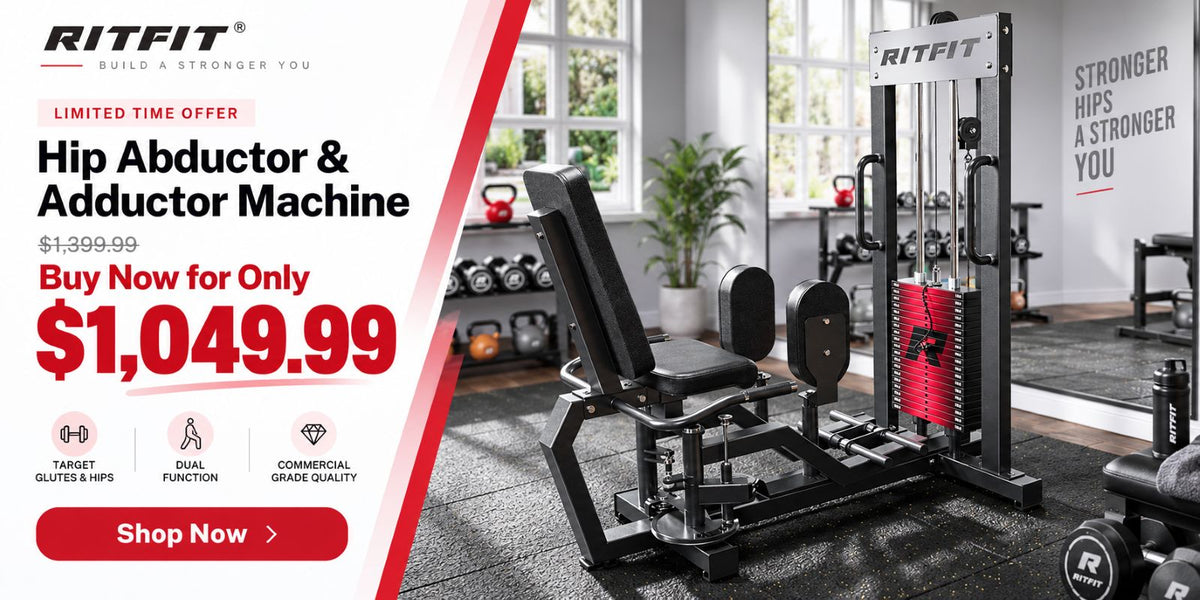
The best hip abductor and adductor machine for a home gym isolates the outer glutes and inner thighs with stable seated positioning and repeatable resistance, filling a gap that squats and bands often leave unaddressed. This guide covers what the machine trains, which features matter most, and how the RitFit Home Hip Abductor and Adductor Machine fits those criteria.
This machine suits home gym owners who already have a core lower body setup and want targeted hip accessory work. Start conservatively if you have any existing hip, knee, or groin discomfort.
Quick Answer: The best hip abductor and adductor machine for a home gym combines dual-function training, adjustable resistance, stable seating, and a compact footprint. The RitFit Home Hip Abductor and Adductor Machine offers a 12.7 sq ft footprint, 200 lb weight capacity, and 70-degree abduction range per side for targeted outer glute and inner thigh training.
Key Takeaways
- Target muscles: Hip abductors (gluteus medius, gluteus minimus, TFL) and hip adductors (adductor longus, brevis, magnus, gracilis, pectineus) are both trained in a single seated station.
- Machine advantage: Dedicated machines provide stable positioning, precise load increments, and repeatable progressive overload that bands cannot match for tracking.
- RitFit footprint: The RitFit Home Hip Abductor and Adductor Machine has a 12.7 sq ft footprint (60.2 in x 30.3 in), suitable for garage and basement gym layouts.
- Weight capacity: The machine handles up to 200 lb, which covers the loading range needed for most hip isolation work.
- Best use case: This machine works best as accessory work alongside compound lower body lifts such as squats, leg press, and hip thrusts, not as a standalone lower body solution.
What a Hip Abductor and Adductor Machine Actually Trains
A hip abductor and adductor machine trains two muscle groups in one seated station: the outer hip muscles that push the legs apart (abductors) and the inner thigh muscles that pull the legs together (adductors). Compound movements like squats and deadlifts load these muscles secondarily, but a dedicated machine isolates them with far more precision and consistent resistance across the full range of motion.
Muscles Targeted: Abductors and Adductors
The abductor side activates the gluteus medius, gluteus minimus, and tensor fasciae latae (TFL) along the outer hip and upper glute. The adductor side works the adductor longus, adductor brevis, adductor magnus, gracilis, and pectineus along the inner thigh.
- Gluteus medius: The primary outer hip stabilizer, responsible for pelvic control during walking, running, and single-leg movements.
- Gluteus minimus: Assists the medius in abduction and internal hip rotation, adding depth to outer glute training.
- Tensor fasciae latae: Connects the hip to the IT band; supporting it reduces lateral knee strain in runners and cyclists.
- Adductor group: The five inner thigh muscles control leg closure, contribute to hip flexion, and stabilize the pelvis from the medial side.
Why These Muscles Matter for Knee Alignment and Pelvic Stability
Hip abductor weakness is linked to various lower-body issues including knee tracking problems and hip instability, according to a 2025 narrative review on hip abductor strengthening for lower extremity rehabilitation.[1] Strengthening both muscle groups with a controlled machine helps build the lateral hip strength that guards against those downstream effects.
- Pelvic drop during single-leg stance: Weak hip abductors allow the pelvis to tilt downward on the unsupported side, adding stress to the knee and IT band.
- Knee valgus (caving in): Insufficient abductor strength is associated with inward knee collapse during squats, lunges, and running gait.
- Groin strains: Underdeveloped adductors increase vulnerability during lateral cuts and explosive direction changes.
A hip abductor and adductor machine gives home gym users direct access to these stabilizing muscles through a dedicated seated station, without requiring cables, extra attachments, or balance-dependent setups.
"Absolutely love this machine! Perfect fit for my home gym!"
Andrea S. Verified Buyer, RitFit Panther Home Hip Abductor and Adductor Machine
"The best home gym equipment earns its space by being useful, adjustable, and easy to use consistently. The RitFit Panther Home Hip Abductor and Adductor Machine does exactly that by combining two valuable lower body exercises in one dedicated station."
BOXROX, One Perfect Machine for Stronger Glutes and Hips
How Does a Hip Machine Compare With Bands and Cables?
A dedicated hip abductor and adductor machine is the most practical option for home gym users who want stable seated positioning, easy load progression, and consistent training from session to session. Bands and cables remain useful tools for activation and variety, but each has specific limitations compared to a machine setup.
When the Machine Wins for Progressive Overload
Machine training provides numbered resistance increments that make load tracking simple and objective. You can increase load by a single increment, record it in a training log, and confirm progress week over week without guessing at band tension.
- Seated stability: The backrest and fixed pad position eliminate balance as a limiting factor, letting you direct all effort into the hip muscles.
- Bilateral symmetry: Both legs train simultaneously and in equal ranges, which makes it easier to notice and address left-right imbalances.
- Higher rep work: Hip isolation is typically trained with controlled moderate-to-high rep sets, and the seated machine supports those sets comfortably without fatigue from stabilizing the rest of the body.
When Bands Still Make Sense
One study found that elastic resistance elicited somewhat higher gluteus medius muscle activity than machine training during hip abduction, while both modalities showed similar activation during adduction exercises.[2] Bands remain a practical choice for warm-up activation, travel workouts, and low-load rehab contexts where a full machine is not available.
- Warm-up drills: Banded clamshells, lateral walks, and monster walks are efficient pre-workout activation tools.
- Travel and budget settings: Bands cost far less and pack into any bag for on-the-go work.
- Variable resistance curve: Bands increase tension as the movement extends, which produces a different stimulus than constant machine resistance.
| Training Option | Best For | Main Limitation |
|---|---|---|
| Hip abductor and adductor machine | Repeatable progressive overload, seated isolation, measurable load tracking | Requires dedicated floor space and upfront investment |
| Resistance bands | Warm-ups, activation drills, travel workouts, low-cost training | Harder to measure and track load precisely over time |
| RitFit M1 Smith Machine With Cable Crossover | Standing hip work, diagonal movement patterns, accessory variety | Requires balance and attachment setup; less direct than seated machine |
Comparison reflects the training tool characteristics discussed in this guide. The RitFit M1 row represents the brand's cable-based alternative for standing hip work.
What Features Should You Look for Before Buying?
The best hip abductor and adductor machine for a home gym should combine a dual-function design, adequate resistance capacity, adjustable range settings, comfortable padding, and a realistic footprint before any purchase is made. Evaluating each feature against your room dimensions, training goals, and body proportions prevents a costly mismatch.
Dual-Function Design and Range of Motion
A single machine that handles both abduction and adduction saves floor space and budget compared to buying two separate stations. Look for a unit where switching between modes requires minimal adjustment, and where both movement arcs are smooth throughout the full range.
- Abduction range: A range of at least 60 to 70 degrees per side allows most users to train through a full outer hip contraction.
- Adduction range: An adduction range above 90 degrees per side accommodates a wider starting position, which helps taller users enter and exit the machine comfortably.
- Pad adjustability: Thigh pads that can be repositioned for different leg lengths and hip widths improve fit for a range of body types.
Resistance Capacity and Progressive Overload
Hip abductor and adductor work typically uses lower loads than compound lower body lifts, but the machine must still allow meaningful progression over months or years of training. A weight capacity of at least 150 to 200 lb is sufficient for most home gym users at all training levels.
- Incremental loading: Choose a machine with clearly marked resistance levels so you can track and repeat load settings across sessions.
- Starting resistance: Beginners often start lighter than expected, so a machine that provides usable resistance at its lower settings matters as much as maximum capacity.
Footprint, Build Quality, and Ergonomics
Measure your available floor space before ordering, including walking clearance around the machine and the space your legs need during the abduction phase. Steel frame construction, quality padding, and a stable base directly affect how comfortable and sustainable the training experience feels over time.
- Floor space planning: Add at least 12 to 18 inches of clearance on each side of the listed footprint for safe entry, exit, and full leg extension during abduction.
- Seat and back support: A non-adjustable seat is common on budget-friendly machines. Confirm the seat height suits your proportions before purchasing, particularly for users over 6 feet tall.
- Frame material: Look for Q235 or similar structural steel, which provides a stable base under load without excessive flex.
Browse the RitFit leg machine collection for a full view of lower body equipment options.
What Are the RitFit Home Hip Abductor and Adductor Machine Specs?
The RitFit Home Hip Abductor and Adductor Machine is built for home leg strength training, providing both outer glute isolation and inner thigh work in a single compact station. According to RitFit product specs, it has a 12.7 sq ft footprint, 200 lb weight capacity, and separate resistance ratios for each movement direction.
Dimensions, Weight Capacity, and Resistance Ratios
The machine measures 60.2 in long, 30.3 in wide, and 63.7 in tall, with a Q235 steel frame. The hip abduction resistance ratio is 0.88:1 and the adduction ratio is 0.66:1, meaning the felt load per pound of plate weight differs slightly between the two movements.
| Specification | Value |
|---|---|
| Length | 60.2 in (153 cm) |
| Width | 30.3 in (77 cm) |
| Height | 63.7 in (162 cm) |
| Footprint | 12.7 sq ft (1.18 m²) |
| Frame material | Q235 Steel |
| Weight capacity | 200 lb |
| Hip abduction range | 70 degrees per side |
| Hip adduction range | 96 degrees per side |
| Hip abduction resistance ratio | 0.88:1 |
| Hip adduction resistance ratio | 0.66:1 |
Source: RitFit product specifications page.
Who It Fits and Height Considerations
The machine is well suited for users up to approximately 6 feet tall. Users taller than 6 feet should note that the back pad is fixed, which may shift where the thigh pads contact the upper leg, though this generally does not affect training effectiveness for most movements.
- Assembly: The machine ships in two primary boxes plus weight stack boxes and can be assembled by one person in roughly two to three hours.
- Floor prep: Use rubber gym flooring under the unit to protect both the machine frame and the floor surface.
- Monthly maintenance: Check bolts, cable tension, and pad condition monthly to keep the movement feel consistent over time.
For a full lower body setup that pairs compound and isolation training, the RitFit Gazelle 3-in-1 Leg Press Hack Squat Machine and the RitFit BE01 Adjustable Back Extension Machine round out a complete lower body accessory station alongside the hip machine.
How to Use the Machine Safely and Effectively
Safe and effective use of the hip abductor and adductor machine starts with a controlled tempo, a neutral lower back, and a range of motion you can own without hip pinching, sharp sensation, or the urge to rock your torso. Setting up correctly before adding load is the most important step for both beginners and experienced users.
Setup and Starting Position
Sit fully back against the pad with your lower back in contact with the support. Position the thigh pads so they contact your outer thighs (for abduction) or inner thighs (for adduction), not your knees, and adjust the starting angle to where you feel mild tension without discomfort before the movement begins.
- Abduction setup: Legs start together; pads brace the outer thighs; push outward to the point of full contraction, then return slowly.
- Adduction setup: Legs start wide; pads brace the inner thighs; squeeze inward to midline, then lower slowly back to the start.
- Grip: Hold the side handles lightly for balance only. Pulling on them to assist the movement shifts load off the target muscles.
Rep Tempo and Range of Motion
A controlled 2-second concentric and 3-second eccentric tempo keeps the target muscles under load throughout the rep and eliminates the momentum that lets heavier but uncontrolled weight substitute for actual muscle work.
- Avoid snapping to the end range: Especially on adduction, letting the weight pull your legs apart quickly at the bottom increases groin strain risk.
- Work within a pain-free arc: If hip pinching or sharp sensation appears within the range, reduce the movement angle rather than pushing through it.
- Full contraction at end range: Pause briefly at the point of peak contraction, especially during abduction, to improve the mind-muscle connection.
Common Mistakes and How to Fix Them
The most common errors on this machine are using too much weight too early, allowing torso rocking, and rushing the eccentric phase. Each one reduces training stimulus and raises injury risk.
- Torso rocking: If your upper body sways with each rep, the load is too heavy. Drop weight until you can complete the set with a still torso.
- Asymmetric leg travel: If one leg travels farther than the other, check pad height symmetry and reduce load until both sides move evenly.
- Skipping the eccentric: The return phase (leg closing on abduction, leg opening on adduction) is half the training stimulus. Control every rep in both directions.
How Should You Program Sets, Reps, and Progression?
Hip abductor and adductor training responds well to moderate rep ranges (10 to 20 reps) with controlled tempo, performed two to three times per week as accessory work after compound lower body lifts. Starting conservatively and progressing load or volume weekly is more sustainable than loading aggressively from the first session.
Starter Sets and Rep Ranges
Begin with 3 sets of 12 to 15 reps on each movement, using a weight that allows full range of motion with clean technique and no torso rocking. Train both abduction and adduction in the same session to maintain balanced hip strength across the inner and outer sides.
- Week 1 to 2: 3 sets x 12 reps, focus on learning range of motion and tempo before adding load.
- Week 3 to 4: 3 sets x 15 reps at the same load if technique is solid; then consider a small load increase.
- Ongoing: Add one increment of resistance when you can complete 3 sets of 15 reps with full control across two consecutive sessions.
When and How to Increase Resistance
A study found that 8 weeks of low-dose hip abductor-adductor training increased peak torque 14 to 18 percent and rate of force development 31 to 39 percent in older adults, suggesting consistent work at manageable loads produces meaningful adaptation over time.[3] Progressive overload on the machine does not require big jumps; small, consistent increments compound significantly over a training cycle.
- Double progression: First increase reps (12 to 15), then increase load by one increment, then repeat the cycle.
- Deload every 4 to 6 weeks: Drop to 2 sets x 10 reps at a lighter load to allow connective tissue recovery before resuming progression.
How to Pair with Compound Lower Body Work
Treat hip abduction and adduction as accessory work, not as the primary lower body stimulus. Perform squats, leg press, or hip thrusts first, then finish with the hip machine while fatigue from the main lifts is the targeted stimulus.
- Lower body day order: Squats or leg press first, then hip machine, then optional isolation work for hamstrings or calves.
- Pairing suggestions: Hip abduction pairs well after hip thrust training to fully exhaust the glute complex, or before a beginner-focused hip machine session to pre-activate the outer glutes.
"Many gyms have machines that allow for this. If you find one that feels right, then go really hard on these and make them a staple movement and go for progressive overload over time. The 4-way hip machine can work well."
Bret Contreras, PhD in Sports Science, known as The Glute Guy, Contreras Strength Institute, Do More Than Just Squat
"Love my dumbbells!! Can't wait till I get the proper rack!!"
Karen J. Verified Buyer, RitFit Pink PVC-Coated Round Dumbbells in Pairs
"My wife wanted some quality dumbbells for a decent price and these hit the mark on both points. She loves them and is happy we ordered them."
Daniel H. Verified Buyer, RitFit Rubber Hex Dumbbells Pairs and Sets
Who Should Buy This Machine?
The RitFit Home Hip Abductor and Adductor Machine is best for home gym owners who want targeted hip, glute, and inner thigh training that delivers measurable progression beyond what bands or compound lifts alone can provide. It works best as a complement to an existing lower body program rather than as an entry-point purchase.
Buy It If
- You want dedicated outer glute and inner thigh isolation with stable seated positioning and trackable resistance.
- You train lower body two or more times per week and have a compound lift base in place (squats, leg press, or hip thrusts).
- You prefer seated machine work over standing cable hip exercises, especially for higher-rep accessory sets.
- You have at least 65 in x 60 in of usable floor space after accounting for entry and exit clearance.
For a complete home gym built around this machine, consider pairing it with the RitFit Home Gym Package M1 Smith Machine or the RitFit Home Gym Package PSR05 Smith Machine for compound lift coverage, or the M3 Home Gym Smith Machine for a premium cable-integrated setup.
Skip It If
- You have not yet set up a primary lower body station (rack, bench, or leg press). Address foundational equipment first.
- You only need light activation work that resistance bands can already cover for your current training goals.
- Space is extremely limited and you still need room for your first squat rack or main compound lower body machine.
For more on building your home gym around compound lower body training, the best rowing machine for home gyms guide covers complementary cardio and full-body options that pair well with a lower body machine setup.
FAQs About the Best Hip Abductor and Adductor Machine for Home Gym
What muscles does a hip abductor and adductor machine work?
The abductor side targets the gluteus medius, gluteus minimus, and tensor fasciae latae along the outer hip. The adductor side works the adductor longus, adductor brevis, adductor magnus, gracilis, and pectineus on the inner thigh, supporting pelvic stability, knee alignment, and balanced lower body strength.
How much space does the RitFit Hip Abductor and Adductor Machine need?
The RitFit machine has a listed footprint of 12.7 sq ft, measuring 60.2 in long by 30.3 in wide. You should also leave clearance on each side for entering, exiting, and the leg range of motion during abduction, so plan for roughly 65 in by 60 in of total floor space in your garage or basement gym.
Is a hip abductor and adductor machine better than resistance bands?
Both are effective tools. The machine offers stable seated positioning, precise load increments, and repeatable progressive overload, which makes load tracking simple and objective. Bands can elicit somewhat higher gluteus medius activation during abduction, so use them for warm-up drills and activation sets.
How often should you train on a hip abductor and adductor machine?
Two to three sessions per week is a practical starting point, with at least one rest day between sessions to allow recovery. If you pair this machine with squats or leg press, treat it as accessory volume performed after your main compound lifts are complete.
What weight should a beginner use on the hip abductor and adductor machine?
Start at a load where you can complete 3 sets of 12 to 15 reps with full control and no hip pinching, which is typically lighter than most beginners expect. Control the return phase on every rep rather than letting the weight snap back.
Can you build glutes with a hip abductor machine?
Hip abduction trains the gluteus medius and gluteus minimus, which shape the outer glute and contribute to hip width. This machine does not replace hip thrusts or squats for overall glute mass, but it adds targeted accessory work that compound movements tend to underload, making it a useful addition to a complete lower body program.
What is the weight capacity of the RitFit Hip Abductor and Adductor Machine?
The RitFit Home Hip Abductor and Adductor Machine has a listed weight capacity of 200 lb. This covers the loading range most users work in for hip isolation exercises, which typically require less resistance than leg press or squat movements. The 0.88:1 abduction and 0.66:1 adduction resistance ratios mean the felt load differs slightly between movements.
Conclusion
The best hip abductor and adductor machine for a home gym trains both the outer glutes and inner thighs in one stable, seated station with trackable resistance. The RitFit Home Hip Abductor and Adductor Machine delivers on all four buying criteria: dual-function design, 200 lb capacity, 12.7 sq ft footprint, and full range of motion.
Start with 3 sets of 12 reps at a conservative load, pair it after compound lower body lifts, and progress one increment at a time. Explore the full leg machine collection to find the complete lower body setup that fits your space and goals.
Disclaimer
This article provides general fitness information for educational purposes only and is not a substitute for professional medical advice, physical therapy evaluation, or personalized training guidance. Consult a qualified healthcare provider or certified strength and conditioning professional before beginning any new exercise program, especially if you have existing hip, knee, groin, or lower back conditions.
References
1. González-de-la-Flor Á. Optimizing hip abductor strengthening for lower extremity rehabilitation: a narrative review on the role of monster walk and lateral band walk. J Funct Morphol Kinesiol. 2025;10(3). doi:10.3390/jfmk10030294. PMCID: PMC12372021
2. Brandt M, Jakobsen MD, Thorborg K, Sundstrup E, Jay K, Andersen LL. Perceived loading and muscle activity during hip strengthening exercises: comparison of elastic resistance and machine exercises. Int J Sports Phys Ther. 2013;8(6):811-9. doi:10.2519/jjspt.2013.4835. PMCID: PMC3867074
3. Inacio M, Rogers MW. Low-dose hip abductor-adductor power training improves neuromechanical weight-transfer control during lateral balance recovery in older adults. Clin Biomech (Bristol). 2018;60:127-133. doi:10.1016/j.clinbiomech.2018.10.013. PMCID: PMC6293473