The best home gym equipment is the equipment that fits your goals, space, budget, and training habits. A smart setup starts with a few versatile RitFit equipment pieces, then expands into racks, benches, free weights, cable attachments, and all in one strength systems as your training becomes more consistent.
Home based exercise strategies can support consistent physical activity when the equipment is practical, accessible, and matched to the user environment.[1] This guide explains how to choose the right RitFit home gym equipment without wasting space or money.
Table of Contents
- How to Choose the Best Home Gym Equipment
- The Best Home Gym Equipment
- Best All in One Equipment: Smith Machine Functional Trainers
- Best Strength Equipment: Racks, Benches, Barbells, and Plates
- Best Free Weights for Home Use
- Best Compact and Space Saving Home Gym Equipment
- Best Home Gym Setups Based on User Type
- Why RitFit Stands Out in Home Gym Equipment
- Common Mistakes When Buying Home Gym Equipment
Key Takeaways
- The best home gym equipment depends on your training goal, available space, safety needs, and upgrade plan.
- Most home gyms work best with one main strength station, one adjustable bench, and a practical set of free weights.
- RitFit Smith machine functional trainers are strong options for solo lifters who want guided bar training, cable work, pull ups, and full body strength exercises in one station.
- Classic strength setups built around a rack, bench, barbell, and plates remain ideal for progressive overload and long term strength development.
- Small spaces can still support serious training when you choose compact racks, foldable benches, dumbbells, resistance bands, and organized storage.
How to Choose the Best Home Gym Equipment
The best home gym equipment should match how you train now and how you plan to progress later. Start with your main goal, then check space, safety, budget, and equipment versatility before buying.
Start With Your Training Goal
Your training goal should decide your first equipment purchase. Strength focused users usually need a rack, barbell, plates, and bench, while general fitness users may start with dumbbells, bands, and a compact bench.
- Muscle growth: Prioritize adjustable resistance, stable pressing positions, and enough load options to progress over time.
- Strength training: Choose equipment that supports squats, presses, rows, deadlifts, and progressive loading.
- Full body fitness: Combine dumbbells, bands, a bench, and cable attachments for efficient upper body, lower body, and core training.
- Solo lifting: Consider safety focused equipment such as Smith machines, power racks, spotter arms, and adjustable benches.
Measure Your Space Before You Buy
Your room size should guide your equipment size. Measure ceiling height, wall clearance, walking space, floor type, and door access before choosing a rack or all in one machine.
- Garage gyms: A rack, Smith machine, bench, barbell, plates, and flooring can create a long term strength setup.
- Basement gyms: Ceiling height matters most, especially for pull ups, lat pulldowns, and overhead presses.
- Apartments: Choose quiet tools such as dumbbells, bands, benches, mats, and compact storage.
- Small rooms: Use vertical storage, foldable benches, adjustable dumbbells, and compact strength stations.
Prioritize Safety, Stability, and Build Quality
Safe equipment should stay stable under load and support controlled movement. Look for sturdy frames, secure adjustment points, reliable safety catches, and enough capacity for your current and future training.
- For racks: Check upright stability, safety arms, J hooks, pull up bar clearance, and floor protection.
- For benches: Check frame stability, pad support, adjustment angles, and whether the bench feels secure during pressing.
- For Smith machines: Check bar path, pulley function, attachment compatibility, and training space around the machine.
- For free weights: Check grip, coating, storage, plate fit, and whether the equipment suits your floor type.
Plan for Progressive Overload
Progressive overload means your equipment should let you gradually increase training difficulty. Research on resistance training shows that different loads can support strength and hypertrophy when training is programmed appropriately.[2]
- Best upgrade path: Start with a bench and dumbbells, then add a rack or Smith machine, barbell, plates, and cable attachments.
- Best long term value: Choose equipment that can support heavier training and more exercises as your strength improves.
- Best space efficiency: Use multifunctional stations that replace several single use machines.
The Best Home Gym Equipment
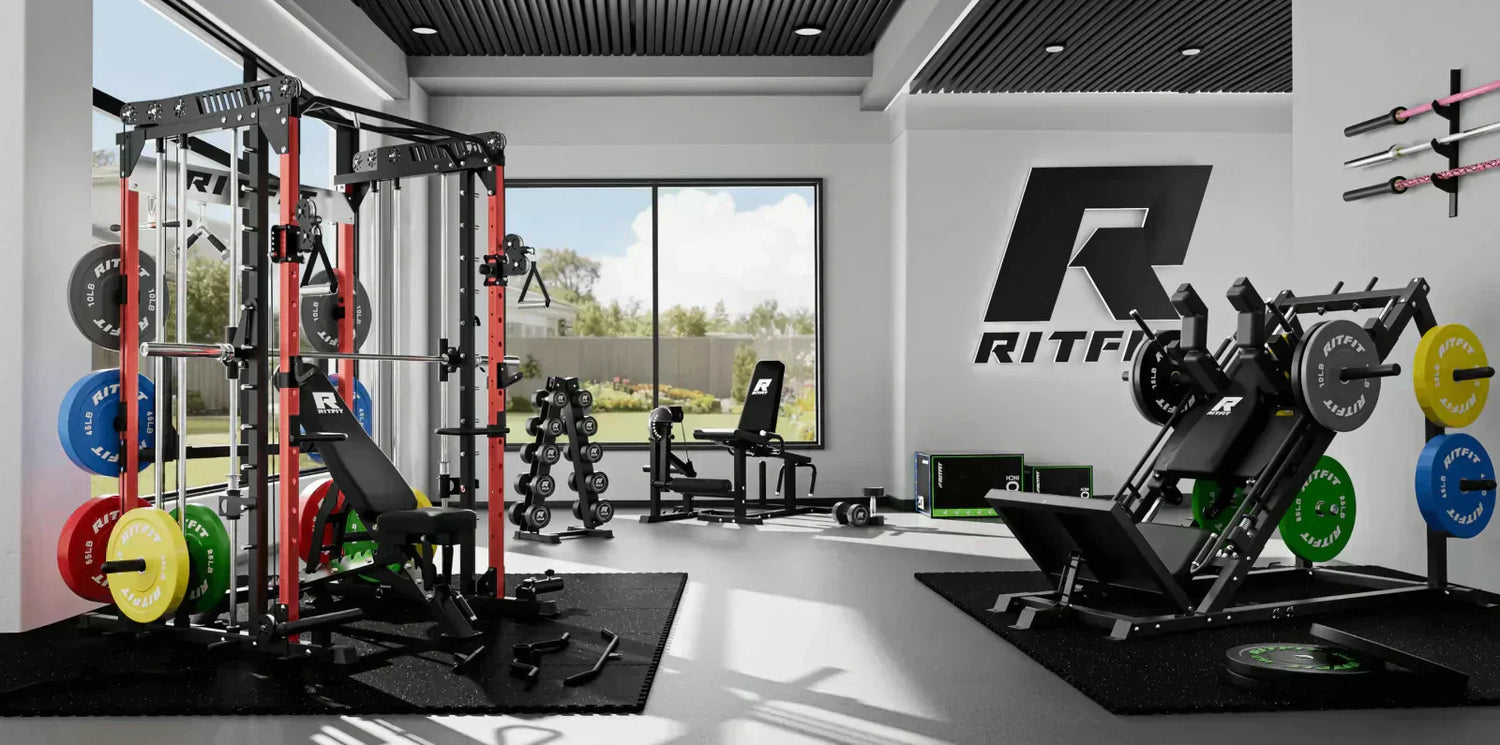
The best home gym equipment usually combines one main strength station, one adjustable bench, free weights, plates, storage, and accessories. RitFit equipment works well for this structure because the product ecosystem covers compact training, progressive strength, and full body home gym setups.
| Equipment Type | Best For | Space Need | RitFit Fit |
|---|---|---|---|
| Smith machine functional trainer | Solo lifters, full body training, guided bar work, cable exercises | Medium to large | M1 PRO, BUFFALO, M2, BPC06 |
| Power rack or half rack | Squats, bench press, pull ups, barbell strength work | Medium to large | RitFit rack and power cage systems |
| Adjustable bench | Flat press, incline press, seated press, dumbbell training | Small to medium | GATOR, BWB01, PWB01 |
| Dumbbells | Beginners, apartments, accessory work, full body training | Small | Rubber hex dumbbells, PVC coated dumbbells |
| Barbell and plates | Progressive overload, compound lifts, garage gym strength | Medium | Olympic barbells and bumper plates |
| Cable attachments | Rows, pulldowns, curls, triceps work, accessory training | Small | Handles, ropes, bars, pulldown attachments |
Best All in One Equipment: Smith Machine Functional Trainers
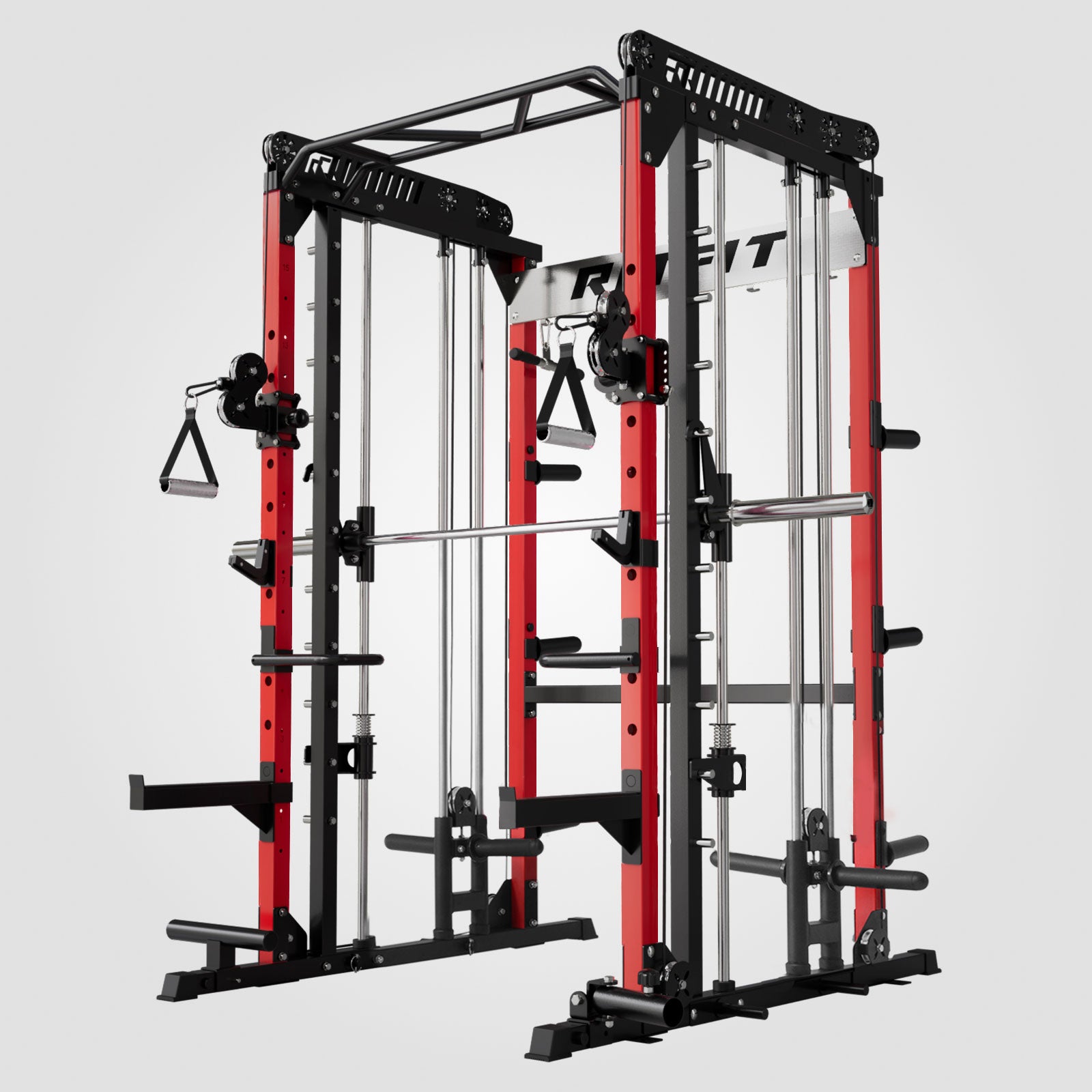
A Smith machine functional trainer is one of the most versatile home gym equipment choices for users who want guided bar work, cable resistance, rack style training, and pull up options in one station. It is especially useful when you train alone and want a more controlled lifting setup.
RitFit M1 PRO Smith Machine Functional Trainer
The RitFit M1 PRO Smith Machine Home Gym Package is a strong option for lifters who want one central strength station for squats, presses, rows, pulldowns, and cable accessories. It is best for users who want a guided bar path, cable crossover training, and an expandable home gym system.
- Best for: Solo lifters, beginners, busy professionals, and home gym users who want full body training in one station.
- Training value: Supports compound lifts, cable work, pull ups, accessory training, and progressive strength routines.
- What to pair with it: Add an adjustable bench, Olympic plates, cable handles, and floor protection for a more complete setup.
- Who should compare options: Users with very small rooms should measure ceiling height and full footprint before choosing any all in one machine.
RitFit BUFFALO Functional Trainer with Smith Machine
The RitFit BUFFALO Smith Machine Home Gym Package is designed for users who want a more complete Smith machine and cable training station. It is a practical choice for couples, families, or shared home gyms where more than one person may train regularly.
- Best for: Households, training partners, garage gyms, and users who want multiple cable and rack style movements.
- Training value: Helps combine presses, squats, rows, pulldowns, curls, triceps work, and core exercises.
- Buying note: Review the product page for exact dimensions, attachments, package options, and weight system details before purchase.
Why Smith Machine and Cable Systems Work Well at Home
Smith machine and cable systems work well at home because they support many movement patterns in one footprint. Progressive overload can also be achieved by increasing load, repetitions, or training volume over time.[3]
- Safety support: A guided bar path can help solo lifters train with more confidence when used correctly.
- Exercise variety: Cables add rows, pulldowns, flyes, curls, triceps work, lateral raises, and core movements.
- Space efficiency: One station can replace several separate strength machines in a garage or basement gym.
- Long term use: Attachments and plates can expand training options without rebuilding the entire gym.
Best Strength Equipment: Racks, Benches, Barbells, and Plates
Traditional strength equipment is still the foundation of a serious home gym. A rack, bench, barbell, and plates provide the most direct path to progressive strength training.
Power Racks and Half Racks
A rack is the best choice for users who want barbell squats, bench press, rows, pull ups, and structured strength training. RitFit power racks and rack systems are especially relevant for users building a garage gym or basement strength setup.
- Best for: Strength builders, barbell lifters, garage gyms, and users who want long term progression.
- Check before buying: Measure ceiling height, rack depth, barbell clearance, bench space, and safety arm position.
- Best pairings: Add a bench, Olympic barbell, bumper plates, plate storage, and cable attachments.
Adjustable Weight Benches
An adjustable bench multiplies your training options because it supports flat, incline, seated, and dumbbell exercises. The RitFit GATOR Adjustable Weight Bench is a strong match for home gym users who want a stable bench to pair with dumbbells, racks, Smith machines, and cable stations.
- Best for: Pressing, rows, seated shoulder work, incline dumbbell training, and rack based strength workouts.
- Check before buying: Review adjustment range, pad comfort, storage needs, and compatibility with your rack or Smith machine.
- Best upgrade path: A bench is often the first major upgrade after dumbbells because it unlocks more upper body training positions.
Barbells and Weight Plates
Barbells and plates are essential for lifters who want measurable strength progression. RitFit Olympic barbells and weight plates pair naturally with racks, Smith machines, benches, and garage gym setups.
- Best for: Squats, deadlifts, bench press, rows, overhead press, hip thrusts, and loaded carries.
- Plate choice: Bumper plates are useful for garage gyms because they are more floor friendly than bare iron when paired with proper mats.
- Buying note: Match plate type, barbell sleeve size, floor protection, and storage before building a full plate setup.
Leg and Lower Body Machines
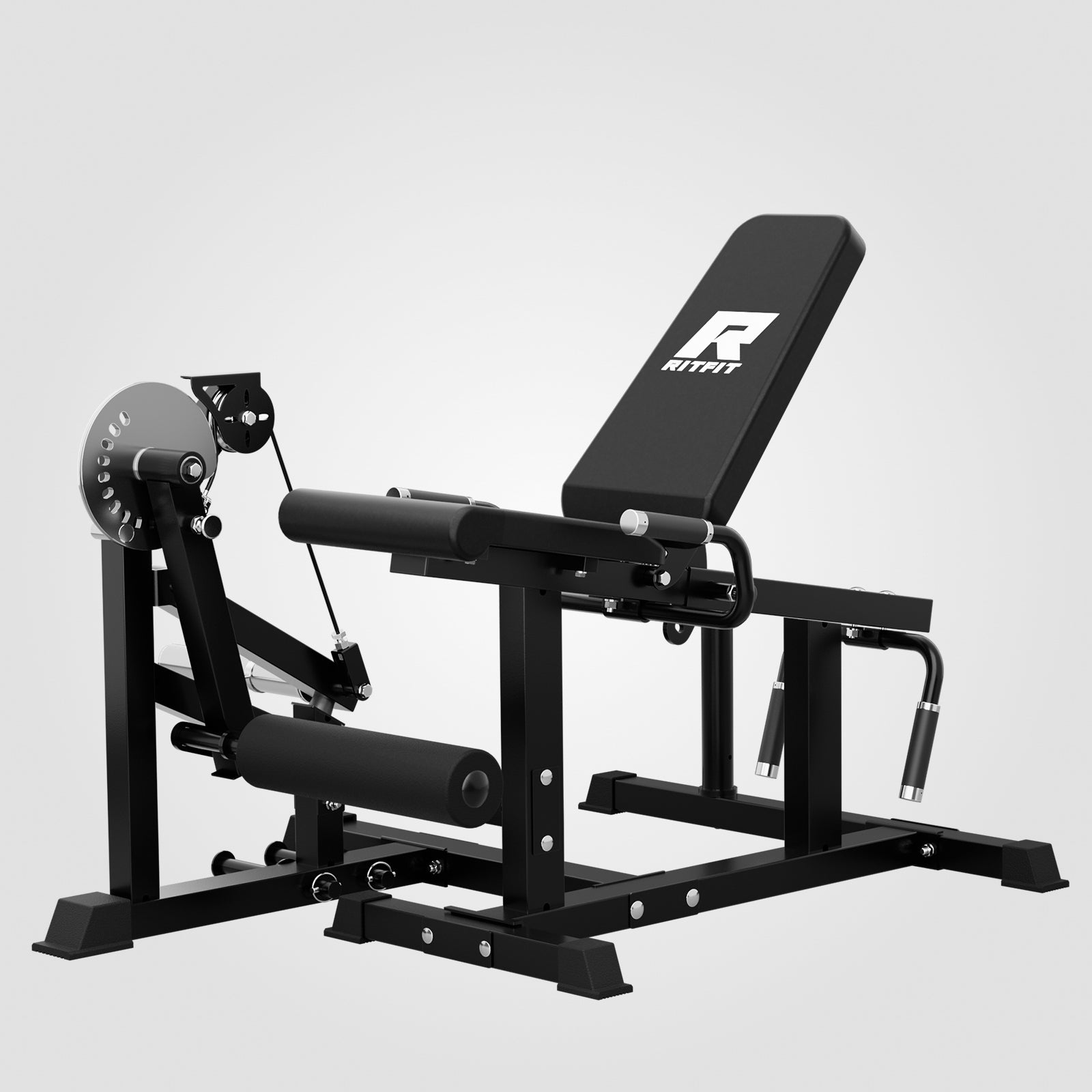
Lower body machines are useful when users want more quad, glute, hamstring, and calf training beyond squats and lunges. The RitFit strength machine category can support users who want dedicated lower body training in a home gym.
- Best for: Users focused on leg strength, hypertrophy, and accessory work after compound lifts.
- Recommended path: Start with foundational equipment first, then add leg press, hack squat, or leg extension equipment if space and budget allow.
- Training note: Effective hypertrophy training typically combines mechanical tension, sufficient volume, and progressive difficulty.[4]
Best Free Weights for Home Use
Free weights are the most flexible equipment for small home gyms. Dumbbells, kettlebells, barbells, and plates can train the whole body with less space than many single purpose machines.
Dumbbells
Dumbbells are the best starting point for many beginners because they are simple, versatile, and easy to store. RitFit home gym dumbbells work well for presses, rows, curls, lunges, split squats, carries, and full body circuits.
- Best for: Beginners, apartment users, small spaces, accessory work, and budget focused home gyms.
- Fixed dumbbells: Best for quick workouts and durability when you have storage space.
- PVC coated dumbbells: A practical choice for lighter training, beginners, and quieter home workout areas.
- Rubber hex dumbbells: Better suited for heavier strength training and garage gym use.
Kettlebells
Kettlebells are compact tools for conditioning, hip hinging, grip work, and loaded carries. They are especially useful when you want powerful full body sessions without a large machine.
- Best for: Swings, goblet squats, presses, rows, carries, and conditioning circuits.
- Space benefit: One or two kettlebells can fit into a closet, corner, or small training mat area.
- Safety note: Learn the hinge pattern before adding speed or high repetition swings.
Cable Attachments and Accessories
Accessories make a home gym more complete because they expand exercise variety without taking much space. RitFit cable attachments and home gym accessories can support rows, pulldowns, curls, triceps work, landmine movements, and core training.
- Best accessories: Lat pulldown bars, cable handles, ropes, ankle straps, barbell pads, ab rollers, and landmine handles.
- Best value: Small attachments can make a Smith machine, rack cable system, or functional trainer feel much more versatile.
- Storage tip: Use hooks, bins, or wall storage so handles and straps do not clutter the floor.
Best Compact and Space Saving Home Gym Equipment
Compact home gym equipment should reduce clutter without limiting your training options. The best small space setup usually combines a foldable or compact bench, dumbbells, resistance bands, storage, and one scalable strength station if space allows.
Best Equipment for Small Rooms
Small rooms need equipment that stores vertically, moves easily, or replaces several machines. Choose adjustable dumbbells, foldable benches, resistance bands, wall storage, and compact Smith machines only after measuring the full footprint.
- Top compact picks: Adjustable dumbbells, resistance bands, foldable benches, push up handles, compact racks, and cable attachments.
- Best upgrade: A compact Smith machine or rack can become the central station if the room has enough ceiling height and walking space.
- Flooring note: Use proper mats to protect floors, improve comfort, and reduce impact noise.
Best Equipment for Garage Gyms
Garage gyms can support heavier and more complete setups because they usually provide more floor space. A rack or Smith machine, adjustable bench, barbell, bumper plates, dumbbells, and storage can create a long term strength environment.
- Best core setup: Rack or Smith machine, bench, barbell, bumper plates, dumbbells, flooring, and wall storage.
- Best comfort upgrade: Add fans, lighting, mirrors, and organization to make the space easier to use year round.
- Safety note: Keep walkways clear and avoid placing plates, handles, or bands where they can become trip hazards.
Best Equipment for Apartments
Apartment home gyms need quiet, compact, and easy to store equipment. Dumbbells, resistance bands, yoga mats, kettlebells, and a compact bench are usually better starting points than heavy machines.
- Best starter list: Dumbbells, bands, mat, foldable bench, kettlebell, and door free storage.
- Noise control: Avoid dropping weights and use mats under any free weight training area.
- Upgrade note: Consider machine based equipment only after checking room dimensions, lease rules, and delivery access.
Best Home Gym Setups Based on User Type
The best home gym setup depends on the person using it. Beginners, busy parents, strength builders, and small space users need different combinations of RitFit equipment.
Best Setup for Beginners
A beginner home gym should be simple, safe, and easy to use consistently. Start with an adjustable bench, dumbbells, resistance bands, storage, and optional rack or compact Smith machine when you are ready to lift heavier.
- Starter equipment: Adjustable bench, dumbbell set, resistance bands, mat, and storage rack.
- Why it works: This setup supports pressing, rows, squats, lunges, curls, core training, and mobility work.
- Next upgrade: Add a rack, Smith machine, barbell, and plates when your strength goals become more structured.
Best Setup for Busy Professionals and Parents
Busy users need equipment that reduces setup time and supports full body training in short sessions. A Smith machine functional trainer, adjustable bench, dumbbells, and cable attachments can cover most weekly workouts efficiently.
- Core equipment: RitFit Smith machine functional trainer, adjustable bench, dumbbells, and cable handles.
- Why it works: You can move from squats to presses to rows to pulldowns without changing rooms or using multiple machines.
- Training style: Use full body sessions, supersets, and short accessory circuits when time is limited.
Best Setup for Muscle and Strength Builders
Strength builders need stable equipment, measurable loading, and enough exercise variety to train hard for years. A rack or Smith machine, heavy duty bench, barbell, plates, dumbbells, and cable system create a serious long term setup.
- Core equipment: Power rack or Smith machine, bench, Olympic barbell, bumper plates, dumbbells, and cable station.
- Why it works: This structure supports progressive overload, compound lifts, accessory work, and balanced full body programming.
- Programming note: Resistance training is also discussed in aging and fall prevention literature when properly designed and instructed.[5]
Best Setup for Small Spaces
Small space users should focus on equipment that folds, stacks, mounts, or serves several purposes. Adjustable dumbbells, a compact bench, bands, mounted storage, and a carefully measured compact Smith machine can deliver strong training value.
- Core equipment: Adjustable dumbbells, foldable bench, resistance bands, mounted storage, and optional compact strength station.
- Why it works: The setup supports full body workouts without filling the room with single purpose machines.
- Buying note: Measure the machine footprint and leave enough room to load plates, adjust pulleys, and move safely.
Why RitFit Stands Out in Home Gym Equipment
RitFit stands out because its equipment ecosystem is built around practical home gym needs. The product range covers Smith machines, racks, benches, barbells, plates, dumbbells, strength machines, attachments, and accessories.
Home Gym Focused Product Ecosystem
RitFit equipment helps users build a complete home gym without mixing too many unrelated systems. A buyer can start with RitFit Smith machines, then add benches, plates, dumbbells, storage, and attachments as training needs grow.
- For beginners: Dumbbells, benches, bands, and compact systems make the first setup less intimidating.
- For solo lifters: Smith machines and racks add safety focused training options when used correctly.
- For families: Adjustable equipment and cable attachments make one setup useful for different training levels.
- For garage gyms: Racks, barbells, bumper plates, and strength machines create a more complete lifting environment.
Better Upgrade Path for Long Term Training
A strong home gym should grow with the user. RitFit equipment supports this by offering core strength stations, free weights, benches, attachments, and strength machines that can be added over time.
- Start simple: Begin with dumbbells, a bench, and bands if budget or space is limited.
- Build strength: Add a rack or Smith machine when you want safer heavy lifting at home.
- Expand variety: Add cable attachments, plates, storage, and dedicated machines as your program matures.
Common Mistakes When Buying Home Gym Equipment
The biggest mistake is buying equipment before defining your training goal, space limits, and upgrade path. A smaller but smarter setup usually produces better long term consistency than a crowded room of rarely used machines.
Buying Too Much Too Soon
Buy the equipment you will use every week before buying specialty machines. A bench, dumbbells, rack or Smith machine, plates, and attachments usually matter more than novelty gear.
- Better choice: Start with core equipment and add pieces only when your training proves you need them.
- Risk to avoid: Overbuying can create clutter, reduce usable space, and make workouts harder to start.
Ignoring Ceiling Height and Footprint
Ceiling height and machine footprint decide whether your setup will feel usable. Always measure height, width, depth, plate loading space, bench clearance, and walking space before ordering large equipment.
- Better choice: Compare your room dimensions with the product page dimensions before purchase.
- Risk to avoid: A machine that technically fits may still feel cramped if there is no space to move or adjust attachments.
Skipping Flooring and Storage
Flooring and storage are not optional details in a functional home gym. Mats protect floors, while racks, hooks, and shelves keep plates, dumbbells, and accessories easy to access.
- Better choice: Plan flooring and storage before adding heavy plates or machines.
- Risk to avoid: Loose plates, handles, and bands can create trip hazards and slow down workouts.
Choosing Equipment Without a Progression Plan
Equipment should support your next year of training, not only your first week. Choose systems that allow more load, more angles, more attachments, or more exercises as you improve.
- Better choice: Pick equipment that can expand with plates, benches, cables, attachments, or storage.
- Risk to avoid: A cheap setup becomes expensive if you outgrow it quickly and need to replace everything.
FAQs
What home gym equipment should I buy first?
Start with an adjustable bench, dumbbells, resistance bands, and floor protection. These pieces cover pressing, pulling, legs, core, and mobility work without taking much space. Add a rack, Smith machine, barbell, and plates when your strength goals require heavier loading and more structured progression.
Is a Smith machine good for a home gym?
Yes. A Smith machine is good for a home gym when you want guided bar training, cable work, and safer solo lifting options in one station. It works best for users who have enough space and want full body strength training without buying several separate machines.
What is the best RitFit equipment for small spaces?
The best RitFit equipment for small spaces includes dumbbells, a foldable or adjustable bench, resistance bands, storage, and a compact Smith machine if the room allows it. Always measure ceiling height, footprint, plate loading space, and walking clearance before choosing larger equipment.
Can beginners use RitFit home gym equipment?
Yes. Beginners can use RitFit home gym equipment when they choose simple pieces first and learn proper setup. Dumbbells, benches, bands, and guided strength stations are useful starting points. New lifters should use controlled loads, follow product instructions, and progress gradually.
Are dumbbells enough for a home gym?
Yes. Dumbbells can be enough for a beginner or compact home gym because they support full body exercises with minimal space. For long term strength progress, many users eventually add a bench, rack or Smith machine, barbell, plates, and cable attachments.
How much space do I need for home gym equipment?
You need enough space for the equipment footprint, body movement, loading plates, and safe walking clearance. Dumbbells and a bench can fit in a small room. Racks, Smith machines, and functional trainers need more ceiling height, depth, and open space around the station.
Should I choose a power rack or a Smith machine?
Choose a power rack if you prefer free weight barbell training and maximal exercise freedom. Choose a Smith machine if you train alone and want a guided bar path, cable exercises, and all in one convenience. The better choice depends on space, experience, and training goals.
Final Thoughts
The best home gym equipment is not the largest setup, it is the setup you can use consistently. Start with RitFit equipment that matches your space and goal, then build around a strength station, adjustable bench, free weights, plates, storage, and accessories as your training grows.
Choose the RitFit M1 PRO or BUFFALO if you want a more complete all in one strength station. Choose a rack, bench, barbell, plates, and dumbbells if you prefer a classic progressive strength setup.
Disclaimer: This article is for general fitness and equipment education only. Always read product manuals, confirm dimensions and weight capacity, use proper setup, and train with safe technique. Consult a qualified fitness or healthcare professional before starting resistance training if you are new to exercise, injured, pregnant, older, or managing a medical condition.
References
- Noori-Sistani M, Allahverdipour H, Vahedian-Shahroodi M, et al. Home based physical activity strategies for healthy adults: a scoping review. J Educ Health Promot. 2025;14:424. doi:10.4103/jehp.jehp_814_24
- Lopez P, Radaelli R, Taaffe DR, Newton RU, Galvão DA, Trajano GS, et al. Resistance training load effects on muscle hypertrophy and strength gain: systematic review and network meta analysis. Med Sci Sports Exerc. 2021;53(6):1206-1216. doi:10.1249/MSS.0000000000002585
- Plotkin D, Coleman M, Van Every D, Maldonado J, Oberlin D, Israetel M, et al. Progressive overload without progressing load? The effects of load or repetition progression on muscular adaptations. PeerJ. 2022;10:e14142. doi:10.7717/peerj.14142
- Krzysztofik M, Wilk M, Wojdała G, Gołaś A. Maximizing muscle hypertrophy: a systematic review of advanced resistance training techniques and methods. Int J Environ Res Public Health. 2019;16(24):4897. doi:10.3390/ijerph16244897
- Rodrigues F, Domingos C, Monteiro D, Morouço P. A review on aging, sarcopenia, falls, and resistance training in community dwelling older adults. Int J Environ Res Public Health. 2022;19(2):874. doi:10.3390/ijerph19020874