








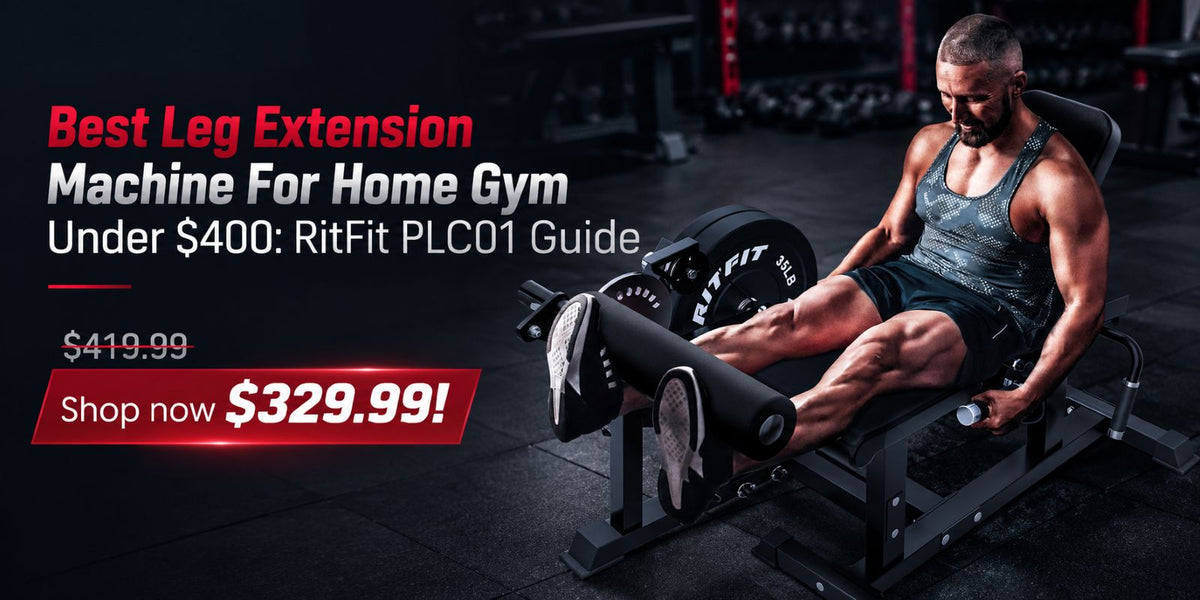
The best leg extension curl machine under $400 for most home gyms is the RitFit PLC01 because it combines quad and hamstring isolation, compact sizing, and strong adjustability without commercial machine pricing.
This guide explains what to look for, why direct leg isolation matters, and how to decide whether the PLC01 fits your training space and body setup.
Quick Answer: The best leg extension curl machine for home gym under $400 is the RitFit PLC01, a 2-in-1 plate loaded unit that delivers smooth quad extensions and hamstring curls in a compact 15.37 sq ft footprint with four backrest angles and 12 range settings.
Key Takeaways
- Best under $400: The RitFit PLC01 is positioned as the best leg extension curl machine under $400 for most home gym buyers because it balances price, footprint, adjustability, and dual function training.
- Two movements in one footprint: A 2 in 1 leg extension curl machine trains quads and hamstrings without requiring separate single purpose machines.
- Setup matters most: Knee pivot alignment, shin pad placement, and range of motion settings decide whether the machine feels natural or awkward.
- Plate loaded can still feel smooth: A cable driven plate loaded system can work well when the resistance path stays consistent and the frame remains stable.
- Measure before buying: Footprint is only one part of fit, because you also need loading clearance, entry space, and room to adjust the pads.
How We Chose the Best Leg Extension Curl Machine Under $400
We evaluated home gym leg extension curl machines based on adjustability, resistance feel, stability, space efficiency, plate compatibility, and practical value. These criteria matter because a machine that does not fit your body or room is unlikely to support consistent training.
- Adjustability: We prioritized knee alignment, backrest options, start position control, and roller pad fit.
- Resistance feel: We looked for smooth loading, controlled eccentrics, and usable tension across common rep ranges.
- Home gym practicality: We considered footprint, storage, plate compatibility, and how easily the machine fits near a rack or bench.
- Budget value: We focused on machines that solve a real training problem without forcing most buyers into commercial pricing.
What Muscles Does the RitFit PLC01 Leg Extension Curl Machine Train?
The RitFit PLC01 primarily trains the quadriceps during seated leg extensions and the hamstrings during prone leg curls. It also encourages better control through the hips, trunk, and lower legs because the user must stay stable while the knee moves through the selected range.
- Quadriceps: Leg extensions target the front of the thigh, including the rectus femoris and vastus group. This makes the movement useful when your program already includes squats but still needs more direct quad work.
- Hamstrings: Prone leg curls train knee flexion, which is different from hip hinge work such as Romanian deadlifts. Hamstring studies show that exercise choice and joint position can meaningfully change the training stimulus.[1]
- Hip stabilizers: Your hips help keep the pelvis steady so the target muscles receive cleaner tension. This matters most during slower reps and higher fatigue sets.
- Core and trunk: Your trunk resists rocking, arching, and sliding during both leg extensions and leg curls. Better control keeps the movement focused on the intended muscles.
Why You Need More Than Squats
Squats are excellent for lower body strength, but they do not always replace direct quad and hamstring isolation. A complete home gym leg setup should cover both compound patterns and targeted knee extension and knee flexion work.
Research on hamstring strength exercises suggests that different exercises can change biceps femoris activation, which supports the value of direct knee flexion work in a balanced program.[2] This is why a leg extension curl machine can be a smart add on to squats, lunges, leg presses, and hip hinges.
If you are building a broader lower body setup, compare the RitFit strength machines collection or review the BLP01 and PLC01 leg workout package.
"If maximum quad growth is the goal, do squats and also do exercises such as front squats, leg press, lunges, and leg extensions."
Bret Contreras, PhD in Sports Science, Contreras Strength Institute, Do More than 'Just Squat'
The Buying Guide: What to Look For
The best leg extension curl machine should fit your space, body, plates, and training style before it impresses you on paper. Use the checklist below before choosing any home gym leg machine under $400.
Space and Function
A home leg extension machine should solve a training problem without taking over your floor plan.
- Choose dual function first: A 2 in 1 unit usually gives better space value than buying separate leg extension and leg curl machines.
- Measure real clearance: Leave room to load plates, adjust the backrest, move around the machine, and perform the full range of motion.
- Plan your training flow: Place the machine near your rack, bench, or dumbbell zone so it fits naturally into leg day.

Resistance Profile and Mechanics
The best budget machines feel useful because the resistance path stays controlled through the full rep.
- Look for cable driven motion: A cable based design can feel smoother than a simple lever arm when the pulley path is well designed.
- Test light and moderate loads: Warmups, controlled eccentrics, and high rep finishers should feel stable, not only heavy top sets.
- Use full useful range: Range of motion matters because lower body hypertrophy often benefits when training uses a controlled and appropriate movement range.[5]

Adjustability
Fit is the detail that decides whether a leg extension curl machine feels natural or uncomfortable.
- Check knee pivot alignment: Your knee should line up with the machine axis instead of being forced forward or backward.
- Check roller pad placement: The pad should sit comfortably near the lower shin without turning the movement into an ankle pressure problem.
- Check start position options: A useful range adjuster helps users find a comfortable stretch and avoid forcing painful angles.

Stability and Build Quality
A machine that shifts under effort will always feel cheaper than its spec sheet suggests.
- Watch frame behavior: Capacity numbers matter, but the frame should also stay planted during normal training loads.
- Look at pad support: Better pads make long sets easier to repeat and can reduce distraction during higher rep work.
- Separate value from commercial grade: A strong budget machine can be the right home gym choice without claiming to match every commercial selectorized unit.
For more planning context, read the best leg machines guide, compare options for glute training with best gym machines for glutes, or review how to progress loads in the leg extension machine weight increments guide.
Top Recommendation: RitFit PLC01 Leg Extension Curl Machine
The RitFit PLC01 is our top pick under $400 for most home gym buyers who want direct quad and hamstring training in one compact machine. It stands out because it combines a 2 in 1 design, cable driven resistance, broad adjustability, and plate compatibility at a budget friendly tier.
See the current product details on the RitFit PLC01 Leg Extension Curl Machine page before purchasing. Prices and promotions can change, so always confirm the final checkout price.
"The leg extension/curl machine is such a great machine especially at that price point. It is another great RitFit machine for my gym!"
Westley W. Verified Buyer, RitFit PLC01 Leg Extension Curl Machine
Key Specs
The PLC01 is built for compact home gym use, with specs that support both space planning and training setup.
| Specification | RitFit PLC01 |
|---|---|
| Overall dimensions | 50.9 in L x 43.5 in W x 42.7 in H |
| Footprint | 15.37 sq ft |
| Product weight | 109 lb |
| Ideal user height range | 5.2 ft to 6.2 ft |
| Maximum user weight | 325 lb |
| Overall capacity | 375 lb |
| Cable ratio | 3:2 |
| Plate compatibility | 2 in and 1 in plate holes |
Best For
The PLC01 is best for buyers who want targeted leg training without building a full commercial machine lineup.
- Garage gym owners: It gives direct quad and hamstring work without the footprint of two separate machines.
- Budget focused lifters: It keeps the buying decision inside the under $400 category while still offering multiple setup adjustments.
- Households with multiple users: The backrest and range settings make it easier for different body sizes to find a workable position.
- Plate loaded home gyms: It works well if you already own standard or Olympic plates from your rack, barbell, or leg press setup.
Who Should Skip It
The PLC01 is not the right answer for every buyer, especially if you expect a full commercial selectorized experience.
- Commercial gym owners: A high traffic facility may need a heavier commercial machine built for constant daily use.
- Buyers who dislike plate loading: A selectorized stack may be more convenient if you want instant weight changes.
- Users with knee symptoms: Open chain knee extension can be programmed safely in clinical contexts, but pain, swelling, or injury history should guide exercise choice and range.[3]

Why It Beats Most Under $400 Alternatives
The PLC01 wins the under $400 category because it focuses on the features that matter most for real home gym use.
- Dual function value: It covers seated leg extensions and prone leg curls in one unit.
- Useful fit range: Four backrest angles and 12 range settings help more users find a better setup.
- Compact footprint: The 15.37 sq ft footprint makes it easier to place beside a rack, bench, or plate storage area.
- Plate compatibility: Support for 1 in and 2 in plates makes it more flexible for existing home gym owners.
For heavier lower body compound work, pair the PLC01 with a machine such as the RitFit BLP01 3 in 1 Leg Press and Hack Squat Machine or build around the RitFit barbells and weight plates collection.

How to Set Up the PLC01 for Better Leg Extensions and Leg Curls
Proper setup matters because small alignment errors can make a good machine feel uncomfortable. Start light, adjust the machine before loading heavily, and keep every rep controlled.
Seated Leg Extension Setup
Set your knee near the machine pivot and place the roller comfortably against the lower shin.
- Backrest: Choose the angle that lets you sit tall without your hips sliding forward.
- Knee alignment: Align your knee with the machine axis before starting the set.
- Start range: Select a start position that gives a useful stretch without forcing the knee into discomfort.
- Tempo: Extend under control, squeeze briefly at the top, and lower without dropping the weight.
Prone Leg Curl Setup
Lie face down with your hips stable and the roller placed near the back of the lower legs.
- Hip position: Keep your hips pressed into the pad instead of arching your lower back.
- Pad placement: Place the roller where it feels secure without digging into the Achilles area.
- Range: Curl through a smooth range and stop before your hips lift or your lower back compensates.
- Control: Lower slowly because the eccentric portion helps keep tension on the hamstrings.
"Love Ritfit couldn't of made a better choice of equipment to start my home gym with, easy instructions to build, and sturdy"
Jackie c. Verified Buyer, RitFit The Ultimate Leg Day Duo
A Sample Leg Finisher Workout
The finisher works best after squats, leg presses, lunges, or Romanian deadlifts. Use moderate loads and clean reps instead of chasing maximum weight at the end of the session.
Quad and Hamstring Superset
Perform the seated leg extension and prone leg curl back to back, then rest 60 to 90 seconds.
- Seated leg extension: Do 12 to 15 reps with a controlled squeeze at the top.
- Prone leg curl: Do 10 to 12 reps while keeping your hips pressed into the pad.
- Total sets: Complete 3 rounds after your main lower body lifts.
- Progression: Add reps first, then add small weight jumps when all sets feel controlled.
Squats remain valuable, but research suggests squat training may not grow every quadriceps region in the same way for every lifter.[4] This is one reason a direct isolation finisher can help round out a home gym leg program.
If you need a stable base for dumbbell split squats, step ups, or seated accessory work, compare options in the RitFit weight benches collection.
FAQs
Is the RitFit PLC01 the best leg extension curl machine under $400?
Yes. For most home gym buyers under $400, the RitFit PLC01 is the strongest choice because it combines leg extension, leg curl, cable driven resistance, and compact sizing. It is not a commercial selectorized unit, but it solves the main home gym isolation problem well.
What muscles does a leg extension curl machine train?
A leg extension curl machine mainly trains the quadriceps and hamstrings. Leg extensions focus on knee extension and the front of the thigh, while prone leg curls focus on knee flexion and the back of the thigh. Stable setup also helps reduce unwanted hip and trunk movement.
Can beginners use the RitFit PLC01 leg extension curl machine?
Yes. Beginners can use the RitFit PLC01 when they start with light plates, align the knee with the pivot, and move through a pain free range. The main goal is controlled technique, not heavy loading, especially during the first few sessions.
How much space does the RitFit PLC01 need?
The RitFit PLC01 has a listed footprint of 15.37 square feet. Buyers should still leave extra room for plate loading, entry, backrest adjustment, and full leg movement. Measuring the floor space before purchase is the safest way to avoid layout problems.
Does the RitFit PLC01 work with Olympic plates?
Yes. The RitFit PLC01 is listed as compatible with both 2 inch Olympic plates and 1 inch standard plates. This makes it practical for home gym owners who already own plates for a barbell, rack, leg press, or other plate loaded equipment.
Is a plate loaded leg extension curl machine smooth enough?
Yes. A plate loaded leg extension curl machine can feel smooth when the cable path, pulley ratio, and frame design are well matched. The PLC01 uses a cable driven setup, so the feel depends on controlled loading, good alignment, and steady rep speed.
Should I buy a 2 in 1 leg machine or separate machines?
Most home gym buyers should choose a 2 in 1 leg machine first. It saves floor space, reduces cost, and covers both direct quad and hamstring work. Separate machines make more sense when you have a large gym room and a commercial style budget.
How should I align my knee on a leg extension machine?
Align your knee close to the machine pivot before starting the set. The pad should sit comfortably near the lower shin, and the movement should feel controlled through the selected range. Stop and adjust if you feel sharp knee pressure or awkward tracking.
Conclusion
The best leg extension curl machine under $400 is the one that fits your body, fits your room, and gives you enough adjustability to train consistently. For most home gym buyers, the RitFit PLC01 is a practical top pick because it delivers direct quad and hamstring training without requiring commercial machine space or pricing.
Disclaimer: This article is for general fitness education only and is not medical advice. If you have knee pain, swelling, instability, previous surgery, or a diagnosed condition, use a pain free range and consult a qualified clinician or physical therapist before adding leg extensions or leg curls.
References
1. Maeo S, Huang M, Wu Y, et al. Greater hamstrings muscle hypertrophy but similar damage protection after training at long versus short muscle lengths. Med Sci Sports Exerc. 2021;53(4):825-837. doi:10.1249/MSS.0000000000002523. PMCID: PMC7969179
2. Llurda-Almuzara L, Labata-Lezaun N, López-de-Celis C, et al. Biceps femoris activation during hamstring strength exercises: a systematic review. Int J Environ Res Public Health. 2021;18(16):8733. doi:10.3390/ijerph18168733. PMCID: PMC8393607
3. Wilk KE, Arrigo CA, Bagwell MS, Finck AN. Considerations with open kinetic chain knee extension exercise following ACL reconstruction. Int J Sports Phys Ther. 2021;16(1):282-284. doi:10.26603/001c.18983. PMCID: PMC8341750
4. Kojic F, Ranisavljev I, Obradovic M, et al. Does back squat exercise lead to regional hypertrophy among quadriceps femoris muscles? Int J Environ Res Public Health. 2022;19(23):16226. doi:10.3390/ijerph192316226. PMCID: PMC9737272
5. Schoenfeld BJ, Grgic J. Effects of range of motion on muscle development during resistance training interventions: a systematic review. SAGE Open Med. 2020;8:2050312120901559. doi:10.1177/2050312120901559. PMCID: PMC6977096





