








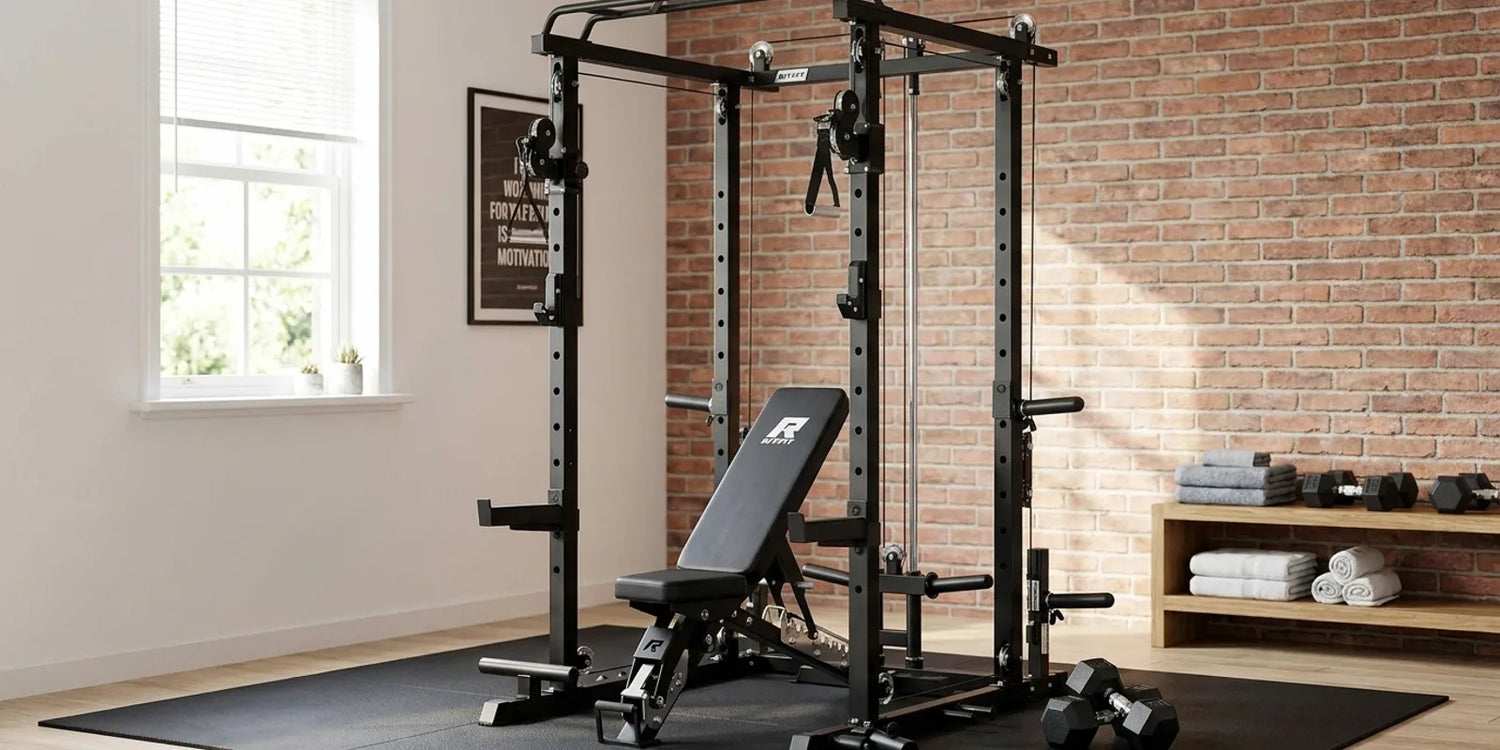
The RitFit P3 is a strong choice for home gym buyers who want a power cage, a multi grip pull up bar, and a smooth plate loaded cable station in one compact frame. It makes the most sense for solo lifters who want better exercise range, useful safety pieces, and better space efficiency than buying separate stations.
Key Takeaways
- The P3 covers the essentials. It combines rack work, pull up training, cable accessories, and storage in one station.
- The footprint is compact for its function set. RitFit lists the frame at 17.53 square feet, but buyers should still plan for real working clearance around the rack.
- The rack is built for home gym versatility. It supports squats, presses, rows, pull ups, pulldowns, flyes, curls, pushdowns, and landmine work.
- The best buyer is not every buyer. The P3 is best for users who value all around function more than a heavy duty 3 x 3 commercial style ecosystem.
- The main value is consolidation. If you want barbell training, upper body pulling, and cable work without filling the room with separate machines, the P3 solves that problem well.
What Is a Power Cage with Pull Up Bar?
A power cage with a pull up bar is a rack system that supports barbell lifts and bodyweight pulling in the same frame. It gives home gym users a safer base for squats, presses, bench work, and pull ups than a simpler stand alone rack setup.
For many buyers, this format works because it puts the main strength training tools in one place. It also becomes more valuable when the rack includes cable training, storage, and attachments that reduce the need for separate stations.
RitFit P3 Power Cage Overview
The RitFit P3 Power Cage is designed for home gym users who want a full rack experience with added cable versatility. It combines a barbell station, pull up station, dual pulley system, plate storage, and attachment support in one compact unit.
Key Specifications
The listed specifications show a rack that is sized for many garage gyms and basement gyms without becoming a towering commercial style unit. The numbers also make it easier to judge whether the P3 fits your room, training style, and loading expectations.
| Specification | Details |
|---|---|
| Dimensions | 67.2 in L x 59.1 in W x 81 in H |
| Footprint | 17.53 square feet |
| Rack Weight | 200 lbs |
| Frame | 2 x 2 inch 14 gauge steel |
| Upright Capacity | 1200 lbs |
| Pulley Capacity | 600 lbs |
| Pull Up Bar Capacity | 308 lbs |
| Safety Spotter Arm Capacity | 440 lbs |
| J Hook Capacity | 440 lbs |
| Cable Ratio | 2:1 |
| Plate Compatibility | 2 inch and 1 inch hole plates |
What Comes With the P3
The P3 includes the core pieces most buyers expect from a multifunction home rack. The real value is that these parts support both primary strength work and lighter accessory training on the same frame.
- J hooks: Support barbell setup for squats, presses, and rack pulls.
- Safety spotter arms: Add a practical layer of protection for solo lifting.
- Multi grip pull up bar: Expands upper body pulling options beyond a single straight grip.
- Dual pulley system: Opens cable rows, flyes, pushdowns, curls, and core work.
- Landmine attachment: Adds pressing, rowing, and rotational movement options.
- Storage pegs: Help keep plates on the rack instead of scattered around the room.
Key Features and Benefits
Heavy Duty Steel Frame
The frame is built for home strength training that includes real barbell work, not just light accessory movement. The 2 x 2 inch 14 gauge build is best understood as a practical home gym standard, not as a premium 3 x 3 commercial rack alternative.
- Why it matters: It gives most home lifters enough structure for squats, presses, rows, and rack based pulling.
- What it means in practice: Buyers who train heavy but still want a manageable rack footprint may find this tradeoff more useful than chasing oversized commercial specs.
Multi Grip Pull Up Bar
The pull up station adds real upper body training value instead of acting as a decorative top crossmember. Multiple grip options help different users find a hand position that feels better for their shoulders, elbows, and back.
- Wide grip work: Useful for a more lat focused feel.
- Neutral or angled grips: Often feel more joint friendly for repeated sets.
- Hanging work: Also supports knee raises and leg raises for trunk training.
Smooth Dual Pulley System
The cable station is what separates the P3 from a basic power rack. It gives the rack more day to day usefulness because home users can train chest, back, arms, shoulders, and core without adding a second machine.
- Accessory efficiency: Cable work fills the gaps that barbell only setups often leave behind.
- Movement variety: You can switch from heavy rack lifts to controlled isolation work without leaving the station.
- Programming flexibility: The same rack can support strength blocks, hypertrophy blocks, and shorter full body sessions.
Safety Pieces for Solo Training
Safety matters more in a home gym because many users train alone. The P3 adds value here by including J hooks and spotter arms that make failed rep planning more realistic than on a simple squat stand.
- Bench press support: Spotter arms help create a safer press setup when no training partner is present.
- Squat setup control: Rack height and safety height can be adjusted more precisely for different users and movements.
- Confidence benefit: Better safeties often mean better training effort because users are less afraid of getting stuck.
Space Saving All in One Design
The P3 is most compelling when you compare it against buying several separate stations. One frame can cover rack work, pull ups, cable accessories, and basic storage, which is a strong value argument for tighter home gyms.
- Garage gym use: Helpful when one corner of the room must handle most of the strength training work.
- Basement gym use: Helpful when buyers want more function without filling the room wall to wall.
- Starter setup logic: It can reduce the need to buy a separate cable tower right away.
Who Is the RitFit P3 Best For?
The P3 is best for buyers who want broad home gym function without stepping into large commercial rack pricing or footprint. It is especially practical for users who want one main station for strength work, pull ups, and cable accessories.
- Solo lifters: The rack and safety setup are more forgiving than lighter stand based systems.
- Garage gym users: The 81 inch height is more realistic for many home ceilings than taller commercial style racks.
- General strength users: The station covers the core lifts and enough accessory work for balanced programming.
- Value focused buyers: It offers more function than a basic rack while staying simpler and cheaper than larger all in one systems.
What Buyers Should Consider Before Choosing the P3
The P3 is versatile, but it is not the perfect answer for every room or every training style. Good buying decisions in home gyms usually come from matching the rack to real space, real lifting numbers, and real long term habits.
- Ceiling clearance: The rack height is 81 inches, but usable pull up space and overhead movement space need extra headroom.
- Working footprint: The listed footprint does not fully capture bench placement, loading space, and cable travel clearance.
- Rack class: Buyers who want a larger 3 x 3 ecosystem with deeper attachment expansion may want to compare the RitFit M2 modular home gym or browse the broader RitFit Smith machine collection.
- Small room alternatives: If space is the main problem, a folding squat rack may be the cleaner fit.
Exercises You Can Perform
Barbell Exercises
The P3 covers the standard barbell lifts that make a rack worth owning in the first place. It becomes far more useful when paired with a bench and a plate set from the RitFit weight benches collection and the RitFit barbells and weight plates collection.
- Back squats: Main lower body strength lift for many home gym users.
- Front squats: Useful for a more upright squat pattern and strong quad demand.
- Bench press: Core upper body pressing movement when a bench is added.
- Overhead press: Effective shoulder and triceps strength work if room height allows.
- Barbell rows: Strong fit for back thickness and upper posterior chain work.
- Rack pulls: Easy to set up with an adjustable rack and safety height.
Pull Up Bar Exercises
The multi grip bar makes the top of the rack useful every week, not just during occasional testing. This section matters because many buyers specifically want upper body pulling without mounting a separate pull up solution to a wall or doorway.
- Pull ups: Great for lats, upper back, and arm involvement.
- Chin ups: Usually easier for many users and often more biceps friendly.
- Neutral grip pulling: Often the most comfortable repeated pulling pattern.
- Hanging knee raises: Simple trunk work that uses the rack height well.
Cable Exercises
The cable system adds the accessory work that helps a home rack feel complete. If you want more ideas for movement variety, the Smith machine with cable system guide is a useful companion read.
- Chest flyes: Helpful for chest work that complements pressing.
- Lat pulldown variations: Useful when total pull up volume is limited.
- Seated or standing rows: Useful for mid back and scapular control.
- Triceps pushdowns: Simple arm accessory that most home users actually repeat.
- Biceps curls: Easy to load, easy to control, easy to recover from.
- Face pulls: Helpful for rear shoulder and upper back balance.
- Wood chops and rotations: Good way to use the cable system for trunk work.
Landmine Exercises
The landmine expands what the rack can do without taking extra floor space. It is especially useful for users who want pressing and rowing patterns that feel different from a straight barbell path.
- Landmine press: Shoulder friendly pressing option for many lifters.
- Landmine row: Useful for heavy back work with a simple setup.
- Landmine squat: Helpful for beginners who want a front loaded squat feel.
- Landmine rotation: Adds controlled rotational work to the rack setup.
Why the P3 Works for Home Gym Programming
Resistance training prescriptions across multiple loading zones improve strength and hypertrophy when the work is progressive and consistent, with higher load work especially useful for maximizing strength.[1] That makes a rack more valuable when it supports both heavy barbell work and lighter cable accessory work on the same station.
Hypertrophy outcomes are shaped by several variables, including volume, exercise selection, weekly frequency, and progression, not by one variable alone.[2] The P3 fits that reality because it allows compound lifts, upper body pulling, and targeted accessory work without forcing you into separate machines.
Time efficient full body programs can still work well when the movement menu is focused and the key lifts are trained hard enough.[3] For busy home gym users, that makes a rack with pull up and cable functions more practical than collecting several single use stations.
Advanced hypertrophy methods can add variety, but they are not the starting point most lifters need.[4] A home setup that handles squats, presses, pull ups, rows, and cable accessories already covers the basics that matter most for long term progress.
Pulley System Mechanics Explained
The 2:1 cable ratio means the felt resistance at the handle is lower than the total load placed on the system. In real use, that usually creates smoother accessory work, longer cable travel, and a more approachable starting feel for many home gym users.
- Smoother accessory work: Helpful for flyes, curls, pushdowns, and controlled rows.
- Longer handle travel: Useful for movements that need more reach and range.
- Beginner friendly loading: Easier to fine tune than jumping straight into heavier barbell work.
- Programming balance: Lets one rack cover both heavy compounds and lighter finishers.
Assembly and Setup
The P3 is a home gym rack, not a small accessory, so setup planning matters before the first bolt goes in. Buyers should measure wall distance, ceiling height, bench path, and cable travel space before delivery day, not after.
Practical Setup Checklist
A good setup is not just about whether the rack fits on paper. It is about whether the room still works once the bar, bench, plates, and your own movement paths are added.
- Measure the room first: Check rack height, pull up clearance, and overhead lighting.
- Plan front clearance: Leave enough space for benching, unracking, and cable movement.
- Plan side access: Make sure plate loading and storage pegs do not press into walls.
- Use stable flooring: A level, protective base improves feel and helps with long term stability.
- Check attachment needs early: If you want future expansion, browse the RitFit rack attachments collection before you finalize the room layout.
Compatibility Information
The P3 is listed as suitable for both 2 inch and 1 inch hole plates, which broadens compatibility for different home setups. Most serious barbell focused buyers will still prefer standard Olympic plates for easier long term progression and better equipment overlap.
Warranty and Support
Warranty matters because a home rack is a long term purchase, not a short term accessory. RitFit states a 3 year power cage basic warranty on frames, a 1 year warranty on parts, and a 90 day warranty on cover and upholstery for applicable power cage models.
Comparing Power Rack Types
Full Power Cage vs Squat Stands
A full power cage gives more safety options, more lift variety, and more confidence for solo training than a basic squat stand. A squat stand can still be a smart value choice, but it does not match a cage for cable work, pull ups, storage, or failed rep protection.
- Choose a cage: Better for all around training and safer solo progression.
- Choose a stand: Better only when budget and space are the main priorities.
Integrated Cable System vs Separate Stations
An integrated cable rack usually wins on room efficiency and setup convenience. Separate stations can offer more specialization, but they often cost more, occupy more floor space, and add more decision friction for the average home lifter.
- Integrated system value: Better for compact rooms and simpler weekly training flow.
- Separate station value: Better only when you want highly specialized equipment and have the room for it.
FAQs
What makes the RitFit P3 power cage a good home gym choice?
The RitFit P3 works well for buyers who want barbell lifts, pull ups, and cable training on one frame. It combines core safety pieces, useful exercise variety, and a manageable footprint, which makes it more practical than buying several separate stations for many home gyms.
How much space does the RitFit P3 power cage need in a home gym?
The stated footprint is 17.53 square feet, but real setup space should be larger. You need room to load plates, bench safely, use the cable handles, and clear the multi grip pull up bar, so wall and ceiling clearance matter as much as floor dimensions.
Is the RitFit P3 power cage stable enough for solo lifting?
Yes. The P3 is designed for solo training with J hooks and spotter arms, but stability still depends on setup, floor level, load selection, and correct safety height. A home lifter should treat the safeties as backup protection, not as a reason to ignore good lifting judgment.
Can the RitFit P3 power cage replace a separate cable machine?
Yes. The dual pulley system can cover many common cable movements, including rows, flyes, pushdowns, curls, and core work. It will not feel identical to every dedicated functional trainer, but it can remove the need for a second cable station in many home gyms.
Which home gym buyer should choose the RitFit P3 over a basic squat stand?
Choose the P3 over a basic squat stand if you want more exercise variety, built in pull up training, and better solo lifting protection. A simple stand can cost less and take less room, but it does not match the P3 for cable work, storage, or all around versatility.
Does the RitFit P3 power cage work with Olympic weight plates?
Yes. RitFit states that the P3 is suitable for both 2 inch and 1 inch hole plates. That gives home gym buyers more flexibility, although most lifters who plan to train seriously with a barbell rack will still prefer standard Olympic plates and collars.
Conclusion
The RitFit P3 is a smart home gym option for buyers who want one rack to cover barbell lifts, pull ups, and a meaningful amount of cable work. It is not the biggest or most expandable rack class on the market, but it solves the real home gym problem of getting broad training function into a manageable space.
Disclaimer: This guide is for general educational and buying support purposes only. It does not replace product setup instructions, professional coaching, or personalized medical advice. Always confirm room dimensions, loading limits, assembly requirements, and your own training readiness before using any strength equipment at home.
References
- Currier BS, McLeod JC, Banfield L, et al. Resistance training prescription for muscle strength and hypertrophy in healthy adults: a systematic review and Bayesian network meta analysis. Br J Sports Med. 2023;57(18):1211-1220.
- Bernárdez-Vázquez R, Raya-González J, Castillo D, Beato M. Resistance training variables for optimization of muscle hypertrophy: an umbrella review. Front Sports Act Living. 2022;4:949021.
- Iversen VM, Norum M, Schoenfeld BJ, Fimland MS. No time to lift, designing time efficient training programs for strength and hypertrophy: a narrative review. Sports Med. 2021;51(10):2079-2095.
- Krzysztofik M, Wilk M, Wojdała G, Gołaś A. Maximizing muscle hypertrophy: a systematic review of advanced resistance training techniques and methods. Int J Environ Res Public Health. 2019;16(24):4897.





