








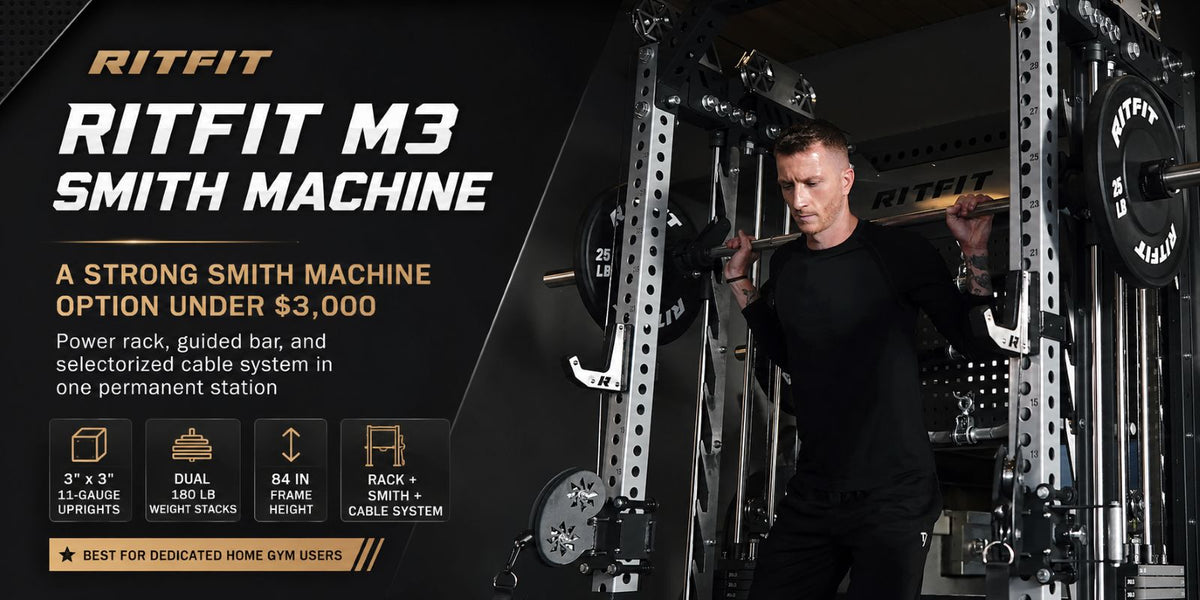
The RitFit M3 PRO is a strong Smith machine option under $3,000 for lifters who want a power rack, guided bar, and selectorized cable system in one permanent station.
The guide covers frame construction, Smith and cable performance, buyer fit, and the space, delivery, and assembly planning that a permanent station requires.
Quick Answer: The RitFit M3 PRO is the best Smith machine under $3,000 for lifters who want a 2,500 pound rated rack, a 352 pound dynamic guided bar, and dual 180 pound selectorized cable stacks in one permanent station. It rewards frequent training, not buyers who need portability.
Key Takeaways
- Frame construction: The M3 PRO uses 3 inch by 3 inch 11 gauge Q235 steel across its front, middle, and rear uprights.
- Cable resistance: Each side contains a 180 pound stack, but the 2 to 1 pulley ratio produces approximately 90 pounds of theoretical resistance at one fully loaded handle.
- Space requirement: RitFit lists a 21.5 square foot base footprint, while the maximum length and width create an outer floor rectangle of approximately 36.3 square feet.
- Best buyer fit: The M3 PRO makes the most sense for frequent home gym users who want rack training, Smith exercises, and fast cable adjustments in one fixed installation.
- Smith capacity: The guided bar carries a published 352 pound dynamic rating, and the higher 572 pound static figure is not the recommended working load.
Quick Verdict and Current M3 PRO Price
The RitFit M3 PRO is best suited to lifters who value built in weight stacks and multiple training stations more than portability or the lowest possible price.
The machine is not automatically the best choice for every home gym. A standalone Smith machine, plate loaded system, or standard power rack may offer better value for buyers with narrower training goals.
The current price and complete specification sheet are listed on the RitFit M3 PRO product page.
Buyers still comparing configurations can browse the complete RitFit Smith machine collection. The collection includes selectorized, plate loaded, compact, and modular systems for different budgets and room sizes.
What to Look for in a Smith Machine Under $3,000
The best machine is the one that supports your training plan, room dimensions, and ownership expectations without forcing unnecessary compromises. Frame construction, resistance type, usable space, bar capacity, and service access matter more than the total number of advertised exercises.
- Frame dimensions: Larger uprights can improve attachment stability and rigidity, but steel dimensions alone do not prove overall durability. Examine tubing size, gauge, base design, hardware, weld quality, and published capacities together.
- Smith bar system: Check the bar path, starting resistance, sleeve length, rack positions, dynamic capacity, and safety stop design. A high static rating does not automatically represent the recommended working load.
- Cable loading method: Selectorized stacks support faster exercise changes, while plate loaded cables usually cost less and can offer a higher practical loading ceiling. The better system depends on whether convenience or maximum loading matters more.
- Pulley ratio: A 2 to 1 ratio means the user moves more cable while feeling about half of the selected stack weight before friction and manufacturing tolerances. It generally produces smoother movement and smaller resistance increments.
- Actual floor envelope: Compare the manufacturer footprint with the maximum external length and width. You also need room for a bench, plates, cable travel, loading access, and the exercises you plan to perform.
- Delivery requirements: Heavy all in one machines commonly arrive by freight rather than parcel service. Check curbside access, crate dimensions, doorway width, floor strength, and the final installation route before ordering.
RitFit M3 PRO Specifications and Features
The M3 PRO combines three primary strength stations within one 84 inch tall frame. Its defining hardware includes uniform 11 gauge uprights, a vertical Smith system, dual cable trolleys, dual selectorized stacks, storage rods, safety arms, and a pull up bar.
| Specification | M3 PRO Data | Buyer Meaning |
|---|---|---|
| Frame dimensions | 86.5 inches long, 60.4 inches wide, 84 inches high | Requires permanent floor and ceiling planning |
| Listed footprint | 21.5 square feet | Manufacturer base footprint, not complete exercise clearance |
| Maximum outer rectangle | Approximately 36.3 square feet | Calculated from maximum length and width |
| Frame material | Q235 steel, 3 inch by 3 inch, 11 gauge | Uniform upright construction across the frame |
| Assembled rack weight | 1,093.5 pounds | Difficult to relocate after complete assembly |
| Frame capacity | 2,500 pounds | Published overall frame rating |
| Smith capacity | 352 pounds dynamic, 572 pounds static | Dynamic capacity is the more relevant training reference |
| Cable stacks | 180 pounds per side | 360 pounds of total installed stack mass |
| Pulley ratio | 2 to 1 | Approximately 90 pounds of theoretical resistance per fully loaded handle |
| Cable positions | 29 trolley positions | Supports low, middle, and overhead cable movements |
| Pulley construction | 16 aluminum pulleys | Integrated dual cable routing |
RitFit M3 PRO official specification summary
Dimension and capacity figures can be confirmed on the official M3 home gym page before you order.
Frame and Rack Construction
The M3 PRO uses the same 3 inch by 3 inch 11 gauge Q235 steel specification across the front, middle, and rear uprights. Its 35 one inch upright holes use approximately 2 inch spacing, supporting J hooks, safety arms, and compatible rack attachments at multiple heights.
Smith Machine System
The vertical Smith system uses a 2.2 meter bar, ten rack positions, and a published dynamic capacity of 352 pounds. Advanced lifters whose working sets regularly exceed that number should compare the Smith capacity carefully rather than relying on the higher 572 pound static rating.
Cable Crossover System
Each cable tower contains a 180 pound selectorized stack and uses a 2 to 1 ratio. This setup prioritizes smooth travel, longer cable movement, and quick resistance changes rather than delivering the full selected stack weight at one handle.
Included Training Hardware
The system includes J hooks, extended safety arms, a pull up bar, plate storage rods, rear pegboard storage, and a landmine station. Buyers may still need a suitable bench, Olympic plates, floor protection, and additional handles based on their program.
A stable bench is essential for Smith presses and seated cable movements, and the RitFit GATOR adjustable bench is one compatible option. Buyers building a complete free weight station can also review RitFit color bumper plates.
Smith Machine and Cable Training Performance
A guided bar is a legitimate strength training tool, but it changes stabilization, technique, and movement specificity compared with a free barbell. The M3 PRO is therefore best viewed as another training method rather than a universal replacement for free weights.
Smith Squat Strength
A 2025 study involving eleven trained women reported an average one repetition maximum of 92.9 kilograms in the Smith squat and 85.1 kilograms in the free weight squat. The guided condition allowed a higher average load in this sample, but the study focused on load velocity measurement and did not prove that the Smith squat is universally superior.[1]
Acute Squat and Leg Press Responses
A 2025 study of twelve recreationally active men found greater acute growth hormone and cortisol responses after high volume Smith back squats than after horizontal leg presses. The Smith squat condition also produced more total mechanical work, so the hormonal results should not be attributed to machine type alone or interpreted as proof of greater long term muscle growth.[2]
Quadriceps Activation and Load Matching
A 2018 investigation developed equations for selecting Smith squat and leg press loads that produced similar quadriceps activation or perceived effort. The authors treated the equations as preliminary decision tools, which means individual technique, anatomy, training experience, and machine design still matter.[3]
Machines Compared With Free Weights
A systematic review of thirteen studies and 1,016 participants found no significant overall difference between machine and free weight training for hypertrophy, jump performance, or directly compared strength outcomes. Strength improvements were more specific to the trained and tested modality, supporting equipment selection based on goals and preference.[4]
- Use the Smith station for: Controlled squats, split squats, presses, calf raises, rows, shrugs, and movements where repeatable bar positioning is useful.
- Use the rack for: Free barbell exercises that require a self selected bar path and greater stabilization demands.
- Use the cables for: Flyes, rows, pulldowns, curls, extensions, lateral raises, rotational work, and accessory supersets.
- Use the safety hardware correctly: Set safety arms or Smith stops before loading challenging sets. A guided bar reduces some spotting demands but does not remove the need for responsible setup and technique.
Users who need additional grips can compare RitFit cable machine attachments. Choose attachments according to cable compatibility, intended exercise, grip comfort, and available range of motion.
Who Should Buy the RitFit M3 PRO
The M3 PRO is a high commitment purchase because of its price, weight, and permanent footprint. It delivers the best personal value when most of its stations will be used consistently.
Buy the RitFit M3 PRO If
- You train several days each week: The Smith station, rack, and cables can support compound lifts, isolation exercises, supersets, and full body programming without changing machines.
- You prioritize fast cable changes: Selectorized stacks remove repeated plate loading between rows, flyes, curls, extensions, and other accessory movements.
- You want uniform heavy frame construction: The M3 PRO uses 3 inch by 3 inch 11 gauge uprights across the entire frame rather than only at the front posts.
- You have a permanent training room: The assembled weight exceeds one thousand pounds, making the system better suited to a long term garage, basement, or dedicated room installation.
- Your Smith working loads fit the rating: The 352 pound dynamic Smith capacity should cover your current program and expected progression.
Choose Another Machine If
- You only need guided bar exercises: A standalone Smith machine can cost substantially less because you are not paying for selectorized cables and rack functions.
- You regularly exceed the Smith capacity: Compare machines with higher published dynamic working limits and confirm how the manufacturer defines each capacity.
- You need to move equipment frequently: A lighter plate loaded system or modular rack will be easier to relocate than a 1,093.5 pound assembled machine.
- Your ceiling is exactly 84 inches or lower: The frame reaches 84 inches, leaving inadequate installation and user clearance under a ceiling of the same height.
- You already own many plates and prefer maximum cable loading: A plate loaded system may provide a lower entry price and greater loading flexibility.
Buyers comparing models across the line can read the RitFit M3 vs M2 vs M1 comparison guide to match a machine to their budget and ceiling height.
Space, Delivery, and Assembly Planning
The M3 PRO requires more practical room than its listed 21.5 square foot base footprint suggests. Use the full 86.5 inch by 60.4 inch dimensions as the starting point, then add space for loading, a bench, cable movement, and safe access.
Measure the Complete Training Zone
A planning zone near 8 feet by 10 feet is more realistic than reserving only the manufacturer footprint, although the exact requirement depends on your exercise selection. Measure ceiling obstructions, garage door tracks, wall outlets, lighting, baseboards, floor slope, and storage access.
Check the Ceiling Before Ordering
The frame is 84 inches high and the pull up bar is approximately 83 inches from the floor. A ceiling only 84 inches high does not provide comfortable pull up clearance and may prevent assembly depending on flooring and structural obstacles.
Plan the Freight Route
The M3 PRO arrives by freight in one wooden crate and becomes difficult to move after assembly. Confirm curbside access, pallet handling, garage or doorway width, turns, stairs, floor loading, and the distance between delivery location and installation area.
Prepare for Assembly
Organize all hardware before tightening the frame and keep major connections finger tight until the structure is aligned. Use multiple capable adults or qualified assembly support, follow the current manual, and never place yourself beneath unsecured frame components.
Plan the Remaining Equipment
The final gym budget may include a bench, Olympic plates, flooring, collars, cable handles, storage, and professional assembly. Confirm exactly what is included in the selected M3 PRO offer before comparing total ownership cost with another machine.
"Anytime I had to drive to a gym, it wasted valuable time. I wanted to be able to walk 50 feet outside my house and have a gym right there."
Dr. Mike Israetel, PhD, PhD in Sport Physiology, Co-founder, Renaissance Periodization
How to Assemble
The RitFit M3 PRO assembles with multiple capable adults following the current manual, and organizing all hardware before tightening the frame saves the most setup time.
FAQs About the RitFit M3 PRO Smith Machine
Is the RitFit M3 PRO worth $2,815.99 for a home gym?
Yes. The M3 PRO is worth considering when you want a Smith machine, power rack, and selectorized cable system in one permanent station. Its value is strongest for frequent lifters who would otherwise buy separate machines, while buyers needing only guided bar training can spend less.
What is the effective cable resistance of the RitFit M3 PRO?
Each side contains a 180 pound weight stack connected through a two to one pulley ratio. That means the theoretical resistance felt at one handle is about 90 pounds at full selection, while the combined installed stack mass across both sides is 360 pounds.
How much floor space does the RitFit M3 PRO really require?
RitFit lists a 21.5 square foot base footprint, but the maximum length and width create an outer rectangle of about 36.3 square feet. Plan additional room for plate loading, bench placement, cable travel, and safe movement comfortably around the machine.
Can the RitFit M3 PRO fit under an 84 inch ceiling?
No. The frame is listed at 84 inches tall and the pull up bar reaches about 83 inches, so an 84 inch ceiling leaves little or no practical head clearance. Measure joists, lights, doors, flooring thickness, and user clearance carefully before ordering.
Does the RitFit M3 PRO include built in weight stacks?
Yes. The M3 PRO includes a 180 pound selectorized stack on each side, giving 360 pounds of installed stack mass. Because the cable ratio is two to one, buyers should distinguish the physical stack weight from the effective resistance delivered at each handle.
How difficult is RitFit M3 PRO delivery and assembly?
The M3 PRO is a freight delivered machine that arrives in one wooden crate, and the assembled rack weighs more than one thousand pounds. Confirm curbside access, doorway dimensions, helpers, tools, and the final installation location before delivery because moving the completed unit is difficult.
Which buyers should choose a plate loaded Smith machine instead?
Choose a plate loaded model when lower purchase price, easier relocation, or a higher cable loading ceiling matters more than fast selectorized changes. Plate loaded systems also suit buyers who already own many Olympic plates and do not mind changing plates between cable exercises.
Is a Smith machine as effective as free weights for building muscle?
Both methods can support muscle growth when training volume, effort, and progression are appropriate. Research suggests hypertrophy outcomes are broadly similar, while strength gains are more specific to the exercises and equipment used, so the better choice depends on goals, skill, and preference.
Conclusion
The RitFit M3 PRO is a compelling Smith machine under $3,000 for buyers who need selectorized cables, rack training, and guided lifting in one permanent system. Its value depends on having enough space, staying within the 352 pound dynamic Smith capacity, and using enough of its stations to justify the $2,815.99 price.
Measure the complete training zone, confirm freight access, and compare the M3 PRO with lower priced selectorized and plate loaded alternatives before ordering. Current promotions are collected in the RitFit discount guide.
Disclaimer
This article provides general product and fitness information and is not medical, rehabilitation, financial, or individualized training advice. Equipment specifications, promotions, availability, warranties, and delivery terms may change, so confirm all details with the manufacturer before purchase and consult a qualified professional before performing unfamiliar or high load exercises.
References
1. Tsoukos A, Bogdanis GC. Effects of transducer placement on load velocity relationships in Smith machine and free weight squats in trained women. J Funct Morphol Kinesiol. 2025;10(2):178. doi:10.3390/jfmk10020178. PMCID: PMC12101428
2. Kotikangas J, Walker S, Häkkinen K, Peltonen H. Acute neuromuscular fatigue, hormonal responses, and recovery in males during high volume resistance exercises: Smith machine back squat vs horizontal leg press. Eur J Appl Physiol. 2025;125(10):2921-2938. doi:10.1007/s00421-025-05793-3. PMCID: PMC12479625
3. Migliaccio GM, Dello Iacono A, Ardigò LP, Samozino P, Iuliano E, Grgantov Z, Padulo J. Leg press vs Smith machine: quadriceps activation and overall perceived effort profiles. Front Physiol. 2018;9:1481. doi:10.3389/fphys.2018.01481. PMCID: PMC6206431
4. Haugen ME, Vårvik FT, Larsen S, Haugen AS, van den Tillaar R, Bjørnsen T. Effect of free weight vs machine based strength training on maximal strength, hypertrophy and jump performance: a systematic review and meta analysis. BMC Sports Sci Med Rehabil. 2023;15:103. doi:10.1186/s13102-023-00713-4. PMCID: PMC10426227





