If you walk into any gym on Earth, you’re likely to be overwhelmed by the number of machines beckoning to you. Some of these are both familiar and intuitive while others appear much more mysterious and complicated. You probably just want to get a good leg day workout in; what’s a lifter to do?!
We could spend hours discussing every niche piece of equipment or leg machine at the gym, but we think it’s better to focus on the ones that are the most common, the most effective, and the most accessible…even if you’re more interested in training at home. Let’s look at the top six leg machines that meet all three of these criteria.
Quick Comparison: Which Leg Machine is Right for You?
| Machine Type | RitFit Model | Best For | Max Weight Capacity | Footprint |
| Power Cage | PPC03 | Heavy lifters wanting maximum safety & versatility | 1000 lbs | 17.33 sq. ft. |
| Smith Machine | M1 / M1 Pro | Solo training & bodybuilding isolation | 1500+ lbs | 22.46 sq. ft. |
| Leg Press | BLP01 | Lower body isolation without back strain | 1200 lbs | 20.3 sq. ft. |
Squat Rack
If you’re serious about making serious leg day gains, you should recognize the squat rack as the focal point of your lower body training. Despite being one of least complicated leg machines at the gym, a good squat rack allows you to safely perform some of the most effective compound exercises including barbell back squats, barbell front squats, and good mornings (Gullet,Tillman, Gutierrez, Chow, 2009).
In addition to providing extensive functionality, many squat racks can be incredibly subtle. Folding squat racks (like the PWM02) can easily fit into an empty corner, enabling even those living in the smallest of spaces to reap their benefits!

Power Cage
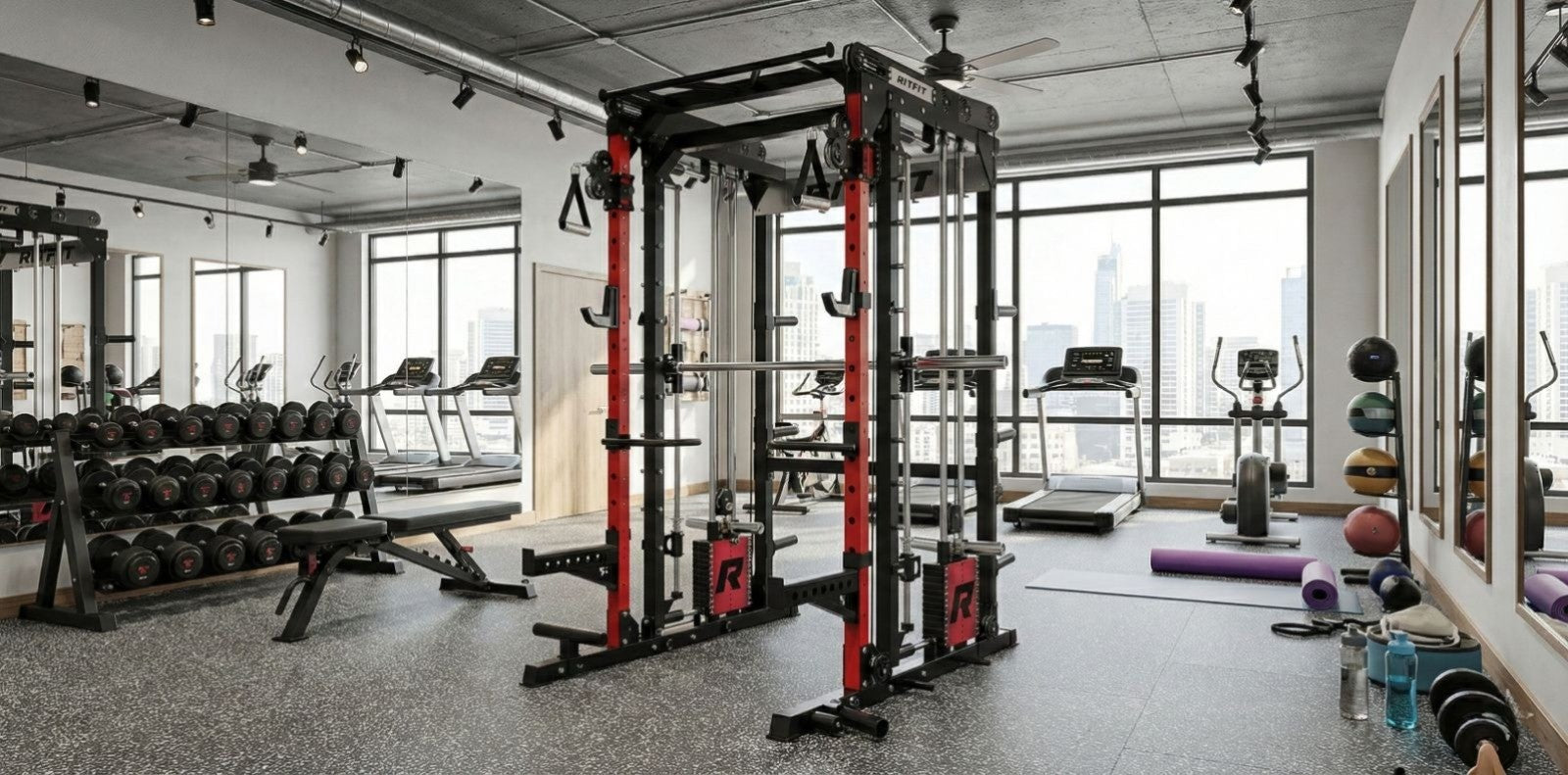
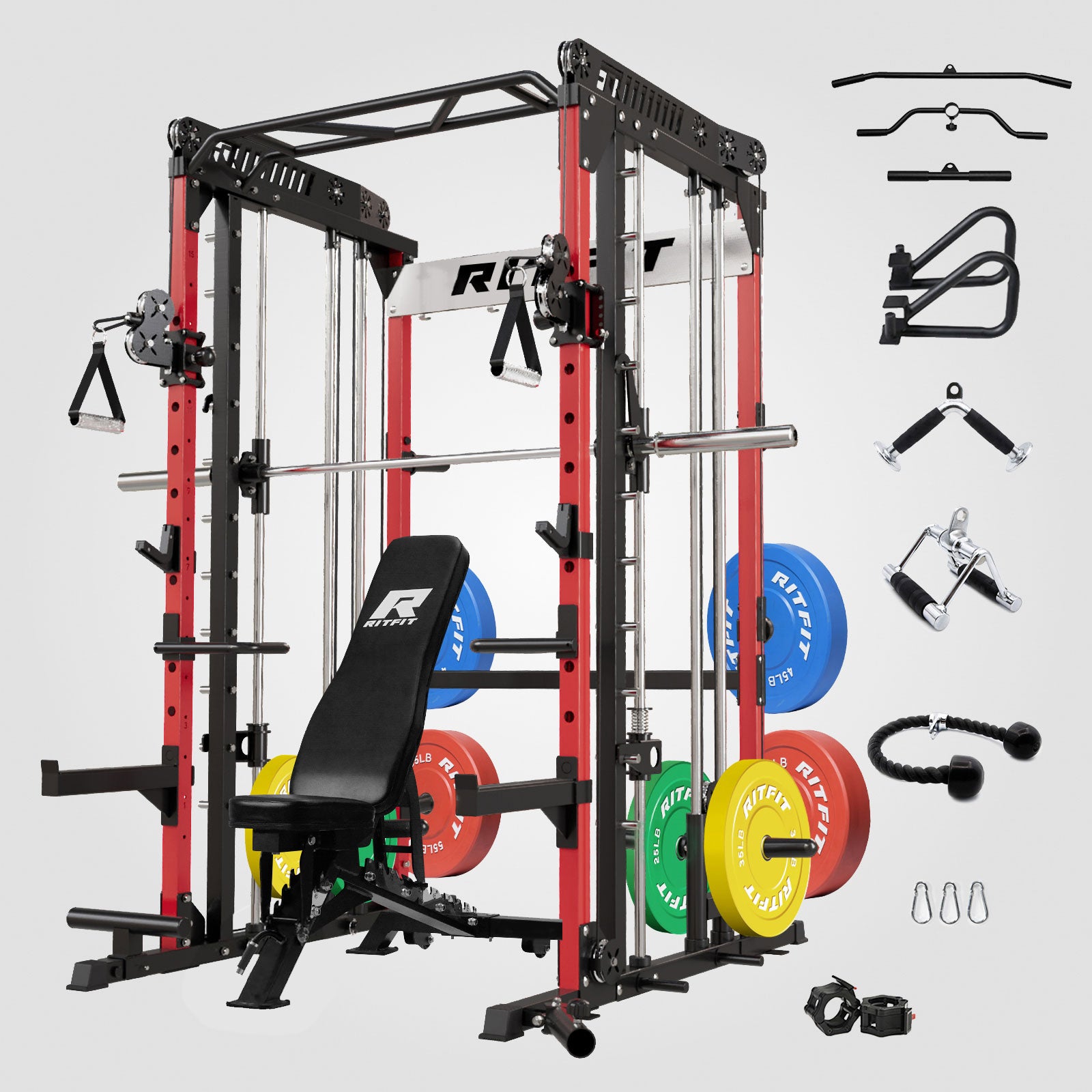
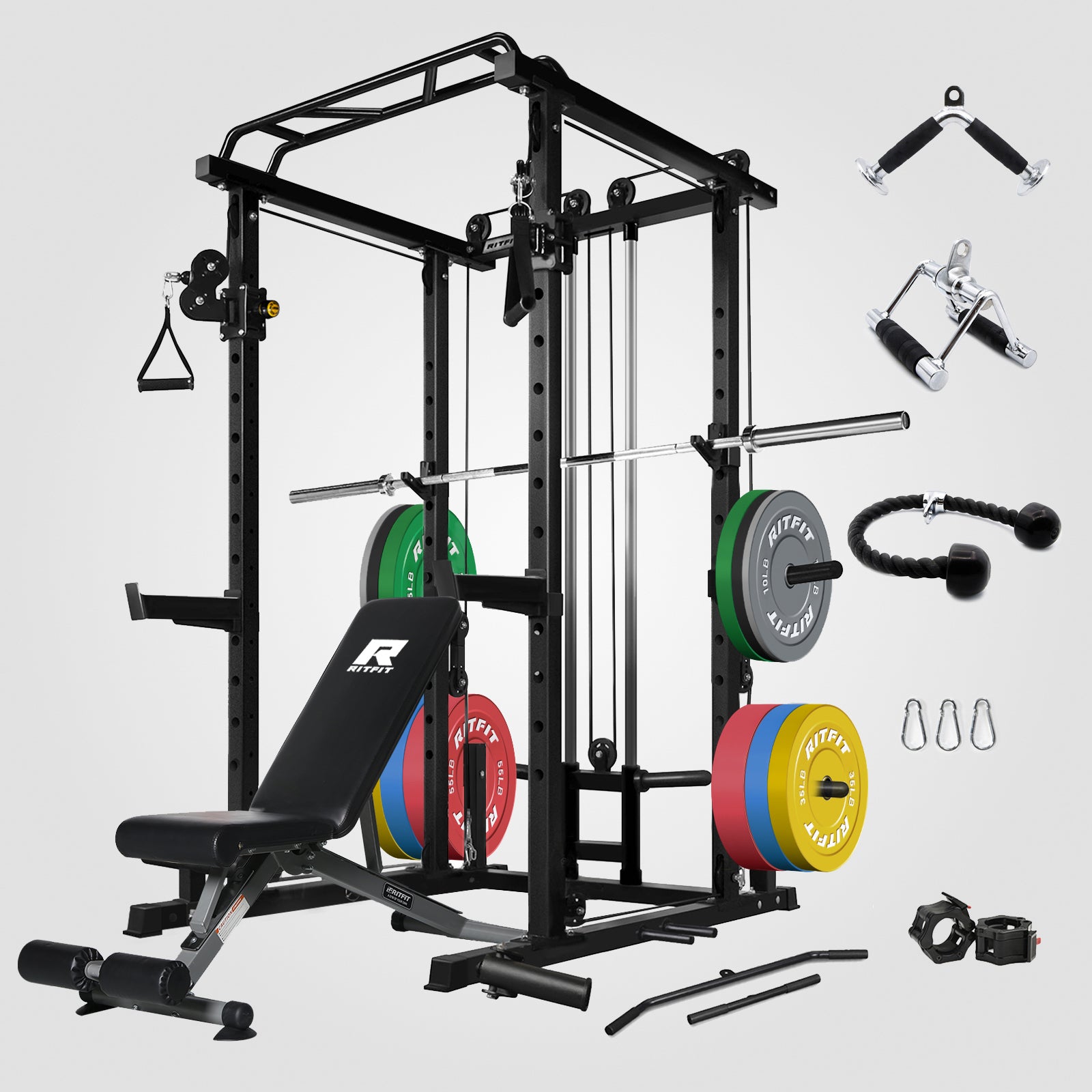
A power cage can be viewed as a good “upgrade” from a basic squat rack. In many cases, a more extensive array of exercises can be done in a power cage, particularly if they include a cable pulley system. Power cages (like the PPC03) also afford lifters more robust safety mechanisms, usually in the form of built-in safety bars which lifters can rely on to “catch” their barbell if they fail a rep. The safety bars are also excellent exercise starting points for exercises such as barbell shrugs and rack pulls.

Due to the plethora of exercise options power cages provide, many assume the title of “all-in-one”. They are one of the few leg machines at the gym that can legitimately service all of your home gym lifting needs.
Smith Machine
The previous two entries focused on machines that mainly facilitate barbell, compound exercises. The Smith Machine (like the PSR05) allows lifters to perform variations of many of these exercises, but in a modified format with a special Smith Barbell. Unlike movements using a “free” barbell, the Smith Barbell moves along a fixed path, safely guiding lifters through picture-perfect exercise technique on each repetition.
The Smith Barbell’s fixed path also allows lifters to perform additional leg exercises, such as vertical leg presses or standing calf raises. To perform these, lifters need to be slightly creative, however the benefits of this creativity are more than worth it.
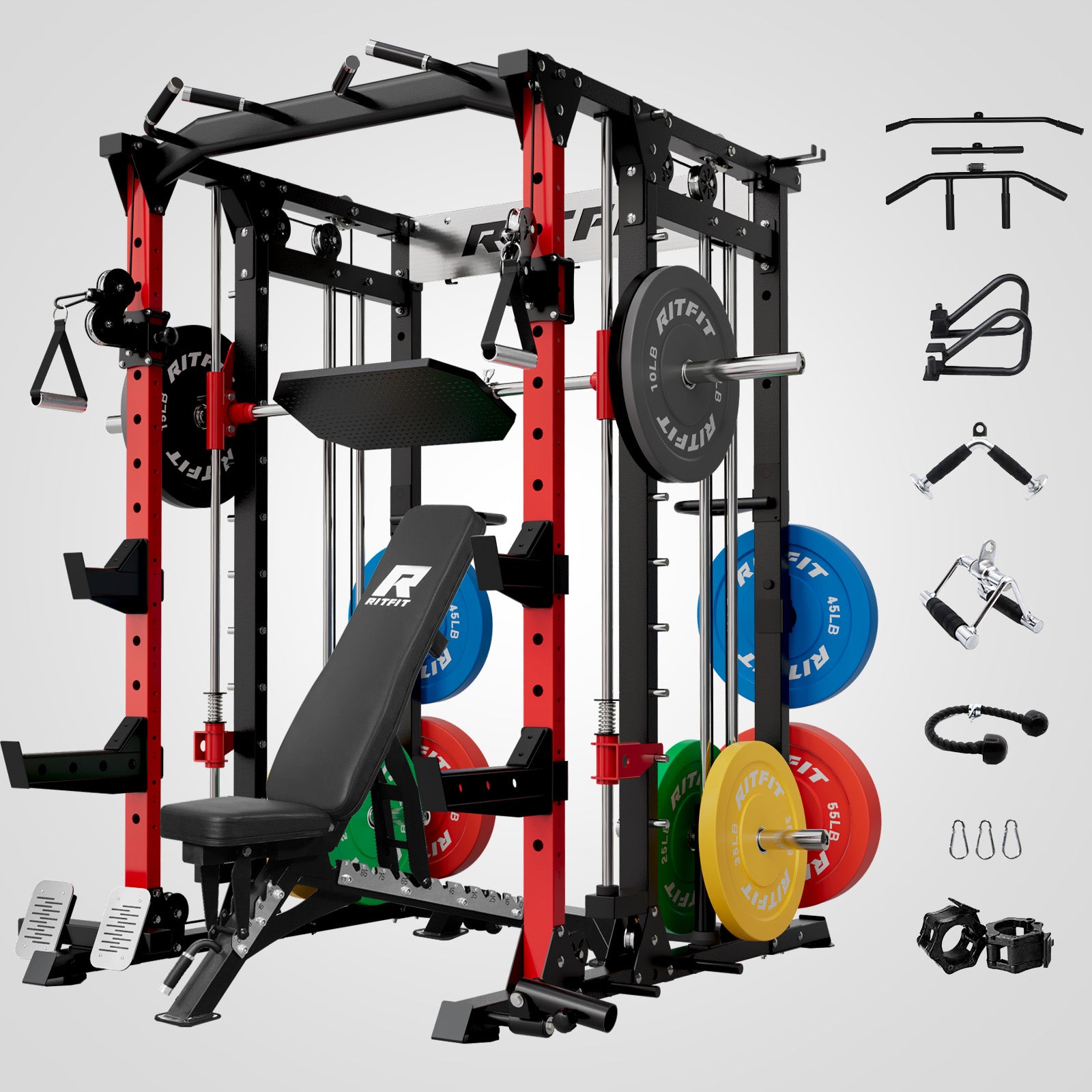
Some power cages actually include built-in Smith Machines (like the M1), providing even more possibilities than either of these leg machines possess on their own. Combination Smith Machine/power racks are unmatched in the sheer amount of functionality they provide lifters.

Leg Press Machine
Of all the leg machines at the gym, the leg press machine might be the most recognizable. It is also the machine that allows lifters to push the most weight, a large contributing factor to overall strength development (Wirth, Keiner, Hartmann, Sander, Mickell, 2016).
Leg press machines come in a number of different formats with the weight-stack, vertical, and angled being the most popular. Although overall functionality is more limited with leg press machines than it is for the previous entries on this list, angled leg press machines generally provide the most of this bunch.
Angled leg press machines can be used for the traditional lying leg press exercise as well as for a number of different lying calf raise movements. Single-leg exercises are also much easier to perform with angled leg press machines than with its counterparts.

Hack Squat Machine
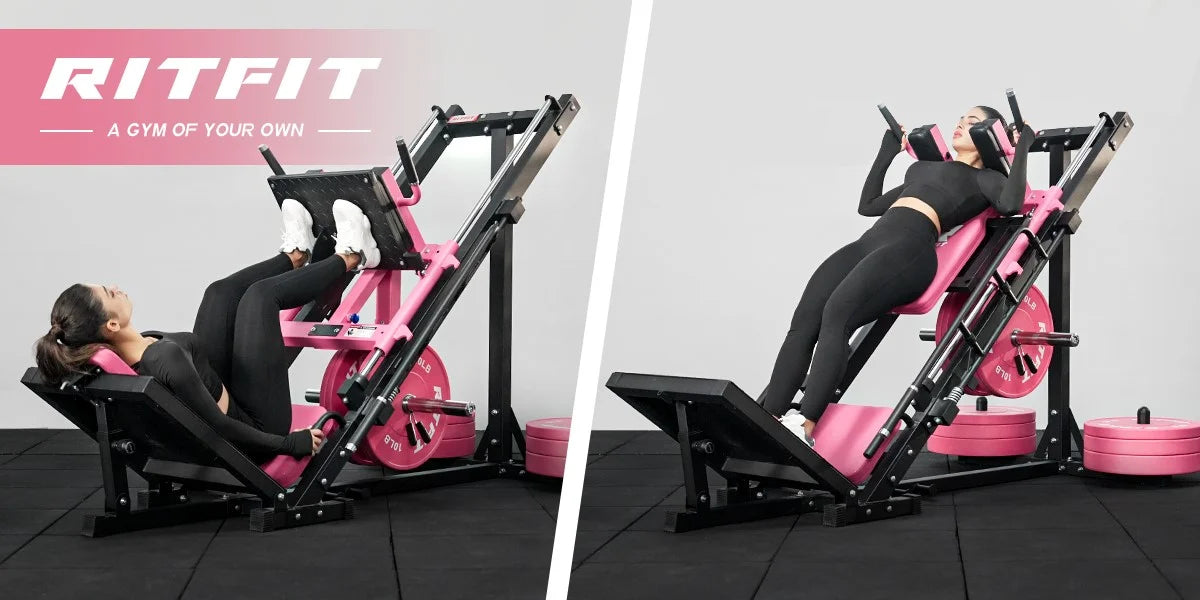
Hack squat machines may look familiar to you as they often bear a rather close resemblance to leg press machines. In many cases, these machines actually are designed as combination apparatuses with the leg press/hack squat machine (like the BLP01) being one of the most common, and the most effective, leg machines in the gym.
Looking at the hack squat machine’s functionality, the hack squat and reverse hack squat exercises create a similar movement pattern as the barbell squat, but their use can result in greater positive performance outcomes (Schwarz, Harper, Waldhelm, McKinley-Barnard, Holden, Kovaleski, 2019). The potential these machines create for increased muscle growth is supplemented by the numerous standing calf raise options hack squat machines provide.
Hip Thrust Machine
Over the past decade, the hip thrust machine has rapidly grown in popularity. It is now a standard piece of equipment in commercial and home gyms everywhere.
Hip thrusts can be executed with just a barbell and a padded mat for additional comfort, but a dedicated hip thrust machine (like the PHM01) does a much better job of isolating the glute muscles, providing back support, and maintaining stability throughout each rep and set.
Hip thrust machines have the most limited scope of any of the leg machines discussed so far, but are the most affordable and most space efficient for lifters who would like to take their lower body training home with them.

Home Gym Safety Checklist
Before buying or using heavy leg equipment, ensure you meet these safety standards:
- Space Requirements: Add at least 2 feet of clearance around machines like the PPC03 or M1 for loading plates and safe movement.
- Floor Protection: Heavy machines (200lb+) can damage floors. Use high-density rubber stall mats (3/4" thick recommended) under your rack or leg press.
- Safety Spotters: Always adjust spotter arms (on racks) or safety stops (on Smith machines/Leg presses) to a height just below your lowest range of motion before loading weight.
Want the most “bang for your buck”? Choose any two from our list!
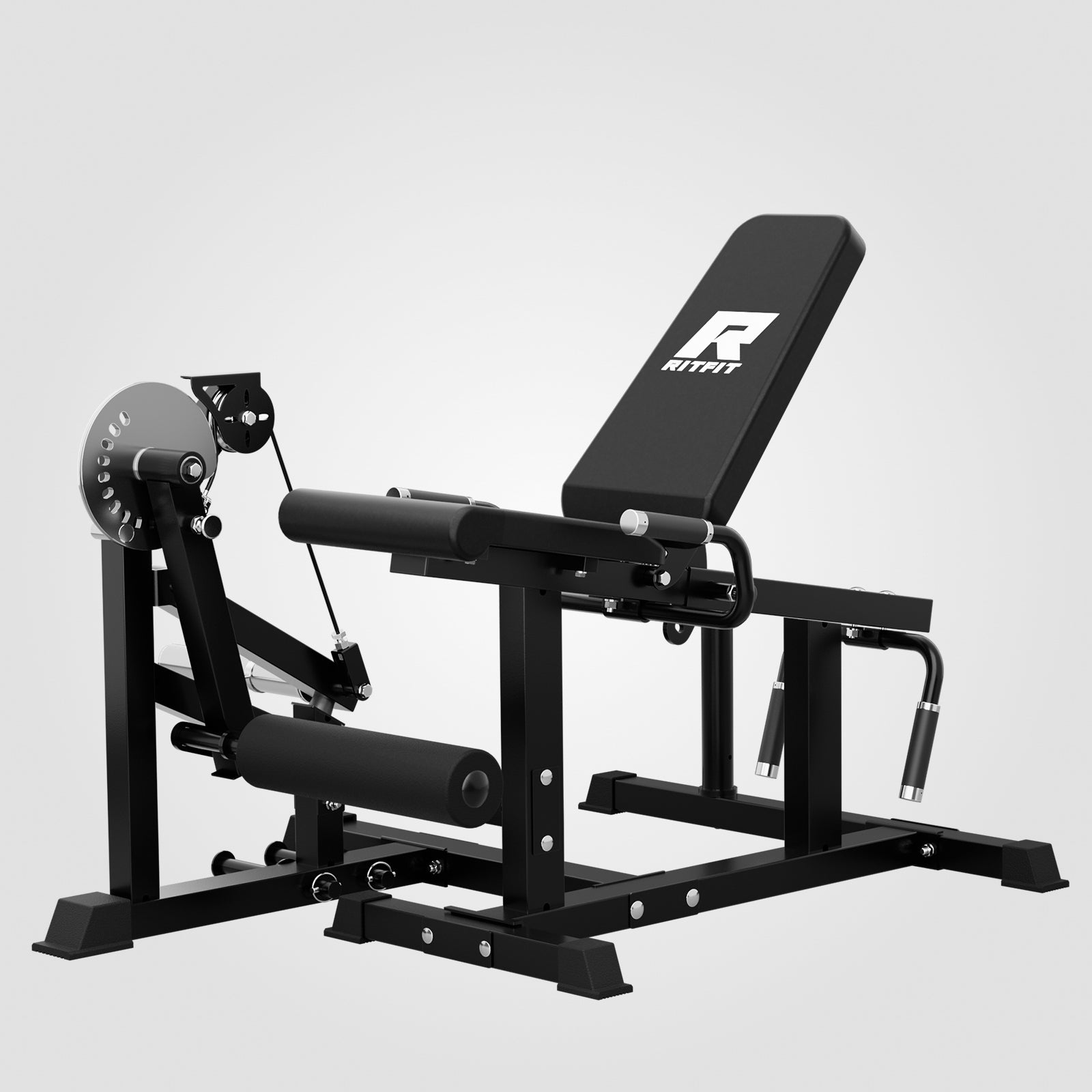
There are so many different leg machines at the gym and you may be wondering why some “fan favorites” may have been left off our list. As much as people love their leg extension machine, leg curl machine, hip abductor machine, and hip adductor machine, these are pieces of equipment that are best left at the gym. Their overall levels of functionality are quite limited, especially in relation to their typically high price points.
As far as the best leg machines at the gym that you can realistically ‘bring home” with you, we are confident that with any combination of two or more of the machines from our list that you can get a very effective lower body workout.
Better results with only a couple of pieces of equipment? Sounds like an efficient way to structure your leg day!
Summary
It's easy to get lost among all of the leg machines at the gym. Instead of struggling to figure out how to operate each and every one, take a look at the top six for overall gains and efficiency.
Important disclaimer: This article is for general educational purposes only and is not medical advice. If you have shoulder, neck, back, elbow, or wrist pain, a recent injury or surgery, numbness or tingling, unexplained weakness, or dizziness, consult a qualified clinician before starting. Stop any exercise that causes sharp pain.
References
Gullett, J., Tillman, M., Gutierrez, G., Chow, J. (2009). A biomechanical comparison of back and front squats in healthy trained individuals. Journal of Strength and Conditioning Research 23(1): 284-292.
Schwarz, N., Harper, S., Waldhelm, A., McKinley-Barnard, S., Holden, S., Kovaleski, J. (2019). A comparison of machine versus free-weight squats for the enhancement of lower-body power, speed, and change-of-direction ability during an initial training phase of recreationally-active women. Sports 7(10): 215-224.
Wirth, K., Keiner, M., Hartmann, H., Sander, A., Mickel, C. (2016). Effect of 8 weeks of free-weight and machine-based strength training on strength and power performance. Journal of Human Kinetics 53: 201-210.