








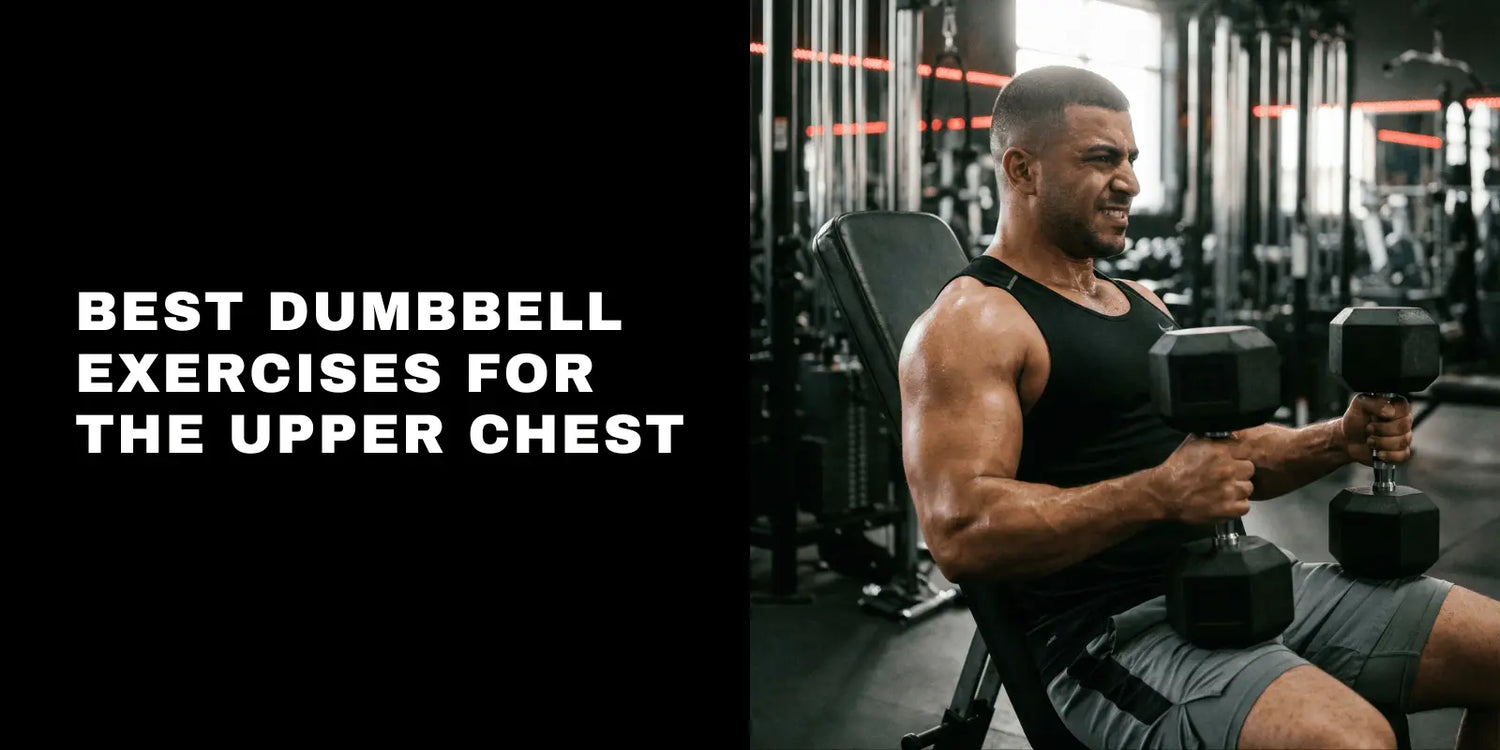
Quick Answer: The best dumbbell exercises for the upper chest are the low-incline dumbbell press, incline dumbbell fly, squeeze press, dumbbell pullover, feet-elevated push-up, upper-chest crossover, and dumbbell raise. Do this upper chest dumbbell workout twice per week on a 15-30 degree incline with shoulder blades tight and a controlled lowering phase.
Key Takeaways
- Main builder: The low-incline dumbbell press at a 15-30 degree angle adds upper-chest mass more reliably than steeper pressing.
- Stretch work: The incline dumbbell fly trains the chest through a long stretch and works best as a secondary movement.
- Adduction finisher: The dumbbell crossover (low to high) adds the up-and-in squeeze that pressing alone does not fully train.
- Light accessory: The dumbbell raise for the upper chest is a controlled move that rounds out any upper chest dumbbell workout.
- Setup wins: Shoulder blades back and down plus a 2-3 second lowering phase beat rushed reps every session.
Why the upper chest is hard to "feel"
The upper chest (clavicular head of the pectoralis major) contributes most when your pressing path moves "up and in" relative to your torso and when your shoulders stay stable. Many lifters miss it because they use a bench angle that's too steep, turn the movement into a shoulder exercise, or rush the lowering phase.
Dumbbells help because they allow a more natural arm path and a longer range of motion. Biomechanical analysis confirms that dumbbells allow for a convergent pressing path, which significantly reduces the risk of subacromial impingement while increasing activation of the target muscle[1].
Quick setup rules for better upper-chest activation
Before you pick an exercise, get these fundamentals right:
- Choose the right incline: Most people feel the upper chest best at 15-30°. Steeper inclines often shift more load to the front delts.
- Lock in your shoulder blades: Think "back and down" (retracted + depressed). Keep your chest "proud," not your shoulders shrugged.
- Use a slight elbow tuck: Roughly 30-60° from your torso is a strong starting point for most lifters.
- Control the eccentric: Lower for 2-3 seconds. The upper chest responds well to controlled tension.
- Press with intent: Drive the dumbbells up and slightly toward the midline without smashing them together.
How to work the upper chest with dumbbells, step by step
Answer: To work the upper chest with dumbbells, set a 15-30 degree incline, pin the shoulder blades back and down, press up and in, and lower for 2-3 seconds. Those four steps keep the tension on the clavicular head instead of the front delts.
- Set the bench to a 15-30 degree incline, the range explained in our best incline for your bench press breakdown.
- Lie back, plant your feet, and lock the shoulder blades back and down before the first rep.
- Press the dumbbells up and slightly toward the midline, following an up-and-in line instead of a straight vertical path.
- Lower for 2-3 seconds under control and stop just short of losing chest tension.
Master these four steps before adding volume, then plug them into the simplest upper chest dumbbell workout below; our best dumbbell chest exercises guide covers the rest of the chest.
"It starts with setting up the right height. That asks the question of what are you actually trying to train. What part of your chest? Because depending upon how high you set this, you could train different areas."
Jeff Cavaliere, MSPT, CSCS, Physical Therapist and Strength Coach, Athlean-X, Jeff Cavaliere Cable Crossover Tips (FitnessVolt)
The best dumbbell exercises for the upper chest
The best dumbbell exercises for the upper chest are the low-incline dumbbell press, incline dumbbell fly, squeeze press, dumbbell pullover, feet-elevated push-up, dumbbell crossover, and dumbbell raise. Pick two or three per session and keep the main pressing movement first.
Low-Incline Dumbbell Press (the main builder)
Why it works: This is the most reliable dumbbell movement for adding upper-chest thickness while keeping the shoulders in a strong position.
How to do it
- Set the bench to 15-30°.
- Lie back, feet planted, shoulder blades back and down.
- Start with the dumbbells near the upper chest line.
- Lower under control until you feel a strong stretch across the chest (no shoulder pain).
- Press up and slightly inward, stopping just short of losing tension.
Common mistakes
- Too steep incline (turns into front-delt pressing)
- Bouncing at the bottom or cutting range short
- Flaring elbows straight out
Best rep range: 6-10 or 8-12
Incline Dumbbell Fly (stretch + shape, done safely)
Why it works: Fly variations train the chest through a long stretch. Research indicates that loading the pectoral muscles in a stretched position promotes "stretch-mediated hypertrophy," triggering superior growth signals compared to mid-range work[2].
How to do it
- Set the bench to 15-30°.
- Start with dumbbells above your chest, palms facing each other, elbows softly bent.
- Open your arms in a wide arc, keeping that elbow angle steady.
- Stop when you reach a deep chest stretch without shoulder discomfort.
- Bring the dumbbells back up using your chest; don't "curl" them with your biceps.
Form cues
- "Hug a tree" arc (not a straight down-and-up drop)
- Move slow: 2-3 seconds down
- Keep shoulders packed; don't let them roll forward.
Best rep range: 10-15
"I have the 10 pound dumbbells and the 45 pound dumbbells and couldn't be Happier with the product"
Chris O. Verified Buyer, ToughFit Decagon PEV Dumbbells
Incline Squeeze Press / Hex Press (upper-chest tension without heavy load)
Why it works: Pressing while keeping the dumbbells close increases constant chest tension. Many lifters feel this is better than standard pressing when they struggle with mind-muscle connection.
How to do it
- Lie on a low incline bench.
- Hold dumbbells close together above the upper chest line.
- Apply gentle inward pressure (don't slam them).
- Lower and press while maintaining the "squeeze."
Best rep range: 10-15
Great for: Shoulder-sensitive lifters who still want a strong chest stimulus
"This makes my 4th RitFit purchase. I have the squat rack cable system. The leg press hack squat, leg extension leg curl and now the shoulder/chest press. I enjoy the brand enjoy the company. Great products. People see it all and think I'm sponsored. I tell them no. Just a huge fan of the brand and would recommend it to anyone."
Preston G. Verified Buyer, RitFit Gorilla 2-in-1 Chest and Shoulder Press Machine
Dumbbell Pullover (optional accessory, not your main upper-chest lift)
Why it's included: Pullovers can feel great for ribcage expansion mechanics, lats/serratus involvement, and a deep "upper torso" stretch. Chest contribution varies by individual anatomy and technique, so treat it as a secondary tool.
How to do it
- Lie on a flat bench with your upper back supported.
- Hold one dumbbell with both hands above your chest.
- Slightly bend elbows and lower the weight behind your head slowly.
- Pull it back over your chest using a controlled shoulder motion, keeping ribs down and core braced.
Best rep range: 10-15
If shoulders complain, skip it and replace it with more incline pressing or push-up variations.
Feet-Elevated Dumbbell Push-Up (best at-home upper-chest finisher)
Why it works: Elevating your feet shifts the push-up angle to emphasize the upper chest, while dumbbells keep wrists neutral and allow a deeper range.
How to do it
- Place dumbbells shoulder-width apart on the floor.
- Put your feet on a sturdy box/bench/step.
- Keep a straight body line with glutes and abs tight.
- Lower your chest between the dumbbells with control.
- Press up powerfully without losing core position.
Best rep range: 8-15
Easy to progress: Elevate feet higher or add a backpack weight.
Dumbbell Upper-Chest Crossover (low-to-high adduction finisher)
Why it works: The dumbbell crossover trains chest adduction on a low-to-high diagonal that matches the up-and-in line of the upper-chest fibers. Unlike barbell pressing, each arm works independently through the full arc, which is the main point in our dumbbell vs barbell bench press comparison.
How to do it
- Stand tall with soft knees, holding a light dumbbell in each hand at your sides.
- Turn the palms slightly forward and keep a small, fixed elbow bend.
- Sweep the dumbbells up and across your body until your hands meet around upper-chest height.
- Squeeze briefly at the top, then lower along the same arc under control.
Form cues
- Think "low to high," not straight across the chest
- Lead with the pinky side of the hand to keep the upper chest doing the work
- Keep the load light; control and a steady arc beat momentum
Best rep range: 12-15
Great for: Lifters who want more adduction work after pressing
Dumbbell Raise for the Upper Chest (light low-incline variation)
Why it works: A dumbbell raise for the upper chest is a shoulder-flexion pattern done on a low incline or with a slight cross-body angle, which lines the load up with the upper-chest line. Keep it light and treat it as an accessory, not a main builder.
How to do it
- Lie back on a 15-30 degree incline (or stand), holding light dumbbells in front of your thighs.
- Keep a small elbow bend and the shoulder blades pinned back and down.
- Raise the dumbbells up and slightly inward to about upper-chest height without swinging.
- Pause briefly, then lower for 2-3 seconds along the same path.
Form cues
- Stop the raise at chest height; going higher shifts the work to the front delts
- Do not lean back or use body English to start each rep
- Warm up the shoulders first if the front delts tend to take over
Best rep range: 12-15
Great for: Home setups; one pair of dumbbells covers every load this move needs
"RitFit Rubber Hex Dumbbell with Metal Handle For Free Weights Exercises|10-60 lbs Weights Range"
Romaine Hall, Verified Buyer, RitFit Rubber Hex Dumbbells Pairs and Sets
The simplest upper-chest dumbbell workout (home or gym)
Train this 2x per week with at least 48 hours between sessions.
Workout A (strength + thickness)
- Low-Incline Dumbbell Press 4 sets x 6-10 reps
- Incline Dumbbell Fly: 3 sets x 10-15 reps
- Incline Squeeze Press 2-3 sets x 10-15 reps
Workout B (hypertrophy + control)
- Low-Incline Dumbbell Press (slightly lighter) 3 sets x 8-12 reps
- Feet-Elevated Dumbbell Push-Up: 3 sets x 8-15 reps
- Dumbbell Pullover (optional) 2 sets x 10-15 reps
Rest times
- Heavy presses: 90-150 seconds
- Fly/push-up/squeeze: 60-90 seconds
Progression rules (how to grow without guessing)
Use this simple "double progression" method:
- Pick a rep range (example: 6-10).
- When you can hit 10 reps on every set with solid form, increase weight next time (even 2-5 lb per dumbbell helps).
- If you stall, keep the weight and try to add 1 rep total across the workout next session.
Weekly volume target (easy guideline)
- Beginners: 8-12 hard sets/week for chest
- Intermediate: 10-16 hard sets/week
(The upper chest is part of total chest work; don't bury yourself with endless incline volume.)
Warm-up that protects shoulders (5 minutes)
A five-minute warm-up that protects the shoulders should prime the upper back and scapular stabilizers before any pressing. Band pull-aparts, scapular push-ups, and one light set of incline presses are enough to prepare the upper chest for work.
- Band pull-aparts or rear-delt raises 2 x 12-20
- Scapular push-ups 2 x 8-12
- One light set of incline presses, 12-15 reps
This primes your upper back and shoulder blades so your chest can do the work.
Common upper-chest problems (and quick fixes)
Most upper chest dumbbell exercises fall short for three fixable reasons: an incline that is too steep, shoulders that shrug forward, and a rushed lowering phase. Fix the angle first, then the scapular position, then the tempo.
"I only feel my shoulders."
- Lower the incline to 15-30°.
- Tuck elbows slightly
- Slow the lowering phase
- Keep shoulders down; don't shrug.
"My shoulders hurt on flyes."
- Reduce range (stop earlier)
- Use lighter weight and slower reps.
- Switch to incline squeeze press or cable fly (if available)
"I can't set up an incline bench at home."
- Use firm pillows/foam wedges to create a low incline.
- Make feet-elevated push-ups your primary accessory.
FAQ
How long until I see upper-chest results?
Most lifters notice better "shape" in 6-10 weeks with consistent training and progressive overload.
What incline angle is best?
Start at 15-30°. If you feel front delts taking over, lower the angle.
Can I train my upper chest every day?
Not recommended.
The upper chest needs recovery like any muscle.
Two focused sessions per week is plenty.
Do flies build muscle or just stretch?
They can build muscle when controlled and loaded appropriately, but they're best as a secondary movement.
Can I build my upper chest with dumbbells at home only?
Yes. A pair of adjustable dumbbells, a low incline built from firm pillows, and the feet-elevated push-up cover the whole routine, and gym lifters can swap in the incline Smith machine press for a more stable setup.
Is the dumbbell crossover good for the upper chest?
The dumbbell crossover is a useful adduction finisher rather than a main builder, and it works best after pressing work like the incline dumbbell press or the incline bench press. Keep the arc low to high and the load light so the chest, not the front delts, finishes each rep.
What dumbbell raise works the upper chest?
The low-incline dumbbell raise shown above is the variation that lines the load up with the upper-chest line, while a flat or high front raise shifts the work toward the front delts. Keep it light and place it after your main pressing work, such as the moves in our dumbbell chest exercises with a bench guide.
Conclusion
Building a defined upper chest isn't about doing "more exercises"; it's about choosing the right incline, stabilizing your shoulders, and progressing smartly. If you do one thing, make the low-incline dumbbell press your foundation, then add flyes and a high-tension variation like the squeeze press. Train twice per week, track reps, and let small weekly progress stack up into visible results.
Important disclaimer: This article is for general educational purposes only and is not medical advice. If you have shoulder, neck, back, elbow, or wrist pain, a recent injury or surgery, numbness or tingling, unexplained weakness, or dizziness, consult a qualified clinician before starting. Stop any exercise that causes sharp pain.
References
1. Nishimura A, Sugita M, Kato K, Fukuda A, Sudo A, Uchida A. Hypoxia increases muscle hypertrophy induced by resistance training. Int J Sports Physiol Perform. 2010;5(4):497-508. doi:10.1123/ijspp.5.4.497
2. Warneke K, Afonso J, Thomas E, et al. Implications and Applications of Stretch-Mediated Hypertrophy in Therapy, Rehabilitation and Athletic Training-An Outlook to Future Potential Applications. Sports Med. 2025;55(8):1815-1825. doi:10.1007/s40279-025-02237-y





