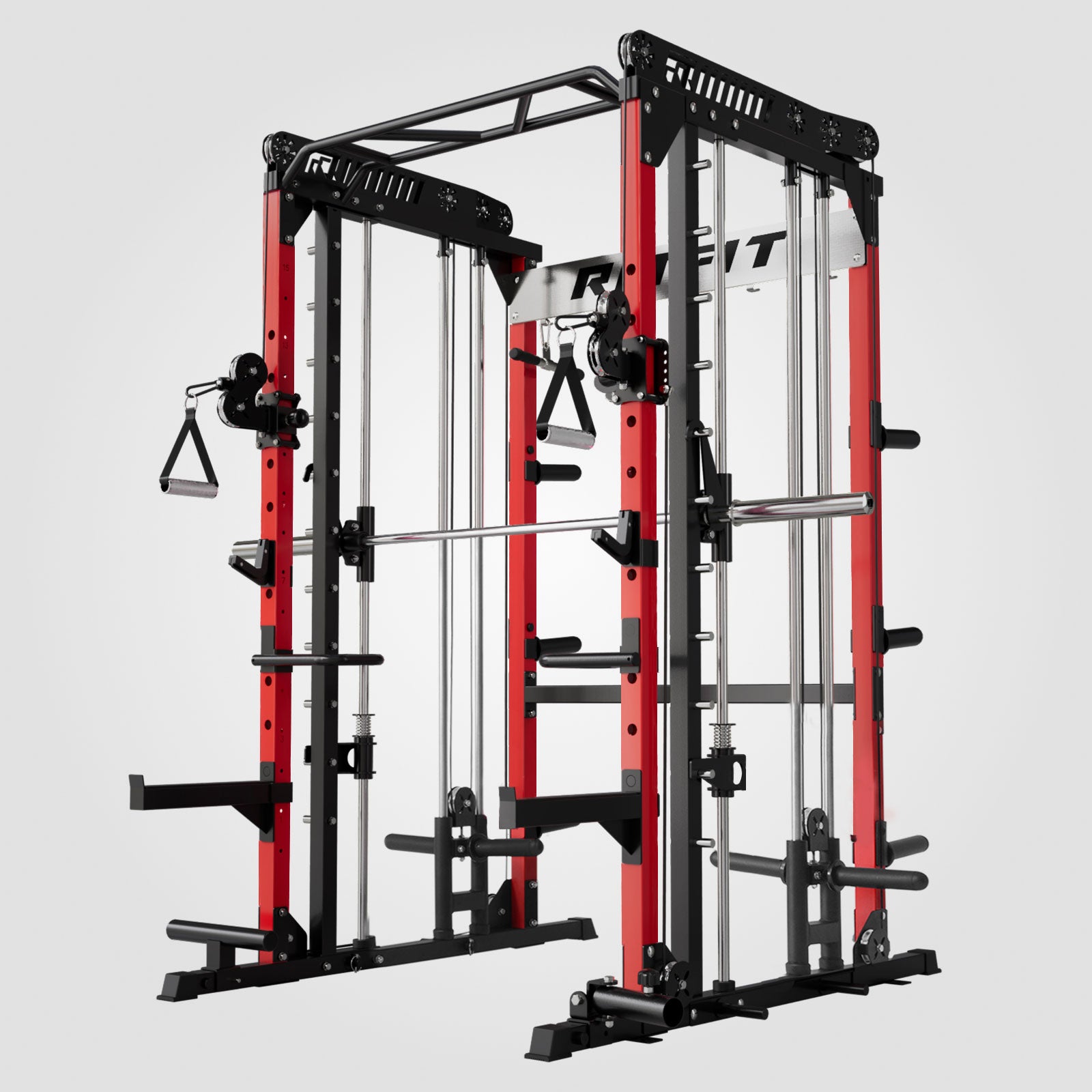
Yes, a Smith machine can feel like it takes off weight, but the exact reason depends on the machine. Counterbalance, rail friction, track angle, and reduced stabilizer demand can all change how heavy the lift feels compared with a free barbell.
The safest answer is not to use a universal conversion. Instead, check the machine label, measure the empty bar resistance, and track Smith machine lifts separately from free weight lifts.
Key Takeaways
- A Smith machine may feel lighter: Counterbalanced bars and smooth guide rails can reduce the effective starting resistance.
- Not every Smith machine removes weight: Non counterbalanced machines may feel closer to a standard Olympic barbell.
- Stability changes the lift: A fixed bar path reduces balance demand, which can make pressing and squatting feel easier.
- There is no universal conversion: Smith machine weight should not be directly compared with free weight numbers.
- Consistent tracking matters most: Use the same machine and the same logging method whenever possible.
Does a Smith Machine Actually Take Off Weight?
A Smith machine does not automatically remove weight from every lift. What often changes is the effective resistance, which is shaped by the bar system, rail design, counterbalance, and movement path.
If your machine has a counterbalanced bar, the empty bar may feel lighter than a 45 pound Olympic bar. If it does not have counterbalance, the bar may feel much closer to a traditional barbell.
Why Smith Machines Can Feel Lighter Than Free Weights
Smith machines often feel lighter because they reduce the need to balance the bar. Research comparing bench press conditions with different stability demands shows that instability can affect muscle activation and coordination during pressing movements.[1]
Counterbalanced Bar Systems
A counterbalanced Smith machine uses internal weights, cables, or pulleys to offset part of the bar resistance. This is why two Smith machines can feel very different even when the plates on each side look identical.
Fixed Bar Path
The fixed rail system guides the bar through a vertical or angled path. This removes much of the horizontal control required during a free weight bench press, squat, or shoulder press.
Reduced Stabilizer Demand
Free weights require more correction from stabilizing muscles because the lifter must control the bar in multiple directions. Smith machine training lets the lifter focus more directly on the target movement pattern.
Rail Friction and Bearing Quality
Smooth linear bearings can make the bar feel easier to move, while poorly maintained rails can add drag. This is one reason a Smith machine can feel lighter in one gym and heavier in another.
How Much Does a Smith Machine Bar Weigh?
A Smith machine bar can vary widely by model, so the most accurate answer comes from the machine label or manufacturer specification. For a deeper breakdown, read RitFit's Smith machine bar weight guide.
Do not assume the bar is automatically 45 pounds. Some counterbalanced commercial machines list a much lower effective starting resistance, while some home gym models may feel closer to a standard bar.
Smith Machine Weight vs Free Weight
Smith machine weight and free weight should be treated as related but separate training numbers. A 200 pound Smith machine bench press does not always equal a 200 pound free barbell bench press.
A 2023 systematic review found that training adaptations can depend on both training modality and testing modality, which means strength tends to transfer best to the way it is practiced and measured.[2]
Why Free Weight Carryover Is Different
Free weights require the lifter to control the bar path, balance the load, and coordinate stabilizing muscles. This is why many lifters should reduce the load when moving from a Smith machine to a free barbell.
- Bench press carryover: Start lighter when moving from Smith machine bench press to free weight bench press.
- Squat carryover: Retest depth, foot placement, and balance before loading heavy free weight squats.
- Progress tracking: Keep separate training logs for Smith machine lifts and free weight lifts.
For a broader comparison, see RitFit's Smith machine vs free weights guide.
Can You Convert Smith Machine Weight to Free Weight?
No, there is no reliable universal Smith machine to free weight conversion formula. Bar resistance, machine angle, rail condition, exercise choice, limb length, and skill level all affect the difference.
A better method is to lower the load, test your form, and build back up gradually. This is especially important when moving from guided pressing to free weight pressing.
How to Test Your Smith Machine Bar Weight
The best way to estimate Smith machine bar weight is to measure the effective empty bar resistance. This gives you a practical baseline for logging your workouts.
- Check the label: Many commercial Smith machines list the starting resistance on the frame.
- Read the manual: The product manual may list the effective bar weight or counterbalance design.
- Use a scale carefully: Place a stable scale under the empty bar and lower the bar slowly onto it.
- Repeat on the same machine: Use the same Smith machine whenever possible for consistent tracking.
Should You Count the Smith Machine Bar Weight?
Yes, count the Smith machine bar if you know its effective starting resistance. If you do not know the number, track only the plates added and keep your logging method consistent.
For example, if your machine label says the bar has 25 pounds of effective resistance, your total logged load is the plate weight plus 25 pounds. If the bar has no label, avoid guessing and write down the machine used.
Does the Smith Machine Reduce Muscle Activation?
The Smith machine can reduce some stabilizer demands, but that does not make it ineffective. Machine based training can still support strength and muscle growth when volume, effort, and progressive overload are programmed well.[2]
One randomized trial in novice males found improvements across strength, muscularity, and functional ability regardless of whether participants trained with machines, free weights, or a transition from machines to free weights.[4]
When Smith Machine Training Makes Sense
Smith machine training makes sense when you want a guided path, easier setup, and safer solo lifting. It is especially useful for home gym users who train without a spotter.
- Solo training: Safety catches can make heavy sets easier to manage without a training partner.
- Hypertrophy work: A fixed path can help you focus on target muscles and controlled reps.
- Accessory lifts: Smith machine split squats, hip thrusts, and incline presses can add stable volume.
- Beginner practice: Guided movement can help new lifters learn positions before progressing to free weights.
If you are building a compact home gym, explore the RitFit Smith machine collection for guided bar systems designed for strength training at home.
Common Mistakes When Tracking Smith Machine Strength
The biggest mistake is treating every Smith machine as if it has the same bar weight. Machines differ by counterbalance, rail angle, bearing condition, and maintenance.
- Using one fixed conversion: Do not assume every Smith machine is 10 percent or 20 percent lighter.
- Ignoring the bar label: The listed starting resistance is more useful than a generic online estimate.
- Comparing different machines: Progress is cleaner when you use the same machine repeatedly.
- Switching to free weights too heavy: Start lighter because free weights require more balance and control.
For practical safety guidance, review RitFit's guide on how to train safely on the Smith machine at home.
Best Smith Machine Exercises for Accurate Progress
The best exercises for Smith machine progress are movements where the guided path supports your goal instead of forcing an awkward pattern. Squats, incline presses, hip thrusts, shoulder presses, and Romanian deadlifts are common options.
Smith machine squat mechanics can also include sticking points and force changes across the lift, which is why position, range of motion, and controlled repetition quality matter.[3]
- Smith machine squats: Use a stance that lets your knees and hips move comfortably through the guided path.
- Smith machine incline press: Keep your wrists stacked and avoid flaring your elbows too aggressively.
- Smith machine hip thrust: Use padding, stable bench support, and controlled lockout mechanics.
- Smith machine RDL: Hinge from the hips and keep the bar path close to the body.
For exercise ideas, compare RitFit's best Smith machine squat exercises and Smith machine with cable system workout guide.
Choosing a Smith Machine for Home Gym Training
The right Smith machine should match your training style, ceiling height, available floor space, and need for attachments. A home gym user who wants guided bar training plus cable exercises may prefer an all in one design.
Before buying, compare frame size, storage, cable setup, attachment compatibility, and the type of bar system used. You can also review RitFit's M1 vs M2 Smith machine comparison for model selection.
FAQs
Does a Smith machine take off weight?
Yes. A Smith machine can feel lighter when the bar is counterbalanced or guided by low friction rails. The machine does not erase the plates you load, but it can change the effective starting resistance, balance demand, and perceived difficulty compared with a free barbell.
How much does a Smith machine bar weigh?
A Smith machine bar weight depends on the machine. Some counterbalanced bars feel much lighter than a 45 pound Olympic bar, while non counterbalanced models may feel closer to a standard bar. The most reliable answer comes from the product manual, machine label, or direct scale test.
Should I count the Smith machine bar weight?
Yes. Count the Smith machine bar if you know its effective starting resistance. If the machine does not list it, track the weight plates separately and keep using the same recording method. Consistency matters more than forcing a universal conversion across different machines.
Why does a Smith machine feel easier than free weights?
A Smith machine often feels easier because the rails control the bar path and reduce balance demands. Your prime movers can focus more on pressing or squatting, while stabilizing muscles do less corrective work than they would with a free barbell.
Can Smith machine weight convert to free weight?
No. There is no universal Smith machine to free weight conversion because bar resistance, rail friction, angle, and technique all vary. When switching to free weights, lower the load, test your form, and rebuild gradually instead of trusting a fixed percentage.
Is the Smith machine good for building strength?
Yes. The Smith machine can build strength when you use progressive overload, full range of motion, and consistent technique. Free weights may transfer better to free weight testing, but machine based training can still improve strength and hypertrophy when programmed well.
Are Smith machine squats easier than barbell squats?
Usually yes. Smith machine squats often feel easier because the fixed path removes much of the balance requirement. However, some lifters may feel awkward or weaker if the rail angle does not match their natural squat pattern.
How do I measure Smith machine effective weight?
Measure Smith machine effective weight by checking the machine label, reading the manufacturer specification, or carefully lowering the empty bar onto a scale. Use that number only for that specific machine, because another Smith machine may have a different counterbalance and rail resistance.
Conclusion
A Smith machine may take off weight, but the real answer depends on counterbalance, rail friction, bar path, and stabilizer demand. Do not use a universal conversion for every machine.
For the most accurate training log, check the label, measure the empty bar resistance, and track Smith machine lifts separately from free weight lifts. This gives you cleaner progress data and safer load selection.
Disclaimer
This article is for general strength training education and equipment understanding only. Always follow the manufacturer instructions for your specific Smith machine, use safety catches correctly, and reduce the load when switching from guided equipment to free weights. Consult a qualified fitness professional if you are new to heavy lifting or returning from injury.
References
- Wang L, Qiao M, Tao H, Song X, Shao Q, Wang C, Yang H, Niu W, Chen Y. A comparison of muscle activation and concomitant intermuscular coupling of antagonist muscles among bench presses with different instability degrees in untrained men. Front Physiol. 2022;13:940719. doi:10.3389/fphys.2022.940719
- Haugen ME, Vårvik FT, Larsen S, Haugen AS, van den Tillaar R, Bjørnsen T. Effect of free weight vs machine based strength training on maximal strength, hypertrophy and jump performance: a systematic review and meta analysis. BMC Sports Sci Med Rehabil. 2023;15:103. doi:10.1186/s13102-023-00713-4
- van den Tillaar R, Kristiansen EL, Larsen S. Is the occurrence of the sticking region in maximum Smith machine squats the result of diminishing potentiation and co contraction of the prime movers among recreationally resistance trained males? Int J Environ Res Public Health. 2021;18(3):1366. doi:10.3390/ijerph18031366
- Aerenhouts D, D'Hondt E. Using machines or free weights for resistance training in novice males? A randomized parallel trial. Int J Environ Res Public Health. 2020;17(21):7848. doi:10.3390/ijerph17217848