Yes, handgrip training can increase forearm size, but it mostly grows the finger flexors that close your hand, not the whole forearm. Grippers alone give limited, lopsided growth.
This guide explains forearm anatomy, what a gripper actually trains, and how to pair grippers with wrist work and progressive overload for real, balanced forearm size.
Table of Contents
Key Takeaways
- Yes, with limits: Grippers grow the finger flexors that close the hand, adding density and some size to the anterior forearm.
- Not the whole forearm: A gripper biases the flexors and barely loads the extensors, so it cannot build balanced size alone.
- Combine for real size: Pair grippers with wrist curls, reverse curls, and loaded carries for complete forearm hypertrophy.
- Progressive overload wins: Forearms grow when you add resistance over time, train near effort, and respect tendon recovery.
- Be patient: Strength shows in weeks, but visible size changes usually take consistent months of training.
Does Handgrip Increase Forearm Size
Yes, a hand gripper can increase forearm size, but the effect is modest and concentrated in the muscles that close your fingers. It is a useful piece, not the whole answer.
Squeezing a gripper loads the finger flexors hard, and these muscles respond to training like any other. Over time that can add density and a little thickness to the inner forearm.
- What grows: The crushing flexors on the palm side of the forearm get the most direct stimulus from gripper work.
- What lags: The extensors on the back of the forearm and the wrist movers see little load from a gripper.
- Bottom line: For balanced, visible size you need more than crushing, which is what the rest of this guide covers.
Forearm Anatomy You Need to Know
The forearm holds about 20 muscles split into two compartments, and understanding them explains why grippers grow only part of your forearm. Anatomy references describe an anterior flexor group and a posterior extensor group.[1]
The flexors on the palm side close the fingers and flex the wrist, while the extensors on the back open the fingers and extend the wrist. A gripper hits the first group and mostly skips the second.
- Anterior flexors: Include the finger flexors and wrist flexors that produce most crushing and gripping force.
- Posterior extensors: Open the hand and stabilize the wrist, and they need their own dedicated training.
- Brachioradialis: Sits on the thumb side and contributes much of the visible upper-forearm mass during pulling.
To learn the basics of the tool itself, read our overview of everything about hand grip strengtheners before building a routine.
What a Hand Gripper Actually Trains
A hand gripper trains crush grip, the force you use to close your hand around an object. Grip coaches and brand guides note it mainly works the finger flexors plus thumb-side and wrist stabilizers.
That makes a gripper excellent for building closing power and inner-forearm density. It is a focused tool, not a full forearm program.
- Crush grip: The squeezing strength that grippers train best, useful for carries, pulls, and daily tasks.
- Flexor density: Repeated hard closes thicken the finger flexors and add a harder, fuller look to the palm-side forearm.
- Limited extensor work: The opening muscles stay nearly idle, which is why a gripper cannot build the whole forearm.
For step-by-step technique, see our guide to hand grip exercises and apply the form cues below.
Why Grippers Alone Build Limited Size
Grippers alone build limited forearm size because they load one region while leaving others undertrained. Muscle grows where it receives tension, so a single movement grows a single area.
Research on upper-limb resistance training shows forearm and elbow flexor muscles respond to progressive overload and can grow with consistent loading.[2] A gripper supplies that stimulus to the flexors only.
- One pattern: Crushing repeats the same closing action, so the extensors and wrist movers stay neglected.
- Mass distribution: Wrist flexion trains the largest share of forearm muscle, and grippers do not replace that work.
- Tendon limits: The fingers and wrist rely on tendons that adapt slowly, so you cannot simply crush harder every day.
How to Train Grippers for Forearm Growth
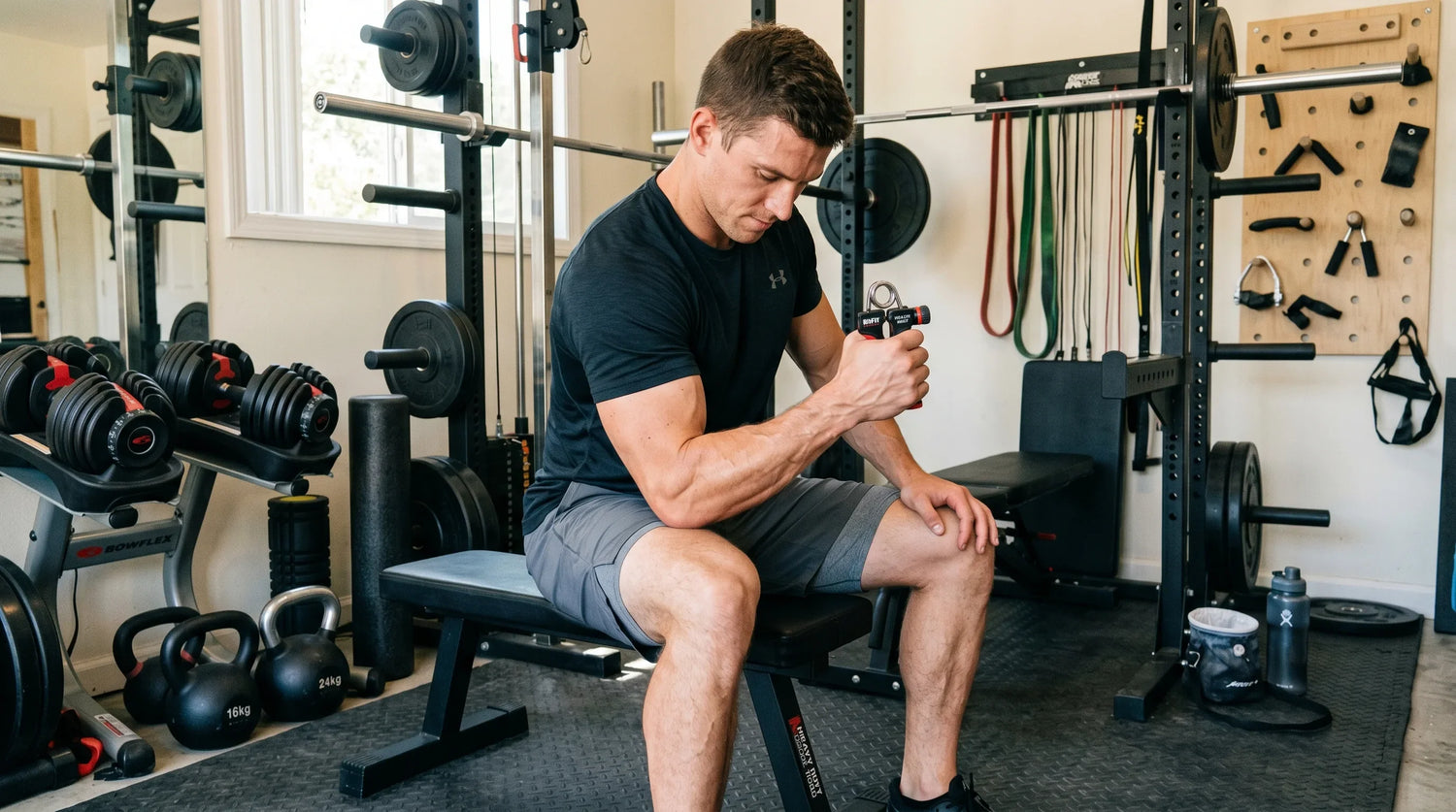
Train grippers for growth by choosing a manageable resistance and progressing it over time. Grip coaches commonly recommend a gripper you can close for 8 to 12 clean reps per hand.
Use controlled form, full closes, and slow releases, then add resistance as you get stronger. Quality reps beat endless pumping.
- Resistance: Pick a gripper you can close for 8 to 12 clean reps, not the hardest one you can barely move.
- Frequency: Train 2 to 3 times per week with a day between heavy sessions, and deload every 6 to 8 weeks.
- Form: Seat the handle deep in the palm, keep the wrist neutral, and finish the close with the ring and pinky fingers.
The video below walks through grip strength principles and forearm-focused methods you can apply to your sessions.
Build Complete Forearm Size
To build complete forearm size, pair grippers with movements that load the wrist and extensors. Evidence-based grip guides recommend adding wrist curls and reverse curls for full development.
Wrist flexion trains the most forearm mass, while reverse curls and extension work fill in the back of the forearm. Together they create balanced thickness.
- Wrist curls: Load the flexors through a full range for the biggest share of forearm mass, using 10 to 20 reps per set.
- Reverse curls and extensions: Train the brachioradialis and extensors that grippers ignore for balanced shape.
- Loaded carries: Holding heavy dumbbells builds support grip and adds time under tension for the whole forearm.
For broader programming ideas, browse our tips to build size and strength and see how we build arm size and strength across multiple heads. Stock the basics from the strength training equipment collection to cover grippers, dumbbells, and bars.
Realistic Timeline and Expectations
Expect strength gains within a few weeks but visible size changes over months of consistent training. Forearms are used all day, so they often need patient, progressive loading.
A 2025 study of 25 recreational athletes found forearm circumference increased significantly over 6 weeks, with the group right forearm rising from 24.6 to 25.4 cm.[3] That protocol combined gym and climbing work, not grippers alone.
- Early phase: The first weeks bring mostly strength and control as your nervous system adapts to the movement.
- Growth phase: Visible thickness usually follows months of steady overload, adequate protein, and recovery.
- Set expectations: Genetics, training history, and total volume all shape how fast your forearms change.
If you want a deeper look at how training drives growth, our notes on muscle size and strength training apply the same principles used for forearms.
Common Mistakes to Avoid
The most common mistake is treating a gripper as a complete forearm program. The second is training too heavy, too often, and ignoring the back of the forearm.
Avoid these errors and your grip and size will both progress more reliably. Recovery and balance matter as much as effort.
- Grip only: Relying on crushing alone leaves the extensors and wrist movers behind and stalls total size.
- No progression: Squeezing the same gripper forever stops growth, so add resistance or reps over time.
- Skipping recovery: Daily maxing strains tendons, so keep rest days and deloads to protect your elbows and hands.
FAQs About Handgrip and Forearm Size
Does handgrip increase forearm size?
Yes. A hand gripper increases the size of the finger flexors that close your hand, adding density to the inner forearm. The growth is modest and one-sided because grippers barely load the extensors, so pair them with wrist work for balanced forearm size.
How long does it take to see bigger forearms from grippers?
Strength often improves within a few weeks, while visible size usually takes months of consistent training. Forearms are used constantly throughout the day, so they need steady progressive overload, enough protein, and adequate recovery before any real thickness becomes clearly noticeable in the mirror.
Can you build forearms with only a hand gripper?
No. A gripper trains crushing through the finger flexors but leaves the extensors and wrist movers undertrained. For complete forearm size you should combine grippers with wrist curls, reverse curls, and loaded carries that directly load the muscles a gripper alone tends to miss.
What muscles do hand grippers work?
Hand grippers mainly work the finger flexors that close the hand, especially the deep and superficial finger flexors, along with thumb-side muscles and wrist stabilizers. This is why grippers build crushing strength and inner-forearm density rather than the whole forearm.
How often should you use a hand gripper for size?
Train grippers 2 to 3 times per week with a rest day between heavy sessions. Forearm muscles recover fairly fast, but the finger and wrist tendons need respect, so avoid daily maxing and schedule a lighter deload week roughly every 6 to 8 weeks.
What resistance gripper should a beginner choose?
Choose a gripper you can close for 8 to 12 clean reps per hand. That range lets you train with control while still challenging the flexors. Move up only when you own all your target reps with clean form across every set.
Are wrist curls better than grippers for forearm size?
Wrist curls train the largest share of forearm muscle, so they are more efficient for raw size. Grippers add crush strength and flexor density that wrist curls do not. The best plan uses both, since they develop different qualities and regions.
Why are my forearms not growing from grip training?
Common reasons include no progression, training only crushing, or skipping wrist and extensor work entirely. Forearms grow with added resistance over time and balanced loading. Check that you steadily increase difficulty, train multiple movement patterns, and allow proper recovery between your harder sessions.
Do hand grippers help with grip strength for lifting?
Yes. Grippers build crush grip that carries over to pulls, carries, and everyday tasks around the house. They are most useful as accessory work, since heavy holds and barbell training drive the support grip that tends to limit your big lifts more directly.
Should you train forearm extensors too?
Yes. Extensor and reverse work balances all the crushing a gripper provides and helps protect the elbows. Adding band extensions or reverse curls fills out the back of the forearm and supports long-term joint health, better balance, and more complete overall size.
Conclusion
Handgrip training does increase forearm size, but mainly in the finger flexors it loads directly. Use a gripper for crush strength and inner-forearm density, then build the rest with wrist work.
Combine grippers with wrist curls, reverse curls, and carries, progress the resistance over time, and respect recovery. Beginners should start light, master form, and stay consistent for months to see balanced forearm growth.
Disclaimer
This article is for general educational purposes only and is not medical advice. Training responses vary by individual, genetics, and history. If you have a wrist, elbow, or hand injury, or any health condition, consult a qualified professional before starting a new grip or forearm training program.
References
- Davis DD, Kane SM. Anatomy, shoulder and upper limb, forearm muscles. In: StatPearls. StatPearls Publishing; 2023. https://www.ncbi.nlm.nih.gov/books/NBK536975/
- Sato S, Yoshida R, Kiyono R, et al. Elbow joint angles in elbow flexor unilateral resistance exercise training determine its effects on muscle strength and thickness of trained and non-trained arms. Frontiers in Physiology. 2021;12:734509. https://pmc.ncbi.nlm.nih.gov/articles/PMC8489980/
- Chomiuk T, Męczyński A, Kasiak P, et al. Impact of 6-week combined gym and climbing training on handgrip strength and arm size, the GRIP-6 study. Journal of Functional Morphology and Kinesiology. 2025;10(4):427. https://www.mdpi.com/2411-5142/10/4/427