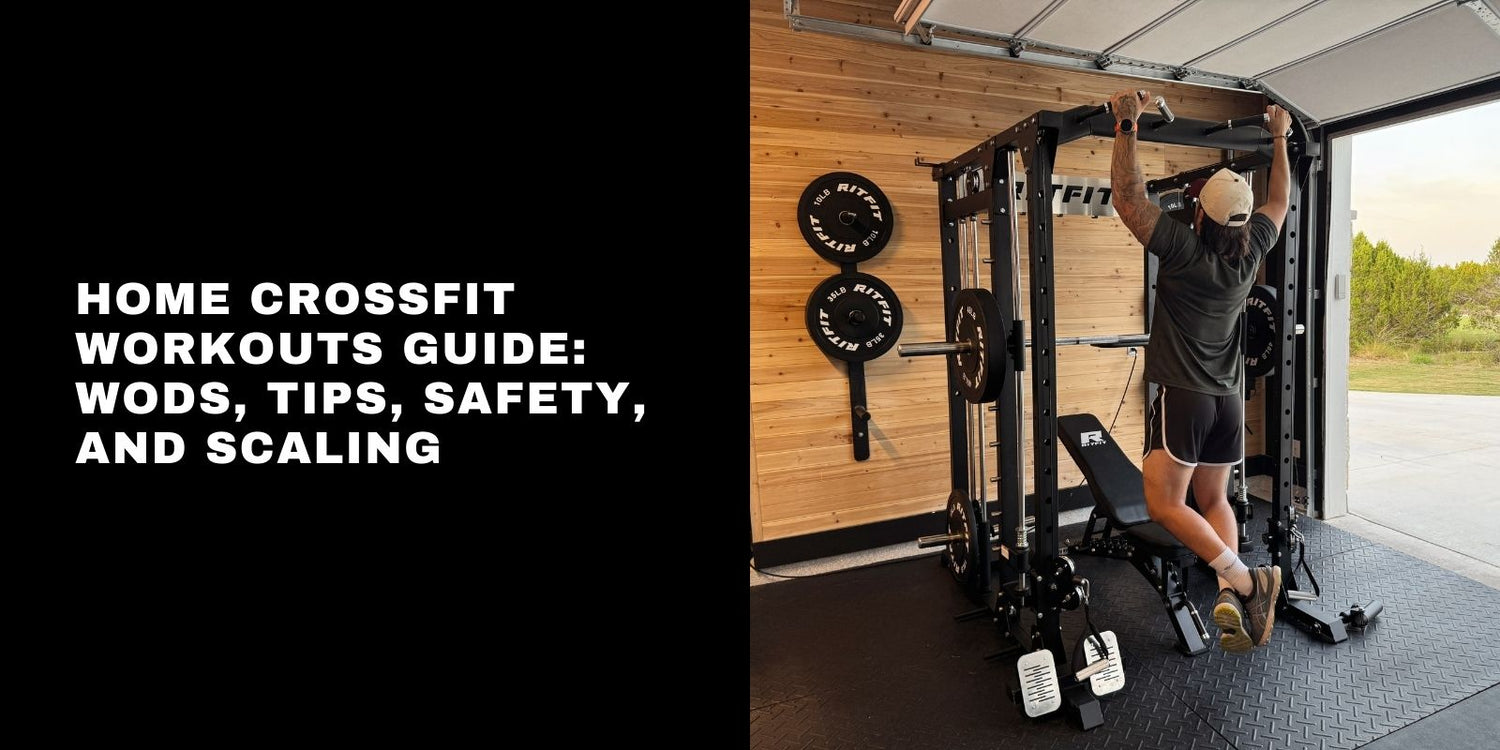
CrossFit workouts at home can be effective when you preserve the workout goal, scale the movements, and keep safety ahead of speed. You can train with bodyweight only, then progress with simple tools like dumbbells, kettlebells, bands, flooring, and an adjustable bench.
This guide shows you how to set up your space, choose safe home WOD formats, modify common movements, and build a weekly routine you can repeat consistently.
Table of Contents
- What Makes a Good Home WOD?
- Benefits of CrossFit Workouts at Home
- Setting Up Your Home CrossFit Space
- Essential Equipment for Home WODs
- How to Adapt CrossFit for Home WODs
- Warm Up and Mobility for Home WODs
- Sample Home WODs
- Programming Your Week of Home WODs
- Tracking Progress and Staying Motivated
- Safety Considerations and Common Mistakes
Key Takeaways
- You can do effective CrossFit style workouts at home with bodyweight movements, smart scaling, and short high intensity formats.
- A safe home WOD setup starts with clear floor space, non slip footing, overhead clearance, and stable equipment.
- The best home WODs use simple movement patterns such as squats, hinges, pushes, pulls, carries, jumps, and core bracing.
- Beginners should start with three to four focused sessions per week instead of training hard every day.
- Progress comes from tracking rounds, reps, time, load, movement quality, and recovery, not from chasing exhaustion.
What Makes a Good Home WOD?
A good home WOD preserves the intended training stimulus instead of copying a gym class exactly. The workout should have a clear format, safe movement options, realistic volume, and a way to measure progress.
- Functional movement patterns: Build sessions around squatting, hinging, pushing, pulling, carrying, jumping, rotating, and bracing. These patterns transfer well to daily strength and general conditioning.
- Clear workout format: Use AMRAP, EMOM, For Time, Tabata, or Chipper formats so the goal is easy to understand. A simple structure also makes your results easier to track.
- Appropriate intensity: Work hard relative to your current fitness level, not someone else’s score. HIIT can improve exercise capacity when programmed appropriately, but the effort must match your ability and recovery level.[1]
- Scalable movement choices: Choose variations that let you keep moving without losing control. A scaled workout that you complete well is more useful than an advanced workout performed poorly.
Benefits of CrossFit Workouts at Home
CrossFit workouts at home help remove common barriers such as commute time, class schedules, gym intimidation, and equipment overwhelm. They work best when you treat home training as a structured routine, not a backup plan.
- Convenience: Training at home reduces friction because your workout space is already available. This makes short morning, lunch break, or evening sessions easier to repeat.
- Cost control: Home WODs can start with no equipment and expand gradually. You can buy versatile tools only when your training needs become clear.
- Privacy: Beginners can practice movement patterns without pressure from a group class. This is useful when learning squats, push ups, burpees, hinges, and pacing.
- Flexible scaling: You can adjust reps, time caps, load, and impact level without waiting for class programming. This helps you match the session to sleep, soreness, and available time.
- Family friendly routine: Home workouts fit more easily around childcare, work breaks, and household schedules. A consistent routine usually beats an ideal routine you cannot repeat.
Setting Up Your Home CrossFit Space
Your home WOD area should let you move safely before intensity increases. A smaller clear space is better than a larger cluttered area with slipping, tipping, or overhead hazards.
Choosing the Right Area
Choose a flat area where you can stand tall, extend your arms overhead, lie down fully, and move through lunges or burpees without hitting furniture.
- Living room: Clear the floor, move sharp furniture edges away, and avoid rugs that slide. Use low impact substitutions if neighbors, flooring, or ceiling height are limiting factors.
- Garage: Check temperature, ventilation, flooring, and storage clutter before starting. A garage works well for jump rope, dumbbell work, loaded carries, and larger setups.
- Backyard: Use level ground and avoid wet grass, loose gravel, or uneven pavers. Outdoor workouts are useful for running intervals, carries, and bodyweight circuits.
- Basement: Confirm overhead clearance before thrusters, jumping, or skipping rope. Low ceilings favor step ups, marching intervals, carries, rows, and controlled strength circuits.
Flooring and Surface Safety
Use a stable, non slip surface before doing fast transitions, loaded squats, burpees, jump rope, or dumbbell work.
- Hard floors: Add traction and shock absorption with rubber gym flooring mats. This can help protect your floor and reduce sliding during high repetition movement.
- Tile or hardwood: Avoid sprinting, jumping lunges, and aggressive burpees if the surface feels slick. Replace them with step backs, reverse lunges, or mountain climbers.
- Carpet: Check whether your feet catch during pivots or transitions. Carpet can work for slow bodyweight training but may not be ideal for jump rope or fast footwork.
Essential Equipment for Home WODs
You can start home WODs with bodyweight only, then add equipment that increases exercise variety without taking over your space. Resistance training can improve muscle mass, strength, and physical function when programmed consistently, so versatile strength tools are worth prioritizing.[2]
Home WOD Equipment Progression
Build your setup in stages so every purchase solves a real training limitation.
| Setup Level | Best Tools | Best For | Example Movements |
|---|---|---|---|
| No equipment | Clear floor space and a timer | Beginners and travel workouts | Air squats, push ups, sit ups, lunges, burpees |
| Minimal setup | Mat, jump rope, bands, backpack | Low cost conditioning and scaling | Rows, step ups, loaded squats, band pulls |
| Strength setup | hex rubber dumbbells, kettlebell set, bench | Progressive strength and full body circuits | Goblet squats, snatches, swings, presses, rows |
| Complete home gym | Bench, plyo box, rack, barbell, plates | Advanced strength and long term progression | Deadlifts, squats, presses, pull variations, loaded carries |
Best First Additions
Choose equipment that supports many movement patterns instead of single purpose tools.
- Dumbbells: A pair of dumbbells supports thrusters, rows, lunges, snatches, farmer carries, floor presses, and Romanian deadlifts. Browse RitFit dumbbells if you want a simple strength upgrade for home WODs.
- Adjustable bench: A bench helps with incline push ups, step ups, split squats, dumbbell presses, rows, and seated work. The RitFit GATOR adjustable weight bench is a natural fit when bodyweight movements start feeling too limited.
- Plyo box: A box can support step ups, box squats, elevated push ups, seated rest periods, and controlled jump training. Explore RitFit plyo boxes if you want scalable lower body conditioning options.
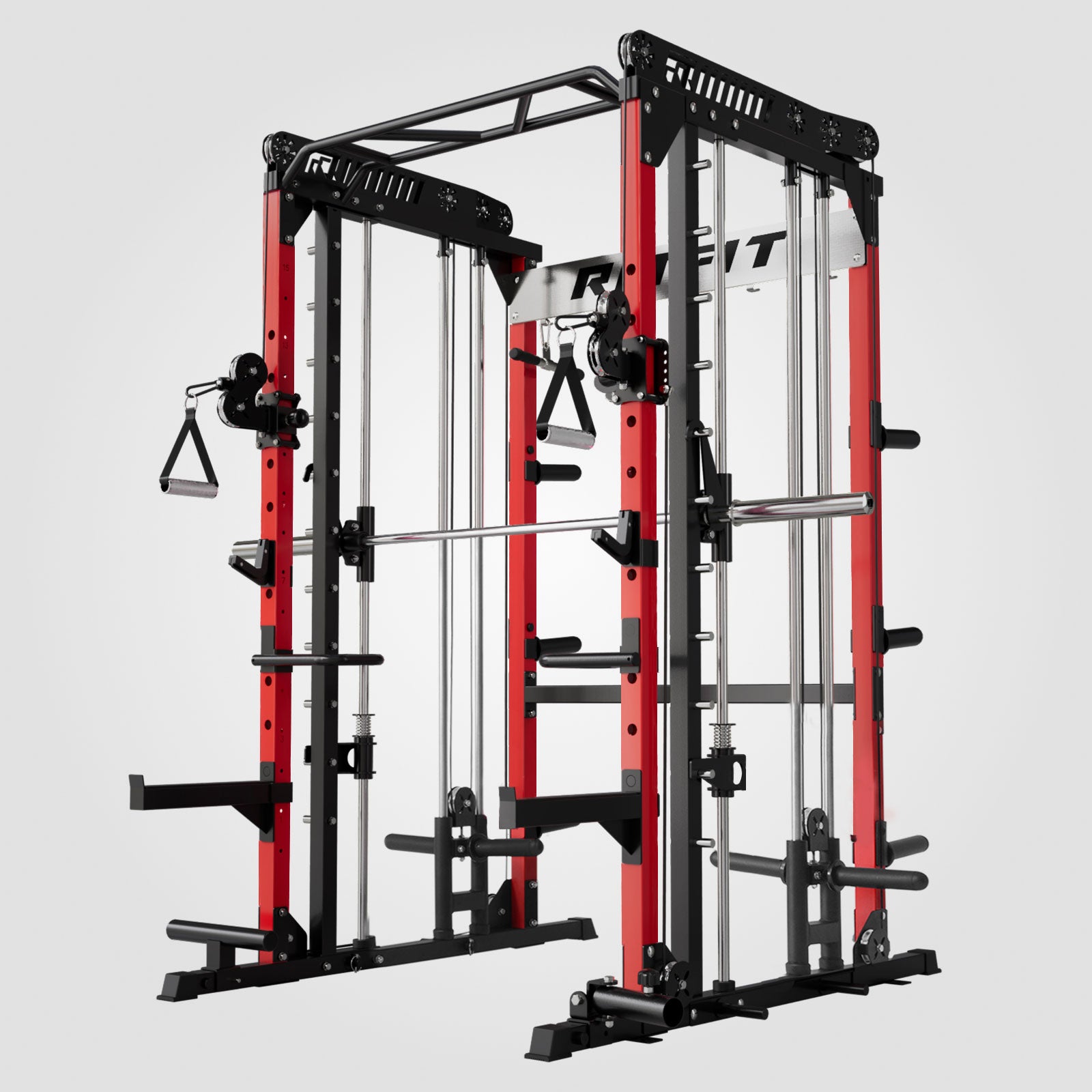
- Rack or Smith machine: A rack expands barbell training, pull variations, and progressive strength work. Advanced home gym users can compare RitFit rack packages or the RitFit Smith machine collection for long term strength progression.
How to Adapt CrossFit for Home WODs
You adapt CrossFit for home training by preserving the movement pattern and intensity goal while changing the equipment, load, impact, or range of motion. The goal is safe continuity, not perfect imitation.
Common Home WOD Formats
Use formats that are easy to time, repeat, and scale without a coach watching every rep.
- AMRAP: Complete as many rounds or reps as possible in a fixed time. This is useful for steady conditioning and progress tracking.
- For Time: Finish a fixed amount of work as quickly as possible with clean form. This rewards efficient movement and controlled transitions.
- EMOM: Start a task at the beginning of each minute and rest for the time left. This is helpful for pacing, skill practice, and fatigue control.
- Tabata: Work for 20 seconds and rest for 10 seconds for 8 rounds. This format is intense, so choose simple movements that stay safe under fatigue.
Movement Substitution Chart
Substitute movements by matching the pattern, target area, and intensity level.
| Box Movement | Home Substitute | Safety Note |
|---|---|---|
| Pull ups | Dumbbell rows, band rows, or inverted rows under a stable heavy table | Only use anchors that cannot tip, slide, or detach |
| Box jumps | Step ups, squat jumps, or broad jumps | Use step ups if landing quality or knee comfort is a concern |
| Wall balls | Dumbbell thrusters, backpack thrusters, or tempo squats | Keep ribs down and avoid pressing into low ceilings |
| Barbell deadlifts | Kettlebell deadlifts, dumbbell Romanian deadlifts, or backpack hinges | Keep the load close and stop if the low back takes over |
| Running | Jump rope, fast step ups, marching intervals, or shuttle walks | Choose low impact options on hard floors or in apartments |
Warm Up and Mobility for Home WODs
A warm up should raise body temperature, activate key muscles, and rehearse the exact movements you will train. Warm ups can also prepare attention, coordination, and movement quality before higher effort begins.[3]
Quick General Warm Up
Spend 5 to 10 minutes increasing body temperature before starting the timer.
- Minute 1 to 2: March in place, easy jump rope, or step touches. Keep the effort low and nasal breathing possible.
- Minute 3 to 4: Add arm circles, hip circles, leg swings, and ankle rocks. Move through comfortable ranges without forcing positions.
- Minute 5 to 6: Practice air squats, hinges, plank holds, scapular push ups, or light rows. Match these drills to the workout you are about to perform.
- Minute 7 to 10: Complete one easy round of the workout movements. Start the real workout only when the positions feel stable.
Movement Specific Prep
Prepare the joints and muscles that the workout will stress most.
- Squat workouts: Use air squats, hip airplanes, ankle rocks, and slow goblet squats. Keep the knees tracking in line with the toes.
- Push workouts: Use scapular push ups, wall slides, plank shoulder taps, and easy incline push ups. Stop if the front of the shoulder feels pinchy.
- Hinge workouts: Use glute bridges, hip hinges, hamstring sweeps, and light deadlift patterns. Focus on moving from the hips instead of rounding the back.
- Jump workouts: Use calf raises, pogo hops, low step downs, and landing practice. Reduce impact if landing gets loud or unstable.
Sample Home WODs
Choose the workout that matches your level, space, equipment, and recovery. If you are new to high intensity training, start with the beginner options and finish with a few good reps left in reserve.
Beginner No Equipment Home WODs
Beginner WODs should be simple, low skill, and easy to repeat without form breakdown.
WOD 1: 10 Minute AMRAP
- 5 push ups, use knees or incline hands if needed
- 10 air squats
- 15 sit ups
Best for: Beginner full body conditioning.
Scaling: Reduce sit ups to 10 reps or use incline push ups.
Watch out for: Do not let speed turn squats into shallow knee bends or push ups into sagging planks.
WOD 2: 3 Rounds For Time
- 20 walking lunges, 10 per leg
- 15 glute bridges
- 10 incline push ups or bench supported push ups
Best for: Lower body endurance, glutes, pressing strength, and beginner pacing.
Scaling: Replace walking lunges with reverse lunges if balance is difficult.
Watch out for: Avoid chair dips if they create shoulder discomfort.
Intermediate Minimal Equipment Home WODs
Intermediate WODs add load or pacing demands while keeping movement selection repeatable.
WOD 3: EMOM 16
- Minute 1: 10 dumbbell thrusters
- Minute 2: 12 kettlebell swings or backpack swings
- Minute 3: 10 burpees
- Minute 4: Rest
Best for: Full body conditioning with built in pacing.
Scaling: Lower the reps so you finish each work minute with 15 to 20 seconds of rest.
Watch out for: Keep swings hip driven and avoid turning them into low back extensions.
WOD 4: 15 Minute AMRAP
- 10 goblet squats
- 10 push ups
- 30 double unders, 60 single unders, or 60 jumping jacks
Best for: Repeatable conditioning, legs, chest, shoulders, and cardio rhythm.
Scaling: Use single unders, marching jacks, or low impact step ups if jumping is not a good fit.
Watch out for: Stop jump rope work if foot, ankle, or calf discomfort builds quickly.
Advanced Home WODs
Advanced WODs should only be used when you can keep control under fatigue.
WOD 5: Chipper For Time
- 50 air squats
- 40 sit ups
- 30 push ups
- 20 burpees
- 10 pistols, alternating legs
Best for: Experienced trainees with strong pacing and stable single leg control.
Scaling: Replace pistols with box assisted single leg squats or alternating reverse lunges.
Watch out for: Do not force pistol squats if the knee caves in or the heel lifts uncontrollably.
WOD 6: 5 Rounds For Time
- 10 dumbbell snatches, 5 each arm
- 10 jump lunges
- 200 meter run or 45 seconds of high knee marches
Best for: Power, coordination, unilateral strength, and aggressive conditioning.
Scaling: Replace jump lunges with split squats and replace running with fast step ups.
Watch out for: Use a lighter dumbbell if the snatch becomes a shoulder pull instead of a hip driven movement.
Programming Your Week of Home WODs
A weekly home WOD plan should balance strength, conditioning, skill, mobility, and recovery. Most beginners make better progress with three to four focused workouts than with seven hard sessions.
Sample Weekly Schedule
Use this structure to avoid repeating the same stress every day.
- Day 1: Full body strength focus plus short metcon. Use squats, presses, rows, and a 6 to 10 minute finisher.
- Day 2: Conditioning focused home WOD. Keep the load lighter and work for 12 to 20 minutes.
- Day 3: Active recovery. Walk, stretch, or do easy mobility work.
- Day 4: Strength and skill practice. Train push up form, single leg strength, handstand progressions, or hinge mechanics.
- Day 5: Longer metcon or Chipper. Keep transitions efficient but do not sacrifice form.
- Day 6: Optional easy WOD or light cardio. Keep effort moderate and recovery friendly.
- Day 7: Full rest day. Use this day to reset soreness, sleep, and motivation.
4 Week Home WOD Progression
Progress one variable at a time so you can tell what is working.
| Week | Main Goal | Progression Method |
|---|---|---|
| Week 1 | Learn movement quality | Use lower reps, longer rests, and conservative pacing |
| Week 2 | Build repeatability | Add one round or 2 to 3 minutes to one workout |
| Week 3 | Increase challenge | Add light load, shorten rest, or increase reps slightly |
| Week 4 | Retest and recover | Repeat one benchmark WOD and reduce volume elsewhere |
Tracking Progress and Staying Motivated
Tracking turns home WODs from random sweat sessions into measurable training. Record the workout format, movements, reps, time, load, scaling choice, and how your body felt afterward.
What to Track
Track both performance and movement quality because faster is not always better.
- Rounds and reps: Use this for AMRAP workouts. Compare the same workout every 4 to 6 weeks.
- Completion time: Use this for For Time workouts. Keep the same movement standards when retesting.
- Load used: Record dumbbell, kettlebell, backpack, or barbell weight. Small increases are easier to manage than sudden jumps.
- Scaling choice: Note whether you used incline push ups, step ups, reverse lunges, or lighter loads. Progress is clearer when the version is consistent.
- Recovery quality: Write down sleep, soreness, joint comfort, and motivation. These markers help you adjust volume before fatigue becomes a problem.
Accountability Strategies
Make training easier to start before motivation drops.
- Schedule sessions: Put workouts on your calendar before the week begins. This reduces decision fatigue.
- Use benchmark WODs: Repeat one beginner and one intermediate workout every month. This gives you clear proof of progress.
- Train with a partner online: Share scores, scaling choices, and weekly goals. Accountability helps when training alone feels repetitive.
- Keep equipment visible: Store small tools where they are easy to use. Browse RitFit weights storage if clutter makes your home workouts harder to start.
Safety Considerations and Common Mistakes
Home WOD safety depends on matching intensity to your movement quality and recovery. Excessive exercise without adequate rest can contribute to underperformance and broader fatigue related issues, so recovery is part of the program, not a weakness.[4]
Common Home WOD Mistakes
Most home workout problems come from rushing, poor setup, or choosing movements that are too advanced for the day.
- Skipping the warm up: Warm up before every hard session, even if the workout is short. Warm up intervention programs have been shown to reduce sports injury rates in youth sport settings, which supports the broader value of prepared movement before intensity.[5]
- Chasing the clock: Do not sacrifice squat depth, push up position, hinge mechanics, or landing quality for a faster score. The score only matters when the reps are repeatable.
- Using unstable furniture: Avoid rolling chairs, weak folding chairs, light tables, and loose benches. If the setup moves, change the movement.
- Training high impact too often: Burpees, jump lunges, sprints, and double unders can accumulate stress quickly. Rotate them with lower impact conditioning when joints feel irritated.
- Ignoring pain signals: Sharp pain, dizziness, numbness, tingling, or loss of balance means stop and reassess. Scaling is a smart training decision, not a failure.
Intensity Control Guide
Use perceived effort to keep hard work productive instead of reckless.
- RPE 6 to 7: Best for beginners, skill practice, and longer workouts. You should feel challenged but controlled.
- RPE 7 to 8: Best for most repeatable home WODs. You can breathe hard while still keeping good mechanics.
- RPE 9: Best for short advanced efforts. Use this sparingly and only with movements you know well.
- RPE 10: Avoid this for most solo home workouts. Max effort fatigue can reduce coordination and increase risk.
FAQs
Can beginners do CrossFit workouts at home safely?
Yes. Beginners can do CrossFit workouts at home safely when they start with simple movements, short time caps, and controlled intensity. The best approach is to master squats, push ups, lunges, hinges, and core work before adding jumping, heavier loads, or advanced gymnastics skills.
What equipment do I need for CrossFit workouts at home?
You can start CrossFit workouts at home with no equipment, but a mat, dumbbells, resistance bands, and an adjustable bench make training more versatile. These tools help you scale strength, conditioning, mobility, and support based movements without needing a full garage gym.
How should I scale CrossFit home WODs?
You should scale CrossFit home WODs by reducing reps, lowering load, shortening time, or choosing safer movement variations. The goal is to preserve the workout stimulus while keeping clean form, steady breathing, and enough control to avoid rushing through poor quality reps.
Is it safe to do burpees and jump lunges on hard floors?
No. Burpees and jump lunges are not ideal on hard or slippery floors if impact, balance, or joint comfort is a concern. Use non slip flooring, reduce jumping volume, or swap to step backs, reverse lunges, mountain climbers, or low impact cardio intervals.
How often should beginners do CrossFit workouts at home?
Most beginners should do three to four CrossFit workouts at home per week, with rest or low intensity movement between harder sessions. More advanced trainees may train more often, but performance, sleep, soreness, and joint comfort should guide weekly volume.
Can home WODs build strength without a barbell?
Yes. Home WODs can build strength without a barbell when you use tempo, unilateral movements, dumbbells, kettlebells, bands, and progressive volume. Strength gains depend on consistent overload, clean movement, adequate recovery, and exercise choices that challenge the target muscles safely.
What is the best warm up for CrossFit workouts at home?
The best warm up for CrossFit workouts at home raises body temperature, opens key joints, and rehearses the exact movements in the workout. Use light cardio, dynamic mobility, activation drills, and practice sets before starting the timer or increasing intensity.
Should I do CrossFit style workouts every day?
No. Most people should not do hard CrossFit style workouts every day because fatigue can build faster than fitness. Use easy movement, mobility, walking, or full rest between intense sessions so your joints, muscles, and nervous system can recover properly.
Conclusion
CrossFit workouts at home work best when they are simple, safe, scalable, and repeatable. Start with clear space, basic movement patterns, smart substitutions, and a weekly plan that balances intensity with recovery.
You do not need a full gym to build momentum. You need clean reps, realistic progression, useful equipment, and enough recovery to keep training consistently.
Disclaimer: This article is for general educational purposes only and is not medical advice. If you have pain, recent injury, surgery, numbness, tingling, dizziness, unexplained weakness, cardiovascular concerns, or any medical condition, consult a qualified clinician before starting high intensity exercise. Stop any exercise that causes sharp pain or unsafe symptoms.
Brand note: This guide discusses CrossFit style functional fitness training and is not affiliated with or endorsed by CrossFit.
References
- Atakan MM, Lin Y, Kosar SN, Turnagol HH, Yan X. Evidence based effects of high intensity interval training on exercise capacity and health: a review with historical perspective. Int J Environ Res Public Health. 2021;18(13):7201. doi:10.3390/ijerph18137201
- McLeod JC, Currier BS, Lowisz CV, Phillips SM. The influence of resistance exercise training prescription variables on skeletal muscle mass, strength, and physical function in healthy adults: an umbrella review. J Sport Health Sci. 2024;13(1):47-60. doi:10.1016/j.jshs.2023.06.005
- Afonso J, Brito J, Abade E, Rendeiro-Pinho G, Baptista I, Figueiredo P, Nakamura FY. Revisiting the Whys and Hows of the warm up: are we asking the right questions? Sports Med. 2024;54(1):23-30. doi:10.1007/s40279-023-01908-y
- Kreher JB, Schwartz JB. Overtraining syndrome: a practical guide. Sports Health. 2012;4(2):128-138. doi:10.1177/1941738111434406
- Ding L, Luo J, Smith DM, Mackey M, Fu H, Davis M, Hu Y. Effectiveness of warm up intervention programs to prevent sports injuries among children and adolescents: a systematic review and meta analysis. Int J Environ Res Public Health. 2022;19(10):6336. doi:10.3390/ijerph19106336