








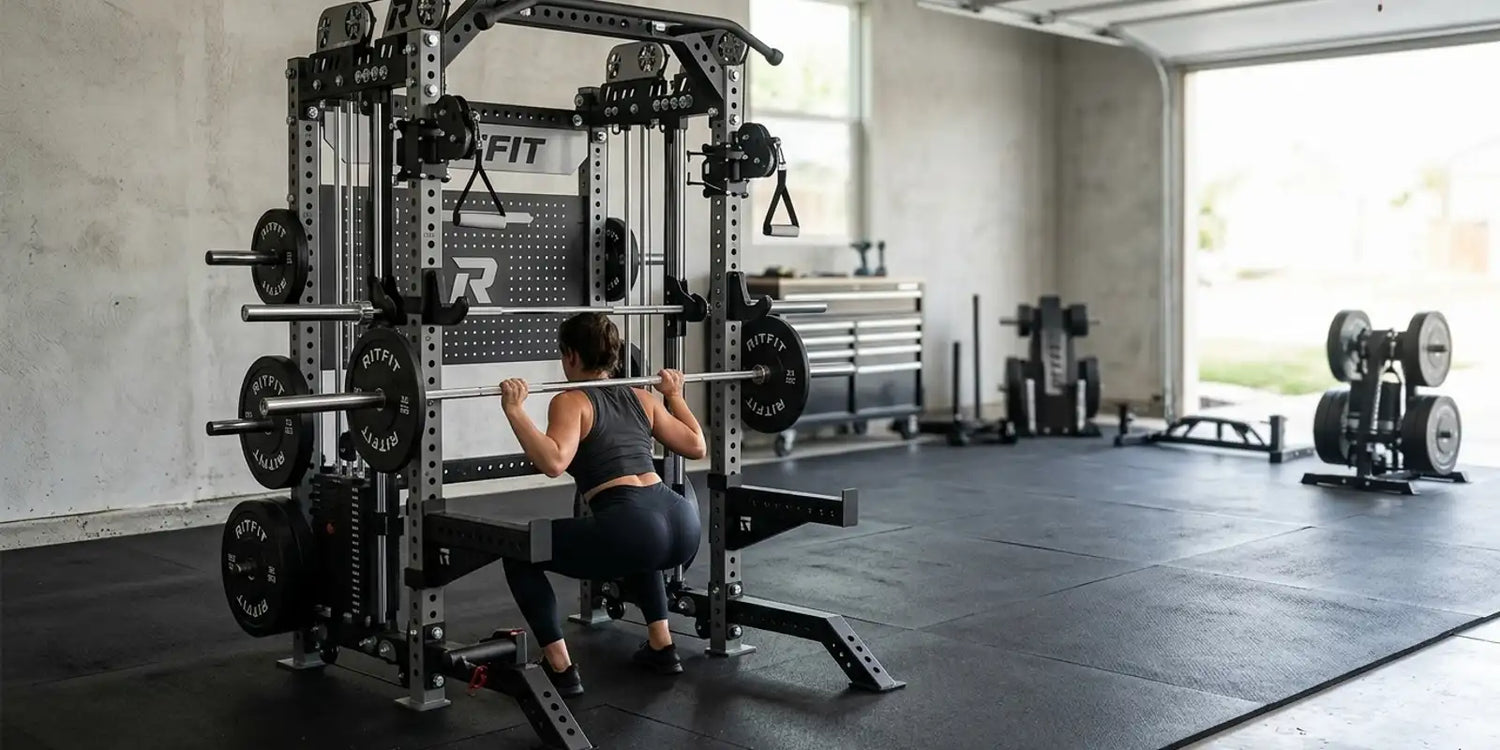
Selecting durable flooring is the foundational step when designing a dependable training space, and horse stall mats for home gym builds offer exceptional protection against heavy barbell impacts. These dense vulcanized rubber sheets absorb punishing drops while keeping your concrete slab and expensive lifting equipment completely safe.
This comprehensive guide covers mat thickness standards, room sizing math, odor mitigation techniques, precision cutting steps, and seamless integration with power racks. Review these recommendations to construct a resilient, commercial-grade lifting platform directly inside your garage.
Quick Answer: Horse stall mats for home gym setups provide heavy-duty floor protection through durable 3/4-inch vulcanized rubber that absorbs heavy barbell drops. Standard 4-by-6-foot mats cover 24 square feet, weigh roughly 95 pounds each, and stay firmly in place when fitted with utility-knife cuts and heavy-duty mending plates.
Key Takeaways
- Standard Thickness: Three-quarter-inch vulcanized rubber remains the gold standard for barbell deadlifts and high-impact strength training.
- Dimensions and Weight: Standard 4-foot by 6-foot mats weigh 90 to 100 pounds each, providing built-in slip resistance under heavy equipment.
- Odor Management: Washing mats with neutral soap and airing them outside for 48 hours rapidly neutralizes vulcanized rubber off-gassing.
- Precision Cutting: Using a sharp utility knife with a 2x4 wooden block beneath the cut line creates clean edges with minimal blade friction.
- Modular Pairing: Stall mats secure heavy rack zones while high-density interlocking tiles protect surrounding mobility and cardio areas.
Are Horse Stall Mats the Same as Gym Flooring?
Horse stall mats and commercial rubber gym flooring share identical high-density vulcanized rubber construction designed to withstand thousands of pounds of pressure. Agricultural stall mats deliver identical impact protection at a fraction of the cost per square foot compared to branded fitness floor coverings.
While specialized fitness tiles offer precision-machined interlocking edges and low-odor finishes, traditional stall mats deliver unmatched resilience under dropped iron plates. Exploring our home gym planning guide helps determine where heavy stall sheets versus precision tiles best fit your training layout.
How Thick Should a Stall Mat Be for Weightlifting?
A 3/4-inch mat thickness is the universal standard for barbell lifting, deadlifts, and heavy power cage installations on concrete slabs. Lighter conditioning zones or dumbbell areas function effectively on 1/2-inch or 3/8-inch rubber surfaces.
Thicker rubber dissipates concentrated point-load forces across a wider subfloor area, preventing concrete spalling beneath bumper plates. Matching rubber thickness directly to your lifting movements preserves equipment integrity over decades of training.
| Mat Thickness | Ideal Use Case | Weight per Mat | Impact Protection |
|---|---|---|---|
| 3/4 Inch (19 mm) | Heavy deadlifts, power cages, Olympic lifting | 90 - 100 lbs | Maximum concrete protection |
| 1/2 Inch (12.7 mm) | Dumbbells, kettlebells, squat stands | 60 - 70 lbs | Moderate impact damping |
| 3/8 Inch (9.5 mm) | Cardio machines, yoga, bodyweight training | 40 - 50 lbs | Light surface scuff guard |
Data reflects standard 4x6 foot vulcanized rubber sheets tested under repetitive strength training loads.
How Many Stall Mats Do You Need and How Heavy Are They?
A standard stall mat measures 4 feet by 6 feet, covering exactly 24 square feet of floor space and weighing 90 to 100 pounds. To calculate required units, divide your total dedicated gym square footage by 24 and round up to the nearest integer.
A standalone power rack zone requires two mats placed side by side to establish an 8-foot by 6-foot lifting footprint. For larger layouts, browse our garage home gym layout ideas to plan clean seam alignments across your entire garage footprint.
How Do You Handle Rubber Smell and Off-Gassing?
Rubber stall mats off-gas harmless volatile organic compounds from the vulcanization manufacturing process when fresh from the warehouse. Sunning the mats outdoors and scrubbing them with a mild dish soap solution accelerates odor dispersion within 48 to 72 hours.
Ensure active ventilation during initial placement by opening garage doors or running exhaust fans. For fully enclosed living spaces where ventilation is limited, integrating rubber interlocking gym flooring mats tiles provides a low-odor alternative that requires zero off-gassing prep time.
How Do You Cut and Install Stall Mats Without Shifting?
Cutting thick 3/4-inch vulcanized rubber requires a heavy-duty utility knife with fresh blades, a straight edge, and a 2x4 piece of lumber placed directly under the cut line. Elevating the cut opens the seam as you score, eliminating blade binding and friction.
Prevent mat separation across high-traffic zones by securing adjacent seams with heavy-duty steel mending plates or double-sided industrial carpet tape. Proper seam locking maintains an immaculate, flat lifting surface during dynamic plyometrics and heavy sled pushes.
When Are Stall Mats Not the Right Choice?
Stall mats may prove unsuitable for upper-story home gyms with low structural load capacities due to their substantial 100-pound per unit dead weight. They are also suboptimal for carpeted basements where moisture retention underneath solid rubber can create mold concerns.
In smaller secondary bedrooms or tight finished spaces, the physical effort of hauling 100-pound sheets through doorways often outweighs their cost benefits. Modular gym tiles or dedicated lifting platforms offer simpler handling for multi-level residential dwellings.
Do Rubber Mats Actually Reduce Impact Forces?
Dense vulcanized rubber significantly attenuates peak vertical ground reaction forces by absorbing kinetic energy during heavy barbell drops and plyometric exercises.[1] Biomechanical testing demonstrates that compliant sports surfaces reduce shock transmission to athlete joints and structural subfloors.[2]
Laboratory evaluations of elastomeric flooring show substantial reductions in peak landing forces compared to rigid concrete surfaces.[3] Installing thick rubber creates a protective kinetic buffer that preserves concrete integrity and lowers ambient acoustic vibration.
How Do You Pair Flooring With Heavy Home Gym Equipment?
Position heavy all-in-one stations directly over 3/4-inch rubber stall mats to ensure absolute frame stability and prevent floor anchoring hardware from damaging concrete slabs. Lifters building out a complete power rack package or installing the RitFit M1 Multi-Functional Smith Machine operate with maximum safety on a level rubber base.
For dedicated strength setups like the RitFit P3 Power Cage Package or the RitFit Buffalo Smith Machine, level seams prevent structural rocking during heavy pull-ups. A unified flooring grid protects your equipment warranty and establishes a professional training atmosphere.
FAQs About Horse Stall Mats for Home Gyms
Are horse stall mats the same as gym flooring?
Essentially yes. Both are vulcanized rubber, both are commonly three-quarter-inch thick, and both last for years under heavy use. Farm-store stall mats simply cost less per square foot but are heavy and unbranded, while purpose-made gym flooring is precision-cut, lower-odor, and easier to ship to your door.
How thick should a horse stall mat be for a home gym?
For heavy barbell work or dropping weights from overhead, choose at least a half-inch mat, and three-quarter-inch is the safer default. If you only do cardio, dumbbells under about fifty pounds, or bodyweight training, a thinner three-eighths-inch rubber surface is usually enough to protect the floor.
How many stall mats do I need for a garage gym?
Each standard mat is four feet by six feet, covering twenty-four square feet. Measure your floor area in square feet and divide by twenty-four, then round up. A typical squat-rack zone needs two mats, while a two-hundred to three-hundred square-foot garage often takes three to four mats plus tiles for open areas.
How do I get rid of the rubber smell from stall mats?
New stall mats off-gas a strong tire-like odor because they are vulcanized for barns. Air them outside or in a ventilated garage for a day or two before installing, wipe them down, and keep the space ventilated. In enclosed basements the smell lingers longer, so consider lower-odor rolled rubber instead.
Do horse stall mats protect a concrete floor and reduce noise?
Yes. The dense three-quarter-inch rubber absorbs impact, helps protect the concrete subfloor from dropped plates, and deadens noise. Research on sports flooring shows rubber surfaces can absorb a meaningful share of peak impact force versus bare concrete, which is why lifters favor thicker mats under racks and platforms.
Conclusion
Horse stall mats for home gym installations deliver unmatched durability, heavy impact absorption, and unbeatable value when outfitting a garage strength sanctuary. Sizing your layout accurately and cutting rubber with proper technique ensures a commercial-grade foundation for decades of rigorous lifting.
Explore equipment packages and apply our latest promotions through the RitFit discount guide to build your dream home workout setup today.
Disclaimer
This guide provides general recommendations for home gym flooring installation and equipment placement based on standard safety practices. Always verify the structural load limits of your specific subfloor before assembling heavy machinery or dropping maximum loads.
References
1. Fu W, Fang Y, Gu Y, Huang L, Li L, Liu Y. Influence of sports flooring and shoes on impact forces and performance during jump tasks. PLoS One. 2017;12(10):e0186297. PMCID: PMC5636165.
2. Klimek A, Kapsdorferova M, Kysel P, et al. Safety Comes First: Novel Styrene Butadiene Rubber (SBR) and Ethylene Propylene Diene Monomer (EPDM) Surfaces as a Response to Sport Injuries. Materials (Basel). 2021;14(13):3737. PMCID: PMC8269860.
3. Ramirez-Campillo R, Garcia-Pinillos F, et al. Effects of plyometric training on softer vs. harder surfaces on jump-related performance in rugby sevens players. Front Physiol. 2022;13:920221. PMCID: PMC9473314.





