Table of Contents
- Why the Empty Leg Press Weight Matters
- Types of Leg Press Machines and Their Typical Weights (Without Plates)
- How to Find the Exact Leg Press Weight Without Plates
- Understanding Effective Load vs. Sled Weight
- Typical Leg Press Weights Without Plates: Quick Reference Table
- How to Log Leg Press Weight in Your Training
- Comparing Leg Press Numbers to Squat Strength
- Safety & Technique Considerations at Any Weight
You load up the plates, sit back, and push. It’s a staple in leg day routines everywhere. But have you ever stopped to wonder exactly how much you are lifting? Most gym-goers simply count the 45-pound plates they slide onto the pegs, completely ignoring the starting resistance.
Knowing the leg press weight without plates is crucial for accurate tracking, preventing ego lifting, and comparing your strength across different gyms. The term "without plates" refers specifically to the weight of the empty carriage, sled, or platform that you must move before adding any external load. While it might seem negligible, this base weight can significantly alter your training volume.
Key Takeaways
- The empty sled or carriage has real weight, and you should account for it if you want accurate logging.
- A standard commercial forty-five-degree sled leg press often starts around seventy-five to one hundred twenty-five pounds, but model and brand can vary widely.
- The most accurate method is to check the machine label or manufacturer specs or measure safely with a scale method.
- For training logs, consistency matters most. Pick one method and stick to it, especially if you use the same machine.
- A big leg press number does not translate one-to-one to squat strength because the movement and stability demands are different.
Why the Empty Leg Press Weight Matters
Many lifters operate under the misconception that "only the plates count." However, the built-in machine weight plays a massive role in your training data. If you are following a program that calls for specific percentages of your one-rep max (1RM), ignoring the leg press weight without plates can throw off your calculations by 10% or more.
Furthermore, knowing this baseline allows for fair comparisons. Pushing 400 pounds of plates on a machine with a 75-pound sled is a very different physical demand than pushing the same plates on a heavy-duty machine with a 150-pound starting sled. Understanding the base load ensures you aren't shortchanging your volume or risking injury by overestimating your strength on a heavier machine.
Types of Leg Press Machines and Their Typical Weights (Without Plates)
Not all Leg Press machines are created equal. The starting resistance varies wildly depending on the design and manufacturing of the equipment.
45-Degree (Angled) Sled Leg Press

This is the most common variation found in commercial gyms. You sit in a reclined position and push a sled upward along rails set at a 45-degree angle. Because the sled is a large metal carriage, it is naturally heavy.
- Light commercial/home models: The leg press weight without plates is typically around 60–80 lbs (27–36 kg).
- Standard commercial: Most gym models weigh between 75 and 125 lbs (34–57 kg).
- Heavy-duty/specialty: Old-school or elite performance machines can weigh upwards of 150–200 lbs (68–91 kg).
Horizontal (Seated) Leg Press

On these machines, you sit upright, and the platform moves horizontally away from you, or you push your body away from a stationary platform. These are often selectorized (using a weight stack with a pin).
- Selectorized machines: The starting resistance is usually low, often around 20–50 lbs.
- Plate-loaded horizontal: The sled mechanism is generally lighter than the 45-degree version, typically ranging from 50 to 100 lbs.
Vertical Leg Press

These require you to lie flat on your back and push the weight directly upward against gravity. While the carriage looks small, the lack of mechanical advantage makes it feel heavy.
Sled weight: The leg press weight without plates is usually between 40 and 80 lbs.
Note that because you are pushing straight up, the perceived difficulty is much higher per pound compared to angled machines.
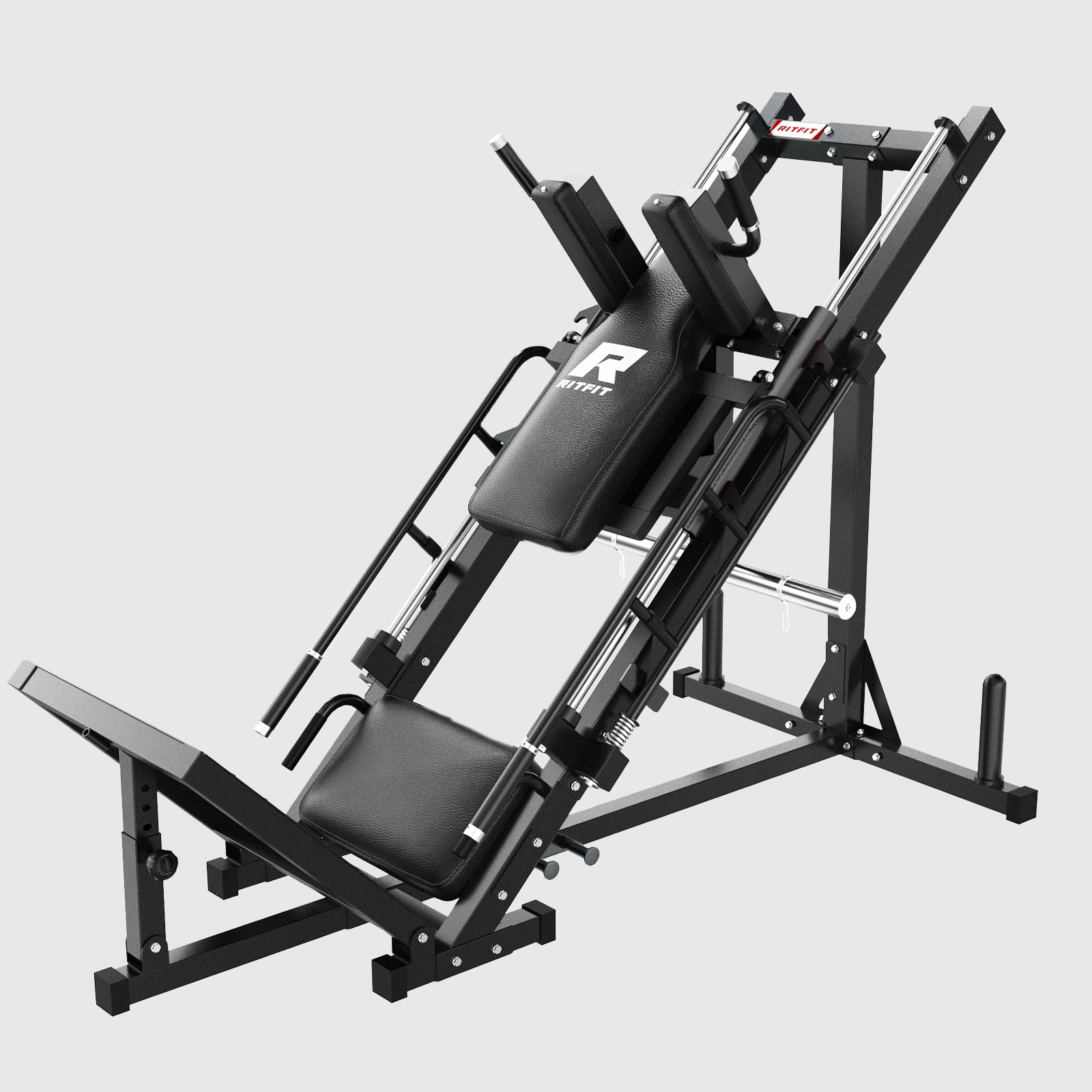
Hack Squat/Leg Press Combo Machines

Many home gyms and smaller studios use combo units. These machines often have complex heavy framing to support both movements. Consequently, the sled weight without plates can be substantial, often landing in the 60–100 lb range depending on the configuration used.
How to Find the Exact Leg Press Weight Without Plates
If you want to be precise rather than relying on averages, there are a few ways to find the true number.
Check the Manufacturer’s Info
The easiest method is to look for a sticker or metal plate on the machine's frame. Manufacturers often list "Starting Resistance" or "Sled Weight." If that is missing, find the model name and search for the user manual or spec sheet online.
Ask Gym Staff or Management
Gyms often keep equipment documentation on file for maintenance purposes. Simply asking, "Do you know the sled weight of this leg press without plates?" can save you the guesswork.
Weigh It Yourself (Practical Methods)
If you have a portable luggage scale or a hanging scale, you can loop it around the handle of the empty sled and lift it just enough to detach it from the safety stops. This gives you an accurate reading of the resistance required to move the empty carriage.
When Exact Measurement Isn’t Possible
If you cannot weigh it or find the manual, stick to a reasonable estimate based on the machine type (e.g., assuming 100 lbs for a standard commercial 45-degree press) and use that number consistently in your logs.
Understanding Effective Load vs. Sled Weight
It is important to distinguish between what the metal weighs and what your muscles actually feel. This comes down to physics, specifically gravity, angles, and friction.
Gravity, Angle, and Friction
On a vertical leg press, you are fighting 100% of gravity, so a 50 lb sled feels like 50 lbs. However, on a 45-degree leg press, the effective load is reduced. You are lifting roughly 70% of the actual weight due to the angle (based on the cosine of 45 degrees). However, friction from the rails adds some resistance back. For the purpose of tracking the leg press weight without plates, most lifters record the mass of the sled, not the calculated force vector.
Simple Example Calculations
If a machine has a sled weight of 100 lbs and you load 200 lbs of plates, your total lifted mass is 300 lbs. Even though the effective load on the legs is technically less due to the angle, for tracking progress, you should simply record "300 lbs" (or "200 lbs + 100 lbs sled") to keep your training data consistent.
Typical Leg Press Weights Without Plates: Quick Reference Table
Use this structured table to estimate the starting weight of the machine at your gym if exact manufacturer specs are unavailable.
| Machine Type | Typical Starting Weight (No Plates) |
| 45° Sled Leg Press | 75–125 lbs (34–57 kg) |
| Heavy-Duty 45° | 120–200+ lbs (54–90+ kg) |
| Horizontal Plate-Loaded | 50–100 lbs (23–45 kg) |
| Selectorized Seated Leg Press | 20–50 lbs starting resistance |
| Vertical Leg Press | 40–80 lbs (18–36 kg) |
Note: These values are averages. Always check specific branding for accuracy.
How to Log Leg Press Weight in Your Training
Options for Tracking
You generally have two options. You can track the total load (sled weight + plate weight) or track plates only while making a note of the machine used. The total load method is superior if you switch gyms often, as it allows you to normalize the numbers.
Consistency Is More Important Than Perfection
Whether you guess the sled is 80 lbs or 100 lbs matters less than sticking to that number every session. Progressive overload requires a consistent baseline. If you switch machines, simply adjust your plate load to compensate for the difference in the new machine's empty weight.
Comparing Leg Press Numbers to Squat Strength
Lifters often wonder why they can leg press significantly more than they can squat. This is due to the stability provided by the machine, the lack of a need to balance the load, and the reduced range of motion. Additionally, as discussed, the 45-degree angle reduces the effective load relative to gravity. Therefore, a 500 lb leg press does not equate to a 500 lb squat. They are different skills, and knowing the leg press weight without plates helps contextualize this, but a direct 1:1 comparison is never accurate.
Safety & Technique Considerations at Any Weight
Even an empty sled can be dangerous if handled improperly. A 100 lb sled falling uncontrolled can cause injury. Always ensure the safety stops are engaged when loading or unloading. Furthermore, knowing the true starting weight helps beginners avoid loading the machine beyond their capacity; if the starting weight is already 115 lbs, a novice might not need to add much (or any) weight to get a stimulus.
FAQs
What is a normal empty sled weight for beginners?
Beginners typically start with 75 to 100 pounds, which is the exact weight of a standard 45-degree commercial empty sled. This base resistance provides a sufficient challenge to safely learn the proper movement pattern and biomechanics without needing additional external plates.
Does every leg press have the same starting resistance?
No, the starting resistance varies significantly by manufacturer, equipment age, and structural design. A modern selectorized seated press might offer just 20 pounds of resistance, whereas a heavy-duty vintage iron 45-degree sled can easily weigh upwards of 150 pounds when entirely empty.
Should I include the sled weight in my training log?
Yes, you should include the sled weight if you want the most accurate tracking of your total volume or if you frequently switch gyms. However, if you exclusively use the exact same machine, tracking just the added plates is perfectly acceptable.
How can I find the exact weight of my gym's leg press?
The most accurate method is to read the manufacturer’s specification sticker usually located on the machine's base frame. If the label is missing, you can safely lift the empty carriage slightly using a portable digital luggage scale to measure it yourself.
Why can I leg press so much more than I can squat?
You can lift more on a leg press because the machine provides total core stability and the 45-degree angle reduces the effective effects of gravity. Unlike a free-weight barbell squat, you do not have to balance the load or stabilize your spine.
Conclusion
The leg press weight without plates is a variable that changes from gym to gym and machine to machine. While it usually hovers between 75 and 125 pounds for standard 45-degree units, the only way to be sure is to check the manufacturer's specs or weigh it yourself. Ultimately, the exact number is less important than your consistency in tracking it. By accounting for the empty sled weight, you ensure accurate progressive overload, safer training, and a more realistic understanding of your true strength potential.