








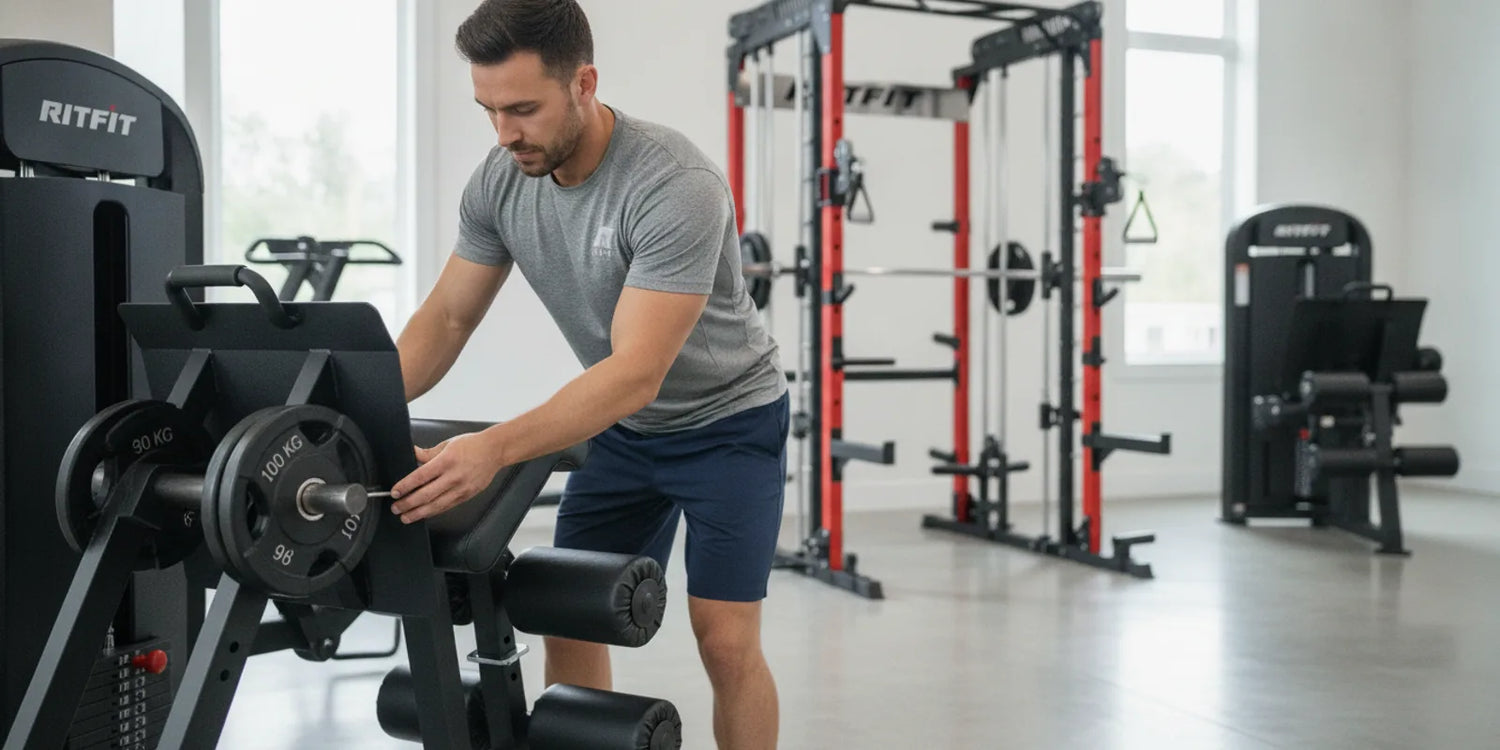
Knowing how much weight you have on a knee extension machine starts with identifying the machine type, then reading the stack pin, the loaded plates, or the unit you assembled at home. The number you see is not always the resistance you feel.
This guide shows you how to read selectorized stacks, plate loaded levers, and home leg extension curl units, plus why cable ratios and friction can change the felt load.
Quick Answer
To know how much weight is on a knee extension machine, first identify the type, then read the load accordingly. On a selectorized machine read the number at the pin and add any engaged incremental weight, while on a plate loaded or home unit you simply sum every plate you loaded, counting about 10 lb per plate on unlabeled stacks.
Key Takeaways
- Identify the type first: Selectorized, plate loaded, and home leg extension curl units are each read in a different way.
- Unlabeled stacks count by 10: On most commercial stacks each plate equals about 10 lb, so plate 10 is roughly 100 lb.
- Add the incremental weight: The small toggle or magnetic add on weight, often around 5 lb, must be counted in your total.
- Felt weight is not loaded weight: Cable ratios, lever arms, and friction make a leg extension feel lighter or heavier than the number.
- Record your real load: Write down the verified working weight each session so your progress stays accurate and repeatable.
| Brand | RitFit Sports |
|---|---|
| Featured Products | Home leg extension and curl machines, plus small weight plates for plate loaded units |
| Key Specs | Selectorized stacks count about 10 lb per plate, add on weights about 5 lb, plate loaded units total the plates you load |
| Best For | Beginners and home gym owners who want to verify their true working weight |
| Not Ideal For | Lifters expecting the stack number to perfectly equal felt resistance on cable based units |
Which Machine Type Are You Using?
The first step to knowing your weight is identifying which of three machine types you are sitting on, because each one is read differently. Selectorized machines use a pin and stack, plate loaded models use a loading peg, and home units use a weight horn you load yourself.
- Selectorized stack: A pin slides into a labeled stack of plates, common in commercial gyms for fast setup.
- Plate loaded: A rod or peg sticks out of the frame where you slide on standard plates, like a barbell.
- Home leg extension curl unit: A compact bench or dedicated unit with a weight horn you load with your own plates.
Strong quadriceps built through knee extension matter for everyday knee protection, and one systematic review and meta analysis reported isometric knee extensor strength can rise up to about 46 percent, with roughly half the gain by the fourth week[1]. Browse home gym equipment if you are choosing your first unit.
How Do You Read a Selectorized Weight Stack?
On a selectorized machine you read the weight at the point where the pin sits in the stack. The plate the pin enters, plus any small add on weight you engaged, equals your total resistance.
When the stack shows pounds
If each plate is stamped with a poundage, simply read the number printed at the pin, since that figure represents the total weight selected below it.
When the stack only shows numbers 1 to 20
Many stacks label plates 1 through 20 instead of pounds, and on most standard machines each plate equals about 10 lb, so plate 10 is roughly 100 lb.
- Check the shroud sticker: A label on the side often confirms the pounds per plate, since some heavy units use larger increments.
- Do the math: Multiply the plate number by the per plate value to get your working weight.
Do not forget the add on weight
A small toggle or magnetic add on weight near the top of the stack adds extra resistance, often around 5 lb, on top of the plate your pin selects, so always include it in your total. Pair this with our guide to leg extension machine weight increments when you plan progression.
This walkthrough shows machine setup and the pin selection step in context, which makes the weight reading easier to follow.
How Do You Read a Plate Loaded Leg Extension?
On a plate loaded leg extension you read the weight by adding up every plate you slid onto the loading peg. Your total resistance is simply the sum of those plates, because you control the load directly.
- Count both sides if applicable: Some levers load on one peg, so add only what is actually on the machine.
- Use small plates for control: Keeping 1.25 lb, 2.5 lb, or 5 lb plates lets you fine tune the load smoothly.
For a dedicated home option, the Mustang Pro Leg Extension Curl Machine is a plate loaded example, and you can stock small exercise weights for precise jumps.
Why the felt weight changes through the range of motion
On a plate loaded lever the resistance you feel shifts through the range because the lever arm carries more or less of the load at different joint angles. Research measuring joint torque on a leg extension machine shows torque is angle dependent and influenced by eccentric loading[2].
- Lever leverage matters: In one informal spring scale self test, a builder observed a 45 lb plate felt like about 28 lb at the bottom and about 52 lb at the top, a single anecdotal result that may not generalize.
- Plan around the hardest point: Choose a load you can control where the lever feels heaviest, not just where it feels light.
How Do You Read a Home Leg Extension Curl Unit?
On a home leg extension curl unit you read the weight by counting the plates you loaded onto the weight horn yourself. Because nothing is preselected, your total is whatever you stacked, with no hidden add on weight to track.
- Note the empty roller bar: The bare lever or roller adds negligible felt load, so your plates are effectively the working weight.
- Match plates to your strength: Start light and add small plates, since these units often progress more smoothly than fixed stacks.
The RitFit PLC01 Leg Extension Curl Machine is a home example, and the PLC01 Pink Leg Extension Curl Machine offers the same plate loaded reading.
Why Can the Number Lie? Cable Ratios and Friction
The number can mislead you because felt resistance depends on machine mechanics, not just the label. Seated machines aim for roughly a one to one ratio, but cable based units can use a one to two or one to four pulley ratio, so you lift less than the number shown.
- Pulley ratio: One equipment guide explains that on a one to two cable machine, pinning plate 10 at about 100 lb of mass means lifting closer to 50 lb of resistance.
- Friction and wear: Worn or dry guide rods add drag, so a poorly maintained unit feels heavier than the listed weight.
Standard seated leg extensions usually track close to one to one, but if a unit runs cables, expect the felt load to differ. Explore the difference further with our cable machines collection.
How Do You Confirm and Record Your True Working Weight?
You confirm your true working weight by reading the load, accounting for any ratio or add on, and writing it down the same way each session. Accurate records are what let small, consistent increases add up over time.
- Step 1, identify the type: Confirm whether it is selectorized, plate loaded, or a home unit before reading anything.
- Step 2, read the base load: Note the pin number or sum the plates you loaded on the peg.
- Step 3, add the extras: Include any engaged add on weight, often around 5 lb, in your total.
- Step 4, note the machine and seat settings: Record the unit, seat position, and pad setting so the load is repeatable.
- Step 5, log it: Write the verified weight, reps, and machine in your training log for next time.
Accurate tracking pays off, since one trial of recreationally active young men doing seated leg extensions for eight weeks reported estimated one rep max rising about 32 to 35 percent and peak knee extension torque about 22 percent[3]. For loading control, keep a set of small RitFit BE01 Back Extension Machine compatible plates nearby for other lifts too.
What Are the Common Mistakes When Judging Machine Weight?
The most common mistake is assuming the stack number always equals the resistance you feel. Lifters also forget the add on weight, ignore cable ratios, and fail to record seat settings that change the load feel.
- Ignoring the add on weight: Skipping the small toggle weight understates your true total by about 5 lb.
- Assuming one to one on cables: Treating a one to two cable unit as one to one overstates what you actually lift.
- Changing seat settings silently: A different knee flexion angle changes felt difficulty even at the same load.
- Comparing across machines: The same number on two brands can feel different due to cams, friction, and lever design.
When Should You Stop and Lower the Load?
You should stop and lower the load when your form breaks down or your knee signals discomfort. The leg extension is an open chain move, so a load that forces sloppy reps is not worth the risk to your joints.
- Form breakdown: If your hips lift off the seat or the weight slams down, the load is too heavy.
- Knee discomfort: Sharp or pinching knee sensation is a signal to reduce weight and reassess setup.
- Loss of control: If you cannot lower the weight slowly, drop to the next lighter plate.
"Overall, leg extensions aren't the worst exercise ever invented, but when you do them wrong, they go from being a quad builder to a knee destroyer."
Jeff Cavaliere, MSPT, CSCS, Physical Therapist and Strength Coach, ATHLEAN-X
FAQs About Knee Extension Machine Weight
How do I know how much weight is on a leg extension machine?
First identify the machine type, then read it accordingly. On a selectorized machine read the number where the pin sits and add any small incremental weight you engaged, while on a plate loaded model you add up every plate on the loading peg, and on a home leg extension curl unit you count the plates you loaded onto the weight horn.
What does it mean when the stack only shows numbers like 1 to 20?
Many commercial stacks label plates 1 through 20 instead of pounds. On most standard machines each plate equals about 10 pounds, so plate 10 is roughly 100 pounds. Check the sticker on the side of the shroud to confirm, because some heavy machines use larger increments per plate.
Why does the leg extension feel heavier or lighter than the number shown?
Felt resistance depends on more than the label. Seated machines aim for a one to one ratio, but cable units may use a one to two or one to four pulley ratio, so you lift less than the number. Worn or dry guide rods add friction that makes the load feel heavier than it really is.
Does the add on incremental weight count toward my total?
Yes. The small toggle or magnetic add on weight near the top of the stack adds extra resistance, often around five pounds, on top of the plate your pin selects, so always include it in your total to keep your tracked working weight accurate from session to session.
How is the weight different on a plate loaded leg extension?
On a plate loaded machine you control the load directly by adding plates to the loading peg, so your total is simply the sum of those plates. However, the lever arm changes how heavy the weight feels at different points in the range, so the felt resistance is not constant even though the loaded weight is fixed.
Conclusion
Knowing how much weight you have on a knee extension machine comes down to identifying the type, reading the pin or plates, and accounting for add on weight and cable ratios. The label is a starting point, not the whole story.
Read the stack carefully, log your verified working weight every session, and browse our weight plates if you want smoother, more accurate progression at home.
Disclaimer
This article is for general educational purposes and does not replace professional fitness or medical guidance. Consult a qualified trainer or healthcare provider before starting new resistance training, especially if you have knee concerns.
Save on your next RitFit order
Tap the button to copy your code, then paste it at checkout.
References
1. Altan E, Seide S, Bayram I, Gizzi L, Ertan H, Röhrle O. A Systematic Review and Meta-Analysis on the Longitudinal Effects of Unilateral Knee Extension Exercise on Muscle Strength. Front Sports Act Living. 2020;2:518148. doi:10.3389/fspor.2020.518148 https://pmc.ncbi.nlm.nih.gov/articles/PMC7739592/
2. Kanada Y, Sakurai H, Sugiura Y, Arai T, Koyama S, Tanabe S. Evaluation of the relationship between joint torque and angular velocity using a modified leg extension machine. Fujita Med J. 2019;5(4):85-91. doi:10.20407/fmj.2018-018 https://pmc.ncbi.nlm.nih.gov/articles/PMC8766240/
3. Varović D, Žganjer K, Vuk S, Schoenfeld BJ. Drop-Set Training Elicits Differential Increases in Non-Uniform Hypertrophy of the Quadriceps in Leg Extension Exercise. Sports (Basel). 2021;9(9). doi:10.3390/sports9090119 https://pmc.ncbi.nlm.nih.gov/articles/PMC8473065/





