Table of Contents
Strong legs are built by combining heavy compound lifts, smart isolation work, steady progression, and recovery that supports growth. The best plan is the one that trains your quads, hamstrings, glutes, and calves hard enough to grow while still being realistic to recover from.
Strong legs improve strength, athletic performance, balance, and daily movement while helping lower your injury risk. If your legs are not growing, the problem is usually not effort alone but poor exercise selection, weak progression, limited recovery, or technique that shifts tension away from the target muscles.
Key Takeaways
- Compound lifts drive most leg growth: Squats, Romanian deadlifts, split squats, and hip thrusts create the biggest overall stimulus for size and strength.
- Isolation work fills the gaps: Leg extensions, leg curls, calf raises, and glute focused movements help bring up muscles that compounds do not fully fatigue.
- Training legs two times per week works well for most people: This usually gives you enough volume for hypertrophy without turning every session into junk fatigue.
- Progressive overload matters more than exercise variety alone: Your legs will not grow unless reps, load, control, or total work improve over time.
- Recovery and nutrition are part of the program: Sleep, protein, calories, and rest days determine how much of your training actually turns into muscle.
Fundamentals of Building Leg Muscle
Basic Muscle Building Principles
Leg muscle grows when training creates enough tension, enough total work, and enough repeat exposure to force adaptation. Progressive overload is the core rule, which means adding reps, load, sets, control, or range of motion over time instead of repeating the same easy workouts.
Training frequency matters because most people grow better from two to three quality leg sessions each week than from one all out day. Recovery matters just as much because hard training only builds muscle when sleep, food, and rest allow the tissue to repair.
Key Leg Muscles You Need to Train
- Quadriceps: The quads sit on the front of the thigh and extend the knee, so they do most of the work in squats, split squats, step ups, and leg extensions.
- Hamstrings: The hamstrings sit on the back of the thigh and help flex the knee and extend the hip, so they respond well to Romanian deadlifts, leg curls, and other hinge patterns.
- Glutes: The glutes create hip extension and help stabilize the pelvis, which makes them essential for force production, posture, and lower body shape.
- Calves: The calves control ankle movement and lower leg stability, so they matter for sprinting, jumping, walking, and balanced lower body development.
Best Compound Leg Exercises
Multi joint leg exercises should anchor your program because they let you load more muscle mass at once and create the biggest overall growth stimulus. They also build coordination, bracing, and lower body strength that carries into other lifts and sport.
Squats
Squats are one of the best leg exercises for total lower body size because they train the quads, glutes, adductors, and trunk together under meaningful load. Back squats usually let you move the most weight, while front squats often increase quad demand and help maintain a more upright torso.
Use a stance that lets your knees track naturally over your toes and lets you reach strong depth without losing spinal position. If barbell squats do not fit your mobility, goblet squats and machine based squat patterns can still be highly effective.
Deadlift Variations
Deadlift variations build the posterior chain, but Romanian deadlifts are often the better hypertrophy choice when your goal is leg muscle rather than pure pulling strength. They keep tension on the hamstrings and glutes through a long loaded stretch, which is a strong driver of muscle growth.
Keep a soft knee bend, push the hips back, and lower only as far as you can while holding a neutral spine. If you mainly feel your lower back, reduce load and focus on hinging through the hips instead of reaching for the floor.
Lunges and Split Squats
Unilateral work is essential because it builds muscle one side at a time, improves balance, and exposes strength asymmetries that bilateral lifts can hide. Walking lunges are excellent for total leg development, while Bulgarian split squats are especially effective for quad and glute hypertrophy.
A shorter step usually increases quad demand, while a longer step often shifts more tension to the glutes. Start lighter than you think you need because these movements become brutally effective when done with full depth and control.
Hip Thrusts and Glute Bridges
Hip thrusts are one of the best choices for glute hypertrophy because they load hip extension heavily in the top half of the movement where the glutes can produce force well. Glute bridges use a shorter range of motion but still work well for beginners, warm ups, or home training.
Drive through the full foot, keep the ribs down, and finish with a hard glute squeeze instead of arching the lower back. If you mainly feel the movement in your low back, reduce the load and clean up your pelvic position before progressing.
Best Isolation Leg Exercises
Isolation work makes your program more complete because it lets you target one muscle group without being limited by grip, balance, or full body fatigue. It is especially useful for bringing up weak points, adding volume safely, and improving mind muscle connection.
For Quadriceps
- Leg Press: The leg press lets you train the quads hard with more external support, which can be useful when balance or back fatigue limits your squat work.
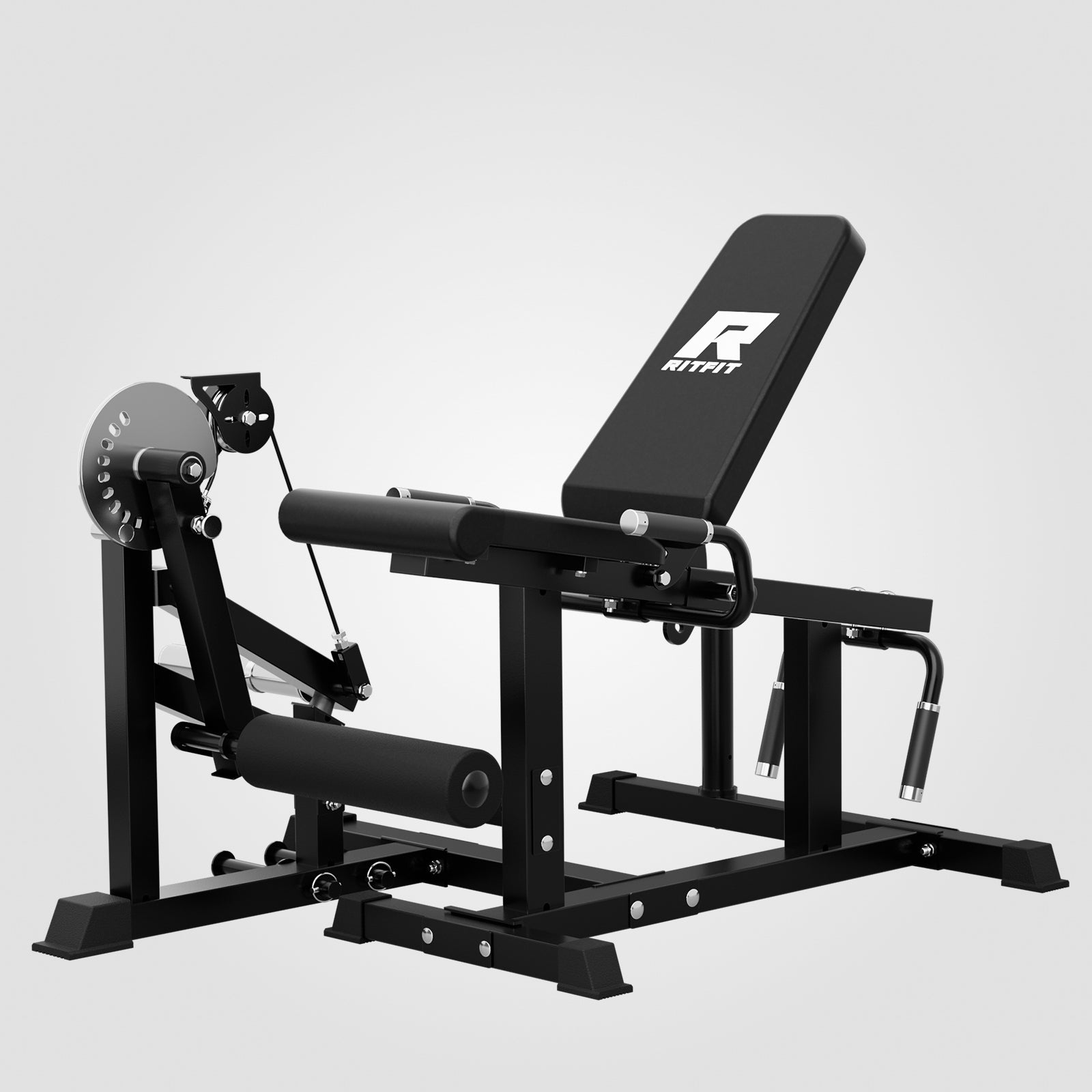
- Leg Extension: Leg extensions isolate the quads directly and work especially well at the end of a session for higher rep hypertrophy focused sets.
- Execution Tip: Use a controlled lowering phase and avoid bouncing through the bottom, especially if your knees are sensitive.
For Hamstrings
- Seated or Lying Leg Curl: Leg curls train knee flexion directly, which complements hinge based movements that emphasize hip extension.
- Nordic Curl: Nordic curls are brutally effective for eccentric hamstring strength and can build serious density if you progress them patiently.
- Execution Tip: Slow the lowering phase and do not rush the squeeze, because hamstrings respond well to control and full contraction.
For Glutes
- Cable Kickbacks: Cable kickbacks help isolate hip extension with less spinal loading and are useful for high quality glute volume.
- Machine Glute Extension: A glute machine can help you feel the target muscle better if you struggle to connect with squats or lunges.
- Bodyweight Bridges: Bridges are a great starting point for beginners who need to learn how to fully lock in glute tension.
For Calves
- Standing Calf Raise: Standing raises place more emphasis on the gastrocnemius and work well with full range of motion and a pause in the stretch.
- Seated Calf Raise: Seated raises shift more work to the soleus and often respond well to higher reps and slower tempos.
- Execution Tip: Do not rush calf training, because partial reps and fast bouncing usually limit both tension and growth.
Sample Leg Workouts
A good leg workout should train the major lower body muscles with enough hard sets to stimulate growth but not so much fatigue that performance collapses. The best setup depends on your training age, recovery, and equipment access.
Beginner Leg Workout
A beginner should focus on a small number of reliable movements that are easy to learn, easy to progress, and hard enough to build muscle. Two weekly sessions with moderate volume are usually enough to create results without crushing recovery.
- Back Squat or Goblet Squat: 3 sets of 8 to 10 reps
- Romanian Deadlift: 3 sets of 8 to 10 reps
- Walking Lunges: 3 sets of 10 to 12 reps per leg
- Seated Leg Curl: 3 sets of 12 to 15 reps
- Standing Calf Raises: 3 sets of 15 to 20 reps
Intermediate Leg Workout
Intermediate lifters usually need more total volume and a clearer split between movement patterns to keep progressing. A quad focused day and a hamstring and glute focused day is a simple way to increase workload without turning each session into a random exercise list.
- Day A, Quad Focus: Front squat, leg press, Bulgarian split squat, leg extension, seated calf raise
- Day B, Hamstring and Glute Focus: Romanian deadlift, barbell hip thrust, lying leg curl, cable kickback, standing calf raise
Advanced Considerations
Advanced lifters need smarter fatigue management because more work is not always better once absolute loads get heavy. Periodizing heavy and moderate phases, rotating rep ranges, and adding extra work only where growth is lagging usually works better than constantly adding exercises.
Technique, Safety, and Progression Tips
Training hard only helps if your technique keeps tension on the target muscles and lets you recover for the next session. Good form does not mean perfect looking reps, but it does mean controlled reps that stay safe and repeatable.
Proper Warm Up for Leg Day
Start with dynamic work that raises body temperature and opens up the hips, knees, and ankles before your first hard set. Leg swings, bodyweight squats, light hinges, and several gradual warm up sets of your first main lift are usually enough.
Form and Injury Prevention
Keep your knees tracking naturally over the toes and maintain a stable trunk during squats, hinges, lunges, and split squats. Work through a pain free range of motion and adjust stance, depth, or exercise choice if a movement causes joint pain instead of normal muscular fatigue.
Progression Strategies
Track reps, load, and effort so you know when you are actually progressing. Once you can hit the top of your target rep range with solid form, increase the load slightly and rebuild from the lower end of the range.
Use a mix of rep ranges across the week instead of forcing every movement into the same scheme. Heavy sets build mechanical tension, while moderate and higher rep sets add hypertrophy friendly volume with less joint stress.
Nutrition and Recovery for Leg Growth
Leg growth depends on what happens outside the gym as much as what happens inside it. If your training is solid but your recovery is poor, your results will look flat no matter how motivated you are.
Eating for Muscle Gain
You need enough calories to support growth, and a slight calorie surplus is usually the most reliable approach if size is the goal. Protein should stay high every day, and carbohydrates matter because hard leg sessions perform much better when muscle glycogen is not chronically low.
Recovery Habits
Sleep for seven to nine hours per night if possible because recovery quality directly affects performance, soreness, and long term progress. If fatigue keeps climbing, soreness never resolves, or your numbers are falling, reduce volume for a week instead of pushing harder into a wall.
Home and Minimal Equipment Options
You can build impressive leg muscle at home if you use challenging movement patterns, enough effort, and smart progression. Limited equipment changes exercise selection, but it does not eliminate the core rules of hypertrophy.
Best Leg Exercises with No Equipment
- Bodyweight Squat: Use high reps, slower lowering, and pauses to make simple squats much harder.
- Alternating Lunge: Lunges train each leg independently and create more effective tension than endless easy bilateral reps.
- Step Up: Step ups build quads and glutes well if the box height is challenging and each rep is controlled.
- Wall Sit: Wall sits add quad endurance and can finish a session when space and equipment are limited.
- Single Leg Progressions: Pistol squat variations increase difficulty fast once basic bodyweight work becomes too easy.
Minimal Equipment Moves
- Dumbbell Goblet Squat: Goblet squats are beginner friendly and surprisingly effective when you use full depth and enough reps.
- Dumbbell Romanian Deadlift: Dumbbells work very well for hamstring and glute training if you keep tension through the hinge.
- Weighted Bulgarian Split Squat: A pair of dumbbells can turn split squats into a serious hypertrophy builder.
- Band Leg Curl: Resistance bands can train knee flexion well enough to support hamstring growth at home.
- Band Glute Bridge: A band around the knees can increase glute demand and improve hip stability during bridge work.
Common Mistakes That Limit Leg Growth
- Skipping Leg Day: Skipping leg training kills momentum because muscle only grows when it gets repeated, high quality exposure. Treat lower body work with the same consistency you give to chest, arms, or shoulders.
- Relying Only on Machines: Machines are useful, but an all machine plan often leaves stabilizers, coordination, and total loading potential underdeveloped. Build the base with compound patterns, then use machines to add targeted volume.
- Poor Depth and Rushed Reps: Shallow reps and fast bouncing reduce tension where you need it most. Control the eccentric, train through as much useful range of motion as your structure allows, and stop chasing numbers with sloppy form.
- Under Eating: You cannot build larger legs if your body does not have enough energy and protein to recover. Many lifters train hard but stay too close to maintenance calories to see noticeable size gains.
- Ignoring Progressive Overload: Doing the same weights for the same reps month after month leads to stagnation. Improvement needs to show up somewhere in the logbook, whether that is more load, more reps, more control, or more total hard sets.
FAQs
How many times per week should I train legs?
Most people make excellent progress with two leg sessions per week. A third weekly session can work well if volume per workout is managed and recovery stays strong.
How long until I see results?
You can usually feel strength improvements within two to four weeks if your effort and exercise selection are solid. Visible leg growth usually takes longer and often becomes easier to notice after eight to twelve weeks of consistent training.
Can I build big legs without squats or deadlifts?
Yes, because leg press, split squats, lunges, hip thrusts, and machine work can all build serious muscle when you apply progressive overload. Traditional barbell lifts are effective, but they are not the only route to hypertrophy.
Are the best leg exercises different for men and women?
No, because the same muscles respond to the same basic hypertrophy principles in both men and women. The biggest differences usually come from individual goals, exercise preference, recovery, and which muscles someone wants to emphasize.
What if I have bad knees or a bad back?
Choose pain free patterns first and use exercise variations that let you train hard without aggravating symptoms. Front loaded squats, supported split squats, leg press, controlled hinges, and reduced ranges of motion are often easier to tolerate than forcing movements that feel wrong.
Conclusion
The best way to build leg muscle is to train the major lower body muscles with hard compound lifts, targeted isolation work, and steady progression you can actually recover from. Pick a routine that fits your level, track your numbers, eat to support growth, and stay consistent long enough for the work to show.
Important disclaimer: This article is for general educational purposes only and is not medical advice. If you have shoulder, neck, back, elbow, or wrist pain, a recent injury or surgery, numbness or tingling, unexplained weakness, or dizziness, consult a qualified clinician before starting. Stop any exercise that causes sharp pain.