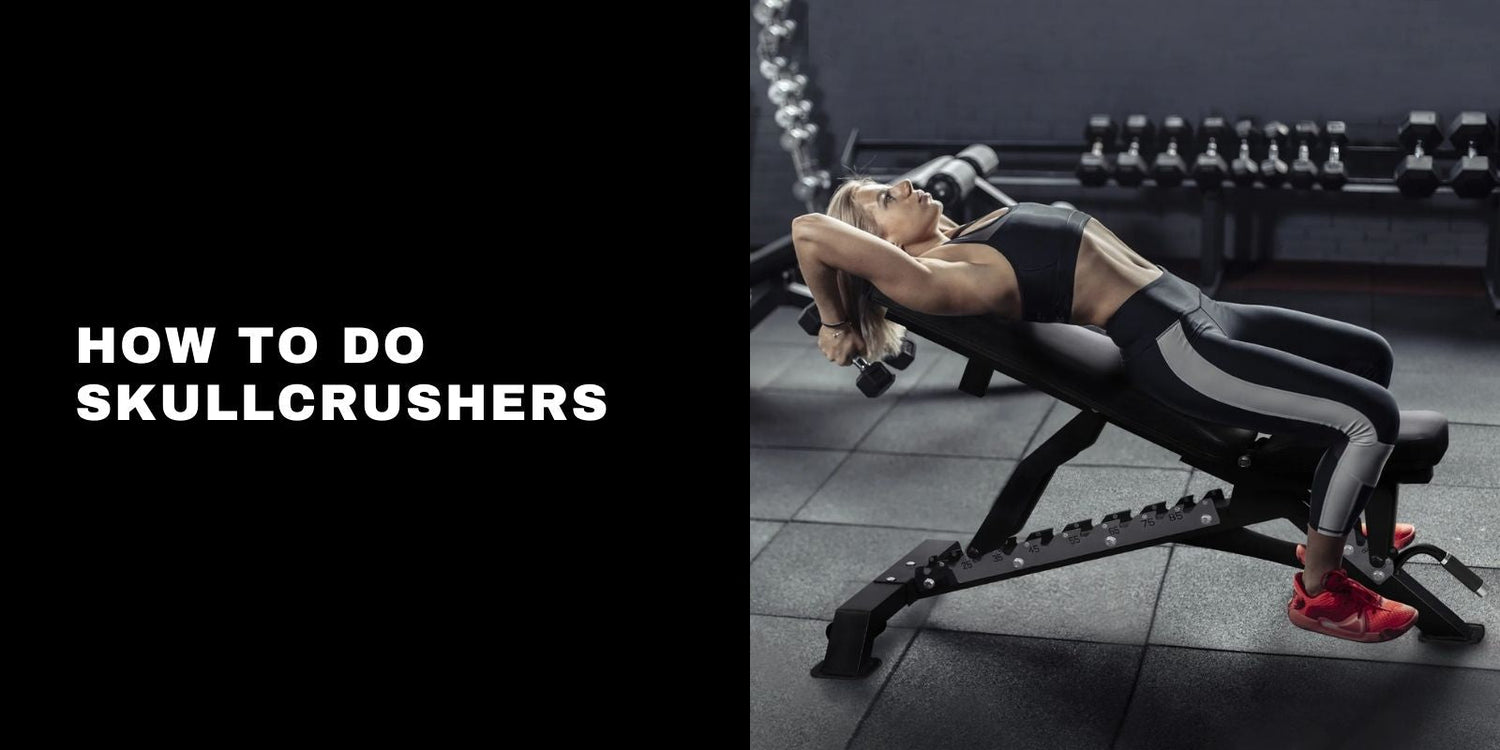
Skull crushers are a lying triceps extension that builds the muscle on the back of your upper arm. That muscle is the triceps, and it makes up about two-thirds of your upper arm mass.
This guide covers how to do skull crushers with perfect form, which equipment to pick, how to keep your elbows safe, and how to add the movement to a push day.
Quick Answer: Skull crushers are a lying triceps extension, and they count as a push exercise for the triceps because your elbows extend to press the weight away. The movement trains all three triceps heads, and it is safe for most lifters when you use dumbbells, keep your elbows tucked, and lower the weight behind your head.
Key Takeaways
- Muscle size: The triceps is the biggest muscle on the back of your upper arm, and it makes up roughly two-thirds of your upper arm mass.
- Heads trained: Skull crushers train all three heads of the triceps by bending and straightening your elbow under control.
- Safest setup: For most people, dumbbells with a neutral grip are the most comfortable and safest way to learn the exercise.
- Form rule: Lower the weights slightly behind your head, keep your upper arms steady, and move only at the elbows.
- Stop signs: If you feel sharp elbow pain, numbness, tingling, or pain that gets worse set to set, stop and switch to an elbow friendlier option.
- Progression: Start light, slow the lowering phase, and earn the right to add weight over time.
What Muscles Are We Actually Moving?
Skull crushers train the triceps, which is the large muscle on the back of your upper arm. The triceps straightens the elbow, and it makes up roughly two-thirds of your upper arm mass.
Before picking up any weights, it is important to understand what is happening beneath the skin.
The Role of the Triceps
The primary function of the triceps is to straighten (extend) the elbow.
You use your triceps in everyday actions such as:
- Pushing a heavy door
- Shooting a basketball
- Throwing a punch
The triceps is not a single muscle. It is made up of three distinct parts, known as heads, that work together to move the arm.
For a deeper look at the muscle and how to grow it, see the triceps growth guide.
The Three Heads of the Triceps
The triceps has three heads, and skull crushers train all three because the elbow extends under load while the shoulder stays fixed. Each head sits in a different place on the back of the arm and contributes to a different part of elbow extension.
1. Long Head
- The biggest section. Because it crosses the shoulder joint, the skull crusher is the premier movement for stretching and growing this head[1].
- Runs along the inside of the upper arm
- Visually, it is the meaty part that touches your body when your arms hang at your sides
- Skull crushers strongly target this head due to the overhead arm position
2. Lateral Head
- Located on the outer side of the arm
- Responsible for the horseshoe shape of the triceps when flexed
- Plays a major role in the aesthetic appearance of the arm
3. Medial Head
- The smallest head
- Sits closer to the elbow joint
- Crucial for elbow stability and controlled extension
The best tricep head exercises guide shows which movements emphasize each of the three heads.
Why Skull Crushers Are So Effective
Skull crushers are effective because they load all three triceps heads at once and put the long head under a deep stretch. That combination makes the movement a highly efficient way to build thick, strong looking arms.
- Skull crushers activate all three triceps heads at the same time
- This makes them a highly efficient exercise
- They provide a deep stretch that exercises like pushups or bench presses cannot match
- Ideal for building thick, strong-looking arms
The close grip bench press pairs well with skull crushers because both movements load the triceps through elbow extension.
Picking the Right Gear for the Job
Skull crushers can be performed with dumbbells, an EZ curl bar, a straight barbell, or just the floor. Dumbbells with a neutral grip are the most comfortable and safest starting point for most lifters.
One of the best things about this exercise is that you can do it with almost any equipment you find in a gym or even at home. You do not need a fancy machine to get a great workout.
Let us look at the different tools you can use and why you might pick one over the other.
Using Dumbbells
Dumbbells allow for a neutral grip (palms facing). Clinical evidence suggests this significantly reduces valgus stress on the elbow ligaments compared to a straight bar, making it the safest option for long-term joint health[2].
Dumbbells also have a safety advantage. If your muscles get too tired and you cannot lift the weight back up, you can simply drop the weights to the floor safely.
You do not have to worry about a bar getting stuck on your chest or your head. Using dumbbells also helps you spot muscle imbalances, and if your right arm is stronger than your left arm, the dumbbells will show you the truth immediately.
A rubber coated dumbbell set with a rack covers the weights you need for this movement, and a pair of adjustable dumbbells works well in a smaller space.
The Curvy EZ Bar
You have probably seen a barbell in the gym that looks bent or wiggly. This is called an EZ bar.
This bar is designed specifically to make arm exercises more comfortable. The little bends in the bar allow your wrists to sit at a slight angle rather than being forced to stay perfectly straight.
Many people find that using a totally straight barbell hurts their wrists because it forces the joint into an awkward position. The EZ bar solves this problem and lets you pile on more weight comfortably.
It is a favorite among bodybuilders because it feels stable and allows you to control heavy loads safely. A RitFit EZ curl bar is one option that loads with standard plates.
The Flat Bench or the Floor
Most people do this exercise lying on a flat weight bench. This allows you to lower the weights down past your head for a huge stretch.
However, you do not absolutely need a bench. You can do this exercise lying right on the floor.
Doing it on the floor is actually very safe for beginners. The floor acts as a safety stop, and if you fail a rep, the weights just touch the ground and you can let go.
You lose a little bit of the stretch at the bottom, but it is still a fantastic workout that you can do in your living room. A stable flat weight bench simply makes the setup quicker.
Equipment Type Comparison
Dumbbells offer the best mix of comfort and safety for skull crushers, while a straight barbell is the least forgiving option for your wrists. The floor version trades a small amount of stretch for the highest level of safety.
| Equipment Type | Comfort Level | Safety Level | Best For |
|---|---|---|---|
| Dumbbells | High | High | Beginners and Wrist Safety |
| EZ Bar | Medium | Medium | Lifting Heavier Weight |
| Straight Bar | Low | Low | Advanced Lifters Only |
| Floor | High | Very High | Home Workouts |
The comparison rates each option on joint comfort and on how easy it is to bail out of a failed rep.
If you train on machines as well, this guide to Smith machine triceps exercises covers the same muscles with more built in stability.
The Step-by-Step Guide to Perfect Form
Skull crushers are performed by lying on a flat bench, holding a pair of dumbbells over your shoulders, and lowering them behind your head by bending only at the elbows. You then straighten your elbows to press the weights back to the starting position without letting your upper arms move.
Now that we have our equipment ready, let us break down exactly how to perform the perfect skull crusher. We will assume you are using dumbbells since that is the easiest and safest way to start, so follow these steps to get the most out of every rep.
Step One: The Setup
Start by grabbing a pair of light dumbbells. Sit on the very end of the bench with the weights resting on your thighs.
Take a moment to make sure your grip is secure. Lay back slowly and lift the weights straight up toward the ceiling.
Your arms should be locked out and positioned directly over your shoulders. Your palms should be facing each other like you are about to clap your hands.
This is your starting position, and your feet should be flat on the floor to give you a solid base of balance.
Step Two: The Lowering Phase
Lower the weights slowly. Crucially, aim to lower the weights slightly behind your head, not to your nose.
This trajectory increases the stretch on the long head, which is the primary driver of stretch-mediated hypertrophy[3].
Do not bring the weights directly to your nose or your forehead even though the name of the exercise suggests it. Instead, aim to lower the weights so they go slightly behind the top of your head.
This path gives your triceps a much deeper stretch, and it also keeps your elbow joints safer. Lower the weights slowly for a count of three seconds until you feel a strong pull along the back of your arms.
If you want a closer look at the same movement pattern with a bar, the lying triceps extension guide walks through the setup step by step.
Step Three: The Lift
Once you feel that deep stretch, breathe out as you push the weights back up to the starting position. Focus on using only the back of your arms to move the weight.
Squeeze your triceps hard at the very top of the movement. Your elbows should not have moved forward or backward during the lift.
They should act like a hinge on a door, simply opening and closing without shifting position. Repeat this motion for ten to twelve repetitions to complete one set.
Keeping Your Elbows Happy and Safe
Skull crushers are safe for most lifters when the elbows stay tucked and the weight travels behind the head. Most elbow pain from the movement comes from heavy loads or a missing warm-up rather than from the exercise itself.
Some people avoid this exercise because they say it hurts their elbows. This is a common complaint, but it is almost always caused by bad form or a lack of warming up.
You can keep your joints feeling great if you follow a few simple rules.
Warm Up Thoroughly
Never walk into the gym and start your workout with heavy skull crushers. Your elbows are complex joints that need to be warmed up first.
Imagine your joints are like cold rubber bands, because if you pull them hard they might snap. If you warm them up, they stretch easily.
Do some light triceps pushdowns with a cable machine or a resistance band to get blood flowing into the area before you lie down on the bench. A proper warm-up is the best way to prevent pain.
Watch Your Grip
If using a barbell makes your wrists or elbows ache, try switching to dumbbells immediately. The neutral grip, where palms face each other, puts much less strain on the tendons in your elbow.
It allows your shoulders and elbows to move in a path that fits your unique body structure. If you only have a bar, try experimenting with how wide you hold it.
Some people feel better with a close grip, while others prefer a wider grip.
Avoid the Snap
When you push the weight back up to the top, avoid snapping your elbows straight with force. You want to stop just before your arms are totally locked out.
This keeps the tension on your muscles instead of transferring all that stress onto your elbow bones. It makes the exercise harder because your muscles never get a rest, but it will save your joints in the long run.
Visual Tricks to Help You Get It Right
Visual cues such as the soccer throw and the frozen elbow challenge help you keep the movement path correct. Every cue points at the same goal, which is to move only at the elbow while the upper arms stay still.
Sometimes it is hard to know if you are doing a movement correctly just by reading about it. Here are some mental images and tricks to help you nail the form every time.
The Soccer Throw Analogy
Imagine you are a soccer player standing on the sideline of a field. You are holding the ball with both hands over your head, and you are about to throw it back into the game.
That motion of bending your elbows to bring the ball behind your head is almost exactly like a skull crusher. The only difference is that you are lying down on your back.
If you can imagine making that big throw, you will have the right motion path.
The Frozen Elbow Challenge
Pretend that your upper arms are glued to the side of your head. They can bend at the elbow, but they cannot move forward or backward or side to side.
If your elbows start drifting around, you are likely using your shoulders or chest to help lift the weight. The goal is to isolate the triceps, so keep those upper arms frozen in place like statues.
Tucking Is Key
Do not let your elbows flare out wide like chicken wings. This puts a lot of pressure on the elbow joint and takes the work off the triceps.
Try to keep your elbows tucked in closer to your body. Imagine you are trying to hide your armpits from someone standing next to you.
This tucked position keeps the tension right where you want it.
Common Mistakes Beginners Make
The most common skull crusher mistakes are lifting too heavy, cutting the range of motion short, and using momentum instead of the triceps. Each one is fixed by lowering the weight and slowing the rep down.
We all make mistakes when we are learning something new. Here are the most common errors people make with skull crushers and how you can avoid them.
Lifting Too Heavy
This is the number one mistake people make. This exercise is not about lifting a million pounds.
It is an isolation exercise meant to stretch and squeeze the muscle. If the weight is too heavy, your form will break down, and you might hurt yourself.
Start with very light weights until you feel comfortable with the movement. Your muscles do not know how much weight is on the bar, because they only know tension.
Short Range Of Motion
Some people only lower the weight a few inches before pushing it back up. You are cheating yourself out of gains if you do this.
The magic of this exercise happens at the bottom of the rep, where the muscle is fully stretched. Go all the way down until the weights are near your ears or behind your head to get the full benefit.
Using Momentum
If you are swinging your arms back and forth to get the weight up, you are using momentum instead of muscle. This usually happens when the weight is too heavy.
Keep your body still and move the weight with control. The only thing moving should be your forearms.
Mistake Table
| Mistake | Why It Is Bad | How To Fix It |
|---|---|---|
| Elbow Flare | Hurts joints and reduces muscle work | Tuck elbows in tight |
| Short Reps | Misses the growth stretch | Lower weight behind head |
| Swinging | Uses momentum not muscle | Lower the weight and slow down |
Each fix lowers the load or slows the tempo so the triceps keep doing the work.
If the weight still feels too heavy, swap in a lighter tricep dumbbell exercise and rebuild your form first.
Ways to Change It Up
Skull crusher variations include the incline bench version, the bodyweight version, and a floor press combo. Each one changes the stretch angle or the load so you can keep progressing without repeating the same rep scheme.
Once you have mastered the basic version, you can try these variations to keep things fresh and challenge your muscles in new ways.
Incline Bench Skull Crushers
Set your weight bench to an incline so you are sitting up slightly. This angle changes how the muscle stretches.
Many people feel a huge stretch in the long head of the triceps with this version because your arms are higher overhead. It is also usually a bit easier on the elbows than lying completely flat.
Bodyweight Skull Crushers
You do not even need weights for this one. Find a low bar or use the edge of a sturdy table or bench.
Lean against it with your hands and step your feet back. Bend your elbows to lower your head toward your hands, then push back up to straighten your arms.
The lower the bar, the harder the exercise becomes. This is a great way to practice the movement pattern anywhere you go, even if you are on vacation.
For a similar bodyweight option, the triceps bench dips guide covers the setup in detail, and the best tricep head exercises for all 3 heads list maps every variation to the head it emphasizes.
The Floor Press Combo
If you are training on the floor, you can combine the skull crusher with a press. Lower the weights down for a skull crusher, and then once they touch the floor, bring your elbows down to the floor and press the weights up like a bench press.
This allows you to handle more weight and pump out a few extra reps when your triceps are tired.
A Simple Workout Plan for You
Skull crushers fit best on a push day or an arm day, and three sets of twelve reps after your pressing work is a practical starting point. Training the triceps about twice a week gives the muscle enough time to recover between sessions.
You should add skull crushers to your push day or your arm day. A push day includes exercises for your chest, shoulders, and triceps because they all work together to push things away from you.
Here is a simple routine you can try to build that upper body strength.
The Push Day Pump Routine
This workout hits all the major pushing muscles.
Dumbbell Bench Press
Do three sets of ten repetitions. This works your chest and shoulders and warms up your arms.
Overhead Dumbbell Press
Do three sets of ten repetitions. This builds big shoulders and helps with stability.
Dumbbell Skull Crushers
Do three sets of twelve repetitions. Focus on the stretch and smooth movement, and do not rush these reps.
Tricep Pushdowns
Do three sets of fifteen repetitions. Use a cable machine or a resistance band, and finish the workout with a great pump.
Rest for about two minutes between each set to let your muscles recover. Drink plenty of water and listen to some good music to keep your energy up.
If you want a shorter session, the 30 minute chest and tricep workout follows the same structure in less time.
Why the Name Sounds So Scary
The name skull crusher comes from the risk of dropping the weight on your face if your arms give out while the bar is over your head. Lowering the weight behind your head instead of toward your forehead removes that risk.
You might be wondering why anyone would name an exercise skull crusher. It sounds like a finishing move in a video game or something from a horror movie.
The name comes from what could theoretically happen if you are not careful. If you hold the weight directly over your face and your arms get too tired to hold it, the weight could fall on your forehead.
That is why we recommend lowering the weight behind your head instead of directly to your forehead. By aiming for the space behind your head, you are safe even if your muscles give out completely.
Plus you get a better muscle stretch that way. So really we should call them something like Head Missers or Tricep Stretchers, but those names do not sound nearly as cool.
As long as you respect the weight and use good form, you have nothing to worry about.
The Mind-Muscle Connection
The mind-muscle connection is the practice of focusing on the target muscle during a set. On skull crushers it means picturing the triceps stretching as you lower the weight and contracting as you press it back up.
It is easy to just go through the motions, but to get real results, you need to focus. This is called the mind-muscle connection.
When you are doing the exercise, close your eyes for a second. Try to picture the triceps muscle stretching out like a rubber band as you lower the weight.
Then picture that rubber band snapping back together as you lift the weight.
If you can feel the muscle working, you will get much better results than if you are just thinking about what you are going to eat for dinner. Focus on the squeeze at the top of every single rep.
If you cannot feel your triceps working, try lightening the weight and slowing down the movement.
When to Do These Exercises
Skull crushers should be trained about twice a week for most beginners, with at least one full rest day between sessions. Muscles grow during recovery, so training the triceps every day works against the goal.
You do not need to do this exercise every single day. Your muscles actually grow when you are resting, not when you are working out.
If you train your triceps hard on Monday, give them a break on Tuesday and Wednesday. A good schedule for a beginner is to train your arms twice a week.
For example, you could do your push workout on Monday and Thursday. This gives your muscles plenty of time to recover and grow bigger.
Getting Help From a Friend
A spotter is someone who stands behind you during a set and helps you return the weight to the starting position if a rep stalls. Having a spotter makes it safer to try a slightly heavier set of skull crushers.
If you are nervous about trying this for the first time, ask a friend to spot you. A spotter is someone who stands behind you while you lift.
If you get stuck at the bottom of a rep, they can grab the weights and help you lift them back up. Having a spotter can make you feel more confident.
It lets you try a weight that might be a little challenging because you know someone has your back. Plus, working out with friends is way more fun than working out alone.
"What I advise in most cases is, instead of looking for a spotter to take you through those areas of a lift that are more difficult, think of other ways you can improve your ability to complete that lift, if strength is your goal."
Jeff Cavaliere, MSPT, CSCS, Physical Therapist and Strength Coach, Athlean-X. Source: Workout Spotting Tips (Men's Health)
Summary of the Golden Rules
The golden rules of skull crushers are to keep your elbows tight, lower the weight behind your head, control the tempo, and use a neutral grip. Follow those four points and the exercise stays both effective and joint friendly.
Let us recap the most important things to remember so you can be a pro at this.
Keep Elbows Tight
Keep them pointing up toward the ceiling, and do not let them flare out to the sides.
Go Behind The Head
Aim for the bench behind you rather than your face to stay safe and get a better stretch.
Control the Weight
Lower the weight slowly for a count of three seconds. Do not let gravity do the work for you.
Use a Neutral Grip
Use dumbbells with palms facing each other to save your wrists and elbows from pain.
Always Warm Up
Get some blood flowing with light movements before you start the heavy lifting.
FAQs About Skull Crushers
Are skull crushers a push exercise or a pull exercise?
Skull crushers are a push exercise because the triceps extend the elbow and drive the weight away from your body. A pull exercise bends the elbow and brings the weight toward you, which is what your biceps and back muscles do. The confusion comes from the lowering phase, because the weight travels toward your head and the rep looks like a pull on the way down. The working phase of the rep is still elbow extension, so skull crushers belong in a push workout or an arm workout.
Are skull crushers bad for your elbows?
Skull crushers are not inherently bad for your elbows, and most elbow pain from the movement comes from using too much weight or skipping a warm-up. The exercise does load the elbow joint, so anyone with existing tendon issues should start very light and build slowly. A neutral grip with dumbbells reduces strain on the elbow ligaments compared to a straight bar, and stopping just short of a hard lockout keeps tension on the muscle instead of the joint. If pain gets worse set to set, switch to a different triceps exercise and have a clinician look at it.
Are skull crushers good for building triceps?
Skull crushers are an effective triceps builder because they train all three heads of the muscle at the same time. The overhead position puts the long head under a deep stretch, and the long head is the section that contributes most to the size of the back of your arm. They work best when you also train the triceps with a pressing movement, so most programs pair skull crushers with a close grip press or dips. Progress comes from adding reps and load over time, not from swinging a heavy weight.
Are skull crushers hard to learn?
Skull crushers are not hard to learn, and most people can perform a clean rep in their first session. The movement is a simple elbow bend and elbow extension while the upper arms stay still. The difficulty comes from keeping the upper arms from drifting, which is exactly what the soccer throw and frozen elbow cues are for. Start with very light dumbbells and the coordination takes care of itself within a few sets.
What can I use instead of skull crushers if I only have dumbbells?
Dumbbells are actually the best equipment for skull crushers, and you can perform the full movement with a pair of them in a neutral grip. If the lying position bothers your elbows, alternatives include the floor press combo, the incline bench version, cable triceps pushdowns, and bodyweight skull crushers on a low bar. Each option still loads the triceps through elbow extension, so you keep the main benefit of the original exercise. Pick whichever version lets you control the lowering phase for a full three seconds.
Where should I feel skull crushers?
You should feel skull crushers in the back of your upper arm, mostly in the long head near the top of the muscle and along the inner side of the arm. You will also feel a strong stretch behind the elbow as the weight travels behind your head. Pain at the front of the elbow, in the wrist, or in the shoulder means the load is too heavy or your elbows are flaring out to the sides. Reduce the weight and recheck your setup before adding load again.
How do I train all three heads of the triceps?
The triceps has a long head, a lateral head, and a medial head, and each one responds to a slightly different arm position. Skull crushers cover the long head and the medial head because the shoulder stays flexed and the elbow extends under load. Pushdowns and close grip presses bias the lateral head. A simple weekly plan is one overhead extension, one pushdown, and one close grip press.
Why do skull crushers hurt my elbows more than pushdowns?
Skull crushers hurt some elbows more than pushdowns because the weight sits behind your head and the elbow joint carries load at a longer muscle length. Pushdowns keep the upper arm at your side, which some lifters find easier to tolerate. The position itself is not the problem, so use a neutral grip, warm up with light pushdowns first, and stop the rep just before a hard lockout. If the ache continues, blend the two by alternating them week to week.
Conclusion
Skull crushers are one of the most efficient triceps exercises you can add to a push day, and the form rules are simple to remember. Keep your elbows tucked, lower the weight behind your head, and control every rep from start to finish.
Start with light dumbbells and add weight only when the last rep still feels controlled. For current offers on benches, dumbbells, and bars, check the RitFit discount guide before your next order.
Disclaimer
This article is for general educational purposes only and is not medical advice. If you have shoulder, neck, back, elbow, or wrist pain, a recent injury or surgery, numbness or tingling, unexplained weakness, or dizziness, consult a qualified clinician before starting any exercise program.
References
1. Baz-Valle E, Fontes-Villalba M, Santos-Concejero J. Total Number of Sets as a Training Volume Quantification Method for Muscle Hypertrophy: A Systematic Review. J Strength Cond Res. 2021;35(3):870-878. doi:10.1519/JSC.0000000000002776
2. Hoffeld K, Wahlers C, Hockmann JP, et al. Evaluating the efficacy of hinged elbow braces in reducing passive valgus forces after ulnar collateral ligament injury-A biomechanical study. J Exp Orthop. 2025;12(1):e70094. Published 2025 Jan 3. doi:10.1002/jeo2.70094
3. Maeo S, Huang M, Wu Y, et al. Greater Hamstrings Muscle Hypertrophy but Similar Damage Protection after Training at Long versus Short Muscle Lengths. Med Sci Sports Exerc. 2021;53(4):825-837. doi:10.1249/MSS.0000000000002523