








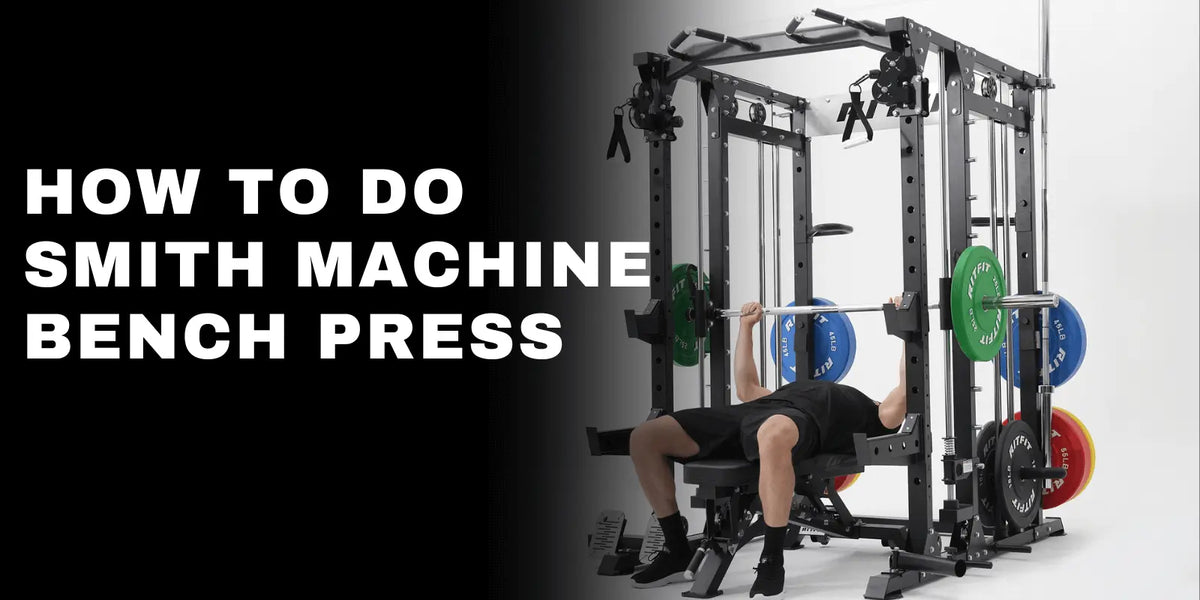
The Smith machine bench press is a guided chest exercise that helps you practice a consistent pressing pattern while the rails control the bar path. This revised guide explains how to align the bench, set the bar and safety catches, perform each repetition, and choose useful variations.
A fixed bar path does not automatically suit every body position. Test the setup with an empty bar, keep the movement controlled, and adjust or stop if the exercise causes sharp or persistent pain.
Quick Answer: To do the Smith machine bench press, center the bench so the bar lowers to your mid to lower chest, set the hooks and safety catches, plant your feet, grip the bar slightly wider than shoulder width, lower it under control, and press it back up while keeping your shoulders set and wrists firm.
Key Takeaways
- Bench position: Align the bar with your mid to lower chest at the bottom of the rep before adding weight.
- Stable base: Plant both feet, keep your upper back supported, and maintain firm wrist and shoulder positions.
- Controlled path: Lower the bar smoothly, use light chest contact, and press without bouncing.
- Safety setup: Adjust the hooks and safety catches so you can rack the bar or end a failed rep without relying on a spotter.
- Movement choice: Use the Smith machine when a guided path fits your body and training goal, and change the setup if the path feels uncomfortable.
What Is the Smith Machine Bench Press?
The Smith machine bench press is a horizontal pressing exercise performed on a bench inside a machine that guides the bar along fixed rails. The movement trains the same primary pressing muscles as a barbell bench press, while the machine reduces the need to balance the bar from side to side.[1]
- Starting position: Place your eyes under the bar or slightly behind it, depending on the machine rail direction and your bench setup.
- Bottom position: Let the bar meet your mid to lower chest without forcing your shoulders into an uncomfortable angle.
- Lockout position: Finish above your chest with your elbows extended without aggressively snapping them straight.
Test the empty bar before loading plates because the best bench position depends on the machine rail angle, your torso length, and the range of motion that feels controlled.
Which Muscles Does the Smith Machine Bench Press Work?
The Smith machine bench press primarily trains the pectoralis major, anterior deltoids, and triceps. A controlled comparison found similar pectoralis major and anterior deltoid activation between Smith machine and free weight conditions, while the free weight condition required more medial deltoid stabilization.[1]
- Pectoralis major: The chest muscles produce much of the horizontal pressing force as the bar moves away from the chest.
- Anterior deltoids: The front shoulders assist with pressing as the arms move toward the top of the rep.
- Triceps: The triceps extend the elbows and help finish the press.
- Upper back and core: These areas help keep your torso and shoulder blades in a repeatable position.
The guided path can reduce balance demands, but it does not remove the need for good shoulder positioning. Reduce the load and reassess the bench position if the bar path feels forced or causes pain.
Why Use a Smith Machine for the Bench Press?
The Smith machine bench press is useful when you want a repeatable bar path, a stable setup, or a pressing option that can be practiced without a traditional spotter. The machine can also help you focus on chest and pressing technique instead of balancing the bar.
Can a guided path help you practice technique?
A guided path lets you concentrate on bench contact points, grip, breathing, and movement order. The repeatable setup can help you identify which bench position fits your body.
- Practice first: Use the empty bar to check where the bar touches your chest before loading plates.
- Keep it comfortable: The rail should guide the lift, not force your shoulders or elbows into a painful position.
How do safety catches support solo training?
Adjustable catches can provide a defined stopping point if you cannot complete a rep. Set them just below your normal chest position, then test the empty bar so the catches allow your intended range of motion.
A home setup such as the RitFit Multifunctional Smith Machine can combine the guided press with other training stations. Check the machine instructions and load limits before using any attachment.
How Do You Perform the Smith Machine Bench Press?
The Smith machine bench press starts with a bench and bar alignment check, followed by a controlled descent and a strong press from a stable base. Use an empty bar for the first setup check and keep the load light enough to maintain the same path on every rep.
How should you set up the bench and bar?
Center your weight bench under the bar so the bar reaches your mid to lower chest when your elbows are bent. Set the hooks for a comfortable unrack and place the safety catches just below the bottom of your normal range.
- Set your body: Keep your head, upper back, hips, and both feet in stable contact with the bench or floor.
- Set your shoulders: Draw your shoulder blades back and down without lifting your hips from the bench.
- Choose your grip: Use a closed grip slightly wider than shoulder width unless the machine instructions or a qualified coach directs another position.
How should you complete each repetition?
Unrack the bar with the machine prescribed wrist rotation, then hold it above your chest with your wrists stacked over your forearms. Inhale as you lower the bar under control, touch the chest lightly, and exhale as you press it back to the starting position.
- Lower with control: Keep your elbows comfortable and avoid dropping the bar onto your chest.
- Press from a stable base: Push through your planted feet while keeping your hips on the bench.
- Finish safely: Rotate the bar back into the hooks after the final rep instead of reaching for the rack while fatigued.
Once the setup is consistent, the RitFit M1 PRO Smith Machine can support a repeatable home gym bench press routine. Follow the product manual for assembly, loading, and safety procedures.
How Does the Smith Machine Bench Press Differ From Free Weights?
The main difference is that the Smith machine controls the bar path, while a free weight bench press requires you to control the bar in three dimensions. That difference changes stabilization demand and can change which setup feels natural for a particular lifter.
| Training factor | Smith machine bench press | Free weight bench press |
|---|---|---|
| Bar control | Rails guide the bar path. | The lifter controls the bar path. |
| Stabilization | The machine reduces side to side balance demands. | The lifter must stabilize the bar throughout the rep. |
| Solo setup | Safety catches can provide a defined stopping point when adjusted correctly. | A rack, safety arms, or a qualified spotter may be needed depending on the setup. |
| Best starting check | Align the bench with the machine rail path and chest position. | Practice the bar path with a light load and a stable rack setup. |
The comparison describes movement and setup differences. It does not establish that one option is best for every lifter.
The Smith machine can be a practical choice for focused chest work or solo sessions, while free weights may suit lifters who specifically want to practice independent bar control. Choose the option that supports your goal without causing pain or sacrificing control.
Which Smith Machine Bench Press Variations Can You Try?
Smith machine bench press variations change the bench angle or hand position while keeping the same basic setup priorities. Start with a light load and confirm that the rail path meets your chest comfortably before progressing.
How do you perform a Smith machine incline press?
Set an adjustable bench to an incline that lets the bar meet your upper chest without forcing your shoulders forward. Keep your feet planted, lower under control, and press through the same stable base used for the flat version.
How do you perform a Smith machine decline press?
Set the bench to a comfortable decline and confirm that the bar reaches the lower chest area without pulling your shoulders out of position. Use the machine safety catches and avoid loading the variation until the empty bar path feels consistent.
When should you use a closer grip?
A closer grip shifts more work toward elbow extension and can make the triceps more prominent. Use a grip that keeps your wrists stacked and your elbows comfortable, and stop if the position creates joint pain.
"There's a little bit of confusion around what the best angle is for the bench on an incline bench press to hit the upper chest. It's pretty conclusive. 30 degrees is a really good place for most of us."
Jeff Cavaliere, MSPT, CSCS, ATHLEAN-X Instagram Reel
Which Smith Machine Bench Press Mistakes Should You Avoid?
The most common Smith machine bench press mistakes involve bar and bench alignment, safety settings, and uncontrolled reps. Correct the setup before adding weight because poor alignment can make the same load feel unnecessarily awkward.
What happens when the bench is too far forward or back?
If the bench is too far forward, the bar may meet the chest too high and pull the shoulders into an uncomfortable position. If the bench is too far back, the bar may meet the stomach or lower chest instead of the intended contact point.
Why should you avoid bouncing the bar?
Bouncing reduces control at the bottom and can create unnecessary stress on the chest and shoulders. Lower the bar until it makes light contact, pause briefly if needed, and press without using momentum.
How can you prevent an awkward unrack?
Set the bar at a height that allows you to unrack without shrugging or reaching. If your elbows begin fully locked before the bar is free, lower the rack position and retest with the empty bar.
- Do not ignore pain: Stop the set and reassess the bench, grip, load, and range of motion if the movement causes sharp or persistent pain.
- Do not skip the catches: Adjust and test the safety catches before working sets, especially when training alone.
- Do not chase load at the expense of form: Progress only when you can repeat the same controlled setup and bar contact point.
FAQs About Smith Machine Bench Press Form
Is the Smith machine bench press good for building muscle?
Yes.
The Smith machine bench press builds chest muscle because it keeps steady tension on the target while allowing heavy loads safely.
Your pecs and front delts do most of the work, and the fixed bar path limits rotator cuff involvement.
How much should I bench press on a Smith machine?
Start with a modest load you can press for 8 to 12 controlled reps with clean form. Because the fixed path removes balance demands, most lifters can safely handle slightly more weight on a Smith machine than with a barbell.
Is the Smith machine bench press safer than a barbell bench press?
Yes.
The fixed bar path and safety catches let you rack the bar quickly if you fail a rep, so you can train solo without a spotter.
This makes it one of the safest ways to bench press in a home gym.
Why does my Smith machine bench press feel so hard?
A common cause is poor setup.
If the bar meets your chest too high or too low, or your bench is off-center, the press feels wrong and your chest cannot work fully.
Reset the bench under the bar and adjust the rack height before your next set.
How many sets and reps should I do for the Smith machine bench press?
For chest growth, do 3 to 4 sets of 8 to 12 reps with a weight that is challenging but clean on the last two reps. Rest 90 seconds to 2 minutes between sets and add load gradually as you get stronger.
Conclusion
The Smith machine bench press can simplify setup and bar control while still training the chest, front shoulders, and triceps. The exercise works best when the bench position, safety catches, grip, and range of motion match your body and the machine rail path.
Test the setup with an empty bar, use controlled repetitions, and progress gradually. If you are choosing equipment for a home gym, compare suitable options on the RitFit sale page and review each machine's specifications before purchasing.
Disclaimer
All training content is for general information only and is not a substitute for professional medical advice. Consult a qualified health care provider before starting a new exercise program, and stop immediately if you feel sharp pain during any movement.
References
1. Schick EE, Coburn JW, Brown LE, Judelson DA, Khamoui AV, Tran TT, Uribe BP. A comparison of muscle activation between a Smith machine and free weight bench press. J Strength Cond Res. 2010;24(3):779-784. doi:10.1519/JSC.0b013e3181c7c0d0
2. Saeterbakken AH, van den Tillaar R, Fimland MS. A comparison of muscle activity and 1-RM strength of three chest-press exercises with different stability requirements. J Sports Sci. 2011;29(5):533-538. doi:10.1080/02640414.2010.543916
3. Haugen ME, Vårvik FT, Larsen S, Haugen AS, van den Tillaar R, Bjørnsen T. Effect of free-weight vs. machine-based strength training on maximal strength, hypertrophy and jump performance: a systematic review and meta-analysis. BMC Sports Sci Med Rehabil. 2023;15(1):103. doi:10.1186/s13102-023-00713-4





