Improving soccer passing starts with clean technique, consistent repetition, and game realistic decision making. This guide shows beginners how to build passing accuracy, first touch, scanning, weak foot control, and passing under pressure through simple drills that progress from solo practice to small sided games.
Key Takeaways
- Start with the inside foot pass: It gives beginners the largest contact surface and the best control for short and medium passes.
- Train first touch with every pass: A good first touch sets up the next pass before pressure arrives.
- Use wall passing for solo practice: It is the easiest way to improve accuracy, rhythm, and weak foot confidence at home.
- Progress from no pressure to game pressure: Beginners should master technique first, then add rondos, defenders, and small sided games.
- Track simple benchmarks: Completion rate, weak foot accuracy, one touch success, and passing speed show whether your training is working.
- Why Passing Matters for Beginner Soccer Players
- Basic Soccer Passing Technique
- Best Soccer Passing Drills for Beginners
- Intermediate Passing Drills for Decision Making
- Advanced Passing Drills for Game Speed
- How to Improve First Touch for Better Passing
- How to Pass Under Pressure
- Common Passing Mistakes Beginners Make
- Four Week Soccer Passing Practice Plan
- How to Track Passing Progress
- Off Field Strength and Conditioning for Better Passing
Why Passing Matters for Beginner Soccer Players
Passing matters because it is the fastest way to move the ball, keep possession, and connect with teammates. Beginners who pass accurately become more useful in every position because they help the team control rhythm and reduce turnovers.
- Ball retention: Accurate passing keeps your team in possession and limits the opponent's scoring chances.
- Creating space: Quick passes pull defenders out of position and open passing lanes for teammates.
- Game intelligence: Passing teaches scanning, timing, body shape, and decision making before the ball arrives.
- Energy efficiency: A team that passes well moves the ball faster than any single player can dribble.
- Team chemistry: Repeated passing patterns help players learn each other's movement, preferred foot, and support angles.
Basic Soccer Passing Technique
A good soccer pass depends on body alignment, locked ankle position, clean ball contact, and the correct weight of pass. Beginners should master these fundamentals before adding speed, pressure, or complex combinations.
Inside Foot Pass
The inside foot pass is the most reliable beginner passing technique because the inside of the foot creates a wide and stable contact surface. Use it for short passes, wall passing, partner passing, rondos, and quick combinations.
- Plant foot: Place your non kicking foot beside the ball and point your toes toward the target.
- Hip position: Open your kicking hip so the inside of your foot faces the target.
- Ankle lock: Keep your ankle firm so the foot does not wobble at contact.
- Contact point: Strike through the center of the ball to keep the pass flat and predictable.
- Follow through: Finish your foot motion toward the target to improve accuracy.
Instep Pass
The instep pass is best for longer passes that need more pace and distance. Beginners should use it after they can consistently control short inside foot passes.
- Approach angle: Approach the ball slightly from the side so your leg can swing naturally.
- Toe position: Point the toes down and lock the ankle before contact.
- Ball contact: Strike the middle of the ball with the laces area.
- Body control: Keep your chest steady so the ball does not rise too much.
Weight of Pass
The weight of pass means how fast the ball travels to your teammate. A good pass is firm enough to avoid interception but soft enough for the receiver to control cleanly.
- Short distance: Use a controlled push from the inside of the foot.
- Medium distance: Add more leg swing while keeping the ankle locked.
- Pass into space: Lead your teammate so they can continue running without slowing down.
- Pass to feet: Aim for the receiver's stronger foot when they are standing or checking toward the ball.
Body Shape and Scanning
Body shape and scanning help you pass faster because you already know your next option before the ball arrives. Research on soccer athletes suggests that skilled players are better at reading soccer specific movement, which supports the value of visual awareness in passing decisions.[1]
- Scan early: Look over your shoulder before receiving the ball.
- Open your hips: Receive on the half turn so you can see the ball and the field.
- Check support: Know where your closest safe option is before pressure arrives.
- Play forward when possible: Use sideways or backward passes when forward lanes are closed.
Best Soccer Passing Drills for Beginners
The best beginner soccer passing drills are simple, repeatable, and easy to measure. Start with solo and partner drills, then add angles, movement, and target gates.
| Drill | Best For | Players Needed | Difficulty | Target Score |
|---|---|---|---|---|
| Wall Passing | Solo accuracy and first touch | 1 | Beginner | 50 clean passes per foot |
| Partner Passing | Basic timing and control | 2 | Beginner | 40 accurate passes |
| Triangle Passing | Angles and movement | 3 | Beginner | 3 clean rotations |
| Gate Passing | Target accuracy | 1 or 2 | Beginner | 15 successful passes from 20 attempts |
| Follow Your Pass | Pass and move habits | 4 | Beginner | 5 minutes without losing rhythm |
Drill 1: Wall Passing
Wall passing is the best solo soccer passing drill because it trains accuracy, rhythm, first touch, and both feet without needing a teammate. Stand 5 to 8 yards from a solid wall and pass the ball back with two touches.
- Setup: Use a flat wall, rebounder, or safe solid surface with enough space around you.
- Execution: Pass with the inside of your foot, control the rebound with one touch, then pass again.
- Progression: Move farther away, use one touch, or complete the set with only your weaker foot.
- Target: Complete 50 clean passes with your right foot and 50 with your left foot.
Drill 2: Partner Passing
Partner passing teaches beginners to pass to a real moving target with proper pace and control. Stand 8 to 10 yards apart and use two touch passing before progressing to one touch passing.
- Setup: Two players face each other with one ball and enough space to pass safely.
- Execution: Receive with one touch and pass back with the second touch.
- Progression: Increase the distance, use one touch, or require both players to use the weaker foot.
- Target: Complete 40 accurate passes without a heavy first touch.
Drill 3: Triangle Passing
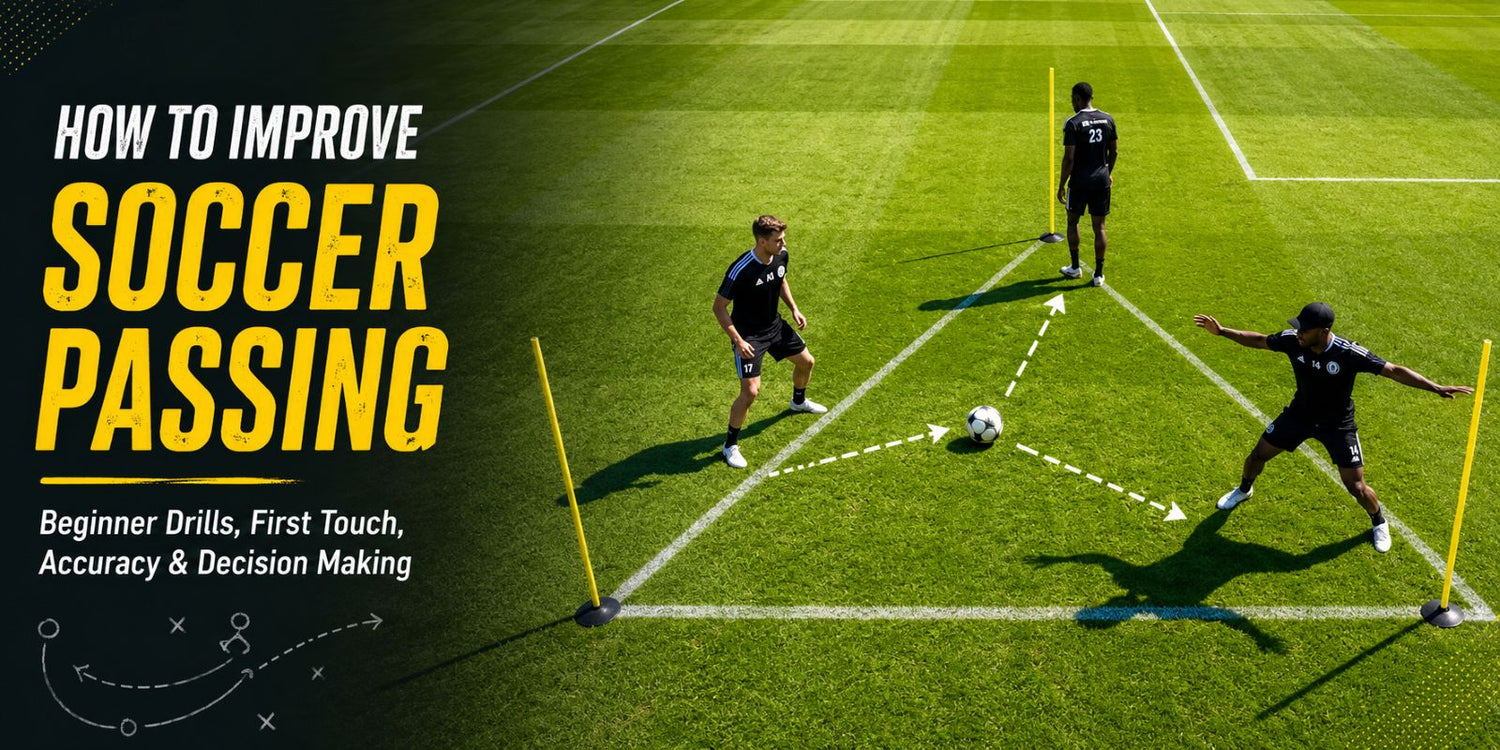
Triangle passing teaches passing angles, support movement, and receiving on the half turn. Set three cones in a triangle and have each player pass, follow the ball, and rotate to the next cone.
- Setup: Place three cones 8 to 10 yards apart with one player at each cone.
- Execution: Player A passes to Player B and follows the pass, then Player B passes to Player C and follows.
- Coaching cue: Open your body before receiving so your next pass is already visible.
- Target: Complete three full rotations without stopping the ball dead.
Drill 4: Gate Passing
Gate passing improves accuracy because the player must pass through a narrow target instead of aiming generally at a teammate. Set several cone gates around the field and pass through each gate in sequence.
- Setup: Create 5 to 6 gates with cones, each about 1 yard wide.
- Execution: Pass the ball through each gate, retrieve it, and move to the next target.
- Progression: Make the gates narrower, increase distance, or use only your weaker foot.
- Target: Score at least 15 clean passes from 20 attempts.
Drill 5: Follow Your Pass
Follow your pass teaches beginners not to stand still after releasing the ball. Four players pass around a square and immediately move to the cone they passed toward.
- Setup: Place four cones in a square with one player at each cone.
- Execution: Pass to the next player and sprint to that player's cone.
- Progression: Add a second ball once the group can keep a steady rhythm.
- Target: Keep the ball moving for 5 minutes with no long pauses.
Intermediate Passing Drills for Decision Making
Intermediate passing drills add pressure, awareness, and faster decisions. These drills help beginners move from clean technique to game realistic possession.
Drill 6: Rondo
A rondo improves quick passing, scanning, body shape, and calmness under pressure. Small sided game research shows that these training formats can improve technical execution in young players, which makes rondos useful once beginners understand the basics.[2]
- Setup: Use 4 to 5 attackers around a circle with 1 defender in the middle.
- Execution: Attackers keep possession while the defender tries to intercept.
- Progression: Start with 5v1, then move to 4v2 when players improve.
- Target: Complete 5 passes before the defender touches the ball.
Drill 7: Three Team Possession
Three team possession teaches players to pass while identifying teammates quickly during transitions. Two teams combine to keep possession against the third team inside a marked grid.
- Setup: Create a 20 by 30 yard grid and divide players into three equal teams.
- Execution: Two teams keep the ball while the third team defends.
- Transition: When the defending team wins the ball, the team that lost it becomes the new defender.
- Target: Play 3 minute rounds with a goal of 8 consecutive passes.
Drill 8: Passing Through Lines
Passing through lines teaches players to find gaps between defenders instead of only passing sideways. This drill is useful for midfielders and defenders who need to break pressure with a controlled forward pass.
- Setup: Create three horizontal zones with two defenders in the middle zone.
- Execution: Attackers in one end zone pass until they can play through the defenders to the opposite end zone.
- Coaching cue: Wait for a passing lane to open instead of forcing the ball through traffic.
- Target: Complete 5 clean line breaking passes in each round.
Drill 9: Directional Possession
Directional possession adds a purpose to passing because the team must move the ball from one end zone to the other. This teaches beginners that possession should help the team progress up the field.
- Setup: Create a 25 by 35 yard grid with a target zone at each end.
- Execution: Each team scores by passing into the opposite target zone.
- Progression: Require at least 3 passes before a team can score.
- Target: Score 5 points through controlled passing, not long hopeful balls.
Drill 10: Overlap Passing
Overlap passing teaches combination play and timing between the passer and runner. Player A passes to Player B, runs around them, and receives a return pass into space.
- Setup: Place three cones in a straight line, about 10 yards apart.
- Execution: Pass, overlap around the receiver, and receive the next pass while running.
- Coaching cue: The return pass should lead the runner, not stop at their feet.
- Target: Complete 10 clean overlaps on each side.
Advanced Passing Drills for Game Speed
Advanced passing drills should be used only after beginners can pass accurately under light pressure. These exercises demand quicker scanning, faster body adjustment, and better communication.
Drill 11: 4v4 Plus 2 Neutral Players
4v4 plus 2 neutrals teaches players to find the extra passing option under pressure. The neutral players always support the team in possession, creating a temporary numerical advantage.
- Setup: Use a 25 by 25 yard grid with two teams of 4 and two neutral players.
- Execution: The team in possession plays with the neutrals to create a 6v4 advantage.
- Rule: Score 1 point for 8 consecutive passes.
- Target: Use the neutral player before pressure traps the ball carrier.
Drill 12: Wave Passing
Wave passing develops longer passing, switching play, and receiving from distance. Players pass in one grid, then switch the ball into a second grid when the coach gives a signal.
- Setup: Create two grids side by side, each about 15 by 20 yards.
- Execution: Players keep possession in one grid before switching the ball to the other grid.
- Progression: Limit players to two touches before the switch.
- Target: Complete 8 successful switches in a round.
Drill 13: Conditioned Small Sided Games
Conditioned small sided games transfer passing technique into realistic soccer situations. Rules such as two touch maximum or 5 passes before scoring force players to use passing with intention.
- Two touch rule: Players must control and pass quickly.
- Five pass rule: A team must complete 5 passes before shooting.
- Forward pass bonus: A team earns extra points for successful forward passes.
- One touch zone: Players in the attacking half must use one touch when possible.
How to Improve First Touch for Better Passing
First touch improves passing because it prepares the body for the next action. A poor first touch forces rushed passing, while a clean first touch creates time, space, and better passing angles.
Receive on the Half Turn
Receiving on the half turn means opening your hips so you can see both the ball and the field. This helps beginners play forward sooner instead of always passing backward.
Touch Into Space
Your first touch should move the ball away from pressure and toward your next passing option. Do not stop the ball dead unless you have time and space.
Soften the Ball
Soften the ball by slightly withdrawing your receiving foot at contact. A stiff foot often makes the ball bounce too far away.
Scan Before Receiving
Scanning before receiving helps you know where teammates, opponents, and open space are located. Look over your shoulder before the pass arrives, then check the ball for contact.
How to Pass Under Pressure
Passing under pressure requires faster decisions, fewer touches, and better protection of the ball. The best option is often the simple pass that keeps possession instead of the risky pass that looks impressive.
- Play faster: Use one touch or two touch passing when defenders close space quickly.
- Use your body: Place your body between the defender and the ball while you prepare the pass.
- Keep simple options: A safe sideways pass is better than a forced forward pass into pressure.
- Communicate clearly: Use simple calls such as time, turn, man on, and one more.
- Support the ball: After you pass, move into a new angle so your teammate has an option.
Common Passing Mistakes Beginners Make
Most beginner passing mistakes come from poor body shape, rushed decisions, or inconsistent contact with the ball. Fixing these basics often improves passing faster than adding harder drills.
Mistake 1: Passing With the Toe
Toe passing is unpredictable because the contact surface is small and unstable. Use the inside of the foot for short passes and the instep for longer passes.
Mistake 2: Not Looking Up Before Passing
Beginners often stare at the ball and miss better passing options. Scan before receiving, choose your target, then look at the ball during contact.
Mistake 3: Standing Still After Passing
Standing still after a pass removes a support option for your teammate. Build the habit of passing and moving in every drill.
Mistake 4: Passing Too Softly
A soft pass gives defenders more time to intercept the ball. Pass firmly enough that the ball reaches your teammate quickly while still being controllable.
Mistake 5: Avoiding the Weaker Foot
A player who cannot pass with the weaker foot becomes easy to defend. Spend at least 30 percent of each passing session using your weaker foot.
Four Week Soccer Passing Practice Plan
A four week passing plan helps beginners progress from basic technique to game speed. Train 3 to 5 times per week and keep each focused session between 20 and 60 minutes.
| Week | Focus | Main Drills | Goal |
|---|---|---|---|
| Week 1 | Technique and clean contact | Wall passing, partner passing, gate passing | Build inside foot accuracy |
| Week 2 | First touch and body shape | Triangle passing, wall receiving, follow your pass | Receive on the half turn |
| Week 3 | Pressure and decision speed | Rondo, three team possession, passing through lines | Pass with fewer touches |
| Week 4 | Game application | Directional possession, 4v4 plus neutrals, conditioned games | Use passing to progress the ball |
How to Track Passing Progress
Tracking passing progress keeps training honest and shows whether your skills are improving. Use simple targets that measure accuracy, touch quality, and decision speed.
- Wall passing score: Complete 100 passes and aim for at least 85 clean returns.
- Weak foot score: Complete 50 weak foot passes and aim for 35 clean passes first, then 45.
- Gate passing score: Take 20 attempts and aim for 15 passes through the gates.
- One touch score: Complete 30 one touch passes and aim for 20 clean passes.
- Rondo score: Help your group complete at least 5 passes before losing possession.
Off Field Strength and Conditioning for Better Passing
Passing is mainly technical, but strength, balance, mobility, and fatigue resistance support better passing late in a game. Strength training research in soccer supports the value of well planned strength work for performance qualities that matter on the field.[3]
Beginner soccer players can build a simple home routine with split squats, lunges, calf raises, planks, side planks, hip bridges, and single leg balance work. A stable training area with interlocking gym flooring mats can make home footwork, balance, and core sessions safer and more comfortable.
For general strength support, players can use hex rubber dumbbells for lunges and carries, a GATOR adjustable weight bench for step ups and core work, and a 3 in 1 soft plyo box for controlled athletic drills.
Players who want a broader home strength setup can add a power cage with cable system or a Smith machine with cable crossover system for lower body, core, and upper body training. Keep strength work supportive, not so fatiguing that it reduces ball practice quality.
Frequently Asked Questions
How can beginners improve soccer passing accuracy at home?
Beginners can improve soccer passing accuracy at home by using wall passing every day. Start 5 to 8 yards from a wall, pass with the inside of the foot, control the rebound, and repeat with both feet until clean contact becomes automatic.
What is the best soccer passing drill for one player?
Wall passing is the best soccer passing drill for one player. It improves passing accuracy, first touch, weak foot control, rhythm, and one touch passing without needing a teammate, field, or complex setup.
How long should a beginner practice soccer passing each day?
A beginner should practice soccer passing for 15 to 30 minutes on most training days. Short consistent sessions work better than one long weekly session because passing improves through repeated clean contact and quick feedback.
Can wall passing improve first touch?
Yes. Wall passing can improve first touch because every rebound forces the player to control the ball before the next pass. Change the angle, speed, and direction of each touch to make the drill more game realistic.
What is the difference between one touch and two touch passing?
One touch passing means you pass the ball immediately without a control touch, while two touch passing means you control first and pass second. Beginners should master two touch passing first, then progress to one touch passing for faster decisions.
How do I stop passing the soccer ball too softly?
To stop passing too softly, lock your ankle, strike through the center of the ball, and follow through toward the target. Practice gate passing from different distances so you learn how much pace each pass needs.
Should beginners practice weak foot passing every session?
Yes. Beginners should practice weak foot passing every session because one footed players are easier to defend. Start with short wall passes, then progress to partner passing, gate passing, and small sided games.
What soccer passing drills help under pressure?
Rondos, three team possession, directional possession, and conditioned small sided games help players pass under pressure. These drills force scanning, quicker decisions, body protection, communication, and simple passing options when defenders close space.
Conclusion
Improving soccer passing is simple when beginners follow the right progression. Master the inside foot pass, train first touch, practice both feet, add pressure gradually, and use small sided games to turn passing drills into real match habits.
Start with 15 minutes of wall passing today, then add partner drills, rondos, and game based passing over the next four weeks. Consistent practice beats complicated drills every time.
Disclaimer: This article is for general sports education only and is not medical advice. Soccer players should adapt drills to age, skill level, field conditions, and injury history. Stop training if pain, dizziness, or unusual discomfort occurs, and consult a qualified coach or healthcare professional when needed.
References
- Romeas T Faubert J. Soccer athletes are superior to non athletes at perceiving soccer specific and non sport specific human biological motion. Front Psychol. 2015;6:1343. doi:10.3389/fpsyg.2015.01343
- Clemente FM Ramirez Campillo R Sarmento H Praça GM Afonso J Silva AF Rosemann T Knechtle B. Effects of small sided game interventions on the technical execution and tactical behaviors of young and youth team sports players: a systematic review and meta analysis. Front Psychol. 2021;12:667041. doi:10.3389/fpsyg.2021.667041
- Silva JR Nassis GP Rebelo A. Strength training in soccer with a specific focus on highly trained players. Sports Med Open. 2015;1:17. doi:10.1186/s40798-015-0006-z
- Bizzini M Dvorak J. FIFA 11+: an effective programme to prevent football injuries in various player groups worldwide. Br J Sports Med. 2015;49(9):577-579. doi:10.1136/bjsports-2015-094765