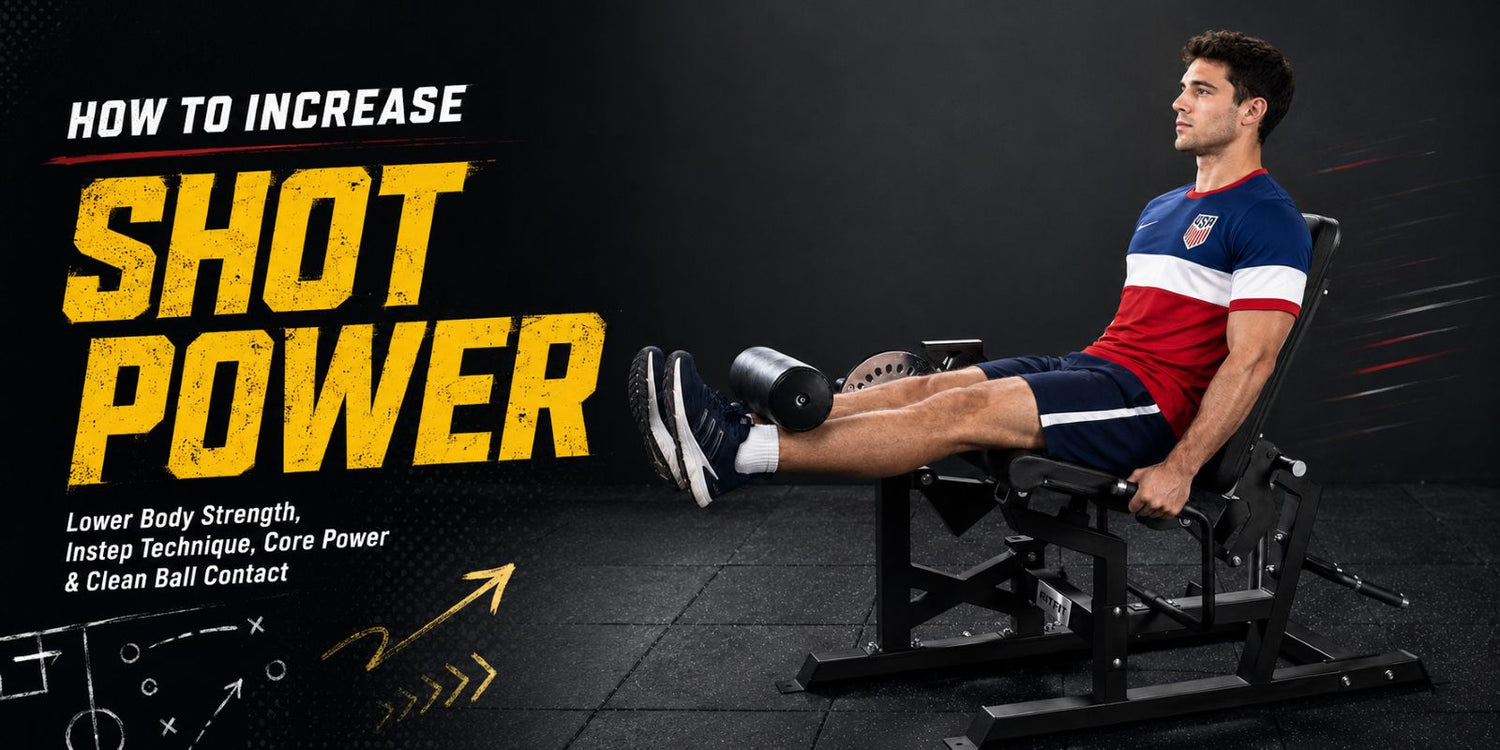
To increase your shot power in soccer, improve instep technique, build lower body strength, train rotational core power, and practice fast clean ball contact. The most powerful shot comes from a stable plant foot, explosive hip rotation, a locked ankle, and a controlled follow through.
This guide explains how to shoot harder, what exercises build power, how to train safely, and how to set up a home gym for soccer strength work.
Key Takeaways
- Technique comes first: A clean instep strike with a locked ankle usually adds more usable power than simply swinging harder.
- The plant foot creates the base: Place it beside the ball and point it toward your target to improve balance and energy transfer.
- Hips and core drive power: Strong hip rotation and trunk stability help move force from the ground into the ball.
- Strength must become speed: Squats, deadlifts, split squats, jumps, and medicine ball throws work best when paired with shooting practice.
- Measure progress carefully: Use video, distance testing, or a radar gun so you can see whether your technique and training are working.
Table of Contents
- Quick Answer
- The Biomechanics of Shot Power
- How to Shoot Harder in Soccer
- Strength Training for Shot Power
- Plyometric Training for Explosive Shots
- Shot Power Training Plan
- Home Gym Equipment for Soccer Strength
- How to Measure Shot Power Progress
- Common Shot Power Mistakes
- Age Specific Safety Notes
- Nutrition and Recovery
Quick Answer
You shoot harder in soccer by striking the ball with the laces, keeping the ankle firm, rotating the hips through the ball, and following through naturally. Off the field, build strength with squats, deadlifts, split squats, rotational core work, and plyometrics.
The goal is not just more effort, it is better force transfer. A relaxed, fast, well timed swing usually beats a tense swing that tries too hard.
The Biomechanics of Shot Power
A powerful soccer shot is a full body movement that starts at the ground and finishes at the ball. Research on the instep kick shows that ball speed is influenced by skill level, age, approach angle, limb dominance, and movement coordination.[1]
The Kinetic Chain
The kinetic chain transfers force from the plant foot through the hips, core, kicking leg, ankle, and foot. If one link is unstable, energy leaks before the ball leaves your foot.
- Ground force: The plant leg creates the base that lets the body rotate and strike with control.
- Hip rotation: The hips turn the body into the shot and add rotational speed to the kicking leg.
- Core stiffness: The trunk helps transfer force without collapsing or twisting out of position.
- Leg swing speed: Faster foot speed at contact usually produces a harder shot when contact is clean.
- Ankle lock: A firm ankle turns the foot into a solid striking surface instead of a soft absorber.
Power Versus Accuracy
Maximum power and perfect accuracy are not always the same goal. Most players need a repeatable powerful shot that stays on frame before chasing maximum ball speed.
How to Shoot Harder in Soccer
Harder shooting starts with better setup, not a wild swing. Use these steps to build an instep drive that produces power without losing control.
- Step 1: Approach at an angle: Approach the ball from roughly 30 to 45 degrees. This gives your hips space to rotate through the shot.
- Step 2: Plant beside the ball: Place your plant foot beside the ball with the toes aimed toward your target. Keep the plant knee slightly bent so you can stay balanced.
- Step 3: Lock the ankle: Point the toes down and strike with the laces. A loose ankle absorbs force and makes the shot weaker.
- Step 4: Keep the chest controlled: Lean slightly over the ball if you want a driven shot. Leaning back often sends the ball high.
- Step 5: Follow through naturally: Let the kicking leg continue forward after contact. Stopping the swing early reduces power and rhythm.
Best Contact Point
For maximum shot power, strike the center or slightly below center of the ball with the firm laces area of the foot. Keep your eyes on the ball until after contact so you do not miss the strike zone.
Simple Technique Drill
Start with 20 slow instep strikes from a stationary ball before adding distance or speed. Focus only on plant foot position, ankle lock, and clean contact.
Strength Training for Shot Power
Strength training supports soccer shot power by improving force production, single leg stability, and the ability to transfer force through the body. Reviews on soccer strength training report that well planned strength work can improve performance qualities that matter to soccer players.[2]
| Exercise | Why It Helps Shot Power | Training Guideline |
|---|---|---|
| Back Squat | Builds quads, glutes, and plant leg strength | 3 to 5 sets of 4 to 8 reps |
| Deadlift | Strengthens posterior chain and hip extension | 3 to 4 sets of 3 to 6 reps |
| Bulgarian Split Squat | Improves single leg strength and hip stability | 3 sets of 8 to 10 reps per leg |
| Cable Woodchop | Trains rotational core power | 3 sets of 10 reps per side |
| Pallof Press | Builds anti rotation control for clean force transfer | 3 sets of 10 to 12 reps per side |
Lower Body Strength
Squats, deadlifts, lunges, and split squats build the strength base behind a harder shot. Train with controlled form before increasing load.
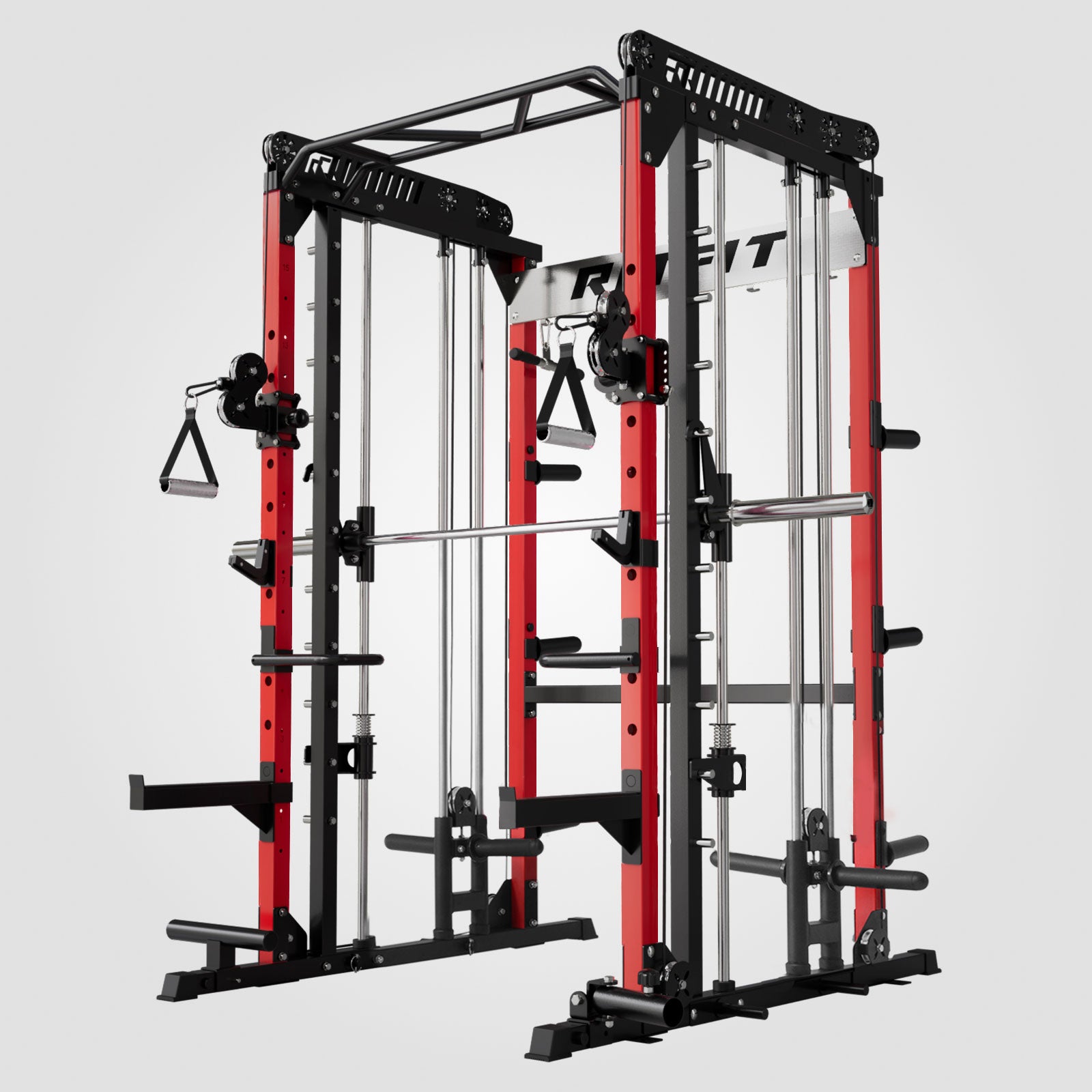
A safe home setup can start with a RitFit P3 Power Cage with cable system, a RitFit Olympic barbell, and barbells and weight plates for progressive lower body training.
Single Leg Strength
Soccer is a single leg sport because one leg often plants while the other strikes. Bulgarian split squats, reverse lunges, step ups, and single leg Romanian deadlifts help close the gap between gym strength and field movement.
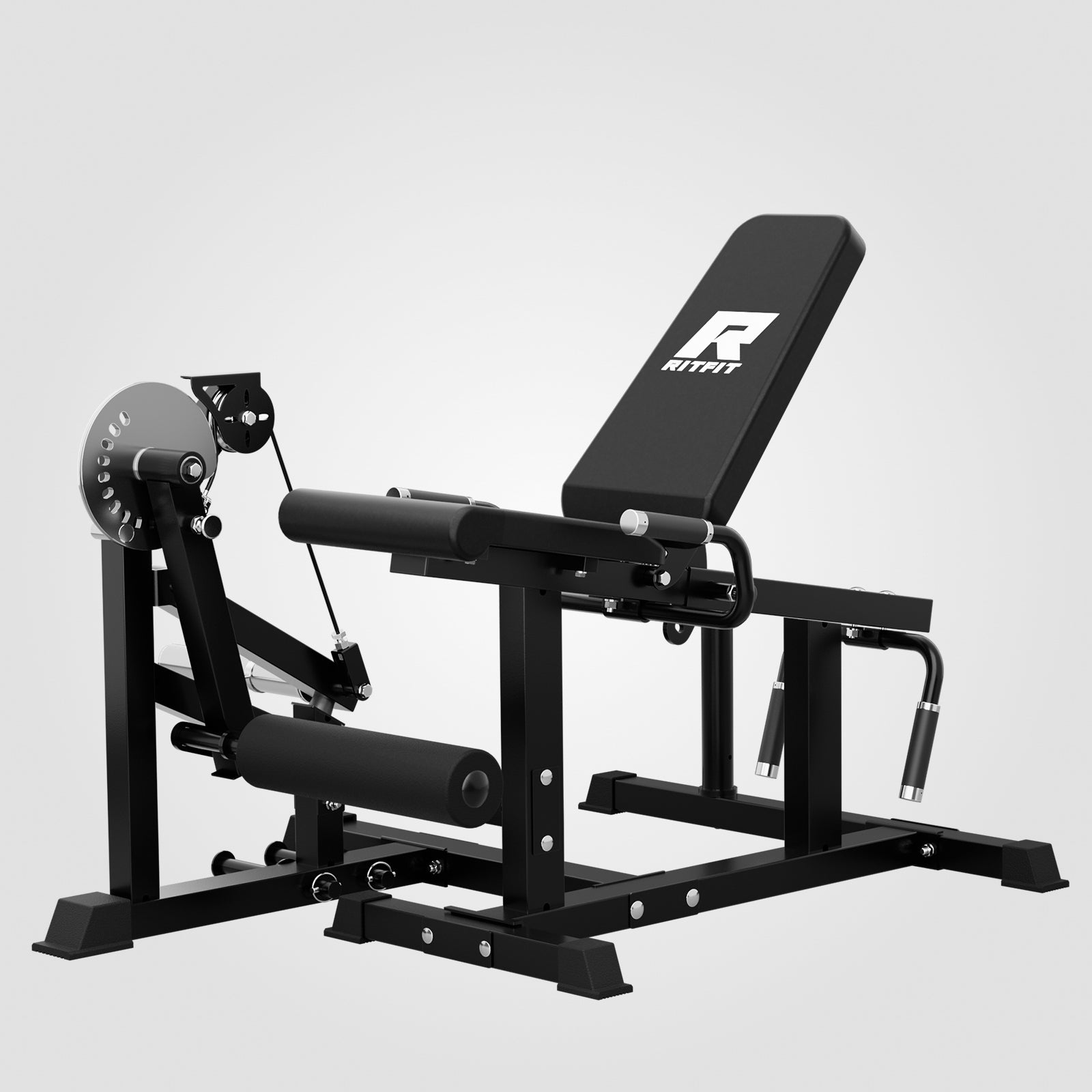
An adjustable weight bench supports Bulgarian split squats, supported rows, and accessory work without taking over a home gym space.
Rotational Core Power
Core training helps the trunk stay stable while the hips rotate and the kicking leg accelerates. A systematic review found that core training can improve soccer players skill related fitness, including power, speed, balance, and agility.[4]
A cable crossover machine makes woodchops, Pallof presses, standing rotations, and anti rotation holds easy to load and repeat.
Plyometric Training for Explosive Shots
Plyometrics help turn strength into fast force production. A soccer specific review on plyometric jump training highlights programming factors such as age, fitness level, exercise type, volume, frequency, and recovery.[3]
Best Plyometric Exercises
Choose jumps that you can land with control before adding height, speed, or single leg difficulty. Quality matters more than fatigue.
- Box jumps: Build explosive leg extension with low landing impact when done correctly.
- Squat jumps: Train vertical power with simple setup and no equipment.
- Skater jumps: Improve lateral power and single leg control for soccer movement.
- Single leg hops: Build plant leg stiffness and coordination.
- Medicine ball slams: Train explosive hip and trunk extension.
For jump work at home, a 3 in 1 soft plyo box can support box jumps, step ups, lateral step drills, and low impact progressions.
Plyometric Programming
Perform plyometrics before heavy lifting when your nervous system is fresh. Keep most sessions to 3 to 5 exercises and stop when landing quality drops.
Shot Power Training Plan
The best soccer shot power program combines technique, strength, plyometrics, and recovery. Use the table below as a practical starting point and adjust based on match schedule, fatigue, and training age.
| Level | Weekly Strength Work | Weekly Power Work | Shooting Practice |
|---|---|---|---|
| Beginner | 2 sessions with goblet squats, lunges, glute bridges, planks | 1 light session with squat jumps and basic hops | 2 to 3 sessions of 30 clean shots |
| Intermediate | 2 to 3 sessions with squats, deadlifts, split squats, woodchops | 2 sessions with box jumps, skater jumps, medicine ball throws | 3 sessions of distance shots and moving ball shots |
| Advanced | 3 sessions with heavier compound lifts and unilateral strength | 2 focused power sessions with longer rest periods | 3 to 5 sessions with varied angles, pressure, and fatigue control |
Four Week Progression
Use week one to build technique, week two to add speed, week three to add resistance, and week four to test progress. Do not test max shot speed when your legs are sore or your technique is breaking down.
Home Gym Equipment for Soccer Strength
A soccer strength home gym should help you train legs, hips, core, and explosive power without needing a large commercial space. Start with versatile equipment that supports progressive overload and safe solo training.
| Equipment | Best Soccer Uses | Why It Matters |
|---|---|---|
| Power cage | Squats, split squats, rack pulls, cable work | Supports safe progressive strength training |
| Adjustable bench | Bulgarian split squats, supported rows, pressing | Adds exercise variety in a compact footprint |
| Dumbbells | Lunges, step ups, single leg deadlifts, carries | Builds unilateral strength and trunk control |
| Plyo box | Jumps, step ups, lateral drills | Turns strength into explosive movement |
Hex rubber dumbbells are useful for lunges, loaded step ups, farmer carries, and single leg exercises that improve control around the hips and trunk.
How to Measure Shot Power Progress
Track progress with one consistent test instead of guessing. Use the same ball, surface, distance, warm up, and testing order each time.
Radar Gun
A radar gun gives the most direct shot speed measurement. Test 5 to 8 shots and record the best clean strike, not a mishit.
Distance Test
A long kick distance test is simple when you do not have a radar gun. Measure from the strike point to the first landing point and repeat under the same conditions.
Video Review
Video shows whether your technique is actually improving. Watch plant foot position, hip rotation, ankle lock, head stability, and follow through.
Common Shot Power Mistakes
Most weak shots come from poor contact, unstable body position, or trying to swing too hard too soon. Fixing one simple technical error can often improve power faster than adding more gym work.
| Mistake | Likely Cause | Fix |
|---|---|---|
| Ball flies too high | Leaning back or planting too far behind the ball | Keep chest over the ball and plant beside it |
| Shot feels weak | Loose ankle or poor instep contact | Lock the ankle and strike with the laces |
| Loss of accuracy | Swinging harder than technique can control | Reduce speed and rebuild clean contact |
| No hip power | Straight approach or stiff trunk | Use an angled approach and rotate through the ball |
Trying Too Hard
Tension can slow the leg swing and ruin timing. Think fast and clean before thinking hard.
Age Specific Safety Notes
Training for shot power should match age, strength level, coaching support, and recovery ability. Youth players can benefit from resistance training when it is supervised, age appropriate, and focused on technique rather than maximal loading.[5]
Youth Players Under 14
Focus on coordination, balance, mobility, bodyweight strength, and clean shooting mechanics. Keep resistance light and supervised.
Players Ages 14 to 18
Introduce structured strength work gradually with strong coaching and excellent form. Avoid rushed max lifting and high volume plyometrics during growth related soreness or pain.
Adult Players
Adults can use heavier strength training and more advanced plyometrics when technique and recovery support it. Warm up well and reduce volume during congested match weeks.
Nutrition and Recovery
Shot power improves when training stress is followed by enough fuel, sleep, hydration, and recovery. Poor recovery can make both lifting and shooting practice less effective.
- Protein: Eat enough daily protein to support muscle repair. Needs vary by body size, age, training volume, and diet.
- Carbohydrates: Use carbohydrates around hard soccer and strength sessions to support repeated high intensity efforts.
- Sleep: Most athletes should prioritize consistent sleep because skill learning and tissue repair depend on recovery.
- Rest days: Use easy walking, mobility, stretching, or light ball work instead of max effort training every day.
FAQs
How can I increase shot power in soccer without losing accuracy?
Increase shot power without losing accuracy by improving clean instep contact before adding speed. Place the plant foot beside the ball, keep your head steady, lock the ankle, and drive through the center of the ball. Once contact is consistent, add strength work, plyometrics, and moving ball shots.
What muscles help increase soccer shot power the most?
The glutes, quadriceps, hamstrings, hip flexors, calves, obliques, and deep core muscles contribute most to soccer shot power. The plant leg creates stability, the hips rotate forcefully, and the striking leg transfers speed into the ball. A balanced program should train lower body strength, single leg control, and rotational core power.
Can squats help me shoot harder in soccer?
Yes. Squats can help you shoot harder when they build usable leg strength and are paired with shooting practice. Stronger quads and glutes support force production, while better trunk control helps transfer energy through the kinetic chain. Use controlled technique, progressive loading, and enough recovery between hard lower body sessions.
How often should I train shot power for soccer?
Train shot power two to four times per week depending on your level, schedule, and recovery. Most players do best with two strength sessions, one or two plyometric sessions, and two or three focused shooting sessions. Keep max effort kicking volume moderate so your technique stays sharp.
Should soccer players do plyometrics before or after lifting?
Do plyometrics before heavy lifting when the goal is speed, coordination, and explosive quality. Jumps and hops require a fresh nervous system, so placing them early helps preserve landing mechanics and output. Keep the volume low, rest between sets, and stop when jump height or control drops.
How do I stop leaning back when shooting?
Stop leaning back by placing your plant foot beside the ball and keeping your chest slightly over the strike zone. Many players lean back because the plant foot is too far behind the ball or because they look up too early. Practice slow instep strikes before adding power.
What home gym equipment helps soccer players build shot power?
Useful home gym equipment includes a power rack, barbell, adjustable bench, dumbbells, bumper plates, plyo box, and cable system. This setup supports squats, deadlifts, split squats, rotational core work, and explosive jumps. Choose equipment that fits your space and allows safe progressive overload.
Is it safe for youth soccer players to lift weights for shot power?
Yes. Youth soccer players can use resistance training when it is supervised, age appropriate, and focused on technique. Young athletes should avoid unsupervised max lifting and rushed progression. Bodyweight drills, light resistance, jumps, coordination work, and coached movement quality should come before heavy loading.
Conclusion
Increasing soccer shot power is a trainable process built on clean technique, stronger legs, explosive hips, a stable core, and consistent shooting practice. Start with the instep drive, add strength and plyometrics gradually, track your progress, and use safe equipment that supports long term development.
For home training, RitFit equipment can help soccer players build the lower body and core strength needed for harder, cleaner shots.
Disclaimer
This article is for general educational purposes only and is not medical advice. Soccer players with pain, injuries, medical conditions, growth related concerns, or limited training experience should consult a qualified coach, athletic trainer, or healthcare professional before starting heavy strength training, plyometrics, or high volume shooting practice.
References
- Kellis E, Katis A. Biomechanical characteristics and determinants of instep soccer kick. J Sports Sci Med. 2007;6(2):154-165.
- Silva JR, Nassis GP, Rebelo A. Strength training in soccer with a specific focus on highly trained players. Sports Med Open. 2015;1(1):17. doi:10.1186/s40798-015-0006-z.
- Ramirez-Campillo R, Moran J, Oliver JL, Pedley JS, Lloyd RS, Granacher U. Programming plyometric-jump training in soccer: A review. Sports (Basel). 2022;10(6):94. doi:10.3390/sports10060094.
- Luo S, Soh KG, Zhang L, Zhai X, Sunardi J, Gao Y, Sun H. Effect of core training on skill-related physical fitness performance among soccer players: A systematic review. Front Public Health. 2023;10:1046456. doi:10.3389/fpubh.2022.1046456.
- Myers AM, Beam NW, Fakhoury JD. Resistance training for children and adolescents. Transl Pediatr. 2017;6(3):137-143. doi:10.21037/tp.2017.04.01.