To squat with a bar as a beginner, set the rack safely, place the bar across your upper back, brace your core, squat with control, and stand back up through your midfoot. This guide explains barbell squat setup, form, common mistakes, beginner programming, and home gym safety.
Quick Answer
Beginner barbell squats should start with an empty bar or lighter training bar, a secure rack setup, and safety pins placed just below your lowest controlled depth. Use a high bar position first, keep your ribs stacked over your pelvis, let your knees track over your toes, and add weight only when every rep stays stable.
Key Takeaways
- Start with safety: Set the J hooks and safety pins before loading the bar.
- Use high bar first: Most beginners learn faster with the bar on the upper traps.
- Brace every rep: A strong breath and core brace help protect your spine under load.
- Control your depth: Squat as low as you can while keeping a neutral spine and steady foot pressure.
- Progress slowly: Add weight only when your setup, balance, and bar path remain consistent.
Table of Contents
- Why Barbell Squats Matter
- Muscles Worked in the Barbell Squat
- Equipment You Need Before You Squat
- High Bar vs Low Bar for Beginners
- How to Squat With a Bar
- Beginner Barbell Squat Form Checklist
- Common Squat Mistakes and Fixes
- Breathing and Bracing
- Foot Position and Squat Depth
- Beginner 8 Week Barbell Squat Program
- Accessory Exercises to Improve Your Squat
- Squat Variations for Beginners
- Home Gym Setup for Barbell Squats
Why Barbell Squats Matter
The barbell squat is one of the most useful strength exercises because it trains a loaded movement pattern used in lifting, sitting, standing, and sport. A biomechanical review notes that squat demands change with trunk angle, stance, depth, load, and other modifiable technique choices, which is why beginners need clear setup guidance before adding weight.[1]
Full Body Strength
The squat mainly trains the legs and hips, but it also requires the trunk and upper back to stabilize the bar. This makes it a compound strength movement rather than a simple leg exercise.
Beginner Skill Development
Barbell squatting teaches balance, bracing, foot pressure, and controlled force production. Those skills transfer to other lower body lifts such as deadlifts, lunges, split squats, and hip thrusts.
Long Term Training Value
A properly coached squat can support strength, muscle growth, athletic performance, and better confidence under load. It should be scaled to the lifter instead of forced into one universal stance or depth.
Muscles Worked in the Barbell Squat
The barbell squat mainly works the quadriceps, glutes, hamstrings, adductors, spinal erectors, and trunk muscles. Different squat styles and depths can shift the emphasis, but the lift remains a multi joint lower body movement.
- Quadriceps: Extend the knees as you stand up from the bottom of the squat. High bar squats often feel more quad focused because the torso stays more upright.
- Gluteus maximus: Extends the hips as you rise. Deeper squats and strong hip drive usually increase glute involvement.
- Hamstrings: Assist hip extension and help stabilize the knee. They are not isolated in the squat, but they support the movement pattern.
- Adductors: Help stabilize the hips and contribute to hip extension. Wider stances often make the inner thighs more noticeable.
- Core and spinal erectors: Keep the trunk stiff under the bar. They help maintain position instead of creating the main upward drive.
- Upper back: Creates the shelf for the bar and keeps the chest from collapsing. A tight upper back also improves bar control.
Equipment You Need Before You Squat
You need a stable rack, a barbell, safety pins, collars, and flat or lifting shoes before you squat with a bar. Home gym users should also check floor protection, ceiling height, and walkout space before training.
Squat Rack or Power Cage
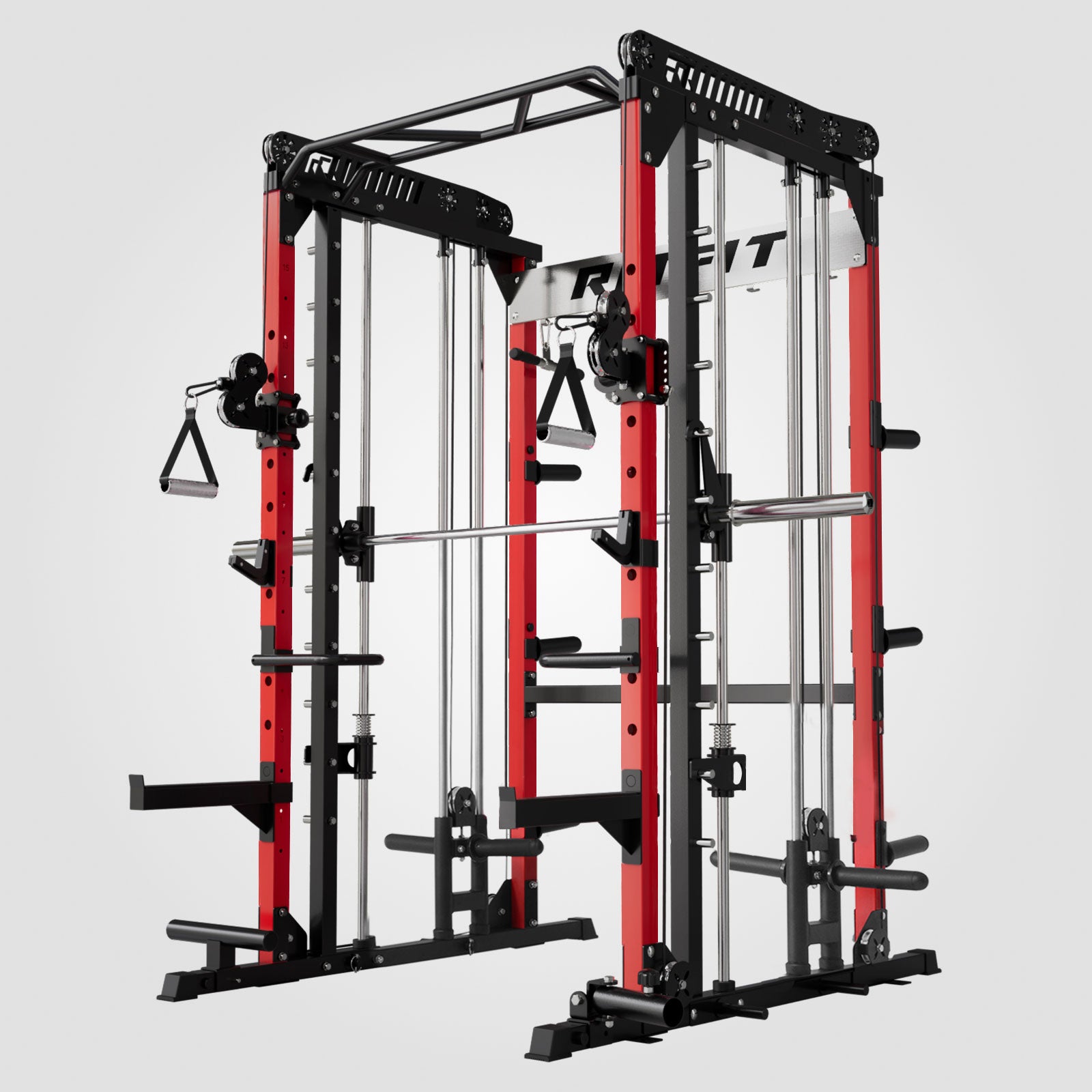
Use a squat rack or power cage that allows safe unracking and failed rep protection. If you train at home, a stable power cage with cable system can support squats, pull movements, and accessory training in one setup.
Safety Pins or Safety Arms
Set the safety pins slightly below your lowest controlled squat depth. They should catch the bar if you cannot stand up, without hitting the bar during normal reps.
Barbell and Collars
Start with an empty Olympic bar only if you can control it safely. Use collars every time you load plates so the weight cannot slide during the walkout or rep.
Footwear
Use flat, firm shoes or weightlifting shoes instead of soft running shoes. A compressible sole can make your balance less predictable under load.
Flooring
Use stable gym flooring to protect the floor and reduce plate impact. For home setups, rubber interlocking gym flooring mats are a practical addition under a rack.
High Bar vs Low Bar for Beginners
Most beginners should start with the high bar squat because it is easier to learn and keeps the torso more upright. Low bar squats can be useful later, but they require more shoulder comfort, trunk control, and technical awareness.
| Feature | High Bar Squat | Low Bar Squat |
|---|---|---|
| Bar Position | Upper traps | Rear delts |
| Torso Angle | More upright | More forward lean |
| Beginner Fit | Easier starting point | Better after skill improves |
| Common Emphasis | Quads and controlled depth | Hips and posterior chain |
How to Squat With a Bar
Proper barbell squat form starts with rack setup and ends with a controlled rerack. Follow these five steps before adding meaningful weight.
- Step 1: Set the rack: Place the J hooks around mid chest height and set the safety pins just below your squat depth. The bar should unrack by standing tall, not by rising onto your toes.
- Step 2: Create your bar shelf: Grip the bar evenly, squeeze your shoulder blades together, and place the bar across your upper traps. Keep your wrists as straight as your mobility allows.
- Step 3: Unrack and walk out: Stand up with the bar, then take two or three small steps back. Set your feet about shoulder width apart with your toes slightly turned out.
- Step 4: Squat with control: Breathe in, brace your core, bend your hips and knees together, and keep your knees tracking over your toes. Descend only as low as you can while keeping your spine neutral.
- Step 5: Stand and rerack: Drive through your midfoot, keep the bar over the center of your foot, and finish tall without leaning back. Walk the bar into the rack until it touches the posts, then lower it onto the J hooks.
Beginner Barbell Squat Form Checklist
A checklist keeps your attention on the most important form cues before each set. Use it during warmups so good habits become automatic.
- Rack height: The bar starts around mid chest height.
- Safety height: The pins sit just below your bottom position.
- Bar position: The bar rests on muscle, not on the neck.
- Grip: Both hands are even and active.
- Brace: Your belly, sides, and lower back expand before each rep.
- Feet: Your weight stays across the whole foot.
- Knees: Your knees track in line with your toes.
- Spine: Your torso stays rigid without lower back rounding.
- Depth: You reach the lowest controlled position you can repeat.
- Finish: You rerack by walking into the rack, not guessing backward.
Common Squat Mistakes and Fixes
Most beginner squat problems come from poor setup, weak bracing, unstable foot pressure, or using too much weight too soon. A technical assessment of the back squat highlights how movement deficits and technique errors can limit performance, which supports using clear form checks early in training.[2]
- Lower back rounding: Stop the squat before your pelvis tucks under and your lumbar spine rounds. Reduce depth, improve bracing, and practice controlled bodyweight squats.
- Knees caving in: Keep your knees tracking over your toes during the descent and ascent. Reduce load and use banded lateral walks or split squats to build better hip control.
- Heels lifting: Keep pressure through your heel, big toe, and little toe. Work on ankle mobility and try a slightly wider stance if depth feels blocked.
- Chest dropping: Tighten your upper back before unracking and keep the bar over your midfoot. A dropped chest often means the load is too heavy or the brace is too weak.
- Rushing the descent: Lower with control instead of bouncing into the bottom. A steady tempo helps you stay balanced and find repeatable depth.
- Reracking carelessly: Walk forward until the bar contacts the rack uprights. Never twist, turn, or look backward while trying to find the hooks.
Breathing and Bracing
Bracing makes the squat safer and stronger by creating trunk stiffness before the bar moves. Take a deep breath into your belly and sides, tighten your torso as if preparing for impact, and hold that pressure through the hardest part of the rep.
How to Brace
Inhale before you descend, expand around your waist, and keep your ribs stacked over your pelvis. Exhale only after you pass the hardest part of the ascent or after you finish the rep.
- Do not breathe only into your chest: Chest breathing gives less trunk support and can make the bar feel unstable.
- Do not relax at the bottom: Losing your brace at the deepest point increases the chance of losing position.
- Do not chase heavy weights without bracing: Load only matters if you can control it with a stable trunk.
Foot Position and Squat Depth
Your best squat stance is the one that lets your hips, knees, ankles, and spine move together without pain or collapse. Research on squat variations shows that stance, depth, and foot rotation can influence muscle activation, so beginners should prioritize repeatable control before chasing one perfect position.[3]
Stance Width
Start around shoulder width and adjust slightly wider or narrower based on comfort. Your knees should track naturally over your toes without collapsing inward.
Toe Angle
Turn your toes slightly outward to give your hips room to descend. Most beginners do well with a moderate toe angle instead of forcing the feet straight ahead.
Depth
Aim to reach at least a controlled near parallel position if your mobility allows it. Stop higher if your heels lift, your back rounds, or your hips pinch.
Beginner 8 Week Barbell Squat Program
A beginner squat program should build skill before intensity. Progressive overload can come from better form, more reps, more sets, or more load, not only from adding plates every session.[4]
| Weeks | Main Goal | Squat Plan | Progress Rule |
|---|---|---|---|
| Weeks 1 to 2 | Learn setup and depth | 3 sets of 8 with empty bar or lighter bar | Add no weight until reps look consistent |
| Weeks 3 to 4 | Add light load | 3 sets of 5 to 8 | Add 5 lb to 10 lb only with clean reps |
| Weeks 5 to 6 | Build repeatable strength | 3 sets of 5 with moderate effort | Keep 1 to 3 reps in reserve |
| Weeks 7 to 8 | Stabilize working weight | 3 sets of 5 plus one lighter technique set | Do not test a max yet |
Accessory Exercises to Improve Your Squat
Accessory exercises help fix weak points that limit squat control. Use them after squats, not before, so they support your main lift without causing early fatigue.
- Goblet squats: Improve depth and torso position. They are useful if the empty bar still feels too heavy.
- Bulgarian split squats: Build single leg strength and hip stability. Use a stable bench such as the RitFit GATOR Adjustable Weight Bench for support.
- Hip thrusts: Train hip extension and glute strength. They pair well with squats when programmed with moderate volume.
- Rows and face pulls: Strengthen the upper back for a more secure bar shelf. They also help keep the chest from collapsing.
- Pallof presses: Build anti rotation core strength. This helps you keep the torso stable under the bar.
Squat Variations for Beginners
Squat variations help beginners learn the pattern without forcing one lift too early. Choose the variation that solves your current problem, not the one that looks hardest.
Goblet Squat
The goblet squat is the best first variation for many beginners because the front loaded weight encourages an upright torso. Use it when barbell balance or depth control feels difficult.
Box Squat
The box squat teaches consistent depth and controlled sitting back. Touch the box lightly instead of relaxing onto it.
Front Squat
The front squat emphasizes upright posture and quad strength. Learn it after you can brace well and maintain a strong upper back.
Smith Machine Squat
A Smith machine squat uses a guided bar path, which can help beginners practice controlled lower body loading without a free bar walkout. If you train alone at home, a Smith machine with cable crossover system can support squat practice and other strength movements.
Home Gym Setup for Barbell Squats
A safe home squat setup needs enough space, reliable safeties, stable flooring, and compatible weight equipment. Resistance exercise can support bone and muscle health, but the equipment environment must be set up to reduce avoidable risk.[5]
- Measure ceiling height: Make sure the rack, bar, and any pull up bar fit your room. Leave enough overhead space for safe movement around the rack.
- Check footprint: Leave room behind the rack for a short walkout. Tight spaces increase the risk of bumping the frame or rushing the rerack.
- Choose compatible weights: Use plates that fit your Olympic bar and storage system. For home strength training, barbells and weight plates should match your long term loading needs.
- Add impact friendly plates: Rubber plates can reduce noise and floor impact compared with bare iron. The RitFit high grade color bumper plates are a practical option for progressive loading.
- Consider modular equipment: If you want squats, cables, and attachments in one station, review the RitFit M2 Series modular home gym package. Match the machine to your room, training style, and budget before buying.
- Use collars and storage: Secure plates every set and store unused plates away from your foot path. A clean lifting area makes the setup easier to repeat.
Sample Barbell Squat Workouts
Beginner workouts should focus on clean squats, simple accessories, and enough recovery between sessions. Use two or three squat sessions per week depending on soreness, schedule, and technique quality.
Workout A
Perform barbell back squat 3 sets of 8, goblet squat 2 sets of 10, hip thrust 3 sets of 10, and plank 3 sets of 30 seconds. Keep all sets controlled and stop if form breaks down.
Workout B
Perform barbell back squat 3 sets of 5, Bulgarian split squat 3 sets of 8 per leg, row 3 sets of 10, and Pallof press 3 sets of 10 per side. Use this workout when your squat form feels stable enough for slightly heavier sets.
Workout C
Perform tempo squat 4 sets of 6 with a light load, box squat 3 sets of 8, Romanian deadlift 3 sets of 10, and face pull 3 sets of 15. This workout is best for technique, balance, and control.
FAQs
How much weight should a beginner use for barbell squats?
Beginners should start with the empty bar only if they can control it safely. If a 45 lb bar is too heavy, use a lighter training bar, goblet squat, or bodyweight squat first, then progress once depth, balance, and bracing are consistent.
What if the empty bar is too heavy for squats?
Use a lighter option before forcing barbell squats. Bodyweight squats, goblet squats, box squats, and training bars can build the same movement pattern while giving you more control, less fear, and better practice before moving to a standard Olympic bar.
Should beginners use high bar or low bar squats?
Beginners should usually start with high bar squats. The bar sits on the upper traps, the torso stays more upright, and the movement often feels easier to learn, while low bar squats require more shoulder mobility and stronger hip control.
Can my knees go past my toes when I squat?
Yes. Your knees can move past your toes if they track in the same direction as your feet and the movement feels pain free. Forcing the knees back can shift stress toward the hips and lower back, especially in upright high bar squats.
How low should beginners squat with a bar?
Beginners should squat as low as they can while keeping a neutral spine, steady feet, and controlled knees. Parallel or slightly below parallel is a useful goal, but stopping higher is smarter if your heels lift, your back rounds, or your hips pinch.
Is a Smith machine squat good for beginners?
Yes. A Smith machine can help beginners practice a controlled squat pattern without managing a free bar walkout. It does not replace free weight skill completely, but it can be useful for confidence, solo training, and home gym safety.
How often should beginners do barbell squats?
Most beginners can squat two or three times per week. Start with lighter technique sessions and leave at least one recovery day between squat workouts, especially if your legs, hips, or lower back remain sore from the previous session.
What should I do if I fail a barbell squat rep?
Lower the bar onto the safety pins and step away once it is supported. Practice this with an empty bar before heavy sets, and never twist, jump backward, or try to save a failing rep with uneven posture.
Conclusion
Learning how to squat with a bar is about safe setup, consistent technique, and patient progression. Start light, use safeties, brace every rep, keep the bar over your midfoot, and build strength only when your form stays repeatable.
Disclaimer
This article is for general fitness education only and is not medical advice. Stop exercising if you feel sharp pain, dizziness, numbness, tingling, or unusual joint discomfort, and consult a licensed clinician, physical therapist, or certified coach if you have injuries, medical conditions, or uncertainty about your squat technique.
References
- Straub RK, Powers CM. A biomechanical review of the squat exercise: implications for clinical practice. Int J Sports Phys Ther. 2024;19(4):490-501. doi:10.26603/001c.94600
- Myer GD, Kushner AM, Brent JL, Schoenfeld BJ, Hugentobler J, Lloyd RS, Vermeil A, Chu DA, Harbin J, McGill SM. The back squat: a proposed assessment of functional deficits and technical factors that limit performance. Strength Cond J. 2014;36(6):4-27. doi:10.1519/SSC.0000000000000103
- Coratella G, Tornatore G, Caccavale F, Longo S, Esposito F, Cè E. The activation of gluteal, thigh, and lower back muscles in different squat variations performed by competitive bodybuilders: implications for resistance training. Int J Environ Res Public Health. 2021;18(2):772. doi:10.3390/ijerph18020772
- Plotkin D, Coleman M, Van Every D, Maldonado J, Oberlin D, Israetel M, Feather J, Alto A, Vigotsky AD, Schoenfeld BJ. Progressive overload without progressing load? The effects of load or repetition progression on muscular adaptations. PeerJ. 2022;10:e14142. doi:10.7717/peerj.14142
- Hong AR, Kim SW. Effects of resistance exercise on bone health. Endocrinol Metab Seoul. 2018;33(4):435-444. doi:10.3803/EnM.2018.33.4.435