Table of Contents
- Why Bands Belong in a Serious Strength Program
- The Science of Bands: How They Build Muscle and Strength
- Types of Bands and What They’re Best For
- How To Use Bands for Big-Time Strength Gains
- How To Use Bands for Max Muscle Growth (Hypertrophy)
- Sample Training Programs Using Bands
- Progression, Programming, and Recovery
- Technique, Setup, and Safety
- Special Uses: Bands for Specific Goals
If you walk into most commercial gyms, you will likely see resistance bands hanging in the corner, gathering dust or being used solely for light warm-ups and rehabilitation exercises. This is a massive oversight. When used correctly, resistance bands are not just a backup plan for when you can’t get to the gym—they are a legitimate, high-performance tool for building serious muscle and strength.
Whether you are training in a home garage, traveling with limited space, or looking to break through a plateau on your barbell lifts, bands offer unique benefits that free weights simply cannot match. This guide explores the science behind variable resistance and provides a roadmap for using bands to achieve big-time gains.
Key Takeaways
- Resistance bands create variable resistance that can match your strength curve and keep tension high through the entire rep.
- Bands can build muscle when you train close to failure, control the lowering phase, and progress tension over time.
- Bands can support strength work by increasing the demand near lockout and encouraging faster intent on the concentric.
- Choosing the right band and anchoring safely matters as much as exercise selection.
- The best results come from combining bands with smart programming, clear progression, and consistent recovery.
Why Bands Belong in a Serious Strength Program
Resistance bands are elastic bands, typically made of latex or rubber, that come in various thicknesses and resistance levels. While they are often marketed to beginners, elite powerlifters and bodybuilders have used them for decades. Why? Because bands offer a distinct training stimulus known as variable resistance.
Unlike a dumbbell, which weighs the same at the bottom of a curl as it does at the top, a band gets heavier the further you stretch it. This allows you to match the resistance to your body’s natural strength curve, providing less resistance where you are mechanically weaker and more resistance where you are stronger. Beyond this, bands are incredibly joint-friendly, portable, and versatile enough to mimic almost any machine or free weight movement.
Important note: bands are not automatically better than free weights. They are different. Your results depend on tension, effort level, exercise selection, and how you progress the stimulus over time.
The Science of Bands: How They Build Muscle and Strength
Variable Resistance Explained
The primary advantage of bands is linear variable resistance. As you perform a repetition, the tension increases. This forces your muscles to work harder through the entire range of motion, specifically at the peak contraction point. In traditional weightlifting, momentum often takes over at the top of a movement. With bands, you must accelerate against increasing tension.
When tension is high enough and you are training close to failure, this increasing demand near the end range can increase the need for high-threshold motor unit recruitment, especially in the stronger parts of the lift.
Hypertrophy Mechanisms with Bands
To build muscle (hypertrophy), you generally need mechanical tension and metabolic stress. Bands excel at both:
- Mechanical Tension: Heavy bands can impose significant load, especially at end ranges of motion.
- Metabolic Stress: Because bands provide constant tension without the "dead spots" found in free weight movements, they create a potent pump and hypoxia (lack of oxygen) environment in the muscle, which is a key driver for growth.
- Stabilization: The unstable nature of bands forces stabilizer muscles to fire constantly, increasing overall muscle activation.
Practical boundary: if the band is too light or you stop far from failure, mechanical tension may be insufficient. If the band is too heavy and you cannot control the eccentric, your technique and joint tolerance will suffer.
Strength Adaptations
For strength athletes, bands can be useful for developing speed and power. By attaching bands to a barbell, sometimes called accommodating resistance, you can train to accelerate the bar faster.
Bands can increase the demand near lockout and reinforce strong intent on the concentric phase. This may improve rate of force development, bar speed habits, and lockout efficiency when paired with solid technique and appropriate loading.
Types of Bands and What They’re Best For
Loop Bands (Power Bands)
These are continuous flat loops, usually 41 inches long. They are color-coded by thickness/resistance.
Best Uses: Squats, deadlifts, overhead presses, assisted pull-ups, and attaching to barbells.
Tube Bands with Handles
These resemble tubing and come with carabiners or fixed handles.
Best Uses: Isolation movements like bicep curls, tricep extensions, lateral raises, and chest presses.
Mini-Bands / Hip Circles
Small loops are primarily used around the knees or ankles.
Best Uses: Glute activation, hip stability, and dynamic warm-ups.
Therapy/Flat Bands
Wide, thin ribbons of latex that are not loops.
Best Uses: Rehabilitation, rotator cuff work, and very light isolation exercises.
How to Choose the Right Resistance
A good rule of thumb is to own a set ranging from light to heavy. Use lighter bands for isolation work and thicker bands for compound movements. If you cannot control the eccentric lowering phase, the band is too heavy.
A better rule is to choose a band that lets you keep constant tension, use a full range of motion, and finish each set with one to three reps in reserve for most hypertrophy work. Save true failure for limited sets when your setup is stable and safe.
How To Use Bands for Big-Time Strength Gains
Bands as Primary Resistance (Band-Only)
When you do not have access to weights, bands can serve as your primary load. To continue getting stronger, you must apply progressive overload. You can do this by using thicker bands, gripping the band lower to increase tension, or adding reps and sets.
You can also progress by stepping farther from the anchor, doubling the band for more tension, or increasing the range of motion while keeping the same band.
Bands + Free Weights (Accommodating Resistance)
This is a staple in powerlifting. You attach bands to a barbell and anchor them to the floor or a rack. As you lift, the weight of the bar remains constant, but the band tension adds load as you reach the top.
Benefits: It builds "lockout strength" and forces you to push hard all the way through the rep.
Programming note: keep technique the priority. Start with modest band tension and keep total intensity appropriate so bar path and speed stay consistent.
Band-Assisted Strength Moves
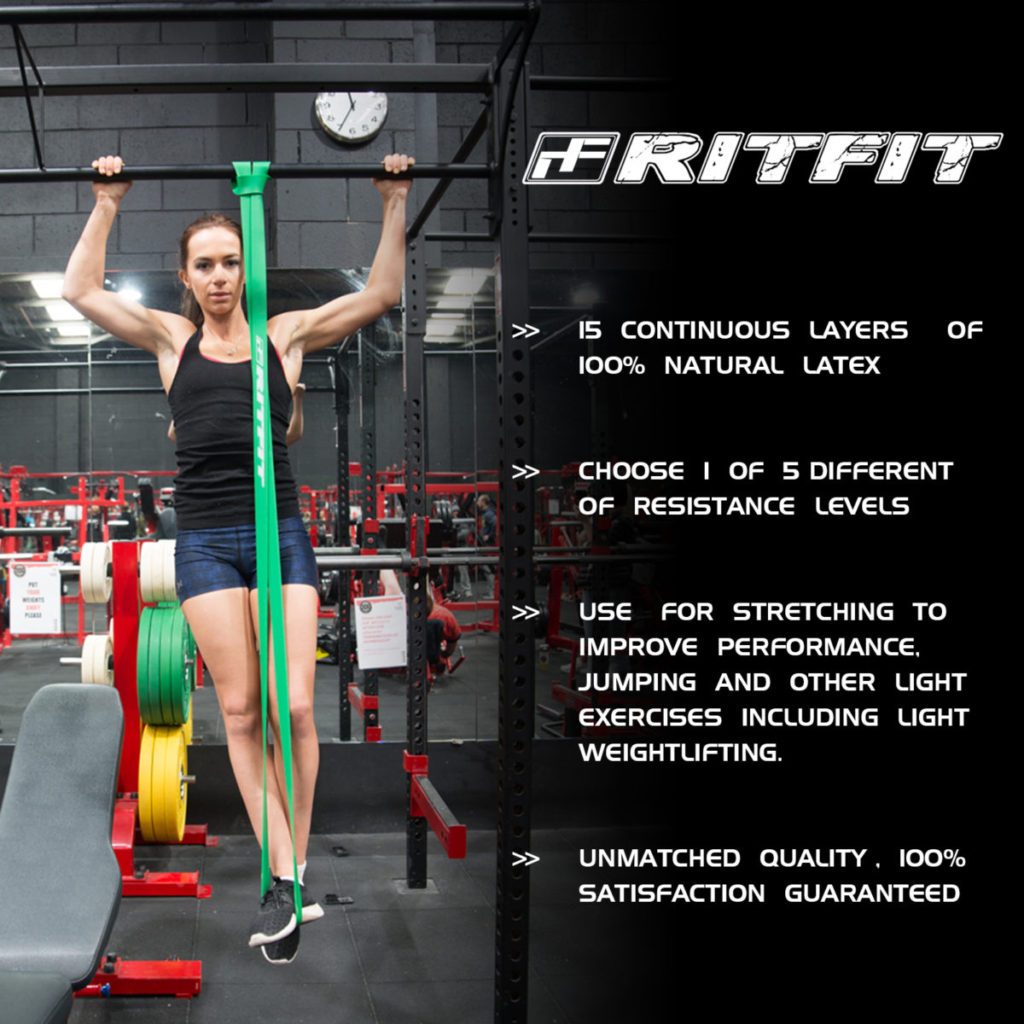
Bands aren't just for resistance; they can also provide assistance. Looping a band around a pull-up bar and stepping into it can help you perform pull-ups or dips by offsetting your body weight at the bottom (the hardest part), allowing you to build the requisite strength for unassisted reps.
Speed and Power Work
Using lighter bands for explosive movements, such as band-resisted sprints, jumps, or dynamic effort box squats, develops the rate of force development—how quickly you can express your strength.
How To Use Bands for Max Muscle Growth (Hypertrophy)
Band-Only Hypertrophy Principles
Since the absolute load might be lower than a heavy barbell, hypertrophy training with bands often requires higher rep ranges (15–30 reps) and shorter rest periods. The focus should be on a controlled tempo and squeezing the muscle hard at peak contraction.
Key Band Exercises by Muscle Group
Chest
- Band Push-Ups: Wrap the band behind your back and under your armpits while performing push-ups.
- Standing Chest Press: Anchor the band behind you and press forward.
- Fly Variations: Great for isolating the pecs with constant tension.
Back
- Band Rows: Perform seated (loop around feet) or standing. Ideally, step back far enough to maintain tension even at the start of the pull.
- Band Pull-Aparts: Essential for rear delts and posture.
- Lat Pulldowns: Anchor the band high and drive elbows down.
Shoulders
- Overhead Press: Stand on the band and press up.
- Lateral Raises: Excellent for side delts; the tension peaks right where the muscle is most active.
Arms
- Bicep Curls: Vary your grip width and angle to hit different heads of the biceps.
- Tricep Pushdowns: Anchor high and extend; easy to superset for massive pumps.
Legs & Glutes
- Band Squats: Stand on the band and loop the other end over your shoulders/neck (carefully).
- RDLs (Romanian Deadlifts): Stand on the band and hold the loops; hinge at the hips.
- Split Squats: Place the band under the front foot for a brutal unilateral leg workout.
Core
- Pallof Press: The gold standard for anti-rotation core strength. Anchor the band to the side, hold it at your chest, and press out while resisting the twist.
Intensification Techniques
To really trigger growth, use mechanical drop sets. Start with a heavy band, go to failure, then immediately switch to a lighter band. Or, simply step closer to the anchor point to reduce tension and squeeze out a few more reps.
Sample Training Programs Using Bands
Full Band-Only Program (Minimal Equipment)
This can be run as a 4-day Upper/Lower split.
-
Day 1 (Upper Push): Band Push-Ups, Overhead Press, Tricep Extensions, Lateral Raises.
-
Day 2 (Lower): Band Squats, Split Squats, Glute Bridges, Pallof Press.
-
Day 3 (Upper Pull): Band Rows, Lat Pulldowns, Bicep Curls, Face Pulls.
-
Day 4 (Lower/Posterior): Band RDLs, Leg Curls (anchor low), Lunges, Plank.
Bands and Weights: Hybrid Strength Program
Use free weights for your main compound lift (e.g., Bench Press) and use bands for high-volume accessories (e.g., Band Flyes, Tricep Pushdowns) to save joints while adding volume.
Travel/Hotel Room Routine
Perform a giant set circuit: Squats -> Push-Ups -> Rows -> Overhead Press. Perform 15 reps each, rest 2 minutes, and repeat 3–4 times.
Progression, Programming, and Recovery
How to Progress
Progression is key. Do not just go through the motions. Record your band color and reps. If you did 15 reps with the red band last week, aim for 18 reps or switch to the black (heavier) band this week.
Frequency and Volume
Because bands cause less muscle damage and joint stress than heavy iron, you can often train with higher frequency. Training muscle groups 2–3 times per week is ideal for band users.
Recovery and Joint Health
Bands are excellent for "active recovery." High-repetition band work (100 reps of leg curls or pull-aparts) drives blood into connective tissues (tendons and ligaments), aiding in repair and reducing soreness.
Technique, Setup, and Safety
Anchoring Safely
Always anchor bands to a fixed, immovable object like a heavy rack, a structural pole, or a specialized door anchor. Never attach bands to furniture that can slide or tip over.
Common Mistakes
- Slack at the bottom: Ensure the band has tension even at the start of the rep. If it's loose, you aren't working the muscle through the full range.
- Poor Alignment: Ensure the line of pull is aligned with the muscle fibers you are trying to work.
Injury Prevention
Check your bands regularly for small tears or dry rot. A snapped band can cause serious injury, especially to the eyes or face. If a band shows wear, replace it immediately.
Special Uses: Bands for Specific Goals
Athletes
Use bands for agility drills and resisted sprinting to improve acceleration mechanics and ground force production.
Older Lifters/Joint-Sensitive Trainees
Bands reduce axial loading (spinal compression). For those with back or knee issues, band squats can provide a quad workout without the heavy load on the spine.
Rehab and Prehab
Shoulder prehab is synonymous with bands. External rotations and face pulls should be a staple in every lifter's warm-up to keep the rotator cuff healthy.
Putting It All Together
Bands are not a lesser alternative to weights; they are a different tool with unique advantages. By understanding how to manipulate variable resistance, you can unlock new levels of muscle growth and strength that static weights alone cannot provide.
Your Action Plan:
- Acquire a set of quality loop bands (ranging from light to heavy).
- Integrate one band exercise into your next workout (e.g., finish your chest day with band flyes or start your leg day with band glute activation).
- Track your progress. Treat the bands with the same respect as iron plates. Aim for more tension, more reps, or better form every session.
With consistency, you will find that these simple loops of rubber can deliver big-time results.