








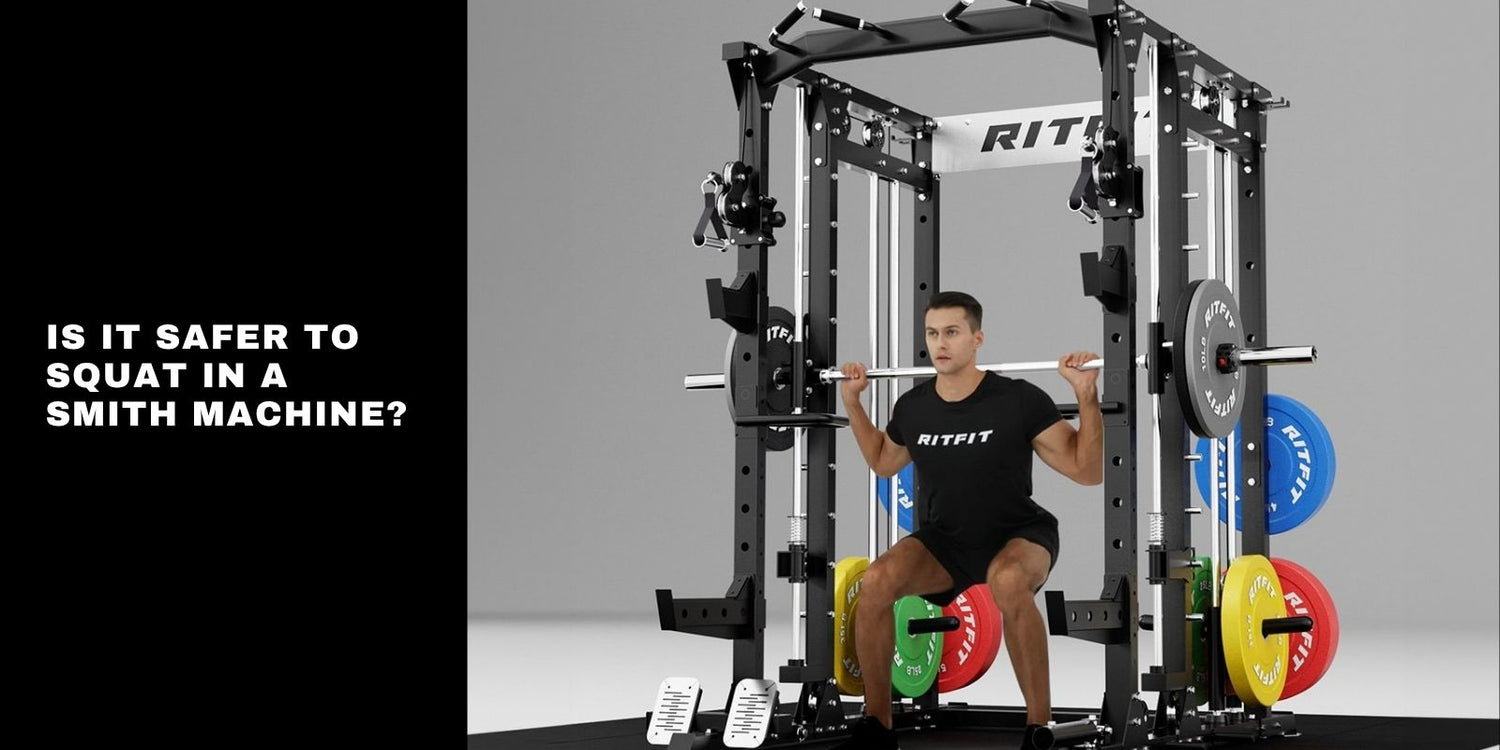
Yes, a Smith machine squat is often safer for solo training because the guided bar and built in rerack points can reduce failed rep risk. It can still feel less safe when the fixed path does not match your mechanics, so setup matters more than the machine alone.
Key Takeaways
- Smith machine squats are often safer for solo lifters because the bar path is guided and easier to rerack.
- Free barbell squats are usually better for learning natural bar control, full balance, and unrestricted squat mechanics.
- Smith squats can work extremely well for hypertrophy, controlled lower body volume, and some return to training phases.
- Poor foot placement can make a Smith machine squat feel worse on the knees, hips, or low back.
- The safest squat option is the one that lets you stay in control, move pain free, and progress with sound technique.
Understanding the Smith Machine
Structure and Mechanics
A Smith machine uses a bar that travels on fixed rails, which reduces balance demand and makes reracking faster than a free barbell. Squat mechanics still change with stance, depth, trunk angle, and joint positioning, so no single squat style is mechanically ideal for every lifter.[1]
Common Uses in the Gym
Lifters use the Smith machine for squats, split squats, presses, hip thrusts, rows, and other movements that benefit from a stable path. It is especially popular with beginners, solo home gym users, and hypertrophy focused trainees who want more control.
How It Differs From a Free Barbell Squat
A free barbell squat requires you to control the load through open space while keeping the system balanced over the midfoot. A Smith squat removes much of that stabilization work, which changes how the lift feels and how force is distributed.
What Safer Really Means in Squatting
Acute Risk vs Long Term Tolerance
Squat safety is not only about avoiding a dropped bar, it is also about whether your joints tolerate the movement over time. A lift can feel secure in the moment yet still become a poor choice if the setup keeps irritating the same tissues.
Why Context Changes the Answer
A beginner training alone in a garage has a different risk profile than an experienced lifter using a power rack with safeties and a spotter nearby. Your training age, mobility, limb lengths, equipment, and goals all change which option is safer for you.
Safety Advantages of Squatting in a Smith Machine
Built In Rerack and Stop Points
The biggest safety advantage is failed rep management, because the bar is easier to hook back into place and many machines allow adjustable stops. That lowers the chance of getting pinned when a rep stalls during solo training.
Lower Balance Demand for Solo Lifters
The guided path reduces front to back balance demands, which makes the lift feel more predictable for many users. That often lets beginners focus on bracing, depth, and leg drive instead of worrying about controlling the bar path.
Better Focus for Controlled Leg Training
Smith squats can be a strong option for quad and glute work when the goal is stable, repeatable, high effort leg training. If you are building a home setup, the RitFit Smith machine collection is designed around that all in one training use case.
Safety Limitations and Risks of Smith Machine Squats
Fixed Bar Path Can Mismatch Your Mechanics
The same rails that make the lift feel controlled can also force you into a path your body would not naturally choose. Stance width, foot angle, and individual squat style all influence knee, hip, and trunk motion during squatting, which is why setup matters so much here.[2]
Poor Foot Position Can Create Joint Irritation
If your feet are too far forward, too far back, too wide, or too narrow, the squat may quickly feel awkward in the knees, hips, or low back. The machine cannot drift into a more natural path to save the rep, so bad positioning is often exposed faster.
Comparing Smith Machine Squats vs Free Barbell Squats
Biomechanics and Muscle Demand
Changes in trunk and shank position can shift how much demand goes to the hip extensors or knee extensors during a squat. In practice, a more forward trunk and a less forward shank tend to bias the lift away from the knee, while a more forward shank tends to increase knee extensor demand.[3]
Skill Transfer and Stabilization
Free barbell squats are usually better for learning full body balance, natural bar path control, and unrestricted coordination. Smith squats still build legs effectively, but they do not teach the same level of real world squat stabilization.
When Each Option Makes More Sense
Choose the Smith machine when your priority is solo safety, controlled hypertrophy, or lower setup stress. Choose a barbell squat when your priority is unrestricted movement, athletic carryover, and long term squat skill.
For deeper setup guidance, see this Smith machine squat form guide, this ultimate Smith machine squat guide, and this Smith machine vs power rack comparison.
Who May Benefit Most from Smith Machine Squats
Beginners and Solo Lifters
Beginners often do well with the Smith machine because the setup is less intimidating and the rerack is easier to understand. If that is your phase right now, this Smith machine for beginners guide can help you build confidence without rushing load.
Hypertrophy Focused Lifters
Bodybuilders and hypertrophy focused lifters often use Smith squats to push leg volume with less balance fatigue. That makes the lift useful for higher effort sets, tempo work, and controlled quad dominant training.
Some Return to Training Phases
Some lifters returning from a layoff may tolerate a controlled machine pattern better before moving back to free squats. That only helps when the setup is pain free and the machine supports your movement instead of fighting it.
Practical Guidelines for Safer Smith Machine Squats
- Start with a midfoot based stance: Set your feet where you can reach depth without losing balance or feeling joint irritation. Small stance changes matter more on a fixed path than many lifters expect.
- Set the safeties before every work set: Do not treat the hooks as your only backup plan. Proper stops make failed reps calmer and give you more confidence to train without a spotter.
- Test the rerack path with a light load: Practice how the hooks rotate into place before hard sets. Panic usually happens when a lifter reaches failure before learning the lockout pattern.
- Adjust foot position before adding load: If your knees feel jammed, your hips feel stuck, or your low back takes over, fix the stance first. Do not assume discomfort will disappear once you go heavier.
- Progress load gradually: Machine stability can hide fatigue and make working weight feel easier than it really is. Add load only when your last sessions stayed smooth, repeatable, and pain free.
- Keep other squat patterns in your program: Pair Smith squats with goblet squats, split squats, or free barbell work when possible. For more home use ideas, this safe Smith machine training guide and the RitFit M1 PRO Smith machine page show how a controlled setup can support full body training at home.
Deep Squat Considerations
Deep squatting is not automatically harmful to healthy knees when it is controlled, tolerated, and matched to the individual. Recent review evidence suggests deep squat exposure can be included without assuming it is inherently dangerous, but tolerance, load, and technique still decide whether it is the right choice for you.[4]
FAQs
Is a Smith machine squat safer for solo training?
Yes. A Smith machine squat is often safer for solo training because the bar is guided and easier to rerack. It can lower the risk of getting stuck under a failed rep, but only when the safety stops are set correctly and your stance feels natural.
What makes a Smith machine squat feel unsafe?
A Smith machine squat usually feels unsafe when the fixed bar path does not match your mechanics. If your feet are placed too far forward or too far back, your knees, hips, or low back may take stress that makes the movement feel awkward or painful.
Can beginners use a Smith machine squat to learn proper form?
Yes. Beginners can use a Smith machine squat to learn bracing, depth control, and lower body loading with less balance demand. It is still smart to practice other squat patterns too, because the machine does not teach full bar path control or full body stabilization.
Does a Smith machine squat build legs as well as free squats?
Yes. A Smith machine squat can build the quads and glutes very well, especially when your goal is controlled hypertrophy. Free squats usually do more for balance and skill transfer, but the Smith machine still works when setup, depth, and loading are managed well.
How should you set up a Smith machine squat safely?
Start with a stance that lets you reach depth without pain and keeps pressure stable through the midfoot. Set the safety stops before every work set, test the rerack motion with a light load, and adjust foot position before adding weight or pushing close to failure.
Should you choose a Smith machine squat over a barbell squat?
It depends. Choose a Smith machine squat when you want more control, solo training confidence, or a stable hypertrophy focused leg pattern. Choose a barbell squat when you want a more natural bar path, more balance demand, and better carryover to unrestricted squatting.
Conclusion
A Smith machine squat is often the safer choice for solo lifters who want a guided path, faster reracking, and controlled lower body training. It becomes the wrong choice when the fixed path fights your structure, your setup is poor, or you use machine stability as an excuse to overload.
Disclaimer
This article is for general education only and does not replace medical, rehabilitation, or individualized coaching advice. If you have knee, hip, back, or balance issues, or you are returning from injury, ask a qualified clinician or coach to assess your squat setup before loading it hard.
References
- Straub RK, Powers CM. A Biomechanical Review of the Squat Exercise: Implications for Clinical Practice. Int J Sports Phys Ther. 2024;19(4):490-501. doi:10.26603/001c.94600
- Lorenzetti S, Ostermann M, Zeidler F, Zimmer P, Jentsch L, List R, Taylor WR, Schellenberg F. How to squat? Effects of various stance widths, foot placement angles and level of experience on knee, hip and trunk motion and loading. BMC Sports Sci Med Rehabil. 2018;10:14. doi:10.1186/s13102-018-0103-7
- Graber KA, Halverstadt AL, Gill SV, Kulkarni V, Lewis CL. The effect of trunk and shank position on the hip-to-knee moment ratio in a bilateral squat. Phys Ther Sport. 2023;61:102-107. doi:10.1016/j.ptsp.2023.03.005
- Rojas-Jaramillo A, Cuervo-Arango DA, Quintero JD, Ascuntar-Viteri JD, Acosta-Arroyave N, Ribas-Serna J, González-Badillo JJ, Rodríguez-Rosell D. Impact of the deep squat on articular knee joint structures, friend or enemy? A scoping review. Front Sports Act Living. 2024;6:1477796. doi:10.3389/fspor.2024.1477796





