








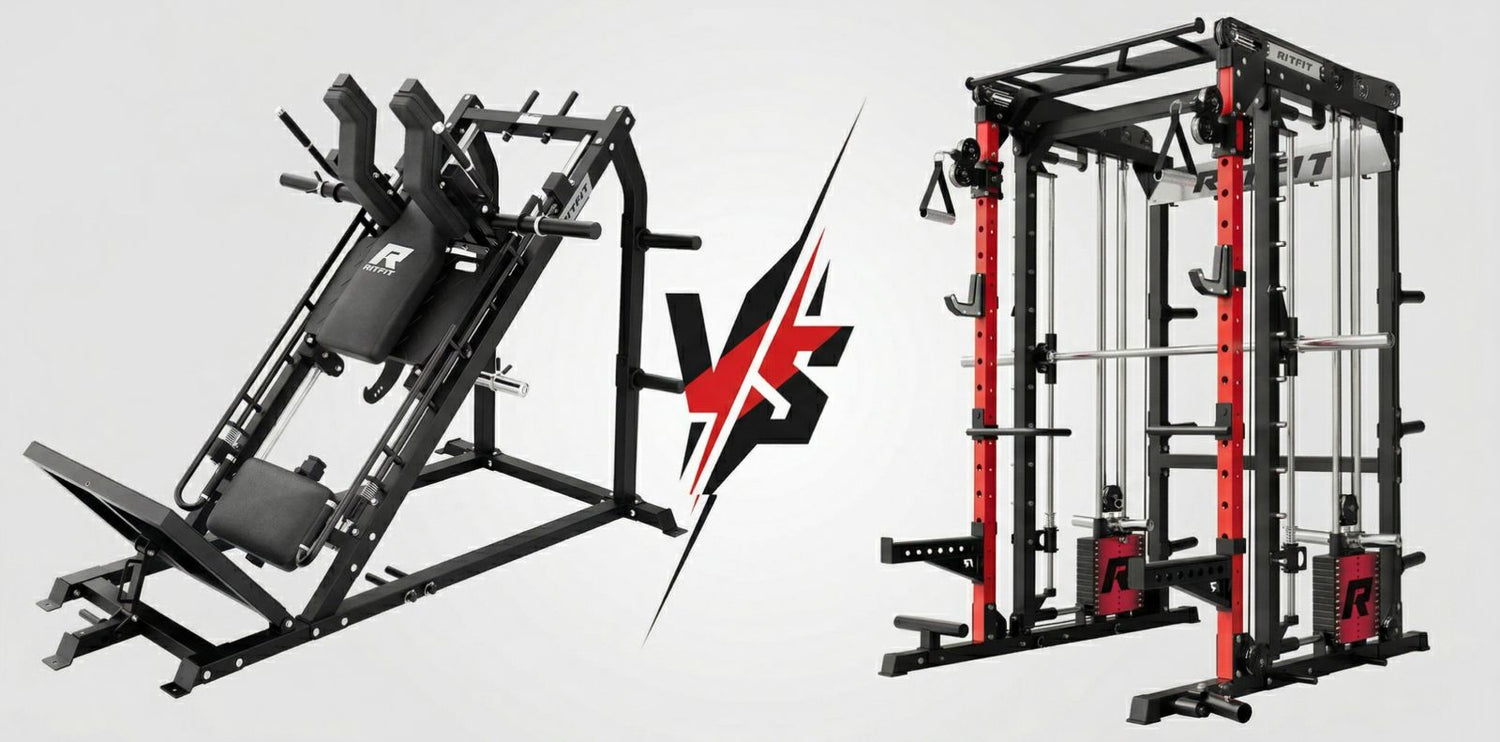
Choose the leg press if you want more supported quad volume and less balance demand. Choose the Smith machine if you want a more versatile lower body station with better carryover to squat patterns and home gym training.
Key Takeaways
- Choose the leg press for stable quad work. It reduces balance demands and makes hard lower body sets easier to repeat with consistent setup.
- Choose the Smith machine for more exercise variety. It supports squats, split squats, lunges, calf raises, hip thrusts, and other standing lower body patterns in one station.
- Neither machine is automatically better for everyone. Your goal, body mechanics, injury history, available space, and training style matter more than gym myths.
- A Smith machine leg press is useful, not equal. It can add pressing volume when you lack a dedicated sled, but it does not fully replace a true leg press.
- The best long term lower body setup often uses both. One can drive stable volume, while the other improves range, skill, and programming flexibility.
Overview of the Leg Press
What Is a Leg Press?
The leg press is a lower body machine that lets you press resistance with your feet while your torso stays supported. Most gyms use either a 45 degree sled or a seated horizontal version, and both reduce balance demands compared with standing lifts.
Muscles Worked by the Leg Press
The leg press mainly trains the quadriceps, while the glutes, hamstrings, calves, and adductors contribute based on setup and depth. A systematic review of leg press muscle activity also supports strong quadriceps involvement across common variants.[1]
- High foot placement: This usually increases hip contribution and can make the movement feel more glute and hamstring biased.
- Low foot placement: This usually increases knee flexion demands and often creates a stronger quad dominant feel.
- Wide stance: This can increase adductor contribution and may feel better for lifters who prefer more hip room.
- Narrow stance: This often feels cleaner for quad focused work when depth and tempo stay controlled.
Pros of the Leg Press
The leg press is excellent for stable hypertrophy work because it supports the torso and reduces the coordination limits of standing lifts. That makes it useful for beginners, fatigued lifters, and anyone who wants to push leg volume without making balance the bottleneck.
Cons of the Leg Press
The leg press has less bracing demand and less direct transfer to squat mechanics than most standing leg patterns. It can also irritate the knees or lower back if load gets excessive, range gets too short, or the pelvis rolls off the pad at the bottom.
Overview of the Smith Machine for Leg Training
What Is a Smith Machine?
A Smith machine uses a bar fixed on rails, so the bar path is guided instead of fully free in space. That makes it more stable than a free barbell while still allowing several squat, lunge, hinge, and calf raise variations.
Common Leg Exercises on the Smith Machine
The Smith machine is highly versatile for lower body training because it supports squats, split squats, reverse lunges, calf raises, hip thrusts, and heel elevated squat variations. If you want technique help on standing patterns, see how to do Smith machine front squats and the broader Smith machine collection.
Muscles Worked with Smith Machine Leg Exercises
Smith machine leg work can train the quads, glutes, hamstrings, calves, and adductors depending on the variation and stance. Because most of these exercises are performed standing, the setup usually demands more bracing and more body control than a leg press.
Pros of the Smith Machine
The Smith machine is a strong choice for solo training because it combines guided movement with built in re rack points. It also gives most home gyms more total exercise options per square foot than a dedicated leg press does.
Cons of the Smith Machine
The fixed path does not fit every body equally well, so stance, foot angle, and depth matter a lot. If the path does not match your mechanics, the movement can feel awkward on the knees, hips, or lower back.
Direct Comparison: Leg Press vs. Smith Machine
| Factor | Leg Press | Smith Machine |
|---|---|---|
| Best for | Supported quad volume | Versatile lower body training |
| Core demand | Lower | Higher |
| Movement carryover | Moderate | Better for squat pattern practice |
| Learning curve | Easier | Moderate |
| Home gym value | Lower if space is limited | Higher for most buyers |
| Back support | Stronger | Depends on setup |
| Exercise variety | Narrower | Much broader |
Muscle Activation and Hypertrophy Potential
The leg press usually has the cleaner edge for supported quad volume, especially when you want to push close to failure without balance limiting output. Direct comparison research also shows that leg press and Smith machine squat tasks can both produce meaningful quadriceps demand when effort and setup are properly matched.[2]
Strength and Performance Transfer
The Smith machine usually transfers better to squat patterns because you still stand, brace, descend, and drive through the floor in a squat like position. A recent biomechanical review of the squat also shows that stance, depth, torso angle, and bar path meaningfully change joint demands, which helps explain why standing patterns carry over better than seated pressing does.[3]
Safety and Joint Considerations
The leg press often feels friendlier for lifters managing back fatigue because the torso stays supported and spinal loading is lower. The Smith machine can still feel very safe for solo training, but only when the stance, foot position, and bar path fit the individual lifter well.
Skill Level and Learning Curve
The leg press is usually easier for beginners because the setup is simpler and the movement is easier to standardize. The Smith machine has a steeper learning curve because stance, bracing, depth, and bar placement all matter more.
Convenience and Accessibility
Both machines are common in commercial gyms, but the Smith machine usually wins on total utility when time, space, or equipment options are limited. Task specific research on free weight and machine based training also supports the idea that both can build performance, but transfer is specific to the movement you actually practice.[4]
Special Section: Using the Smith Machine as a Leg Press
What Is a Leg Press in a Smith Machine?
A Smith machine leg press is a workaround where you press the bar with your feet while lying under it on the floor or a bench. If you want the full setup idea, see this guide to the vertical leg press on the Smith machine.
How to Set It Up
Use a flat, stable setup with safeties already in place and keep the load light to moderate until the movement feels secure. Your feet should stay flat on the bar, your hips should stay stable, and every rep should move under full control.
Pros of Doing a Leg Press in a Smith Machine
This variation can help home gym users add quad focused pressing volume without owning a separate sled. It also reduces shoulder and spinal loading compared with some standing squat variations.
Cons and Safety Warnings
This setup is more awkward than a real leg press and carries real slipping risk if your foot pressure, footwear, or setup is poor. It is not the best option for beginners, careless loading, or maximal strength work.
When to Use This Variation
Use it when you only have a Smith machine and want extra pressing volume after squats, split squats, or lunges. Skip it when a standard leg press, hack squat, or safer alternative is available.
Which Should You Choose?
Based on Your Goal
Your goal should decide the machine, not your ego. Most buyers get better results when they match the machine to the problem they actually need to solve.
- Muscle size: Choose the leg press if you want more stable quad volume, and choose the Smith machine if you want more variety plus more standing lower body options.
- Strength and athletic carryover: Choose the Smith machine if you want a pattern that feels closer to squatting and standing force production.
- General fitness: Either machine can work, but the Smith machine usually gives more value from one station.
- Home gym efficiency: The Smith machine is usually the better investment because it covers more movement patterns in one footprint.
Based on Experience Level
Beginners often learn effort, depth, and leg drive more easily on the leg press. Intermediate and advanced lifters often benefit from using both, with the leg press driving stable volume and the Smith machine adding more programming flexibility.
Based on Injury History
If back loading is a major concern, the leg press often feels more manageable because the torso stays supported. If seated pressing bothers you more than controlled standing patterns, the Smith machine may still be the better fit, but individual joint comfort should lead the decision.
Based on Home Gym Buying Logic
If you need one machine to do more jobs, start with a Smith machine and then add a dedicated leg machine later if needed. For buying research, compare the RitFit M1 vs M2 Smith machine comparison, the RitFit M1 Smith machine, and this guide to Smith machine vs power rack.
Sample Programs and Use Cases
Beginner Lower Body Day
Start with stable patterns and repeatable effort before you chase complexity. A simple lower body day can look like the list below.
- Leg Press: 3 sets of 10 to 12 reps.
- Smith Machine Split Squat: 3 sets of 8 to 10 reps per leg.
- Hamstring Curl: 3 sets of 10 to 12 reps.
- Calf Raise: 3 sets of 12 to 15 reps.
Hypertrophy Focused Leg Day
Use one standing compound and one supported press if muscle gain is the priority. Full range training also tends to support better lower body hypertrophy outcomes than partial range only approaches in many contexts.[5]
- Smith Machine Back Squat: 4 sets of 8 to 10 reps.
- Leg Press: 4 sets of 10 to 15 reps.
- Romanian Deadlift: 3 sets of 8 to 10 reps.
- Optional Finisher: Smith machine leg press for 15 to 20 controlled reps if a standard leg press is unavailable.
Home or Minimalist Gym Scenario
If space is tight, build the session around one versatile station and then add targeted accessories later. You can learn more from this guide on how to use a leg press hack squat machine, this buying guide for the best 3 in 1 leg press and hack squat machine for home gym, and the RitFit GAZELLE PRO.
- Smith Machine Squat: 4 sets of 6 to 10 reps.
- Smith Machine Reverse Lunge: 3 sets of 8 to 10 reps per leg.
- Smith Machine Heel Elevated Squat: 3 sets of 10 to 15 reps.
- Optional Finisher: Smith machine leg press for a light to moderate pump set.
Common Mistakes to Avoid
On the Leg Press
The biggest mistakes are loading too much weight, shortening the range, and letting the pelvis roll off the pad. Depth, control, and balanced foot pressure usually matter more than chasing the heaviest number on the machine.
On the Smith Machine
The biggest mistakes are using the wrong foot position and forcing a bar path that does not match your structure. Small stance changes often fix the issue better than trying to copy someone else exactly.
FAQs
Which is better for quad growth, the leg press or the Smith machine?
The leg press is usually better for supported quad volume, because it reduces balance limits and makes hard sets easier to repeat. The Smith machine can still build excellent quads, especially with heel elevated squats and controlled depth, but it usually wins more on versatility than pure isolation.
Is the Smith machine safer than the leg press for beginners?
It depends on the setup and the lifter. The leg press is usually easier to learn because the torso is supported, while the Smith machine asks for more stance control, bar placement awareness, and bracing, even though its fixed path and re rack points can still make solo training feel secure.
Can a Smith machine leg press replace a real leg press?
No. A Smith machine leg press can add quad focused pressing volume when you lack a dedicated machine, but it does not fully replace the comfort, stability, or loading potential of a true leg press. It works best as a controlled workaround, not as your main maximal strength movement.
Should I choose a leg press or a Smith machine for a home gym?
Choose the Smith machine for most home gyms, because it covers more exercises in one footprint and supports squats, split squats, lunges, calf raises, and hip thrusts. Choose the leg press when your top priority is stable lower body volume and you already have other equipment for standing strength work.
How much does foot placement change muscle emphasis on the leg press?
Foot placement can change the feel of the leg press, but it does not turn the exercise into a completely different pattern. Lower placements usually feel more quad biased, while higher placements often increase hip contribution, and your depth, comfort, and control still matter more than internet myths.
Do leg press numbers carry over well to Smith machine squats?
Not always. Leg press strength does not transfer cleanly to Smith machine squats because the two movements differ in torso position, bracing demand, range of motion tolerance, and coordination. A big leg press can help you build muscle, but it does not guarantee equal skill or confidence in standing squat patterns.
Conclusion
Choose the leg press if you want stable, supported quad work with less balance demand. Choose the Smith machine if you want more lower body exercise variety, better standing pattern carryover, and a more efficient option for most home gyms.
Disclaimer: This article is for general education only and does not replace medical or individualized coaching advice. If you have joint pain, recent injury, or uncertainty about exercise setup, use conservative loads and get qualified in person guidance before pushing intensity.
References
- Martín-Fuentes I, Oliva-Lozano JM, Muyor JM. Evaluation of the Lower Limb Muscles' Electromyographic Activity During the Leg Press Exercise and Its Variants: A Systematic Review. Int J Environ Res Public Health. 2020;17(13):4626.
- Migliaccio GM, Dello Iacono A, Ardigò LP, Samozino P, Iuliano E, Grgantov Z, Padulo J. Leg Press vs. Smith Machine: Quadriceps Activation and Overall Perceived Effort Profiles. Front Physiol. 2018;9:1481.
- Straub RK, Powers CM. A Biomechanical Review of the Squat Exercise: Implications for Clinical Practice. Int J Sports Phys Ther. 2024;19(4):490-501.
- Wirth K, Keiner M, Hartmann H, Sander A, Mickel C. Effect of 8 Weeks of Free Weight and Machine Based Strength Training on Strength and Power Performance. J Hum Kinet. 2016;53(1):201-210.
- Schoenfeld BJ, Grgic J, Van Every DW, Plotkin DL. Loading Recommendations for Muscle Strength, Hypertrophy, and Local Endurance: A Re Examination of the Repetition Continuum. Sports. 2021;9(2):32.





