Table of Contents
Between busy work schedules, family responsibilities, and commuting, many people struggle to find time for a commercial gym. A home gym lets you train on your own schedule, stay consistent, and keep making progress without leaving the house.
Whether you are just getting started or looking to make better use of the equipment you already own, this guide will walk you through five simple, effective workouts you can do in a home gym using basic equipment like a power rack, adjustable bench, barbell, dumbbells, and a jump rope.
A well-planned home gym offers several advantages:
- You save time by eliminating the commute to and from the gym
- You can work out whenever it fits your schedule
- You have more privacy and control over music, temperature, and environment
- You can train safely with the right equipment setup, such as a sturdy power rack with safety bars
- You are more likely to stay consistent when everything you need is only a few steps away
Below you’ll find five cornerstone exercises that together can form a short, full-body training session you can repeat two to three times per week.
5 Convenient Workouts that Can be Done in a Home Gym
By freeing up some space and investing in a few key pieces of equipment, you can build a simple routine around the five movements below that trains your legs, upper body, core, and cardiovascular system in one session. Compound exercises like squats and deadlifts recruit significantly more muscle mass and elicit a greater hormonal response than isolation exercises, making them superior for time-efficient training[1].
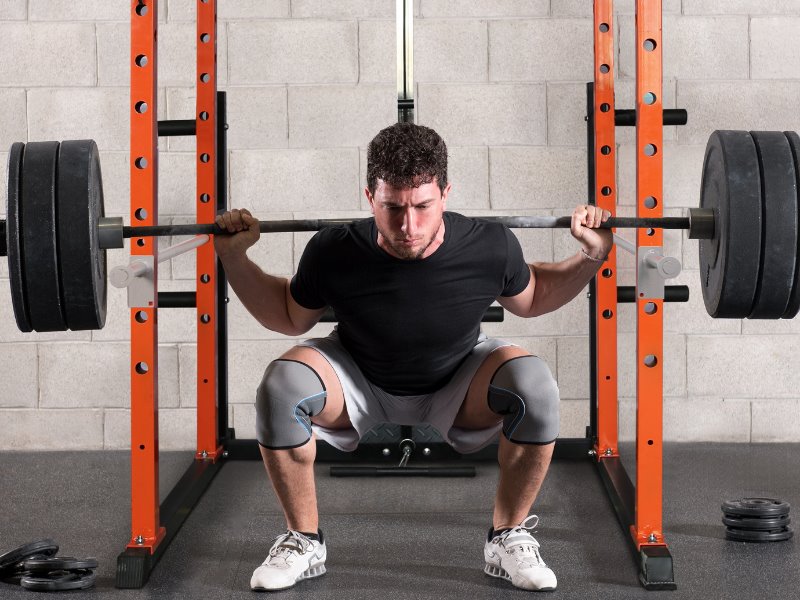
1. Barbell Back Squats
There are four major barbell exercises: squat, overhead press, deadlift, and bench press. These exercises are perfect for maintaining a healthy body and staying in shape. Barbell exercises are ideal for building muscles and are suitable for cardio too.
In addition to that, barbell exercises also help in improving athletic performance and strengthening your neuromuscular connection.
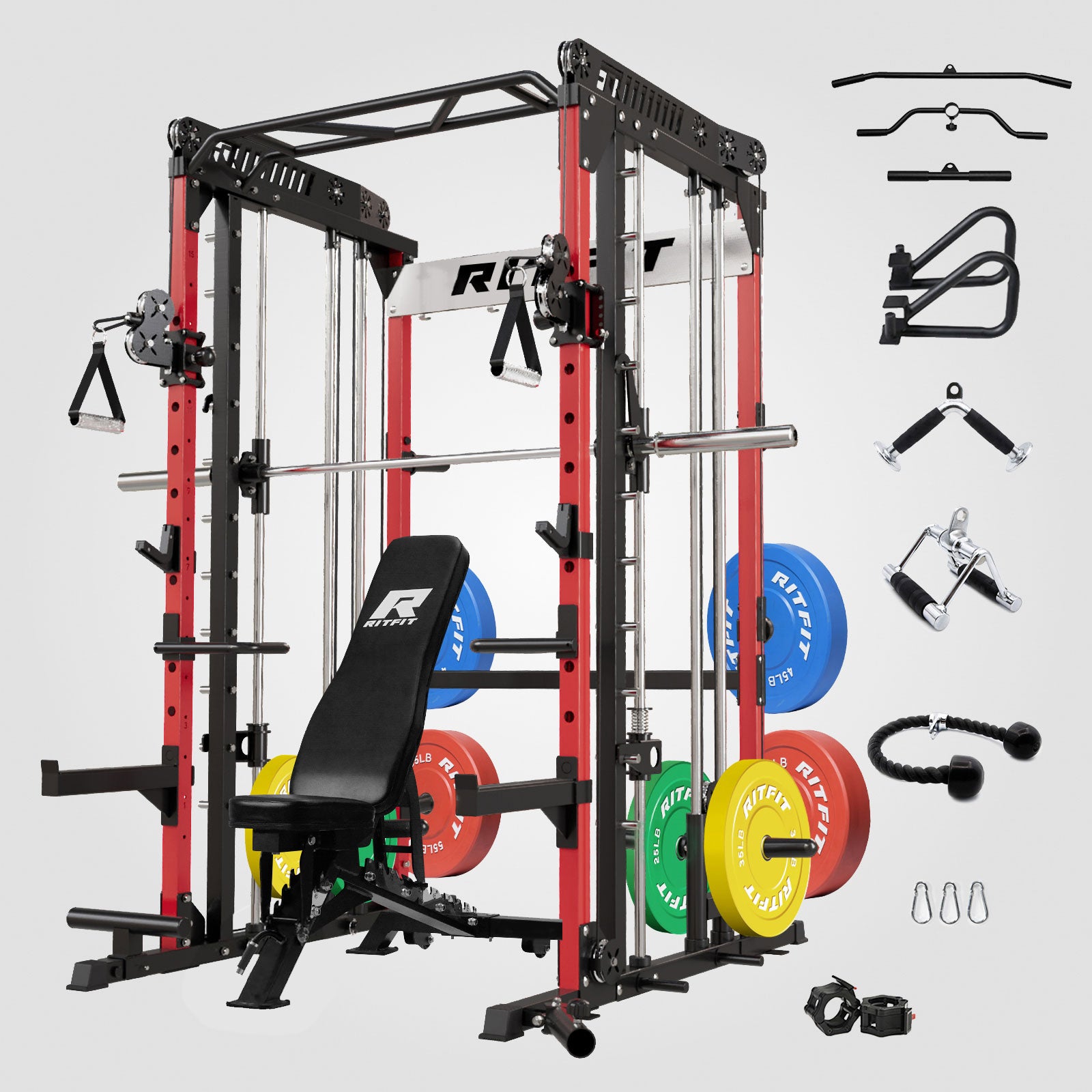
You will need to arrange a power rack in your home gym for performing barbell exercises. A power rack or a squat rack is a steel cage in which you stand while exercising. The horizontal safety bars in these cages can be adjusted at varying heights to spot you during workouts.
Back squat is regarded as the "king of all exercises." This exercise improves your leg strength and hypertrophy. Studies comparing free weight squats to machine squats found that free weights result in 43% higher muscle activation in the stabilizers[1].
Muscles worked:
primarily the quadriceps, glutes, and hamstrings, with strong assistance from your core and upper back.
Equipment needed: a barbell, weight plates, and a sturdy power rack or squat rack with safety bars, such as a compact home power cage or multi-functional Smith machine.
Back squats are a great way to build strength in your lower body that you can use in everyday life, like climbing stairs, lifting groceries, and getting up from low chairs. Talk to a doctor or coach before doing this movement with a lot of weight if you have had pain in your knees, hips, or lower back in the past.

How to do Back Squats?
Follow the steps discussed below to perform back squats.
- Step under a barbell and set the foundation by flexing the core to lift the barbell off the squat rack.
- Grip the barbell in such a position that allows optimal shoulder mobility to get the elbows under the bar.
- Set it high or low on your upper back and unrack it. Take a few steps backward.
- Pull the bar down to create tension.
- Keep the chest up and take a deep breath in.
- Squat down to an achievable depth and pause for a beat.
- Move your feet through the floor until the lockout
Beginner guideline:
Start with 2 to 3 sets of 6 to 10 repetitions using a weight that lets you keep a flat back and stable knees. Rest 60 to 90 seconds between sets.
Home gym safety tip:
Set the safety bars of your rack one or two inches below the bottom of your squat so they can catch the bar if you cannot stand back up.
2. Dumbbell Shoulder Press
An adjustable weight bench and a pair of dumbbells open up many options for upper-body training in a home gym. The dumbbell shoulder press is one of the best ways to build strong shoulders and triceps while also challenging your core to stabilize your torso.
Compared with a barbell overhead press, using dumbbells can feel more joint-friendly and allows each arm to work independently, which helps correct strength imbalances.
You can perform the dumbbell shoulder press seated with the bench set to an upright or slight incline position. A stable adjustable bench with good back support is ideal for this exercise.
How to do Dumbbell Shoulder Press?
Here's an easy way to do a seated dumbbell shoulder press in your home gym:
- Put your feet flat on the floor and sit on a bench that is straight or slightly slanted.
- With your palms facing forward and your elbows bent at about 90 degrees, hold a pair of dumbbells at shoulder height.
- Keep your ribcage down, brace your core, and press the dumbbells straight up until your arms are almost straight but not locked out.
- Lower the weights under control until they are back to shoulder height. Keep your forearms straight up.
- Do the exercise 8 to 12 times in a smooth, controlled way.
Beginner guideline:
Pick a weight that feels good for the first four or five reps but gets harder after eight to ten reps. It shouldn't make your lower back arch. Do 2–3 sets, taking 60–90 seconds of rest between each set.
Safety tip:
If you feel sharp pain in your shoulders, stop the set, lower the weight, or switch to a more comfortable variation like a landmine press or incline dumbbell press.

dumbbell shoulder press on RitFit Adjustable Bench
3. Deadlift Exercise
The deadlift is one of the easiest and most effective strength exercises you can do at home. You pick up a weighted barbell from the floor, stand up straight with it, and then put it back down on the floor with control.
Deadlifts work your hamstrings, glutes, lower back, and core the most, but they also work your grip and upper back. Strengthening this pattern makes it safer and easier to do things like lift boxes or carry groceries every day.
You usually use a barbell and plates on a flat, non-slippery surface in a home gym. If you want to lift heavier weights, rubber bumper plates are a fantastic choice because they protect both your floor and your equipment.
How to do the Deadlift Exercise?
Here is the complete procedure for performing a barbell deadlift..
- Stand behind the barbell with your feet at least shoulder-width apart.
- Sit on your hips while bending the knees slightly and leaning your torso forward. Do all this while maintaining a tight core and flat back.
- Grab the bar. While grabbing, make sure your hands are shoulder-width apart and your palms are facing toward your body.
- Stand up tall while pushing your feet into the floor. Pull the weight with you, keeping your arms straight. Bring your hips forward and squeeze the abs and glutes at the top.
- Gradually reverse the movement while bending your knees and pushing your butt back. This will help in lowering the weight back to the floor.
- While doing this exercise, keep the bar close to your body and maintain a flat back. This is the complete one rep.
Beginner guideline:
Start with a light weight that allows you to complete 2 to 3 sets of 6 to 8 reps without your back rounding. Rest around 90 seconds between sets.
Safety tip:
Keep the bar close to your shins and avoid jerking the weight off the floor. If you feel sharp pain in your lower back, stop the set and reduce the weight or consult a qualified professional.

deadlift with RitFit Black Bumper Plates
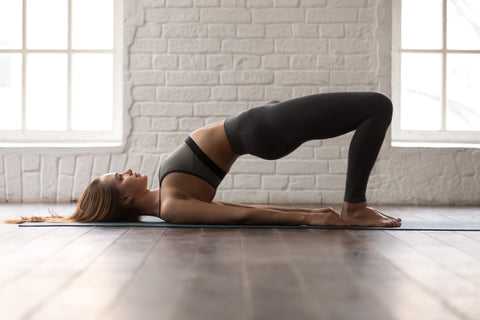
4. Bridge Exercise
You can add simple bodyweight floor exercises to your home gym if you have room for a mat. These will help you build strength in your hips and core. The bridge exercise is one of the best ways to work out your glutes and hamstrings while also working out your lower back and deep abdominal muscles.
Having stronger glutes and a more stable core can help you stand up straighter, ease the strain on your lower back, and help you do better in squats, deadlifts, and everyday tasks like walking, climbing stairs, or picking things up off the floor.
If you're recovering from an injury or have problems with your pelvic floor or lower back, talk to a doctor or physical therapist before using bridge variations as your main form of exercise.
How to Do Bridge Exercise?
To perform a basic glute bridge, follow these steps:
- Put your knees on the floor, your feet flat , and your hips apart. Put your arms at your sides with your palms facing down.
- Gently brace your core, as if getting ready for a light punch, and keep your ribs down.
- To lift your hips, press through your heels and squeeze your glutes. Your body should be in a straight line from your shoulders to your knees. Don't bend your lower back too much.
- Take a breath and stop at the top for one to two seconds.
- Lower your hips back to the floor slowly and carefully, and do this 10 to 15 times.
Beginner guideline:
Perform 2 to 3 sets of 10 to 15 reps. If this is too simple, you can hold the top position for longer or try different types of single-leg bridges.
5. Jumping Rope
Jumping rope is one of the most effective cardio exercises you can perform in a small home gym. A study in the Research Quarterly for Exercise and Sport found that 10 minutes of jumping rope is equivalent to 30 minutes of jogging in terms of cardiovascular improvement[3].
Choose a jump rope for home use that is strong, rotates smoothly, and has handles that are comfortable so you can keep a relaxed grip. Check that you have enough space above you and a flat, non-slippery surface to jump on.
How to Start Jumping Rope in a Home Gym
- Jump for 20 to 30 seconds, then rest for 30 to 40 seconds.
- Try to do 5 to 10 rounds, and instead of jumping high, focus on light, quick contacts with the floor.
- Don't use your shoulders to turn the rope; use your wrists instead. Keep your elbows close to your sides.
- If you trip over the rope a lot, slow down and practice small, controlled jumps without worrying about how fast you are going.
Beginner guideline:
Incorporate jump rope intervals as a short finisher at the end of your strength workout two to three times a week.

jumping rope
Sample 30-Minute Home Gym Workout Plan
Use this beginner-friendly template two or three days per week, leaving at least one day of rest between sessions:
Warm-up (5 minutes):
Light cardio such as marching in place or gentle jump rope without the rope, plus dynamic stretches for hips, shoulders, and ankles.
Strength block (about 20 minutes):
- Barbell Back Squat: 2–3 sets of 6–10 reps
- Dumbbell Shoulder Press: 2–3 sets of 8–12 reps
- Deadlift: 2–3 sets of 6–8 reps
- Bridge Exercise: 2–3 sets of 10–15 reps
Rest 60 to 90 seconds between sets and exercises. Pick weights that are hard but not too hard, and end each set with at least one or two good reps left over.
Cardio finisher (about 5 minutes):
- Do 20 seconds of jump rope, then take a 40-second break. Do this 6 to 8 times.
- If you're just starting to work out, do one or two sets of each movement and focus on your form before adding weight or volume.
Use this beginner-friendly template two or three days per week, leaving at least one day of rest between sessions. If you are looking for a more comprehensive weekly schedule to maximize muscle growth, check out our Ultimate 5 Day Workout Routine for Men to take your home training to the next level.
Final Words
When you focus on a few high-value movements and do them regularly, training at home can be easy, comfortable, and surprisingly effective.
You can make a simple workout plan that works with your schedule and equipment by doing the five exercises in this guide. You can also keep track of your progress by adding a little weight or a few extra reps when the sets start to feel easy.
If you're not sure about your form, you could work with a qualified coach in person or online, or you could record your sets to see how you're doing. If you feel sharp pain instead of normal muscle fatigue, always stop a set.
Do you not have all the equipment you need for these home workouts? Look through our home gym packages, racks, benches, and other items to find ones that fit your budget and training space.
If you have any medical conditions, joint pain, or haven't been active in a while, talk to your doctor or another licensed healthcare professional before starting a new exercise program.
References
- Mangine GT, Hoffman JR, Gonzalez AM, et al. The effect of training volume and intensity on improvements in muscular strength and size in resistance-trained men. Physiol Rep. 2015;3(8):e12472. doi:10.14814/phy2.12472
- Schwanbeck S, Chilibeck PD, Binsted G. A comparison of free weight squat to Smith machine squat using electromyography. J Strength Cond Res. 2009;23(9):2588-2591. doi:10.1519/JSC.0b013e3181b1b181
- Fountaine CJ, Schmidt BJ. Metabolic cost of rope training. J Strength Cond Res. 2015;29(4):889-893. doi:10.1519/JSC.0b013e3182a35da8
FAQs
Is it safe to work out in a hot garage gym?
Yes, if you manage heat, hydrate, and stop with dizziness, nausea, or chest pain. People with heart or lung issues should ask a doctor first.
What’s the most budget-friendly way to cool my garage gym?
Open doors or windows, clear clutter, and use fans for cross-breeze. Light walls, simple window shades, and rubber mats also help a lot.
Do I really need a mini split, or will fans be enough?
Fans plus a dehumidifier are enough for many gyms. Choose a mini split or portable AC if you live in very hot, humid areas or want steady year-round comfort.
How can I reduce the “sticky” humidity feeling in my garage gym?
Run a dehumidifier, use fans, and ventilate with open doors or windows. Rubber flooring and basic window coverings also help control moisture.
How should I adjust my workouts during very hot days?
Train in the coolest hours, shorten sessions, and favor strength or moderate cardio over brutal conditioning. Rest more and listen to your body.