








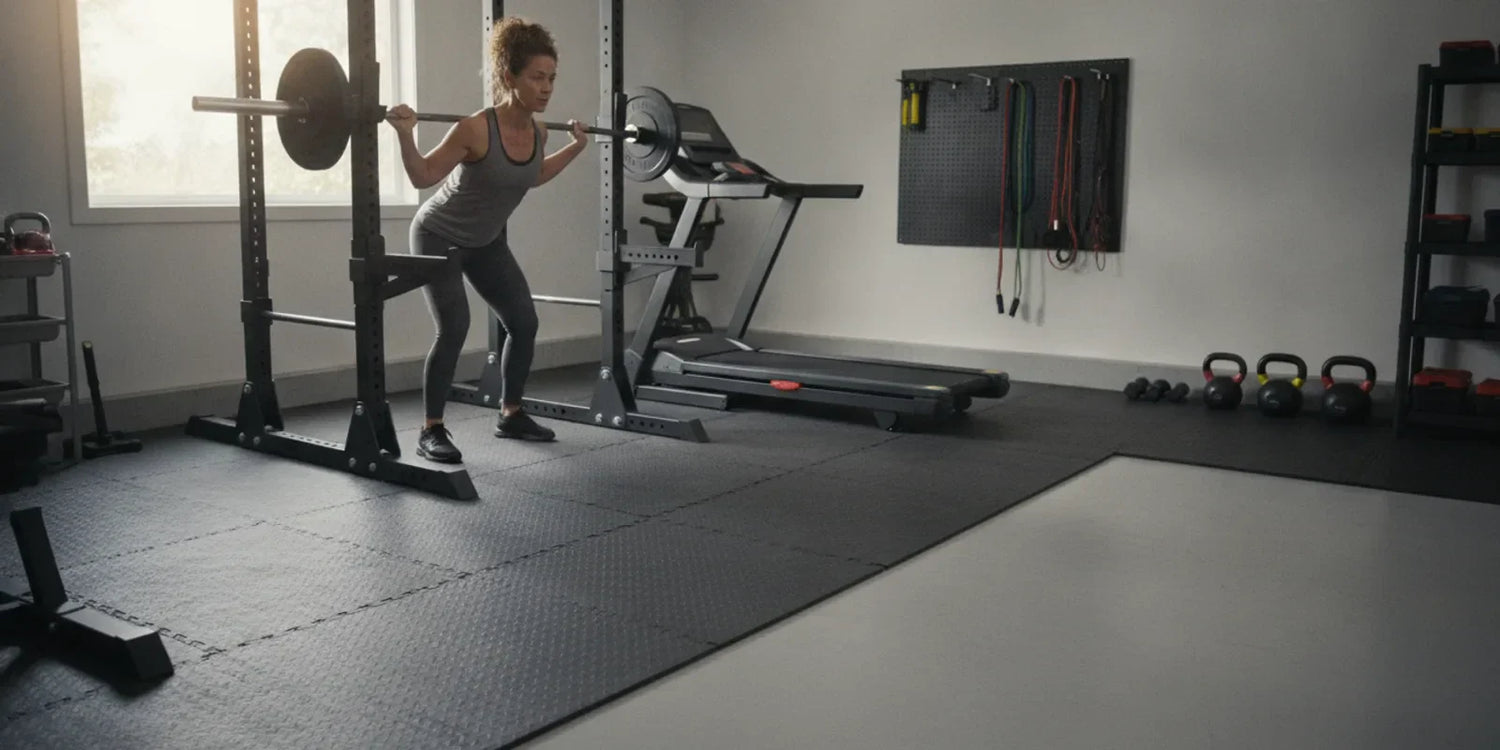
A mat under gym equipment protects the floor, quiets vibration, and keeps heavy machines planted through every rep. Thickness and coverage decide how stable a treadmill, power rack, or weight bench feels once it is loaded.
This guide covers mat thickness by equipment type, sizing math for treadmills, racks, and benches, material choices, and placement on concrete, wood, and carpet. Use it to settle flooring before your heavy equipment arrives.
Quick Answer: A mat under gym equipment should be solid rubber sized at least 6 to 12 inches wider than the machine footprint. Use 3/8 inch for cardio machines, 1/2 inch for most mixed home gyms, and 3/4 inch for power racks, heavy deadlifts, and concrete garage floors.
Key Takeaways
- Thickness by load: Use 3/8 inch rubber for cardio machines, 1/2 inch rubber for most mixed home gyms, and 3/4 inch rubber for heavy lifting or dropped weights.
- Size beyond the footprint: Extend the mat at least 6 to 12 inches past every equipment edge, and leave 18 inches behind a treadmill belt.
- Best material: Solid rubber is the safest all around material under gym equipment because it resists compression better than EVA foam.
- Concrete floors: Concrete has no natural cushioning, so 1/2 inch rubber is the minimum practical choice for strength training setups.
- Flexible coverage: Interlocking rubber tiles make it easier to cover racks, benches, treadmills, and free weight zones without cutting full rolls.
Why should you put a mat under gym equipment?
You should put a mat under gym equipment because heavy machines concentrate force through small feet, rollers, and contact points. A rubber mat spreads that load, reduces floor wear, and limits vibration transfer into the room and the structure.
Biomechanics research shows that surface coverings can change measured ground reaction forces, which means surface material and thickness matter when impact and loading are involved.[1]
- Floor protection: Metal rack feet, dumbbell impacts, and treadmill vibration can scratch concrete, dent wood, or damage carpet fibers over time.
- Noise control: Rubber reduces vibration transfer from treadmills, rowers, racks, and dropped accessories, which matters in shared living spaces.
- Equipment stability: Rubber gives machine feet and rack bases more grip than smooth concrete, polished wood, or carpet alone.
Adding a mat also makes the space feel purpose built. If you are setting up a basement gym, flooring is one of the first decisions to make before heavy equipment goes in.
"The best gym flooring choice is the one that protects the subfloor without making the equipment feel unstable under load."
RitFit Editorial Team, Home Gym Equipment Editors, RitFit
What mat thickness should you choose for each equipment type?
Choose mat thickness by equipment load, training impact, and subfloor type. Cardio machines usually need 3/8 inch to 1/2 inch rubber, while power racks, deadlift zones, and weight drop areas need 1/2 inch to 3/4 inch rubber.
3/8 Inch, Cardio and Light Equipment
A 3/8 inch rubber mat is the minimum useful thickness for treadmills, ellipticals, rowers, and light dumbbell stations. It works best when the goal is vibration reduction and surface protection rather than heavy impact absorption.
1/2 Inch, The Sweet Spot for Most Home Gyms
A 1/2 inch rubber mat handles adjustable dumbbells, kettlebells, benches, cable machines, and power racks used without regular barbell drops. For most mixed home gyms, this thickness balances protection, cost, weight, and stability.
3/4 Inch, Heavy Deadlifts and Weight Drops
A 3/4 inch rubber mat is the right choice for heavy deadlifts, Olympic lifting, power racks, and garage gyms where loaded weights may hit the floor. More compliant sports surfaces can reduce impact related loading, but the mat must still feel stable under the lifter.[2]
| Equipment Type | Minimum Thickness | Recommended Thickness |
|---|---|---|
| Treadmill, elliptical, rower | 3/8 inch, 9mm | 1/2 inch, 12mm |
| Adjustable dumbbells, kettlebells, bench | 1/2 inch, 12mm | 1/2 inch, 12mm |
| Power rack, squat stand, cable system | 1/2 inch, 12mm | 3/4 inch, 18mm |
| Olympic lifting, heavy deadlifts, weight drops | 3/4 inch, 18mm | 3/4 inch, 18mm |
Mat thickness guide by common home gym equipment type. Use the higher recommendation when the equipment sits on concrete, when weights may be dropped, or when the room is above another living space.
For a modular setup, pair the right thickness with rubber interlocking gym flooring mats so you can cover the exact footprint without cutting large rolls to size.
How big should a mat be under gym equipment?
A mat under gym equipment should extend at least 6 to 12 inches beyond the equipment footprint on every side. The active training zone often reaches beyond the machine base, especially around treadmills, benches, racks, and free weights.
Treadmill Mat Size
A standard treadmill footprint is often around 28 by 60 inches. Add a 12 inch border on the sides and front, plus an 18 inch zone behind the belt, which gives a practical target near 52 by 90 inches.
Power Rack and Squat Stand Mat Size
A typical four post power rack may sit in a footprint near 48 by 48 inches, but the lifting zone extends beyond the uprights. For a full barbell setup on concrete, a 7 by 7 foot coverage area is a reasonable baseline.
"Was hesitant about adding a dumbbell set when I already had the cable-pulley system, but figured it would make a great addition to the overall gym. The weights have a great feel to them. Kind of odd that there is no 40# set, but I can live without that...may add that set later on."
Robert H. Verified Buyer, RitFit Rubber Hex Dumbbell Set with Rack
Weight Bench Mat Size
A standard flat bench is often around 18 by 48 inches. The mat should extend 12 inches beyond each end and at least 6 inches on both sides, giving a practical minimum near 30 by 72 inches.
When building a budget home gym, many best home gym equipment under $500 lists focus on the equipment first. Add flooring to the budget early, because cheap mats often need to be replaced once racks, benches, and weights arrive.
Which material is best for gym equipment mats?
Solid rubber is the best material for most gym equipment mats because it supports sustained load without the same compression issues as foam. EVA foam is better for stretching and bodyweight work, while horse stall mats are a budget garage gym option.
Solid Rubber Rolls and Interlocking Tiles
Solid rubber is the standard choice for spaces where weights are involved. It handles sustained equipment load, resists moisture better than foam, and works for treadmills, benches, dumbbells, cable machines, and racks.
- Interlocking tiles: They can be moved, expanded, and arranged around unusual equipment footprints, which helps when a rack, bench, and cardio machine share one room.
EVA Foam Tiles
EVA foam is not suitable under free weight equipment, heavy racks, or loaded benches. It can compress under sustained load, which may create an uneven and unstable lifting surface.
- Where it works: Use EVA foam only for yoga, stretching, mobility work, and bodyweight zones.
Horse Stall Mats
Horse stall mats are popular in garage gyms because they are thick, dense, and usually less expensive per square foot than purpose made gym tiles. The tradeoffs are heavy weight, strong rubber odor, fixed large sizing, and extra work if clean edge cuts are required.
| Material | Best For | Not Suitable For | Typical Use Life |
|---|---|---|---|
| Solid rubber tiles | Strength equipment, treadmills, mixed home gyms | Very soft floor feel preferences | Long term home gym use |
| EVA foam tiles | Yoga, stretching, bodyweight training | Free weights, racks, benches, barbells | Light use applications |
| Horse stall mats | Garage gym powerlifting, budget builds | Small rooms needing custom sizing | Long term garage gym use |
Material comparison for mats placed under home gym equipment. Actual lifespan depends on load, humidity, ventilation, cleaning routine, and whether weights are dropped directly onto the surface.
For a complete home gym budget, see the home gym equipment guide under $2000 and plan flooring as part of the total build, not as an afterthought. You can compare tile and roll options in the mats and flooring collection before you commit.
How should you lay gym mats on concrete or wood?
You should lay gym mats on a clean, dry, flat surface and position equipment feet on solid mat areas instead of seams. Concrete needs more shock absorption, while wood needs careful load distribution and protection from point pressure.
Concrete Subfloor
Concrete provides almost no cushioning, so the rubber mat carries the full job of shock absorption and surface protection. For strength training on concrete, 1/2 inch rubber should be treated as the minimum, and 3/4 inch is preferred for barbell work.
- Moisture: Garage and basement concrete can hold moisture, so add a vapor barrier before placing heavy rubber mats over the slab in below grade or humid spaces.
Wood and Carpet Subfloors
Wood has some natural give, but it can be damaged by rack feet, bench legs, and dropped weights. A 1/2 inch rubber mat spreads point load across a wider surface and reduces visible floor damage.
- Carpet: Rubber over carpet beats no mat at all, but soft carpet can make racks less planted, so place 3/4 inch plywood under the mat in the rack zone for heavy lifting.
Step by Step Mat Placement
- Step 1: Clean the subfloor completely and let it dry before placing mats.
- Step 2: Lay the mat or tiles dry first so the equipment layout can still be adjusted.
- Step 3: Place equipment feet on solid mat surfaces, not directly on tile seams.
- Step 4: Let rolled rubber rest flat for 24 to 48 hours before loading it with heavy equipment.
Treadmill surface research also shows that running surfaces have distinct mechanical properties, which supports the practical idea that floor material should match the training use case.[3] The minimum home gym equipment list treats flooring as a foundational purchase alongside the rack, bench, and barbell.
What mistakes should you avoid when choosing gym mats?
The biggest gym mat mistakes are using foam under heavy equipment, sizing only to the equipment base, and choosing thin rubber for concrete barbell zones. These choices can reduce stability, expose the floor, and shorten the useful life of the setup.
- Using EVA foam under weighted equipment: Foam can compress under load and create an unstable lifting surface.
- Sizing only to the equipment footprint: Dropped plates, shoes, and bench movement often land beyond the base of the machine.
- Choosing 3/8 inch for barbell work on concrete: This thickness may reduce scratches, but it is not enough for repeated heavy impact.
- Putting rack feet on seams: Seams under heavy contact points can lift, separate, or wear faster.
- Skipping airing time: New rubber can smell strong, so ventilate mats before placing them in an enclosed room.
- Ignoring concrete moisture: Moisture trapped under rubber can cause odor, staining, or mold risk in below grade rooms.
If you are setting up a garage gym equipment package with a rack and barbell, 3/4 inch rubber over the main training zone is the safer flooring baseline. For CrossFit equipment with barbell cycling and box jumps, plan the same level of coverage.
Flooring also matters for older adults and budget builds. The home gym equipment for seniors guide and the home gym equipment guide under $1000 both treat floor protection as part of the total setup cost.
FAQs About Mat Under Gym Equipment
What thickness mat should I put under my treadmill?
A 3/8 inch to 1/2 inch rubber mat is ideal under a treadmill. The mat absorbs vibration, reduces noise through the floor, and helps prevent machine movement. On carpet, choose 1/2 inch rubber for better stability and less compression under the treadmill feet.
Do I need a mat under my power rack?
Yes. A mat under a power rack is strongly recommended on concrete, wood, and carpet. Use at least 1/2 inch rubber for regular lifting, and choose 3/4 inch rubber if you deadlift heavy, drop weights, or train in a garage gym.
Can I put gym equipment directly on carpet?
Yes, but it is not ideal for heavy strength equipment. Carpet can compress, shift, and make racks or benches feel less stable. A rubber mat over carpet improves load distribution, but heavy rack zones may still need plywood under the mat.
What is the best mat material to put under gym equipment?
Solid rubber is the best material to put under gym equipment. It supports heavy machines, resists permanent compression better than foam, and works across treadmills, benches, racks, and free weight areas. EVA foam should be reserved for stretching and bodyweight zones.
How big should the mat be under gym equipment?
The mat should extend 6 to 12 inches beyond the equipment footprint on every side. For treadmills, add about 18 inches behind the belt. For power racks, cover the full lifting stance and the areas where plates or barbells may land.
Is EVA foam good enough under a weight rack?
No. EVA foam is not good enough under a weight rack. It can compress under sustained load, reduce equipment stability, and provide weak protection against dropped weights. Use solid rubber tiles or dense rubber mats for any rack, bench, or barbell setup.
Conclusion
The right mat under gym equipment is one of the most cost effective decisions in a home gym build. For most setups, 1/2 inch solid rubber flooring sized beyond the equipment footprint works well for treadmills, benches, dumbbells, cable machines, and moderate rack training.
If you lift heavy, drop weights, or train on concrete, step up to 3/4 inch rubber and cover the full training zone. Start with the equipment that hits the floor hardest, then expand coverage around your full home gym package.
Disclaimer
This article is for informational purposes only and does not replace professional flooring, structural, or safety advice. Always check floor load capacity before installing heavy gym equipment, and consult a licensed contractor if you are unsure about subfloor strength or moisture conditions.
References
1. Smith T, Ditroilo M. Force plate coverings significantly affect measurement of ground reaction forces. PLoS One. 2023;18(11):e0293959. doi:10.1371/journal.pone.0293959. PMCID: PMC10624306
2. Gustavsson J, Nilson F, Bonander C. Compliant sports floors and fall-related injuries: evidence from a residential care setting and updated meta-analysis for all patient care settings. Inj Prev. 2023;29(4):283-289. doi:10.1136/ip-2022-044713. PMCID: PMC10423535
3. Colino E, Felipe JL, Van Hooren B, et al. Mechanical Properties of Treadmill Surfaces Compared to Other Overground Sport Surfaces. Sensors (Basel). 2020;20(14). doi:10.3390/s20143822. PMCID: PMC7412192
Save on your next RitFit order
Tap the button to copy your code, then paste it at checkout.





