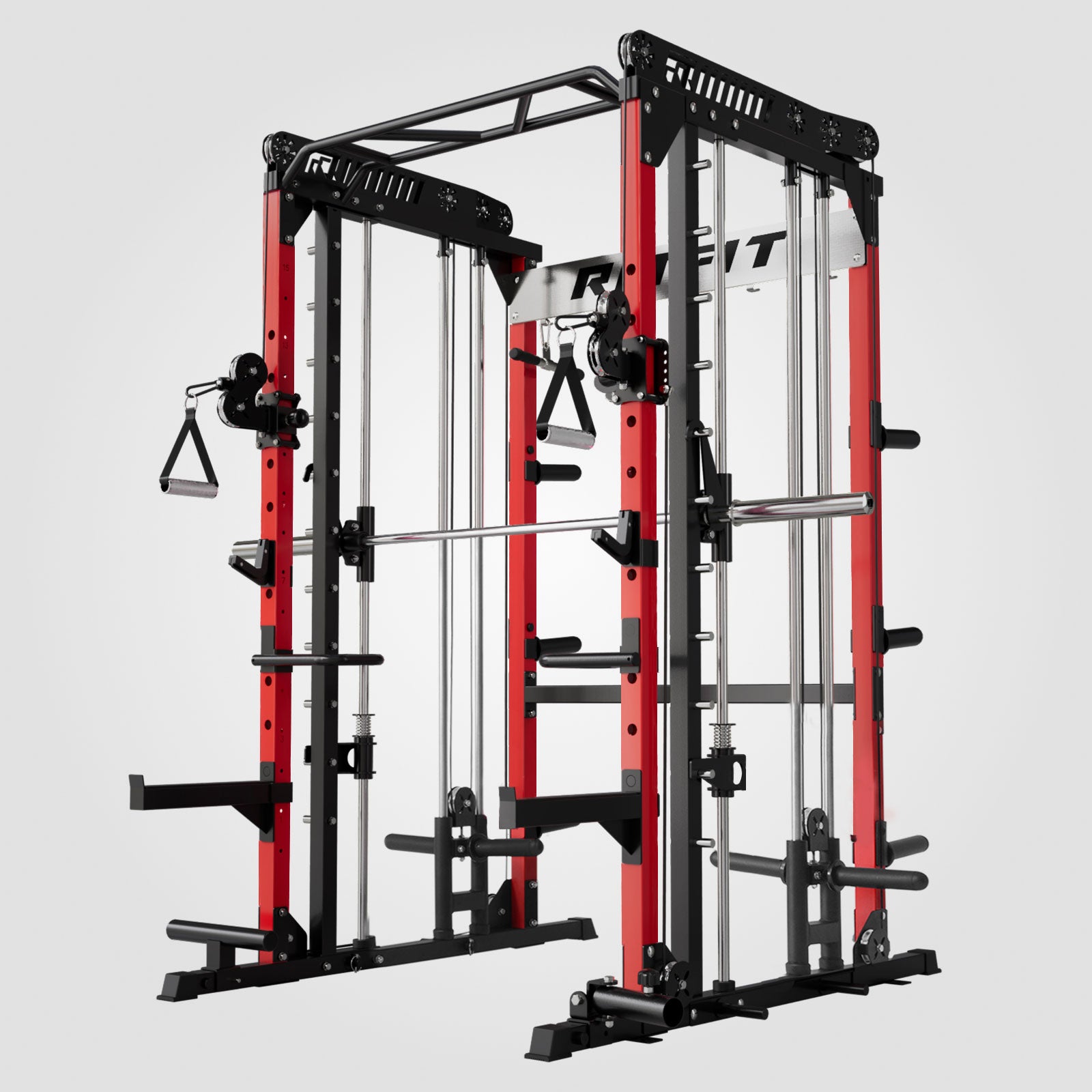
The minimum equipment for a complete home gym is a rack or Smith machine, adjustable bench, Olympic barbell with plates, dumbbells, and resistance bands. This setup covers squat, hinge, push, pull, carry, and core training without filling your space with single purpose machines.
A complete home gym is not defined by how many machines you own. It is defined by whether you can train safely, progress gradually, and hit every major movement pattern with enough resistance.
Key Takeaways
- Start with movement patterns: A complete setup should cover squat, hinge, push, pull, carry, and core work.
- Choose versatile equipment first: A rack or Smith machine, bench, barbell, plates, dumbbells, and bands give the best training range per square foot.
- Prioritize safety for solo lifting: Safety arms, stable bench support, proper flooring, and controlled loading matter more than extra machines.
- Use bands as low cost accessories: Bands are useful for warmups, assisted pull ups, shoulder work, glute activation, and travel workouts.
- Add specialty equipment later: Cable stations, leg machines, and storage upgrades are valuable only after the core setup is working well.
What Counts as a Complete Minimal Home Gym?
A complete minimal home gym should let you train the major body parts through repeatable strength patterns. Research shows that resistance training can improve muscle mass, strength, and physical function when it is consistently programmed and progressively loaded.[1]
The goal is not to recreate a commercial gym at home. The goal is to build a compact strength station that lets you train hard, stay consistent, and avoid buying duplicate equipment.
Minimum Home Gym Equipment Checklist
| Training Need | Minimum Equipment | Why It Matters |
|---|---|---|
| Heavy lower body training | Rack or Smith machine, barbell, plates | Supports squats, deadlifts, lunges, split squats, and progressive overload. |
| Upper body pressing | Adjustable bench, barbell, dumbbells | Covers flat press, incline press, shoulder press, and unilateral pressing. |
| Back and pulling strength | Pull up bar, dumbbells, barbell, optional cable system | Supports rows, pull ups, pulldowns, rear delt work, and lat training. |
| Accessory training | Dumbbells and resistance bands | Covers curls, raises, triceps work, glute activation, and warmups. |
| Safety and consistency | Safety arms, stable bench, flooring, storage | Reduces risk and keeps the space usable for long term training. |
The Five Core Equipment Categories
1. Power Rack or All In One Smith Machine
A rack or Smith machine is the safety and structure center of a home gym. It supports heavy squats, presses, pull ups, rack pulls, and solo training when paired with proper safety arms or guided bar control.
2. Adjustable Weight Bench
An adjustable bench expands your pressing, rowing, split squat, hip thrust, and seated accessory options. Choose one that feels stable under your body weight and working load, not just one that folds small.
3. Olympic Barbell and Weight Plates
A barbell and plates give you the most efficient path to progressive overload. They support squats, deadlifts, bench presses, rows, overhead presses, hip thrusts, and loaded carries.
4. Dumbbells
Dumbbells add unilateral training, accessory work, and movement freedom that barbells cannot always provide. They are especially useful for single arm rows, split squats, curls, lateral raises, and dumbbell presses.
5. Resistance Bands
Resistance bands add warmup, mobility, activation, and assisted bodyweight options with almost no storage cost. Elastic resistance can produce strength gains similar to conventional resistance in available research, which makes bands a useful compact accessory.[2]
Recommended RitFit Equipment Path
If you want a traditional free weight setup, start with a stable rack, a bench, a barbell, plates, dumbbells, and bands. You can compare rack based options in the RitFit racks and power cage packages collection.
If you want fewer separate stations, an all in one Smith machine can combine guided bar training and cable based movements in one strength hub. Start your comparison with the RitFit Smith machine collection or the RitFit M1 multi functional home gym Smith machine.
For pressing and accessory work, pair your main rack or Smith machine with a stable adjustable bench. Browse the RitFit adjustable weight benches collection before choosing your final setup.
For loading, prioritize Olympic compatible plates and a barbell that match your rack, Smith machine, and training goals. You can build that foundation through RitFit barbells and weight plates.
For accessory training, dumbbells are the most efficient add on after the barbell setup. The RitFit dumbbells collection supports rows, presses, curls, raises, lunges, and full body circuits.
For organization, storage is not optional once your plates and dumbbells start growing. The RitFit weights and storage solutions collection helps keep the training area safer and easier to use.
What This Minimal Setup Lets You Train
The five core categories let you train every major muscle group with enough variety for strength, hypertrophy, and general fitness. The key is pairing compound lifts with targeted accessories instead of buying a separate machine for every body part.
| Body Area | Primary Exercises | Core Equipment Used |
|---|---|---|
| Quads | Back squats, front squats, lunges, split squats | Rack or Smith machine, barbell, plates, dumbbells |
| Hamstrings | Deadlifts, Romanian deadlifts, hip hinges | Barbell, plates, dumbbells |
| Glutes | Squats, hip thrusts, deadlifts, band walks | Bench, barbell, plates, dumbbells, bands |
| Chest | Bench press, incline press, dumbbell press | Bench, barbell, dumbbells |
| Back | Rows, pull ups, rack pulls, cable rows if available | Rack or Smith machine, dumbbells, barbell, cable option |
| Shoulders | Overhead press, lateral raises, face pulls | Barbell, dumbbells, bands, cable option |
| Arms | Curls, extensions, presses, rows | Dumbbells, bands, cable option |
| Core | Planks, carries, hanging leg raises, loaded bracing | Rack, dumbbells, barbell, plates |
How To Choose the Right Minimal Setup
- Choose a budget free weight setup: This works best if you want the lowest entry cost and can train safely with a rack, bench, barbell, plates, dumbbells, and bands.
- Choose a power rack setup: This is ideal if you plan to squat, bench, pull up, and use rack attachments over time.
- Choose an all in one Smith machine setup: This is best if you want guided bar training, cable exercises, and free weight style options in one equipment family.
- Choose more dumbbells first: This works well if your main goal is accessory work, bodybuilding volume, or quick workouts in a small room.
- Choose storage early: This keeps plates, dumbbells, collars, and attachments off the floor, which improves safety and makes training easier to repeat.
What You Do Not Need at First
Most beginners do not need multiple single purpose machines to build a complete home gym. Start with equipment that supports many exercises, then add specialty machines only when your training goals justify them.
- Multiple cardio machines: One cardio option is enough for most home gyms, especially if strength training is the main goal.
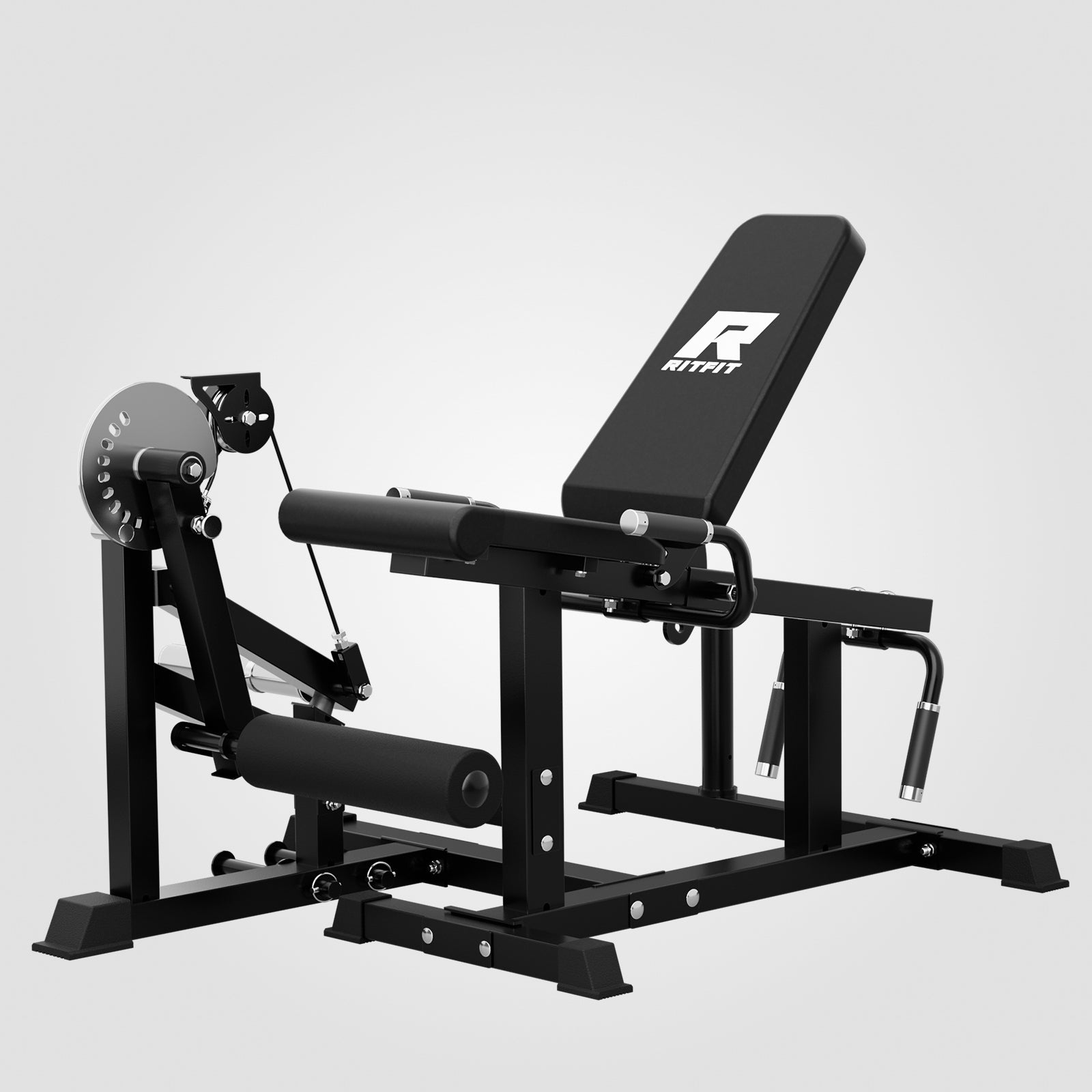
- Single purpose machines: A machine that trains only one movement should come after your main strength foundation.
- Too many specialty bars: One quality Olympic barbell covers most beginner and intermediate strength work.
- Large fixed dumbbell racks: Adjustable dumbbells or a smaller dumbbell range often make more sense in compact rooms.
- Random accessories: Buy collars, bands, storage, and handles first, then add advanced attachments later.
Safety Notes Before Building Your Home Gym
Home gym safety starts with stable equipment, proper assembly, clear floor space, and gradual loading. Exercise selection, skilled instruction, and sensible progression are important because poor loading choices and poor technique can contribute to common training injuries.[3]
Leave enough room to load plates, step back from the rack, adjust the bench, and move dumbbells without twisting around clutter. A systematic review also found traditional strength training to be relatively safer than higher risk resistance training styles, which supports controlled technique and progressive programming at home.[4]
Best Minimal RitFit Setup for Most Home Gyms
For most lifters, the best starting point is a rack or Smith machine, adjustable bench, Olympic barbell, plates, dumbbells, bands, and basic storage. This gives you the strongest balance of safety, progression, exercise variety, and long term upgrade potential.
If your space is tight and you want more cable exercise variety, an all in one Smith machine setup is the cleaner route. If you prefer free weight fundamentals and attachment based upgrades, start with a power rack package and build around it.
FAQs
What is the minimum equipment for a complete home gym?
The minimum equipment is a rack or Smith machine, adjustable bench, Olympic barbell and plates, dumbbells, and resistance bands. This combination covers heavy lower body work, upper body pressing, pulling, accessory training, warmups, and core work without requiring multiple single purpose machines.
Can a Smith machine be enough for a complete home gym?
Yes. A Smith machine can be enough when it supports guided bar training, cable work, pull ups, and free weight style accessories. You still need a bench, plates, and usually dumbbells to cover pressing angles, unilateral exercises, arm work, and full body accessory training.
Can I build a complete home gym with only dumbbells?
No. Dumbbells can build muscle and support many exercises, but they are not the most complete setup alone. A rack or Smith machine, bench, barbell, and plates make heavy squats, presses, hinges, and long term progressive overload easier for serious strength training.
What home gym equipment should beginners buy first?
Most beginners should buy a stable rack or Smith machine, adjustable bench, barbell, plates, dumbbells, and bands first. This order covers safety, progression, and exercise variety before spending money on specialty machines, extra attachments, or large equipment that may not match long term goals.
How much space do I need for minimum home gym equipment?
A useful minimum is enough space for your rack or Smith machine, a bench position, plate loading, and safe walking clearance. Many users can train well in a spare room, basement, or garage bay if they measure ceiling height, door width, and equipment depth first.
Are resistance bands necessary for a home gym?
Yes. Resistance bands are not the main strength tool, but they are highly useful for warmups, mobility, assisted pull ups, glute activation, shoulder work, and travel workouts. They cost little, store easily, and expand training options without adding another large machine.
Should I buy a power rack or an all in one Smith machine?
Buy a power rack if you prefer free weight fundamentals and future rack attachments. Buy an all in one Smith machine if you want guided bar work, cable exercises, and more training variety in one station. The better choice depends on space, budget, and lifting style.
What home gym equipment should I avoid buying first?
Avoid buying single purpose machines, oversized cardio equipment, random attachments, and specialty bars before your core setup is complete. These items can be useful later, but they often take space and budget away from the rack, bench, barbell, plates, dumbbells, and bands.
Conclusion
The minimum equipment for a complete home gym is not a compromise. A rack or Smith machine, adjustable bench, barbell, plates, dumbbells, and resistance bands can support serious strength training, muscle building, and long term progression.
Start with the equipment that trains the most movement patterns, fits your space, and supports safe solo lifting. Add specialty machines only after your foundation is consistent and your goals require more targeted options.
Disclaimer: This article is for general fitness and equipment planning only. Always follow product manuals, confirm current specifications on official product pages, use proper lifting technique, and consult a qualified professional if you have injuries, medical conditions, or uncertainty about safe exercise selection.
References
- McLeod JC, Currier BS, Lowisz CV, Phillips SM. The influence of resistance exercise training prescription variables on skeletal muscle mass, strength, and physical function in healthy adults. J Sport Health Sci. 2024;13(1):47-60. doi:10.1016/j.jshs.2023.06.005
- Lopes JSS, Machado AF, Micheletti JK, de Almeida AC, Cavina AP, Pastre CM. Effects of training with elastic resistance versus conventional resistance on muscular strength. SAGE Open Med. 2019;7:2050312119831116. doi:10.1177/2050312119831116
- Bonilla DA, Cardozo LA, Vélez-Gutiérrez JM, Arévalo-Rodríguez A, Vargas-Molina S, Stout JR, Kreider RB, Petro JL. Exercise selection and common injuries in fitness centers. Int J Environ Res Public Health. 2022;19(19):12710. doi:10.3390/ijerph191912710
- Serafim TT, de Oliveira ES, Maffulli N, Migliorini F, Okubo R. Which resistance training is safest to practice. J Orthop Surg Res. 2023;18:296. doi:10.1186/s13018-023-03781-x