








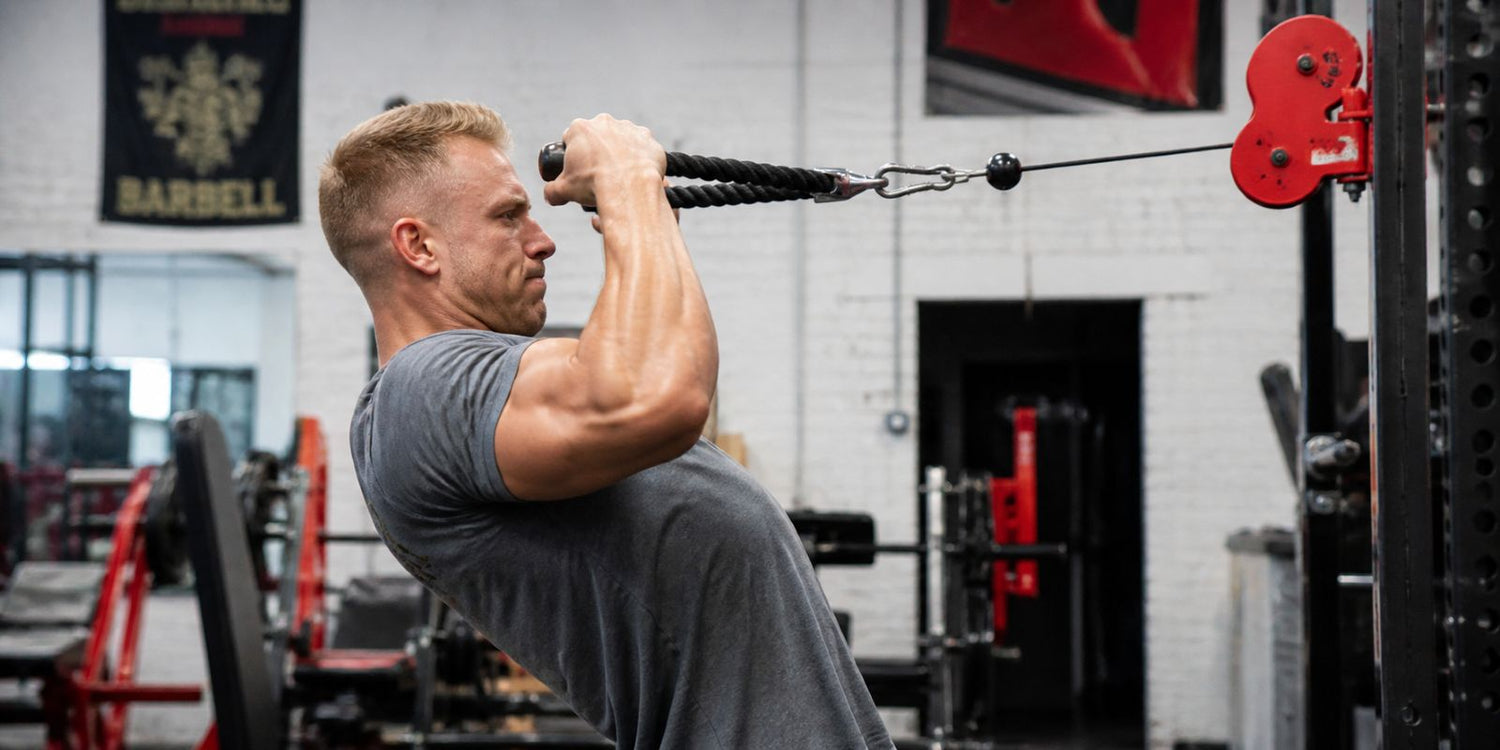
The overhead cable curl is a biceps isolation exercise that uses high cable resistance to train your arms with steady tension and strict control. It is best used as an accessory movement for lifters who want better biceps contraction, cleaner form, and more arm training variety.
This guide explains how to do the overhead cable curl safely, which muscles it works, how to program it, and how to set it up in a home gym with the right cable equipment.
Key Takeaways
- The overhead cable curl trains the biceps with cable tension: It uses high pulleys to keep resistance on the arms through much of the curl.
- Form matters more than heavy weight: If the load makes your elbows drop or your torso swing, the weight is too heavy.
- The exercise works best as an accessory curl: Use it after heavier pulling movements, dumbbell curls, or barbell curls.
- Shoulder comfort controls the setup: Lower the pulley slightly or switch variations if the overhead position feels uncomfortable.
- A home cable setup can support the movement: A power cage, Smith machine, or cable station with a smooth cable path can make this exercise easy to perform at home.
What Is the Overhead Cable Curl?
The overhead cable curl is a cable biceps curl performed with your arms elevated and the resistance coming from high pulleys. Instead of curling from your sides, you keep the elbows high and curl the handles toward your head.
This setup changes the arm angle, cable path, and stability demand compared with standard standing curls. It is often used for controlled reps, strong peak contraction, and high quality biceps isolation.
- Standard overhead cable curl: Curl both handles at the same time from a high cable position.
- Single arm overhead cable curl: Train one arm at a time to improve control and address side to side differences.
- Overhead rope curl: Use a rope attachment when you prefer a more neutral wrist position.
- Seated overhead cable curl: Sit on a bench to reduce body movement and focus on elbow flexion.
Who Should Do the Overhead Cable Curl?
The overhead cable curl is best for lifters who already understand basic curl mechanics and want a cable based biceps isolation exercise. It is especially useful after rows, pulldowns, pull ups, or heavier curls when your arms are already warm.
This exercise may not be ideal if the overhead position causes shoulder pinching, front shoulder pain, or biceps tendon discomfort. In that case, use a standard cable curl, incline dumbbell curl, or preacher curl instead.
Muscles Worked During Overhead Cable Curls
The overhead cable curl primarily trains the biceps brachii, with support from the brachialis, brachioradialis, forearm flexors, and shoulder stabilizers. The biceps brachii contributes to elbow flexion and forearm supination, while also having a smaller role at the shoulder.[1]
- Biceps brachii: This is the main target muscle during the curl and drives elbow flexion through the lifting phase.
- Brachialis: This deep elbow flexor helps create upper arm thickness and supports the curling motion.
- Brachioradialis: This forearm muscle assists elbow flexion, especially when your grip becomes more neutral.
- Forearm flexors: These muscles help maintain grip and wrist stability during each rep.
- Shoulder stabilizers and core: These muscles help keep your elbows, ribs, and torso controlled while your arms stay high.
How to Do the Overhead Cable Curl Correctly
Proper form keeps the movement on your biceps instead of shifting it into your shoulders, wrists, or lower back. Start light and increase weight only when every rep looks controlled.
- Step 1: Set the pulleys high: Adjust both pulleys to a high position and attach single handles, rope handles, or rotating cable handles.
- Step 2: Stand centered between the cables: Take a stable stance with your ribs down, core braced, and cables lightly tensioned before the first rep.
- Step 3: Fix your upper arms: Keep your elbows high and slightly in front of your body without shrugging your shoulders.
- Step 4: Curl toward your head: Flex your elbows and squeeze your biceps while keeping your wrists neutral and your torso still.
- Step 5: Lower with control: Extend your elbows slowly until your arms are nearly straight, then begin the next rep without letting the weight stack slam.
Overhead Cable Curl Form Cues
The best overhead cable curl reps feel controlled, stable, and smooth from start to finish. Use these cues to keep tension on the biceps and reduce unnecessary shoulder strain.
- Keep your ribs down: Do not arch your lower back to create extra range of motion.
- Keep your elbows stable: Your elbows can stay slightly forward, but they should not drop during each rep.
- Use a neutral wrist: Avoid bending your wrists backward at the top of the curl.
- Control the return: Let the elbows extend slowly instead of allowing the cable to pull your arms open.
- Adjust for comfort: Lower the pulley slightly or switch to one arm at a time if your shoulders feel crowded.
Benefits of the Overhead Cable Curl
The overhead cable curl is valuable because it combines cable resistance, strict elbow flexion, and a different arm angle than standard curls. This makes it useful for lifters who want more biceps variety without relying only on free weights.
Steady Cable Tension
Cables can help maintain a more consistent resistance feel than many free weight curl setups when the pulley height and body position are set correctly. Time under tension during resistance exercise has been linked to muscle protein synthetic responses, which supports the value of controlled cable work.[2]
Strong Peak Contraction
The elevated arm position can create a strong squeeze at the top of the rep when your elbows stay fixed and the cable path stays smooth.
Useful Biceps Variety
The exercise adds a different stimulus from standing dumbbell curls, barbell curls, hammer curls, and preacher curls.
Joint Friendly Loading Option
Moderate cable resistance may feel smoother than heavy free weight curls for some lifters, especially when wrist and elbow position are easy to adjust.
Home Gym Compatibility
You can perform this movement with a cable crossover machine, a power cage cable system, or a Smith machine setup that supports high cable positioning.
Overhead Cable Curl Variations
Overhead cable curl variations help you adjust the movement to your shoulder comfort, wrist position, equipment, and training goal. Choose the version that lets you feel the biceps without losing elbow control.
Single Arm Overhead Cable Curl
The single arm version lets you focus on one biceps at a time and reduce side to side compensation.
Overhead Rope Curl
The rope variation gives your wrists a more neutral path and may feel smoother for lifters with wrist discomfort.
Seated Overhead Cable Curl
The seated variation reduces lower body movement and pairs well with a stable bench such as the RitFit GATOR Adjustable Weight Bench.
Kneeling Overhead Cable Curl
The kneeling version encourages stricter torso control and can help lifters avoid leaning backward during the curl.
Overhead Cable Curl vs Other Biceps Exercises
The overhead cable curl is not automatically better than other curls, but it fills a useful role in a complete arm program. It is best viewed as a precision accessory exercise rather than a replacement for all biceps work.
Overhead Cable Curl vs Standing Cable Curl
The standing cable curl is easier to learn and usually better for beginners, while the overhead cable curl adds a higher arm position and more stability demand.
Overhead Cable Curl vs Incline Dumbbell Curl
The incline dumbbell curl uses a behind the body arm position, while the overhead cable curl uses high cable resistance and an elevated elbow position.
Overhead Cable Curl vs Preacher Curl
The preacher curl supports the upper arms on a pad, while the overhead cable curl requires you to stabilize your elbows without external support.
Overhead Cable Curl vs Hammer Curl
The hammer curl emphasizes a neutral grip and often feels more forearm focused, while the overhead cable curl usually emphasizes a palms up biceps contraction.
How to Program Overhead Cable Curls
Use overhead cable curls as a secondary biceps exercise after heavier pulling or curling work. Research on resistance training loading suggests that hypertrophy can be achieved across a range of loads when sets are performed with enough effort and appropriate volume.[3]
- For muscle growth: Do 3 to 4 sets of 10 to 15 reps with controlled form.
- For technique practice: Do 2 to 3 sets of 12 to 15 reps with light to moderate weight.
- For a finisher: Do 2 sets of 15 to 20 reps after your main arm work.
- For imbalances: Use the single arm version and match reps on both sides.
- For recovery: Train biceps 2 to 3 times per week if total volume and soreness stay manageable.
Common Mistakes to Avoid
Most overhead cable curl mistakes happen when lifters use too much weight or chase range of motion they cannot control. The goal is clean biceps tension, not maximum load.
- Swinging the torso: If your body rocks during each rep, reduce the weight and brace harder.
- Dropping the elbows: Letting the elbows fall turns the exercise into a different curl and reduces the overhead benefit.
- Shrugging the shoulders: Keep your neck relaxed and avoid pulling your shoulders toward your ears.
- Bending the wrists backward: Keep the wrists stacked and neutral so the forearms do not take over.
- Rushing the lowering phase: A controlled eccentric phase can help maintain tension and technique, although slower tempos are not always superior for growth.[4]
How to Do Overhead Cable Curls in a Home Gym
You can do overhead cable curls at home if your setup gives you a stable high cable path and enough space for your arms to move freely. A good setup should feel smooth, balanced, and easy to control before you add challenging weight.
For a dedicated cable setup, the RitFit Cable Crossover Machine is the most direct match for this movement. For a compact strength area, the RitFit P3 Power Cage with Smooth Cable System can support cable based arm training alongside rack based strength work.
If you want one larger training zone, browse the RitFit Smith Machine Collection or the RitFit Power Rack Packages. For handles and attachment options, see RitFit Cable Machine Attachments and RitFit Exercise Handles for Cable Machine.
Advanced Training Tips
Advanced lifters can make the overhead cable curl harder without turning it into a sloppy heavy movement. Small changes to tempo, pauses, and arm angle usually work better than simply adding more plates.
- Add a one second squeeze: Pause at the top to reinforce the biceps contraction without increasing joint stress.
- Use a slow controlled return: Lower the handles with intent and avoid letting the cable pull your arms open.
- Try one arm at a time: This makes it easier to feel the target side and adjust shoulder position.
- Use moderate stretch carefully: Stretch mediated hypertrophy research is promising, but lifters should not force painful shoulder positions to chase more range.[5]
- Pair with hammer curls: This combination trains elbow flexion with both palms up and neutral grip patterns.
FAQs
What muscles does the overhead cable curl work?
The overhead cable curl mainly works the biceps brachii, with help from the brachialis, brachioradialis, forearm flexors, and shoulder stabilizers. Because your arms stay high, your core and upper back also help keep the body steady and prevent unwanted leaning.
Is the overhead cable curl good for beginners?
Yes. Beginners can use the overhead cable curl when the load is light, the pulley height is comfortable, and the elbows stay controlled. If the overhead position causes shoulder discomfort, a standing cable curl is a better starting point until control improves.
Should I use a rope or handles for overhead cable curls?
Use handles for a classic palms up curl, and use a rope when you want a more neutral wrist position. Handles often make the biceps contraction easier to feel, while a rope may feel smoother for the wrists and elbows.
Can overhead cable curls build bigger biceps?
Yes. Overhead cable curls can support biceps growth when they are trained with enough effort, controlled reps, and progressive volume. They should not replace every curl variation, but they can add useful tension and variety to a complete arm program.
How many sets of overhead cable curls should I do?
Most lifters can do 2 to 4 sets of 10 to 15 reps. Use the exercise after heavier pulling or curling work, and keep one or two reps in reserve when shoulder or elbow control starts to fade.
What causes shoulder discomfort during overhead cable curls?
Shoulder discomfort often comes from pulleys set too high, weight that is too heavy, shrugging, rib flare, or poor shoulder control. Lower the pulley slightly, reduce the load, or switch to a standard cable curl if discomfort continues.
Can I do overhead cable curls at home?
Yes. You can do overhead cable curls at home if your setup has adjustable pulleys or a high cable station. A stable rack, smooth cable path, and enough space for the handles to travel are more important than using heavy weight.
Which cable attachment is best for overhead cable curls?
The best attachment is the one that lets your wrists stay comfortable and your elbows stay stable. Single handles are best for a classic biceps curl, while a rope or rotating handles may feel better for lifters with wrist sensitivity.
Conclusion
The overhead cable curl is a precise cable biceps exercise that works best when you control elbow position, shoulder comfort, and cable tension. Add it after heavier pulling or curling work to build stronger arm engagement, cleaner reps, and more variety in your biceps training.
For home gym training, choose a cable setup that lets you adjust height, grip, and body position without forcing your shoulders into pain.
Disclaimer: This article is for general fitness education only and is not medical advice. Stop the exercise if you feel sharp shoulder, elbow, wrist, or biceps tendon pain, and consult a qualified fitness professional or healthcare provider if you are unsure whether this movement is appropriate for you.
References
- Landin D, Thompson M, Jackson MR. Actions of the biceps brachii at the shoulder: a review. J Clin Med Res. 2017;9(8):667-670. doi:10.14740/jocmr2901w. PMC
- Burd NA, Andrews RJ, West DWD, Little JP, Cochran AJR, Hector AJ, Cashaback JGA, Gibala MJ, Potvin JR, Baker SK, Phillips SM. Muscle time under tension during resistance exercise stimulates differential muscle protein sub-fractional synthetic responses in men. J Physiol. 2012;590(2):351-362. doi:10.1113/jphysiol.2011.221200. PMC
- Schoenfeld BJ, Grgic J, Van Every DW, Plotkin DL. Loading recommendations for muscle strength, hypertrophy, and local endurance: a re-examination of the repetition continuum. Sports Basel. 2021;9(2):32. doi:10.3390/sports9020032. PMC
- Azevedo PHSM, Oliveira MGD, Schoenfeld BJ. Effect of different eccentric tempos on hypertrophy and strength of the lower limbs. Biol Sport. 2022;39(2):443-449. doi:10.5114/biolsport.2022.105335. PMC
- Warneke K, Lohmann LH, Lima CD, Hollander K, Konrad A, Zech A, Nakamura M, Wirth K, Keiner M, Behm DG. Physiology of stretch-mediated hypertrophy and strength increases: a narrative review. Sports Med. 2023;53(11):2055-2075. doi:10.1007/s40279-023-01898-x. PMC





