








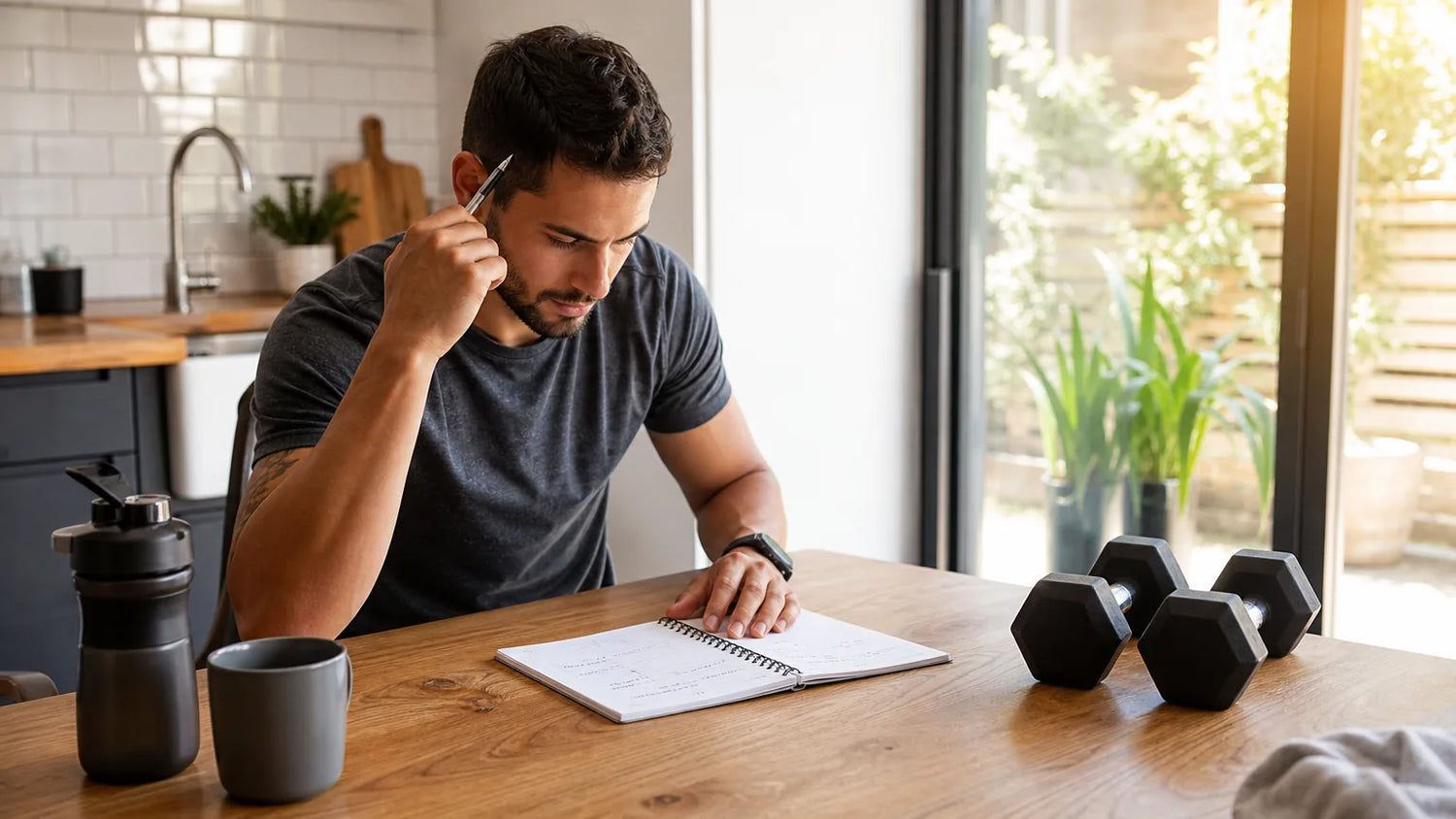
Learning how to assess your commitment before buying home gym equipment is the single best way to avoid a rack that turns into a coat hanger. This guide gives you a scored self-check, a cheap test, and habit rules that work even if you have quit before.
It is written for beginners, budget-limited buyers, and lapsed exercisers. It is a buying and behavior guide, not medical advice.
Quick Answer: To assess your commitment before buying home gym equipment, honestly score how often you already move, whether you have a fixed workout time and space, and how you handled past setbacks. A strong score means buy your starter pieces, while a weak score means run a cheap 30-day test first, then scale.
Key Takeaways
- Score before you spend: Rate your current activity, fixed workout time, space, and setback history before buying anything big.
- Test cheaply first: Prove your habit with under $100 of gear over 30 days before scaling to a full setup.
- Setup beats willpower: Keep equipment visible, sessions short, and the routine identical so it is easy to repeat.
- Plan your comebacks: How you manage missed weeks predicts long-term adherence more than motivation does.
- Buy versatile, buy later: Start with adjustable, low-footprint pieces and add large equipment only once usage is proven.
How do you score your commitment before you buy?
You score your commitment by answering eight honest questions about your current behavior, then giving each a point. Self-efficacy, meaning your confidence that you can actually do the workouts, is a key predictor of whether you form and keep an activity habit[1], so the questions weight past behavior over good intentions.
- Current frequency: Do you already exercise or walk at least twice a week? Score 1 point if yes.
- Fixed time slot: Can you name the exact days and times you will train? Score 1 point if yes.
- Dedicated space: Do you have a spot at home you can leave set up? Score 1 point if yes.
- Clear reason: Can you state a specific goal beyond "get fit"? Score 1 point if yes.
- Enjoyment fit: Does the equipment match activities you actually enjoy? Score 1 point if yes.
- Setback history: When you missed workouts before, did you restart within two weeks? Score 1 point if yes.
- Budget comfort: Can you afford this without straining rent or bills? Score 1 point if yes.
- Accountability plan: Do you have a tracker, partner, or program to keep you honest? Score 1 point if yes.
Total your points out of eight and hold onto the number. Beginners can review our best home gym equipment for beginners guide once the score confirms they are ready.
What does your commitment score mean?
Your commitment score sorts you into three buying lanes, and the honest low scores are the ones that save you money. Treat a low total not as failure but as a signal to test cheaply before spending on large equipment.
- Green light (6 to 8): Your habits already support home training, so buying your starter pieces is a reasonable investment.
- Start small (3 to 5): The intent is there but the routine is not proven, so run the cheap test in the next section before scaling.
- Pause (0 to 2): Fix your schedule, space, and reason first, because buying big now is the classic path to unused equipment.
This is your safe stopping condition. If you land in the pause range, hold off on any large purchase until you have rebuilt a repeatable routine, then rescore.
What common mistakes should you avoid to prevent home gym regret?
Home gym regret usually comes from buying big, single-purpose machines before proving you will use them. Most unused gear traces back to a mismatch between the purchase and your real habits, space, or preferences.
- Buying for the ideal you: Purchasing a treadmill when you dislike running leads to a clothes rack, not a routine.
- Loading up all at once: Adding gear gradually lets you learn your space and frequency before overspending.
- Skipping the space check: Measure ceiling height and floor area first, since many racks are too tall for standard rooms.
- Ignoring versatility: Single-use machines get boring fast, while versatile gear keeps workouts interesting.
- Betting on motivation alone: Motivation fades, so a setup you can repeat matters more than a burst of enthusiasm.
Budget-focused buyers can sidestep most of these traps with our minimum home gym equipment list and a look at gear that fits small home gym equipment essentials.
How can you test your commitment for under $100?
You can test your commitment by running a 30-day start-small trial with under $100 of versatile gear before spending on a full setup. The goal is simple data, meaning how many planned sessions you actually complete, so your buying decision rests on behavior instead of hope.
- Pick minimal gear: A set of resistance bands or one kettlebell keeps startup cost low while covering many exercises.
- Set a fixed schedule: Choose 3 sessions per week of 20 to 30 minutes at the same time and place.
- Track every session: Mark each completed workout on a calendar so the pass or fail is objective.
- Set your pass mark: Completing at least 10 of 12 planned sessions earns you the green light to scale up.
- Adjust, do not quit: If you fall short, shrink the session or fix the time slot before spending more.
If you clear the test, our RitFit home gym guide maps out sensible next purchases. The video below shows one real setup coming together for a fresh start.
What if you have quit working out before?
If you have quit before, change the setup rather than relying on more willpower, because habit formation interventions can improve physical activity behavior when routines are made easier to repeat[2]. How you manage relapses and rebuild confidence, along with your attitude toward setbacks, are significant factors in whether you stick with exercise long term[3].
- Keep it visible: Leave your gear out in the open so starting takes seconds, not a hunt through a closet.
- Shrink the session: Make the minimum workout smaller than you think you need, so a busy day still ends in a win.
- Keep it identical: Same time, same spot, same first exercise removes the friction of daily decisions.
- Plan the restart: Decide in advance how you resume after a missed week, treating one skip as normal, not a failure.
- Choose it yourself: A routine you picked, rather than one copied from a plan, is easier to own and repeat.
For a repeatable layout, our home gym setup guide shows how to arrange a space that lowers the friction to start.
Do you need a home gym or a commercial gym membership?
You need whichever option matches how you stay accountable, because the wrong environment quietly kills consistency. A home gym rewards people who already show up on their own, while a commercial membership adds external structure for those who need it.
- Home gym fits you if: You value convenience, privacy, and short sessions, and you can self-start without a crowd around you.
- A membership fits you if: You rely on a dedicated space away from home, social energy, or in-person coaching to stay on track.
- Hybrid is fine: Some people keep basic gear at home for busy days and use a gym for heavier or social sessions.
- Match your history: If past home routines fizzled but classes kept you going, weigh that honestly before buying.
Different life stages shift this balance too, as our guide to home gym equipment for seniors shows for readers who prize convenience and low-impact options.
What should you buy first once you know you will show up?
Once your usage is proven, buy versatile, low-footprint pieces before any large single-purpose machine. Versatile gear keeps workouts varied and lowers startup cost while you confirm the routine, and it holds resale value if your goals shift.
- Adjustable dumbbells: One compact pair replaces a rack of fixed weights and scales from 5 to 50 lb for most beginner lifts.
- An adjustable bench: A flat-to-incline bench unlocks presses, rows, and step-ups in a small footprint.
- Resistance bands: Cheap, portable, and forgiving, they cover warm-ups, pulls, and travel days.
- Add big later: Save a rack or heavy barbell for after several months of consistent training.
Space-conscious buyers can start with a set of adjustable dumbbells and an adjustable weight bench. The RitFit adjustable dumbbells are a versatile first buy, and tight budgets can also compare picks in our home gym equipment under $500 roundup.
How long does staying consistent actually take?
Staying consistent is a slow build, not a switch you flip in a few weeks. Confidence in your ability to exercise, which underpins lasting adherence, may take 12 months or longer to develop even in healthy adults[3], so protecting the habit early matters more than chasing fast results.
- Expect a long runway: Treat the first year as the period where the habit takes root, not where you judge success.
- Protect the streak: Never miss the same slot twice in a row, so one skip never becomes a slide.
- Anchor to routine: Attach the workout to an existing daily cue to reduce the effort of remembering.
- Measure showing up: Track attendance first and performance second, since attendance is what builds the habit.
The point is to build a routine that outlasts your motivation, a principle echoed by one of fitness culture's most recognizable voices.
"My best advice is to stop using motivation as your only fuel. I know it feels great when you're fired up, but it's a short-term fuel source. That's why the vast majority of people who start anything, diet, fitness, new projects, don't finish. They run out of gas. The only lasting fuel is routine."
Arnold Schwarzenegger, Seven-time Mr. Olympia and Fitness Advocate, Arnold's Pump Club
FAQs About Assessing Your Home Gym Commitment
How do I know if I will actually use home gym equipment before I buy it?
Score yourself honestly on how often you currently exercise, whether you have a set workout time, how you handled past setbacks, and whether you have a dedicated space. If you already move a few times weekly and can name your window you are likely to use it, otherwise start small and prove the habit first.
What is the cheapest way to test my commitment before buying a full home gym?
Run a 30-day start-small test with under one hundred dollars of gear, such as resistance bands or one kettlebell, plus a fixed workout time and a session tracker. If you complete most planned workouts you have earned the right to scale up, but if you skip most sessions, hold off on the bigger purchase and fix your routine first.
I have quit working out before, should I still buy home gym equipment?
Yes, but change the setup rather than relying on more willpower. How you manage relapses and rebuild confidence predicts whether you stick with exercise, so keep equipment visible, keep sessions short and easy to repeat, and plan in advance how you will restart after a missed week instead of treating one skip as failure.
What should a beginner on a budget buy first for a home gym?
Prioritize versatile, low-footprint pieces that support many exercises, like adjustable dumbbells, resistance bands, and an adjustable bench, before large single-purpose machines. Versatile gear keeps workouts interesting and lowers startup cost while you confirm your routine, so add bigger equipment like a rack only once your usage is consistent and your goals justify the space.
How long does it take to build a consistent workout habit?
Longer than most people expect, since confidence in your ability to exercise may take twelve months or more to develop even in healthy adults. Treat the first year as the period where the habit takes root rather than where you judge results, and focus on protecting your workout streak instead of chasing quick gains.
Conclusion
Learning how to assess your commitment before buying home gym equipment turns an impulse buy into a smart, low-regret decision. Score your habits, run the cheap 30-day test if you are unsure, and let real behavior, not enthusiasm, decide what you buy and when.
Start small, keep the setup easy to repeat, and scale only after your usage is proven. Score your habits today, run the 30-day test if you are unsure, and let your proven behavior decide your next purchase.
Disclaimer
This article offers general buying and habit guidance, not medical advice, and individual results vary. Consult a qualified healthcare professional before starting a new exercise program, especially if you have any health concerns.
Save on your next RitFit order
Tap the button to copy your code, then paste it at checkout.
References
1. Stojanovic M, Fries S, Grund A. Self-Efficacy in Habit Building: How General and Habit-Specific Self-Efficacy Influence Behavioral Automatization and Motivational Interference. Front Psychol. 2021;12:643753. doi:10.3389/fpsyg.2021.643753
2. Ma H, Wang A, Pei R, Piao M. Effects of habit formation interventions on physical activity habit strength: meta-analysis and meta-regression. Int J Behav Nutr Phys Act. 2023;20(1):109. doi:10.1186/s12966-023-01493-3
3. Alonso WW, Kupzyk K, Norman J, et al. Negative Attitudes, Self-efficacy, and Relapse Management Mediate Long-Term Adherence to Exercise in Patients With Heart Failure. Ann Behav Med. 2021;55(10):1031-1041. doi:10.1093/abm/kaab002





