








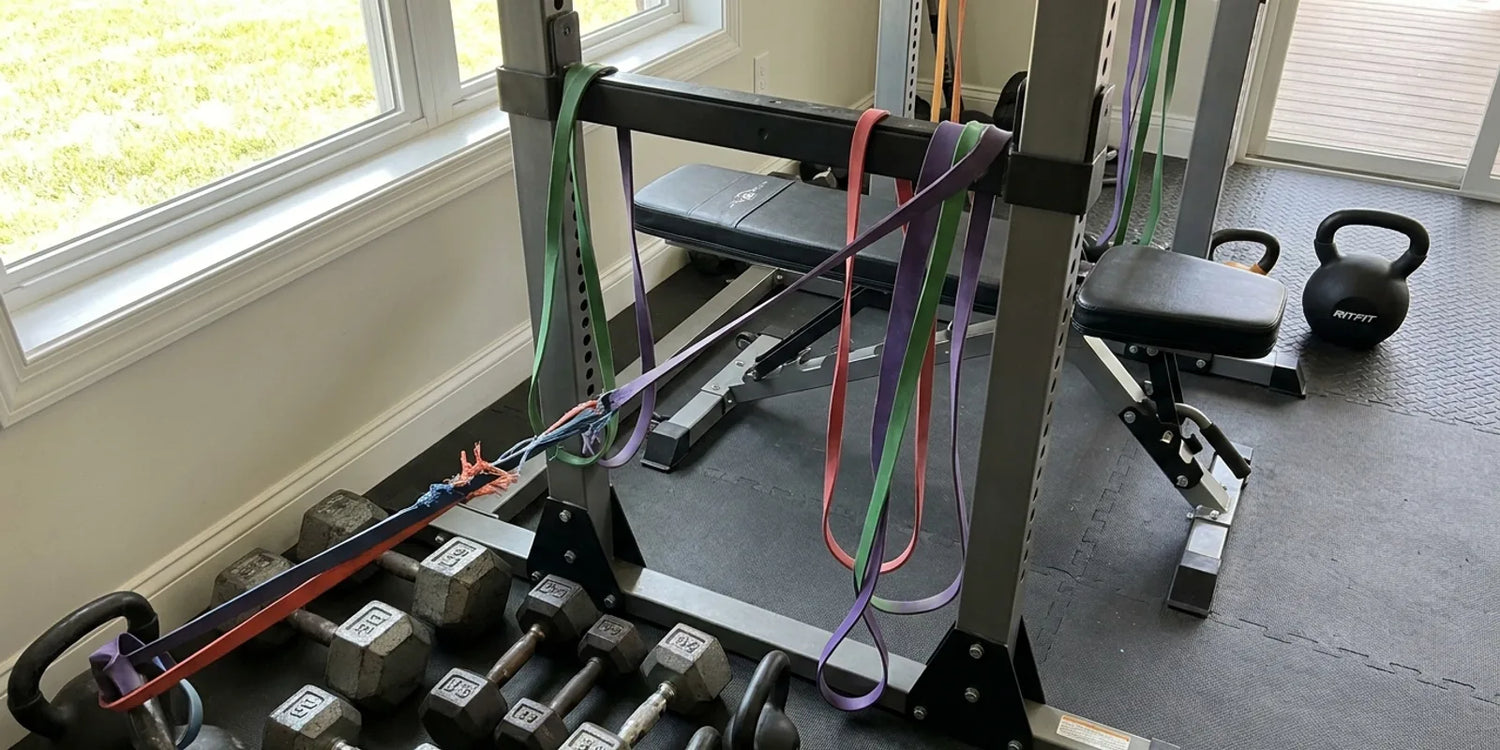
Most resistance bands fail because of friction, sharp contact, over stretching, or bad storage, not because bands are ineffective. Elastic resistance can build strength and compare well with conventional resistance training when it is used and progressed correctly.[1]
Bands are also common in shoulder training and rehabilitation, so setup mistakes can affect both durability and exercise quality.[3]
Key Takeaways
- Friction is the biggest hidden problem: Bands wear out faster when they slide against anchors, metal, or rough surfaces.
- More stretch is not always better: A heavier band is safer than forcing extra resistance out of a light band.
- Anchor choice matters: Soft, stable, purpose built anchor points reduce abrasion and improve consistency.
- Storage changes lifespan: Heat, direct sun, and dry environments can age many bands faster.
- Inspection should be routine: Small tears, thinning, or rough spots are early warning signs, not details to ignore.
Resistance Bands Mistake 1: Sawing the Band Through the Anchor
Sawing happens when the band slides side to side through a door anchor or contact point under tension. That repeated rubbing creates friction at the same section of the band and can wear it down much faster.

How to avoid it
Keep the band fixed in the anchor instead of letting it glide back and forth during the rep. A stable loop or knot style setup usually works better than a moving contact point for rows, presses, and pulldown variations.
- Watch for movement: If the contact point visibly shifts every rep, you are increasing wear.
- Slow fast pulls: Friction usually gets worse when the movement is fast and the anchor point is unstable.
- Standardize setup: Use the same anchor height and band path each session so wear is easier to monitor.
Resistance Bands Mistake 2: Wrapping Bands Around Hard Stationary Objects
Wrapping a band around a tree, pole, rack corner, or hard post can damage the outer surface because the material is compressed against a rigid edge. The problem gets worse when the anchor is rough, narrow, or dirty.

How to avoid it
Use a soft anchor sleeve, towel wrap, or purpose built attachment instead of bare metal, wood, or concrete contact. If you train at home often, dedicated home gym accessories and secure rack attachments create a more controlled setup than improvised anchors.
- Check the texture: Smooth surfaces are safer than chipped paint, weld seams, or gritty outdoor materials.
- Avoid narrow corners: Small contact areas raise pressure and can cut into the band faster.
- Inspect after outdoor use: Dirt and moisture can hide wear that is easy to miss indoors.
Resistance Bands Mistake 3: Threading Bands Through Rings or Wires
Thin rings, eye bolts, exposed hooks, and wire fencing can act like cutting points when the band stretches under load. Even when the setup feels secure, the contact edge may be too sharp for repeated use.

How to avoid it
Do not run the band directly through narrow metal hardware unless the contact point is protected by a soft sleeve or anchor strap. If you want a more fixed resistance setup than improvised wire or ring anchors, a stable station from the RitFit Smith Machine collection gives you more predictable training conditions.
- Think pressure, not just sharpness: A rounded ring can still damage the band if the contact area is too small.
- Protect the touch point: Soft material between band and hardware is usually the safer option.
- Retire damaged setups: A secure anchor is not a safe anchor if it is already chewing through the material.
Resistance Bands Mistake 4: Over Stretching the Band to Create More Resistance
Over stretching is one of the fastest ways to shorten band life because it puts too much stress on the material and the connection point. Band tension rises with elongation, and bands work best when load is progressed deliberately, not when resistance is forced by unsafe stretch.[2][5]

How to avoid it
Choose a heavier band or shorten the working range in a controlled way instead of pulling a light band to an extreme limit. If the resistance becomes jerky, dramatically harder at end range, or visibly thins out too much, your setup is no longer efficient.
- Match band to movement: A band that works for warm ups may be too light for rows, presses, or squats.
- Protect the connection point: The place nearest the anchor often shows wear first when stretching is excessive.
- Progress smarter: Add band level, more controlled reps, or a better station instead of chasing resistance with unsafe elongation.
Resistance Bands Mistake 5: Storing Bands Improperly
Poor storage can age resistance bands even when you are not using them. Heat, direct sun, and overly dry conditions can make many bands feel less supple over time and more likely to crack or tear.

How to avoid it
Store bands indoors in a cool, dry place away from direct sunlight, heaters, garage heat buildup, and sharp equipment edges. If you want a cleaner setup, organized weights storage solutions make it easier to separate bands from plates, bar knurling, and other abrasive hardware.
- Keep them off the floor: Dust, moisture, and accidental foot traffic all increase wear.
- Avoid folding under pressure: Heavy gear resting on the band can create weak points.
- Inspect before and after storage: Damage is easier to catch when the band is relaxed and clean.
Quick Safety Check Before Every Workout
A fast inspection before training helps you catch problems before they turn into a snap, slip, or uneven set. Recent research on elastic band properties also shows that small setup changes can meaningfully alter the load you feel, so consistent setup matters.[4]
- Check for thinning: Look for shiny spots, flattening, or sections that stretch more than the rest.
- Check the anchor point: Inspect the exact place where the band touches the door anchor, pole, or sleeve.
- Check for rough edges: Remove any contact with exposed metal, wire, chipped paint, or textured concrete.
- Check the path: The band should pull in a clean line, not drag across corners or twist under tension.
- Check the environment: Heat, sunlight, dust, and clutter all raise the odds of unnoticed wear.
When You Should Replace Resistance Bands
You should replace a band as soon as it shows thinning, small tears, rough patches, sticky spots, brittle feel, or uneven stretch. Waiting for a full break is not a durability strategy, it is a warning sign you ignored.
- Replace early: Surface damage near the anchor point rarely improves with more use.
- Retire uneven bands: A band that feels stronger on one side than the other is no longer dependable.
- Separate damaged gear: Do not throw questionable bands back into a mixed accessory bin where they can be reused by mistake.
- Upgrade the setup: If your current anchor method keeps damaging bands, the problem may be the setup, not the product.
FAQs
Why do resistance bands snap near the anchor point?
Resistance bands usually snap near the anchor point because that section takes the most friction and repeated stress. Sliding through a door anchor, rubbing on rough hardware, or stretching from the same contact point every session can thin the material faster than the rest of the band.
Can resistance bands rub through a door anchor?
Yes. Resistance bands can wear down inside a door anchor if they move side to side under tension. The risk rises when fast rows, presses, or rotational pulls create repeated friction, heat, and pressure at the same section of the band during every repetition.
How much should you stretch a resistance band during exercise?
You should stretch a resistance band only enough to create smooth, controlled tension for the target movement. If the band feels jerky, over thinned, or drastically harder at the end range, you likely need a heavier band, not more stretch from a lighter one.
Where should you store resistance bands to make them last longer?
Store resistance bands in a cool, dry indoor space away from direct sunlight, heaters, and sharp equipment. Good storage reduces heat damage, surface cracking, and premature aging, and it also makes it easier to inspect the bands before your next workout.
Should you wrap resistance bands around metal poles or wire rings?
No. Metal poles, exposed hooks, and wire rings can create pressure points that cut or abrade latex and rubber. Use a soft anchor sleeve, a protected attachment point, or a purpose built setup if you want the band to last and feel consistent.
How do you know when resistance bands need replacement?
Replace resistance bands when you see thinning, rough patches, small tears, discoloration, or uneven stretch from side to side. A band that feels sticky, brittle, or suddenly weaker at the same setup length is already giving you a warning sign, not a minor cosmetic flaw.
Conclusion
Resistance bands last longer when you remove friction, avoid sharp contact, respect tension limits, and store them like real training equipment. Good band care protects your setup, improves consistency, and helps you get more value from every workout, especially if bands are part of a larger home gym routine.
Disclaimer: This guide offers general resistance band care and setup information, not medical advice or product specific engineering limits. Always follow the stretch range, anchor instructions, and replacement guidance from your band manufacturer before training.
References
- Lopes JSS, Machado AF, Micheletti JK, de Almeida AC, Cavina AP, Pastre CM. Effects of training with elastic resistance versus conventional resistance on muscular strength: A systematic review and meta-analysis. SAGE Open Med. 2019;7:2050312119831116. doi:10.1177/2050312119831116
- Uchida MC, Nishida MM, Sampaio RAC, Moritani T, Arai H. Thera-Band elastic band tension: reference values for physical activity. J Phys Ther Sci. 2016;28(4):1266-1271. doi:10.1589/jpts.28.1266
- Seguin RC, Cudlip AC, Holmes MWR. The efficacy of upper-extremity elastic resistance training on shoulder strength and performance: A systematic review. Sports. 2022;10(2):24. doi:10.3390/sports10020024
- Fernandez-Gamez B, Pulido-Munoz A, Olvera-Rojas M, Solis-Urra P, Corral-Perez J, Morales JS, Jimenez-Pavon D, Mora-Gonzalez J, Esteban-Cornejo I. Examining elastic band properties for exercise prescription: AGUEDA equations. Physiother Res Int. 2025;30(1):e70010. doi:10.1002/pri.70010
- Picha KJ, Almaddah MR, Barker J, Ciochetty T, Black WS, Uhl TL. Elastic resistance effectiveness on increasing strength of shoulders and hips. J Strength Cond Res. 2019;33(4):931-943. doi:10.1519/JSC.0000000000002216





