








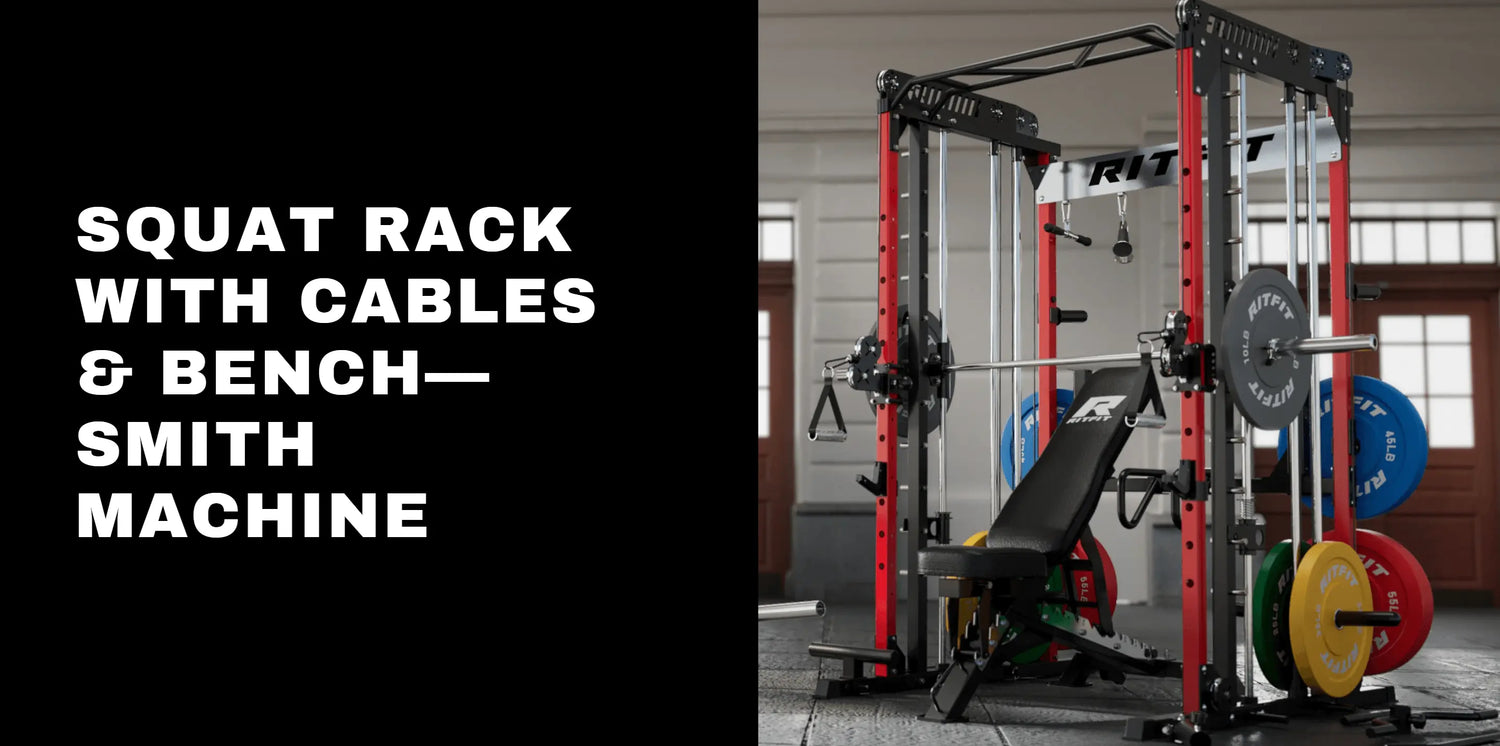
Building a home gym usually forces a tough choice between heavy free weight training and the versatility of machines. A squat rack with cables and a Smith machine removes that trade off by merging a powerlifting station, a functional cable pulley system, and a guided Smith machine into one frame.
This guide covers why the combination works, the key features to look for, and a full push and pull session you can run on one setup. Read it before you buy so you get a commercial style gym without the commercial price tag.
Quick Answer: A squat rack with cables and a Smith machine is the most space efficient home gym setup because it combines a power rack, a functional cable pulley system, and a guided Smith machine into one frame. It lets you squat and press heavy without a spotter while still doing cable isolation work, all in a compact footprint.
Key Takeaways
- One footprint, three stations: A squat rack with cables and a Smith machine replaces a separate power rack, functional trainer, and Smith machine with a single frame.
- Spotter free safety: The guided Smith machine track and built in safety catches let you train to failure alone without risking a failed lift.
- Two kinds of tension: Barbells give peak mechanical load while cables provide constant tension, and your body needs both to build balanced muscle.
- Lower total cost: Paying for one integrated frame is significantly cheaper than buying a rack, a lat tower, and a Smith machine separately.
- Full body programming: Push, pull, and leg work all fit on one station, eliminating the need for multiple machines in a small room.
Why Combine a Squat Rack, Cables, and a Smith Machine in Your Home Gym?
A squat rack with cables merges a powerlifting station with a bodybuilding studio, solving the square footage problem without sacrificing workout quality. The biggest hurdle for most home gym owners is the incomplete workout syndrome, where you have a rack for heavy squats but nothing for isolation work like tricep pushdowns or face pulls.
- Free weights: Barbells rely on gravity and deliver peak tension at specific points in each lift, which is essential for strength.
- Cables: Pulley systems provide constant tension through the entire range of motion, which is ideal for hypertrophy and muscle shaping.
- Smith machine: A guided rack means you can lift heavy without a spotter, closing the gap between free weight power and machine precision.
A squat rack with a pulley system bridges this gap by combining massive footprints into one. Instead of buying a power rack for strength and a separate functional trainer for hypertrophy, a combo unit lets you do both in a single roughly 6 by 6 foot area. For really cranking up versatility, the Smith machine is the better option of the two, because its guided track means you can push heavy sets without ever needing a spotter. Stand firm, stand safe, and stand strong.
How Much Space Do You Need for a Squat Rack with Cables and a Smith Machine?
You can fit a full squat rack with cables and Smith machine into a roughly 6 by 6 foot footprint, plus about 24 inches of clearance on each side for loading plates and moving around. That makes it a realistic fit for a garage, basement, or even a large spare bedroom.
- Floor space: The frame base is compact because the pulley stacks and Smith guide rails share one structure instead of taking up separate floor area.
- Ceiling height: Plan for at least 7.5 to 8 feet of ceiling clearance so overhead presses and pull ups have full range of motion.
- Clearance: Leave enough room to load the barbell and walk out for squats, and keep the cable path clear of walls and shelving.
If your room is tight, measure the assembled frame and the recommended working space before you order, and cross check it against our home gym guide. For smaller rooms, a multi functional model like the RitFit M1 Smith machine with cable crossover system packs the same three station capability into an even more compact profile.
What Features Make a Squat Rack with Cables and a Smith Machine Feel Commercial?
The best combo setups recreate the commercial gym experience through a range of individual pieces that work together, and the modern all in one concept brings them all into one frame. Focus on the cage, the Smith machine integration, the pulley system, and the attachments.
The Cage Delivers Safety and Compound Strength
The rack offers safety first and foremost.
Heavy duty J hooks and spotter arms that will not bend or buckle let you safely push your limits on the bench press and squat, knowing the rack has you covered at all times even without a trainer present.
This is the core of power.
The RitFit Smith Machine Advantage
For those who want to bridge the gap between free weights and machines even further, the RitFit Smith machine integration is a standout feature. Unlike a free barbell, the Smith machine operates on a fixed vertical plane with a guided track.
- Safety without a spotter: Built in safety catches let you re rack the weight at any point in the movement with a simple twist of the wrist. This is ideal for pushing to failure safely when you train alone. A systematic review found that training to failure on a Smith machine without a spotter produces similar hypertrophy gains to heavy free weight training[1].
- Isolation focus: Because the bar is stabilized for you, you do not have to worry about balance. This lets you focus purely on the muscle contraction, and it is especially effective for seated overhead presses, calf raises, and split squats where stability is often the limiting factor.
"The smith machine is great because it's going to take a lot of the pressure out of your shoulders because it's supporting itself and you can do a little bit more weight on here. So it can help you break some barriers too, and also if you don't have a spotter you can utilize the tabs. Put that right here so if you drop it it'll just bounce and then you won't hurt yourself."
Jeff Cavaliere, Physical Therapist and Strength Coach, former Head Physical Therapist for the NY Mets, Athlean-X
The Integrated Pulley System Adds Versatility
A standard rack limits you to push and pull movements with a bar.
A squat rack with lat pulldown changes everything.
Vertical pulling is critical for shoulder health and posture, and having a high pulley lets you do lat pulldowns and face pulls, while a low pulley opens up seated rows, bicep curls, and leg work.
Functional Attachments Fill the Gaps
Do not overlook the smaller additions. A squat rack with dip attachment turns the side of your rack into a premier upper body builder. Dips are often called the upper body squat because of how effectively they build the chest and triceps, and having this attachment eliminates the need for a separate wobbly dip station. For lower body work, a leg press hack squat combo pairs naturally with the rack when you want added knee flexion work, and any setup you buy from the Truemed eligible gym rack range keeps you aligned with insurance friendly purchasing.
How Do You Structure a Workout on a Squat Rack with Cables and a Smith Machine?
With a setup like the RitFit all in one trainer, you do not need to leave your station to hit every muscle group. Structure each session so a heavy compound comes first, followed by a Smith machine or cable exercise, then an accessory and a finisher.
The Push Session (Chest, Shoulders, Triceps)
- Compound (free weight): Incline bench press using the squat rack and bench for mechanical load.
- Compound (stability): Seated Smith machine shoulder press using the guided track to safely overload the delts.
- Accessory: Cable flys using the pulleys for constant chest tension.
- Finisher: Tricep dips using the squat rack with dip attachment.
The Pull Session (Back, Biceps, Rear Delts)
- Compound: Rack pulls or barbell rows under heavy loading.
- Accessory: Wide grip lat pulldowns using the squat rack with lat pulldown attachment.
- Finisher: Cable face pulls, which are crucial for rotator cuff health.
Run the push session one day and the pull session the next, and you will cover every major movement pattern from one station. For more programming ideas, see our breakdown of the best power rack Smith machine combo for home gym and the best all in one power rack for home gym.
What Should You Check Before Buying a Squat Rack with Cables and a Smith Machine?
When selecting your equipment, focus on stability and smoothness, because those two qualities decide whether the rack feels safe or frustrating. Test each one in person if you can, and confirm the specs before you commit.
- Stability: Make sure the rack is heavy enough that it does not wobble during pull ups or dips, and check that the base footprint matches your floor space.
- Glide quality: Whether it is the cable pulleys or the Smith machine guide rods, you want a system that offers smooth travel without sticking points.
- Bench quality: Your bench should be adjustable from flat to incline to maximize the utility of the rack and Smith machine.
Consider cable weights, steel gauge, and weight capacity so the unit matches the loads you plan to move. If your ceiling height is a limiting factor, a wall mounted folding squat rack is worth reviewing before you settle on a floor model. Browse home gym ideas to see how other lifters arranged their space, then choose the option that fits both your room and your budget.
FAQs About a Squat Rack with Cables and a Smith Machine
Can you squat in a Smith machine with a rack?
Yes, a Smith machine with a rack lets you squat safely because the bar follows a fixed vertical track. You simply set the safety catches to chest height, walk in, and push the bar up and down without balancing it, which makes heavy squatting possible without a spotter.
Is it worth getting a squat rack with cables?
Yes, a squat rack with cables is worth it for most home gym owners because it replaces a separate functional trainer. You get lat pulldowns, face pulls, seated rows, and cable crossovers from the same frame as your barbell work, which saves space and money.
What is the difference between a Smith machine and a squat rack?
A Smith machine locks the bar onto guided rails so it moves only up and down in a fixed path, while a squat rack lets the barbell move freely in all directions. The Smith machine adds safety and stability, while the free rack builds more stabilizer strength.
How much space do you need for a Smith machine with cable crossover?
You need a roughly 6 by 6 foot footprint plus about 24 inches of clearance on the sides for loading plates. You should also have at least 7.5 to 8 feet of ceiling height so overhead presses and pull ups have full range of motion.
Can you do deadlifts on a Smith machine?
Yes, you can do deadlifts on a Smith machine, and the fixed path makes the movement more stable. However, the straight vertical track limits natural bar travel, so many lifters prefer rack deadlifts or free barbell deadlifts for a more complete pull.
Is it safe to train alone with a Smith machine?
Yes, training alone with a Smith machine is safe because the guided track and built in safety catches catch the bar at any point in the movement. You can push sets to failure and re rack the weight with a simple wrist twist, which removes the need for a spotter.
Conclusion
A squat rack with cables and a Smith machine is not just a space saver, it is a complete fitness solution. It eliminates the friction of driving to a gym or cobbling together workouts with mismatched gear, and it gives you the safety of heavy iron, the precision of a Smith machine, and the versatility of cables in one station.
Ready to build your ultimate setup? Check the options at RitFit to see how you can fit a commercial gym experience into your home, and ask about RitFit sales to make your upgrade more affordable.
Disclaimer
The information in this article is for educational purposes only and is not a substitute for professional medical or training advice. Always consult a qualified coach or physician before starting a new strength program, and inspect your equipment before every session.
References
1. Haugen ME, Vårvik FT, Larsen S, Haugen AS, van den Tillaar R, Bjørnsen T. Effect of free-weight vs. machine-based strength training on maximal strength, hypertrophy and jump performance, a systematic review and meta-analysis. BMC Sports Sci Med Rehabil. 2023;15(1):103. Published 2023 Aug 15. doi:10.1186/s13102-023-00713-4.





