Table of Contents
- Quick Answer: Can a Smith Machine Fit in a Low Ceiling Room?
- Why Ceiling Height Matters More Than You Think
- How to Calculate Smith Machine Ceiling Clearance
- Understanding Smith Machine Height Requirements
- What to Look For in a Low Ceiling Smith Machine
- Top Smith Machine Styles for Low Ceilings
- Recommended Picks for Low Ceiling Home Gyms
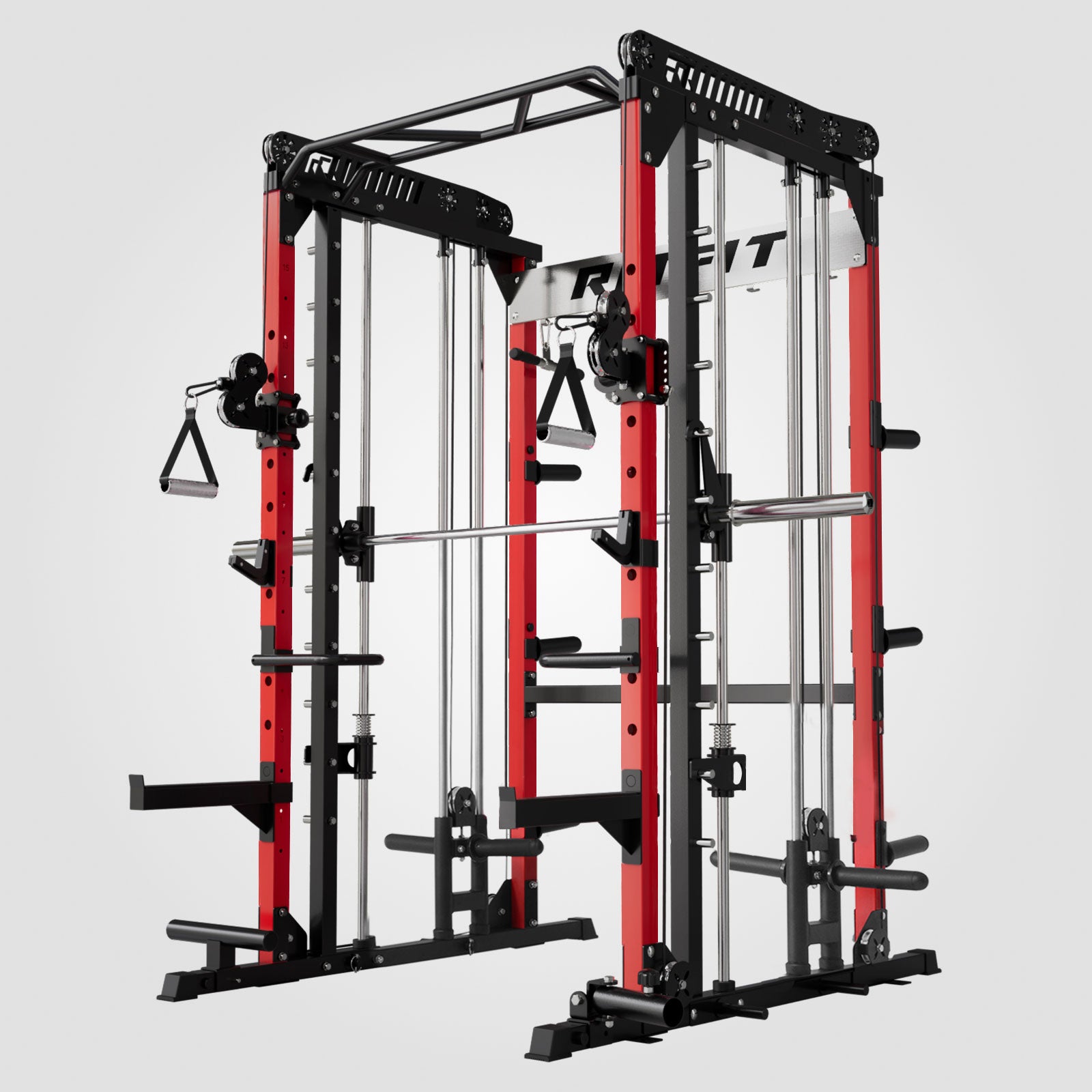
- RitFit PSR05 Smith Machine Home Gym Package
- RitFit Buffalo Smith Machine Home Gym Package
- Which Low Ceiling Smith Machine Should You Choose?
- How to Make Sure It Actually Fits Your Space
- Common Setup Mistakes to Avoid
- Safety Features That Really Matter
- Low Ceiling Home Gym Tips
- Training Tips for Low Ceiling Smith Machine Workouts
A Smith machine can fit in a low ceiling home gym if the machine height, flooring thickness, and overhead clearance all work together.
For most basement and garage gyms, start by measuring your usable ceiling height before choosing a compact Smith machine.
Key Takeaways
- Measure usable height first: Subtract flooring thickness and leave at least 2 to 3 inches of safety buffer above the machine.
- Compact height matters most: Smith machines around 82 to 83 inches are more realistic for many 7 to 8 ft home gym spaces.
- Check attachments carefully: Pull up bars, lat pulldowns, and cable stations may need more clearance than the frame alone.
- Match the machine to your training style: PSR05 works well for compact guided lifting, while Buffalo adds more cable training variety.
- Train around the ceiling: Seated presses, incline presses, rows, squats, lunges, RDLs, and hip thrusts fit low ceiling rooms better than standing overhead work.
Quick Answer: Can a Smith Machine Fit in a Low Ceiling Room?
Yes, a Smith machine can fit in a low ceiling room when the machine is shorter than your usable ceiling height.
The most important number is not the ceiling height alone, but the ceiling height after subtracting flooring thickness and safety clearance.
Why Ceiling Height Matters More Than You Think
Ceiling height matters because Smith machines combine a fixed frame, a guided bar path, and optional upper attachments.
Even if the frame fits, pull up bars, lat pulldown movement, and taller users can create clearance issues.
- Overhead clearance: A low ceiling can limit standing presses, pull ups, and tall cable movements.
- User height: A 6 ft 2 in lifter usually needs more motion clearance than a shorter lifter.
- Flooring thickness: Rubber mats protect your floor, but they also reduce usable height.
- Attachment clearance: Lat pulldown bars, cable handles, and pull up bars may need extra space above the frame.
How to Calculate Smith Machine Ceiling Clearance
Use this formula before buying any Smith machine for a basement, garage, attic, or spare room.
Usable ceiling height equals actual ceiling height minus flooring thickness minus safety buffer.
| Measurement | Example | Why It Matters |
|---|---|---|
| Actual ceiling height | 84 inches | This is your raw room height before equipment and flooring. |
| Flooring thickness | 0.75 inches | Rubber flooring reduces the final vertical space. |
| Safety buffer | 2 inches | This prevents the frame or attachments from sitting too close to the ceiling. |
| Usable ceiling height | 81.25 inches | This is the practical height you should compare with machine height. |
If your usable height is lower than the machine height, do not force the setup.
If the machine barely fits with less than 1 inch of clearance, choose a shorter model or reduce flooring thickness.
Understanding Smith Machine Height Requirements
Smith machine height requirements depend on the frame, bar path, attachments, flooring, and the exercises you plan to perform.
A compact frame is usually better for low ceiling home gyms than a tall commercial style station.
- Commercial style Smith machines: These often need more vertical room and may feel cramped in basements or garages.
- Compact home gym Smith machines: These are better suited for 7 to 8 ft rooms when the total rack height is verified.
- Smith machines with pull up bars: These need extra attention because the pull up bar can be the highest point.
- Smith machines with cables: These add training variety, but cable handles and pulldown bars need movement clearance.
Smith machine and leg press exercises can both create meaningful quadriceps demands, so the best choice should match your space and movement preferences rather than relying on one machine type alone.[1]
What to Look For in a Low Ceiling Smith Machine
The best low ceiling Smith machine should fit your room, support safe solo lifting, and still allow the exercises you actually use.
Start with height, then confirm footprint, bar path, safety stops, and attachment clearance.
- Machine height: Compare the highest point of the machine with your usable ceiling height.
- Stable frame: A compact machine still needs a stable base and solid steel structure.
- Guided Smith bar: A guided bar path can help users train confidently when lifting alone.
- Adjustable safety stops: Safety stops matter for bench press, squat, hip thrust, and failed reps.
- Clear front space: Leave room for a bench, plate loading, rows, lunges, and RDL setup.
- Compatible accessories: Choose attachments that add function without creating overhead problems.
Top Smith Machine Styles for Low Ceilings
Low ceiling rooms work best with compact Smith machines, short hybrid stations, or simple guided bar systems.
The right style depends on whether you value space savings, cable variety, or a more complete home gym setup.
Compact Smith Machine
A compact Smith machine is usually the safest starting point for 7 to 8 ft home gyms because the frame is easier to fit and plan around.
- Best for: Basement gyms, garage gyms, spare rooms, and users who want guided lifting.
- Main benefit: It provides Smith bar training without the height demands of a large commercial unit.
- Watch out for: Standing overhead presses may still be unrealistic for taller lifters.
Smith Machine With Cable System
A Smith machine with cables is best when you want more upper body and back training options without buying several separate machines.
- Best for: Users who want rows, pulldowns, cable curls, triceps work, and chest fly movements.
- Main benefit: It turns one footprint into a broader strength training station.
- Watch out for: Cable bars and handles may need more space during movement.
Short Low Profile Smith Machine
A short low profile Smith machine is useful when height is the main buying constraint.
- Best for: Very tight basements and simple home gym layouts.
- Main benefit: It keeps the vertical footprint easier to manage.
- Watch out for: Shorter frames may reduce bar travel for tall users or certain exercises.
Recommended Picks for Low Ceiling Home Gyms
Two RitFit models stand out for low ceiling planning because their official listed heights are within a compact home gym range.
The RitFit PSR05 Smith Machine Home Gym Package is the more compact choice, while the RitFit Buffalo Smith Machine Home Gym Package offers more cable training variety.
| Model | Official Height Detail | Best Fit | Training Focus |
|---|---|---|---|
| RitFit PSR05 | 82 inches, includes pull up bar | Compact low ceiling setups | Smith bar, lat pulldown, low row, basic full body strength |
| RitFit Buffalo | 81 inches rack height, 83 inches with pull up bar | Larger garage or basement gyms | Smith bar, cable crossover, pulldown, heavier all in one training |
For more options beyond these two models, compare the full RitFit Smith machine collection before buying.
RitFit PSR05 Smith Machine Home Gym Package
The PSR05 is a strong choice when your main concern is fitting a Smith machine into a lower ceiling room.
Its official product specs list an 82 inch rack height including the pull up bar, 70.8 inch rack length, 46.3 inch rack width, and 14.91 sq ft soft footprint.
The PSR05 works best for lifters who want a compact Smith machine station for squats, presses, rows, pulldowns, and general strength training.
Pair it with an adjustable bench like the RitFit adjustable foldable utility bench if your training plan includes seated presses or incline pressing in a low ceiling room.
Top Benefits
The Buffalo is best for lifters who want a stronger all in one training station and have enough floor space to use it safely.
- More training variety: The package supports Smith bar work, cable crossover, pulldown training, and rows.
- Low ceiling aware height: The listed 83 inch height including pull up bar can work in many 8 ft rooms with proper clearance.
- Large footprint: The 38.1 sq ft soft footprint means it needs more floor planning than the PSR05.
- Steel frame: The product page lists 2 x 3 inch 13 gauge steel in the upright and materials section.
- Cable pulley ratio: The listed 2 to 1 cable pulley ratio can support controlled cable movements for accessory work.
RitFit Buffalo Smith Machine Home Gym Package
The Buffalo package is better for users who want more cable training variety while still staying within a compact height range.
Its official specs list an 81 inch rack height, 83 inch height including the pull up bar, 68 inch rack width, and 38.1 sq ft soft footprint.
The Buffalo works best in a garage or basement where the ceiling can handle the 83 inch pull up bar height and the room has enough floor space for a wider station.
For loading options, compare compatible Olympic barbells and weight plates before finalizing your setup.
Which Low Ceiling Smith Machine Should You Choose?
Choose the PSR05 if your first priority is compact height and a smaller footprint.
Choose the Buffalo if you have more floor space and want more cable based training options.
| Choose This | Best For | Why |
|---|---|---|
| PSR05 | Compact basement or garage gym | Lower footprint, 82 inch listed height, simple full body Smith machine training. |
| Buffalo | Larger low ceiling home gym | More cable variety, wider station, 83 inch listed height including pull up bar. |
Both options can support strength training, but the right choice depends on ceiling clearance, floor space, and the exercises you actually plan to do.
Research comparing free weight and machine based training suggests both can support strength and hypertrophy outcomes when programmed well, so space fit and consistency matter more than equipment bias alone.[2]
How to Make Sure It Actually Fits Your Space
Measure the room before you buy, because low ceiling mistakes are expensive and difficult to fix after assembly.
Use a tape measure, check your flooring thickness, then compare your usable height with the machine’s highest point.
- Step 1: Measure ceiling height: Measure from the finished floor to the lowest ceiling point, including beams or ducts.
- Step 2: Subtract flooring thickness: Rubber mats may reduce usable height by 0.5 to 1 inch.
- Step 3: Add a safety buffer: Leave at least 2 to 3 inches above the machine when possible.
- Step 4: Check user movement: Tall lifters may need seated presses instead of standing overhead presses.
- Step 5: Plan front clearance: Leave enough room for bench setup, rows, lunges, and plate loading.
For floor protection, use stable gym flooring such as rubber high density interlocking gym flooring mats.
Common Setup Mistakes to Avoid
The most common setup mistake is building the machine before confirming the final location.
Once a Smith machine is assembled and loaded, moving it can damage floors, walls, or the machine frame.
| Setup Step | Common Error | How to Do It Right |
|---|---|---|
| Location | Building in the wrong spot | Measure doorways and assemble the machine in its final position. |
| Leveling | Ignoring a sloped floor | Use a level and stable shims so the bar path feels smooth. |
| Bolts | Tightening everything too early | Keep bolts hand tight until the frame is fully aligned. |
| Flooring | Using unstable foam mats | Use firm rubber flooring that supports heavy equipment. |
Squat mechanics can change with stance, trunk position, depth, and load, so a stable machine setup helps keep movement more consistent.[3]
Safety Features That Really Matter
Safety features matter because many home gym users lift without a spotter.
Look for secure hooks, adjustable safety stops, stable uprights, and enough room to exit a failed rep safely.
| Safety Feature | Purpose | Home Gym Tip |
|---|---|---|
| Wrist hooks | Help lock the Smith bar during a set | Practice the twist motion with no weight first. |
| Safety stops | Limit how far the bar can drop | Set them before heavy squats or presses. |
| Guide rails | Keep the Smith bar on a fixed path | Wipe rails clean and check for smooth movement. |
| Frame stability | Reduces rocking during training | Keep weight plates stored evenly and follow the manual. |
Resistance training injury risk is influenced by exercise type, training style, load, and user behavior, so proper setup and conservative progression matter in a home gym.[4]
Low Ceiling Home Gym Tips
A low ceiling gym works best when you protect vertical space and keep the floor clear.
Prioritize compact equipment, wall storage, low profile flooring, and seated exercise variations.
- Use wall storage: Store bands, cable handles, collars, and small attachments away from the lifting area.
- Choose low profile flooring: Thick flooring feels protective, but it also reduces usable ceiling height.
- Use seated shoulder work: Seated presses and incline presses are usually safer than standing overhead presses.
- Keep a clear bench path: Leave room to move a bench in and out of the Smith bar path.
- Store plates close: Plate storage reduces clutter and helps stabilize the lifting zone.
For compact strength setups beyond Smith machines, compare RitFit racks and Smith machines.
Training Tips for Low Ceiling Smith Machine Workouts
Low ceiling Smith machine workouts should avoid unnecessary overhead movement and focus on strong, controlled patterns.
Use seated shoulder work, presses, rows, squats, lunges, RDLs, hip thrusts, and cable accessories when space allows.
- Use seated presses: They train shoulders while reducing overhead clearance risk.
- Use incline pressing: High incline bench work can replace standing overhead pressing in low rooms.
- Train rows often: Smith rows and cable rows fit low ceilings well and support back development.
- Use hip thrusts and RDLs: These movements build lower body strength without overhead space demands.
- Keep accessories controlled: Cable curls, triceps pressdowns, and face pulls work best when handles stay clear of the ceiling.
Time efficient resistance training can still be effective when programs prioritize key compound lifts and well selected accessory movements.[5]
FAQs
Can a Smith machine fit under a 7 ft ceiling?
Yes. A Smith machine can fit under a 7 ft ceiling only if its total height is below your usable ceiling height. Measure the ceiling, subtract flooring thickness, then leave a safety buffer before buying any compact Smith machine for a basement or garage gym.
How much clearance should I leave above a low ceiling Smith machine?
Leave at least 2 to 3 inches above the highest point of the Smith machine. More clearance is better if the machine has a pull up bar, lat pulldown, cable handle path, or if you plan to move attachments near the ceiling.
What is the best Smith machine height for low ceilings?
The best Smith machine height for low ceilings is usually below your usable ceiling height after flooring and safety buffer are removed. For many home gyms, compact machines around 82 to 83 inches are easier to plan than taller commercial style units.
Can tall lifters use a Smith machine in a low ceiling room?
Yes. Tall lifters can use a Smith machine in a low ceiling room, but exercise selection may need to change. Seated presses, incline presses, rows, squats, hip thrusts, and RDLs usually work better than standing overhead presses in tight spaces.
Is PSR05 or Buffalo better for a low ceiling home gym?
PSR05 is usually better for tighter rooms, while Buffalo is better for users with more floor space. PSR05 has a smaller listed footprint, while Buffalo offers more cable training variety and needs more planning around width, depth, and attachment clearance.
Do cable attachments need extra ceiling clearance?
Yes. Cable attachments can need extra clearance because handles, bars, and pulldown paths move above or around the frame. Before buying, check the machine height, attachment path, your body position, and whether the movement brings equipment close to the ceiling.
Should I choose a Smith machine or power rack for a low ceiling room?
Choose a Smith machine if guided bar training, solo safety, and compact all in one function matter most. Choose a power rack if you prefer free barbell lifting and have enough height for the rack, bar path, pull up bar, and overhead movements.
How do I measure my room before buying a Smith machine?
Measure from the finished floor to the lowest ceiling point, then subtract flooring thickness and safety clearance. Also measure width, depth, doorway access, front bench space, and side plate loading room so the machine fits both your ceiling and your workout flow.
Final Thoughts
You can build a strong low ceiling home gym if you measure first and choose a Smith machine that fits your usable height.
PSR05 is the better compact choice, while Buffalo is better for users who want more cable variety and have enough floor space.
Disclaimer: This article is for general fitness and equipment planning only. Always follow the manufacturer’s assembly guide, safety instructions, and weight limits. If your floor is uneven, your ceiling is unusually low, or you are unsure about anchoring or assembly, consult a qualified installer before training.
References
- Migliaccio GM, Dello Iacono A, Ardigo LP, Samozino P, Iuliano E, Grgantov Z, Padulo J. Leg press vs Smith machine: quadriceps activation and overall perceived effort profiles. Front Physiol. 2018;9:1481. doi:10.3389/fphys.2018.01481
- Haugen ME, Varvik FT, Larsen S, Haugen AS, van den Tillaar R, Bjornsen T. Effect of free weight vs machine based strength training on maximal strength, hypertrophy and jump performance: a systematic review and meta analysis. BMC Sports Sci Med Rehabil. 2023;15(1):103. doi:10.1186/s13102-023-00713-4
- Straub RK, Powers CM. A biomechanical review of the squat exercise: implications for clinical practice. Int J Sports Phys Ther. 2024;19(4):490-501. doi:10.26603/001c.94600
- Serafim TT, de Oliveira ES, Maffulli N, Migliorini F, Okubo R. Which resistance training is safest to practice? A systematic review. J Orthop Surg Res. 2023;18(1):185. doi:10.1186/s13018-023-03644-5
- Iversen VM, Norum M, Schoenfeld BJ, Fimland MS. No time to lift? Designing time efficient training programs for strength and hypertrophy: a narrative review. Sports Med. 2021;51(10):2079-2095. doi:10.1007/s40279-021-01490-1