








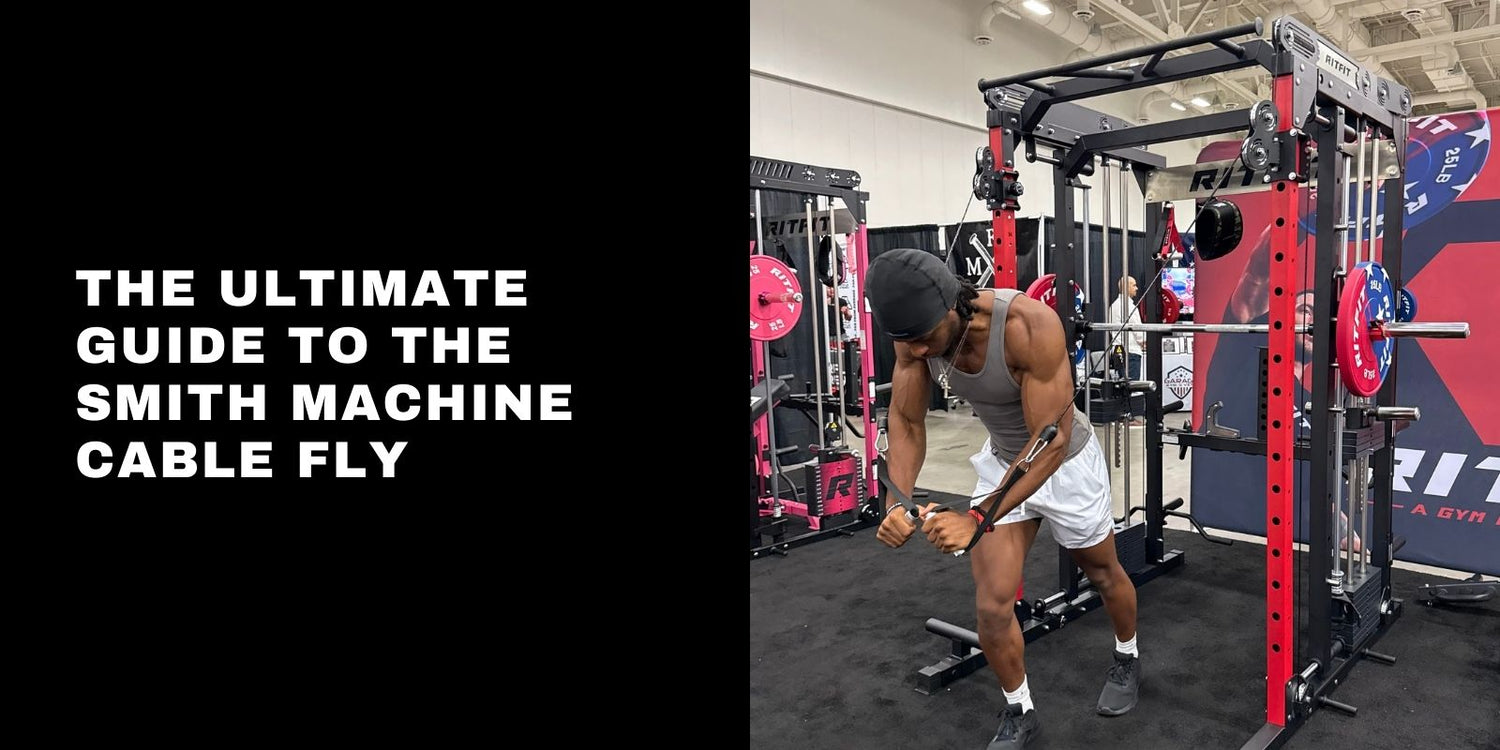
A Smith machine cable fly can build chest muscle at home when your setup, arm path, and load are right. This guide shows how to perform the movement on compact cable based home gym systems, keep shoulder stress low, and hold strong chest tension on every rep.
You will learn the best pulley height, a step by step setup and form guide, angle variations, narrow width fixes, and a simple way to program the exercise into a chest session.
Quick Answer: Yes, a Smith machine cable fly can build your chest at home when you set the pulleys at chest height, keep a soft fixed elbow bend, and drive the upper arms across the body. It works best as chest isolation volume after pressing rather than as your main overload movement.
Key Takeaways
- Stance: Use a split stance with a slight forward lean to stay stable and keep the movement centered on the chest.
- Elbow: Start with a soft, fixed elbow bend and keep that bend consistent through the whole rep.
- Range: Stop the stretch when chest tension is high and shoulder position is still clean.
- Narrow machines: Step farther forward and bring the upper arm across the body at the finish.
- Programming: Use the exercise as chest isolation work after presses, not as your main overload movement.
Why Does a Smith Machine Cable Fly Build the Chest at Home?
A Smith machine cable fly builds the chest because it trains horizontal adduction with continuous cable resistance, which helps many lifters hold tension on the pecs near the finish of each rep. A biomechanics paper also suggests that pressing and cable pulley work complement each other for fuller upper limb range training, while cable crossover patterns demand good stabilization and sensible loading.[1]
- Home gym friendly: You do not need a huge commercial crossover. A compact dual pulley setup still works well when your stance and finish are adjusted to the machine width.
- Good after presses: The movement fits well after Smith pressing, dumbbell pressing, or push ups. It lets you challenge the chest without making triceps strength the main limiter.
- More chest specific: The goal is not maximal loading. The goal is driving the upper arm across the body with a stable torso and steady chest tension.
On a compact machine with dual adjustable pulleys, such as the RitFit M1 Smith machine with cable crossover, you get the setup range this movement needs without taking up a full room.
"We have to train adduction.
This is not an optional exercise if you want your biggest chest.
I don't like the unsupported dumbbell flyes.
"
Jeff Cavaliere, MSPT, CSCS, Physical Therapist and Strength Coach, Creator of ATHLEAN-X, Generation Iron
What Muscles Does the Smith Machine Cable Fly Work?
The pectoralis major is the main target, especially when you keep the elbows softly bent and think about bringing the upper arms toward each other rather than pressing the handles forward. Resistance exercise drives hypertrophy through programming and muscle biology together, which is why setup quality, effort, and recovery matter more than any single cue.[5]
- Pectoralis major: This is the prime mover. Mid height flys usually feel strongest through the mid chest, while lower or higher pulley positions can bias the upper or lower fibers.
- Anterior deltoid: The front shoulder helps stabilize and guide the arm path. It should assist, but it should not become the main muscle you feel.
- Biceps and forearm: These work mainly as grip and elbow stabilizers. If they dominate the set, the load is often too heavy or the handle path is drifting into a press.
- Core and lower body: A standing fly needs trunk stiffness and a stable stance. That is especially true on compact home gym systems with narrower cable angles.
What Equipment Do You Need for a Smith Machine Cable Fly?
The best Smith machine cable fly setup starts with understanding the pulley path, handle position, and machine width in front of you. On many home gym systems, the narrower cable origin changes the feel of peak contraction, so small setup changes matter more than on a commercial crossover.
- Adjustable pulleys: Dual adjustable pulleys give you the most useful setup range for fly angles. Machines that pair a Smith bar with a cable crossover are more versatile for fly angles than a fixed single line pulley.
- Machine category: Some readers will do this movement on a full rack system, and others on a compact trainer. Browsing a Smith machine collection helps you see how cable layout changes between models.
- Pulley ratio feel: Many home trainers use a lighter handle feel than the plates or stack number suggests. That can actually be helpful for flys, because the exercise rewards precision more than raw load.
- Bench option: A seated variation can improve bracing on some systems. Pairing the setup with a RitFit Gator adjustable weight bench makes it easier to test seated and incline fly variations.
How Do You Set Up a Smith Machine Cable Fly?
Good setup protects the shoulder and makes the rep feel like chest work from the first inch of motion. You need adjustable pulleys, a handle you can control, enough floor space to step forward, and a load light enough to keep the arm path clean.
- Pulley height: Set both pulleys at about chest or shoulder height for a standard fly. Move them lower for an upper chest bias and higher for a lower chest bias.
- Stance: Use a split stance first. One foot forward and one foot back makes it easier to resist the pull of the cables without swaying.
- Torso angle: Lean slightly forward. A small forward lean helps you stay stacked over the movement instead of letting the cables pull you upright.
- Shoulder position: Keep the chest up and the shoulders set, not shrugged. You want a stable upper back, not a rolled forward shoulder at the bottom.
- Elbow bend: Start with a soft bend and keep it nearly fixed. This keeps the exercise a fly instead of turning it into a standing cable press.
- Handle selection: Standard D handles work well for most lifters. For more options on attachments and home gym cable work, see this Smith machine with cable system workout guide.
How Do You Perform a Smith Machine Cable Fly?
Controlled execution matters more than heavy loading in a Smith machine cable fly. A broad load range can build muscle when effort is high enough, so there is no need to force this exercise into a heavy strength movement.[2]
- Step 1: Set the pulleys and grab the handles. Bring both handles close to your body before you step into position so you do not start from a deep stretched position.
- Step 2: Step forward and lock in your stance. Get into a split stance, brace your trunk, and raise the handles to the start position with a chest press style path.
- Step 3: Open under control. Let the arms move out and back only as far as you can keep chest tension and shoulder control, not as far as the cables will allow.
- Step 4: Bring the upper arms across the body. Think about hugging a barrel, not pushing the handles away. On narrow machines, let the hands pass slightly across the midline to keep the chest active at the finish.
- Step 5: Use a controlled eccentric and a clean squeeze. A controlled lowering phase helps preserve tension and technique, and movement tempo changes total tension exposure over time.[3]
Which Angles and Variations Shift Chest Focus?
Low to high, mid height, and high to low fly setups all train the chest, but the line of pull changes which region tends to feel most involved. The best angle lets you keep pressure on the pecs without losing shoulder position or turning the rep into a press.
- Low to high fly: Start with the pulleys low and finish around upper chest or shoulder level. Many lifters use this variation when they want more upper chest involvement.
- Mid height fly: This is the standard version for overall chest development. It is usually the easiest angle to learn and the easiest to feel in the chest.
- High to low fly: Start higher and finish lower, around lower chest or upper ab level. This often feels strong when the goal is a downward and inward chest squeeze.
- Single arm fly: One arm at a time can be a smart choice on narrow machines. It gives you more room to cross the body and makes left to right differences easier to spot.
- Seated fly: Seated versions reduce balance demands. They can be especially useful when standing versions turn into a torso swing.
How Do You Adjust the Cable Fly for Narrow Home Gym Widths?
Narrow home gym systems can still make Smith machine cable flys productive, but they reward smart positioning more than ego loading. That is one reason many readers compare compact racks, cable layouts, and pulley feel before buying, as covered in this piece on plate loaded vs weight stack Smith machines.
- Step farther forward: This changes the cable angle and usually improves chest tension near the finish. It is often the easiest fix on compact trainers.
- Use a smaller bottom range: Do not chase a dramatic stretch just because the machine is narrower. Stop where you still control the shoulder and keep the chest loaded.
- Finish across the body: A slight cross body finish helps compensate for a narrow cable origin. Focus on the upper arm moving inward, not on smashing the handles together.
- Try one arm at a time: Unilateral work often feels smoother on narrow systems. It also helps you match range and control from side to side.
- Compare with related chest work: This movement pairs well with the ideas in best Smith machine chest workouts if you want a fuller chest session around it.
What Are Common Smith Machine Cable Fly Mistakes and Fixes?
Most problems come from using too much load, too much stretch, or too much arm bend change. A recent pec fly ultrasound study also found measurable pectoralis major thickness changes during the exercise, and larger changes when real time biofeedback improved execution, which reinforces the value of controlled technique over careless reps.[4]
- Mistake 1, turning it into a press: If the elbows keep flexing and extending, the movement stops being a true fly. Lower the load and keep the elbow angle almost fixed.
- Mistake 2, overstretching the shoulder: Going too deep usually shifts stress forward into the shoulder. Shorten the bottom range until chest tension stays clear and shoulder position stays clean.
- Mistake 3, shrugging and rolling forward: This often happens when the set gets too heavy or the stance is too weak. Reset your upper back and reduce the load before adding more reps.
- Mistake 4, swinging the torso: Momentum hides poor control. Use a staggered stance or sit down and make each rep look the same.
- Mistake 5, forcing equal range on both sides: Small asymmetries are common. Use single arm work when needed and keep the stronger side from dictating the whole set.
How Do You Program the Smith Machine Cable Fly?
The Smith machine cable fly works best as a chest isolation lift placed after a heavier press, or as a lighter chest focused movement when shoulder comfort matters. It is not the best exercise for chasing your heaviest numbers, but it is very useful for accumulating quality chest volume.
- After pressing: Use it after flat, incline, or Smith pressing. That order lets you overload first, then finish the chest with a more focused movement. For more on safe Smith work, see this Smith machine safety guide.
- As a lighter chest day option: Use it earlier in the session when you want cleaner chest work without maximal joint stress. This can work well for lifters who do not love very heavy flys. Review this how to use a Smith machine at home guide for the wider movement options.
- Typical hypertrophy range: Start with 2 to 4 sets of 10 to 15 reps. Keep 1 to 3 hard reps in reserve early on, then push closer to failure once technique is stable.
- Tempo idea: Lower the handles under control, pause briefly in the stretch if you can still keep tension, then squeeze back in without jerking. Clean reps matter more than rep speed.
- Simple pairing: Pair it with incline pressing, push ups, or machine chest work. Readers building a broader all in one setup can also explore this functional trainer with Smith machine guide.
FAQs About the Smith Machine Cable Fly
Can you do a Smith machine cable fly on a narrow home gym?
Yes.
A narrow home gym can still make Smith machine cable flys effective, if you step forward enough, keep a soft elbow bend, and finish by bringing the arms across the midline.
The goal is chest tension, not the widest possible stretch or the heaviest possible load.
What pulley height is best for a Smith machine cable fly?
Mid height is best for a standard Smith machine cable fly, because it lines the pull up with the middle chest. Lower pulleys shift emphasis toward the upper chest, while higher pulleys shift emphasis toward the lower chest, so the best setting depends on the angle you want to train.
How far should you stretch on a Smith machine cable fly?
You should stretch only until you feel clear chest tension without losing shoulder position. Going much deeper than your active control allows does not make the Smith machine cable fly better, and it can shift stress away from the chest and toward the front of the shoulder.
Should a Smith machine cable fly replace pressing for chest growth?
No. A Smith machine cable fly works best as a chest isolation lift, not as your only chest movement. Pressing is still useful for overload, while cable flys help you train the chest through a long arc and keep tension high near peak contraction.
Why do I feel my shoulders more than my chest during a Smith machine cable fly?
You usually feel the shoulders more when the load is too heavy, the stretch is too deep, or the elbows keep changing angle. A better Smith machine cable fly uses a fixed soft bend, a controlled eccentric, and a finish that brings the upper arm across the body.
Is a seated Smith machine cable fly better than a standing version?
It depends.
A seated Smith machine cable fly can improve stability and reduce swaying, which helps some lifters focus on the chest.
A standing version can feel more natural on compact home gyms, especially when you need to step forward to improve cable angle and tension.
How often should you do a Smith machine cable fly for chest growth?
Two to three chest sessions per week is enough for most lifters, with the cable fly placed after a press. Keep it to 2 to 4 sets of 10 to 15 reps and progress weight or reps only when your technique stays clean.
Conclusion
The Smith machine cable fly is a strong home gym chest movement when you respect setup, shoulder position, and machine width. Keep the load controlled, use the angle that lets you feel the chest best, and treat the exercise as focused chest volume rather than a maximal strength test.
Start light, refine your form, and pair the fly with pressing to keep your chest session simple and effective. You can also check RitFit sales and bundles when you are ready to build out your home gym.
Disclaimer
This article is for general educational purposes only and is not medical advice. Stop the exercise if you feel sharp pain, instability, numbness, or unusual joint symptoms, and consult a qualified clinician or coach if you have a current injury or movement limitation.
References
1. Schütz P, Zimmer P, Zeidler F, Plüss M, Oberhofer K, List R, Lorenzetti S. Chest Exercises: Movement and Loading of Shoulder, Elbow and Wrist Joints. Sports. 2022;10(2):19. doi:10.3390/sports10020019
2. Lopez P, Radaelli R, Taaffe DR, Newton RU, Galvão DA, Trajano GS, et al. Resistance Training Load Effects on Muscle Hypertrophy and Strength Gain: Systematic Review and Network Meta analysis. Med Sci Sports Exerc. 2021;53(6):1206-1216. doi:10.1249/MSS.0000000000002585
3. Wilk M, Zajac A, Tufano JJ. The Influence of Movement Tempo During Resistance Training on Muscular Strength and Hypertrophy Responses: A Review. Sports Med. 2021;51(8):1629-1650. doi:10.1007/s40279-021-01465-2
4. Cai S, Lin Y, Chen H, Huang Z, Zhou Y, Zheng Y. Automated analysis of pectoralis major thickness in pec-fly exercises: evolving from manual measurement to deep learning techniques. Vis Comput Ind Biomed Art. 2024;7(1):8. doi:10.1186/s42492-024-00159-6
5. Lim C, Nunes EA, Currier BS, McLeod JC, Thomas ACQ, Phillips SM. An Evidence-Based Narrative Review of Mechanisms of Resistance Exercise-Induced Human Skeletal Muscle Hypertrophy. Med Sci Sports Exerc. 2022;54(9):1546-1559. doi:10.1249/MSS.0000000000002929





