Table of Contents
Squat machines help you train legs with more stability, clearer movement control, and less need for free weight balance. The best option depends on your goal, space, joint comfort, and whether you train in a commercial gym or a home gym.
This guide compares the most common types of squat machines, explains how to use each one, and shows which option fits beginners, bodybuilders, athletes, and home gym users.
Key Takeaways
- Smith machines are best for versatility: They support squats, presses, lunges, rows, calf raises, and many guided bar exercises in one footprint.
- Hack squat machines are best for quad focus: The angled platform and back support help lifters keep tension on the front of the thighs.
- Belt squat machines are best for reducing axial loading: They load the hips instead of placing weight across the shoulders.
- Leg press and hack squat machines are strong home gym choices: They combine lower body training options without needing several separate machines.
- No squat machine removes the need for good form: Foot placement, knee tracking, depth, bracing, and load control still matter on every machine.
Why Use Squat Machines?
Squat machines make lower body training more controlled by guiding the load through a fixed or supported path. This can help beginners, solo home gym users, and advanced lifters train legs with less balance demand than free weight squats.
Machines are not automatically safer than barbell training, but they can make setup, reracking, and focused muscle tension easier. The best squat machine still depends on enough weekly work, because higher training volume can enhance hypertrophy when recovery is managed.[1]
- For beginners: Machines reduce the learning curve by limiting balance demands.
- For muscle growth: Machines can help lifters train close to fatigue with more consistent movement paths.
- For home gyms: Multi function machines save space by replacing several single purpose stations.
- For joint sensitive lifters: Machines allow more controlled range of motion and foot placement adjustments.
Quick Comparison of Squat Machine Types
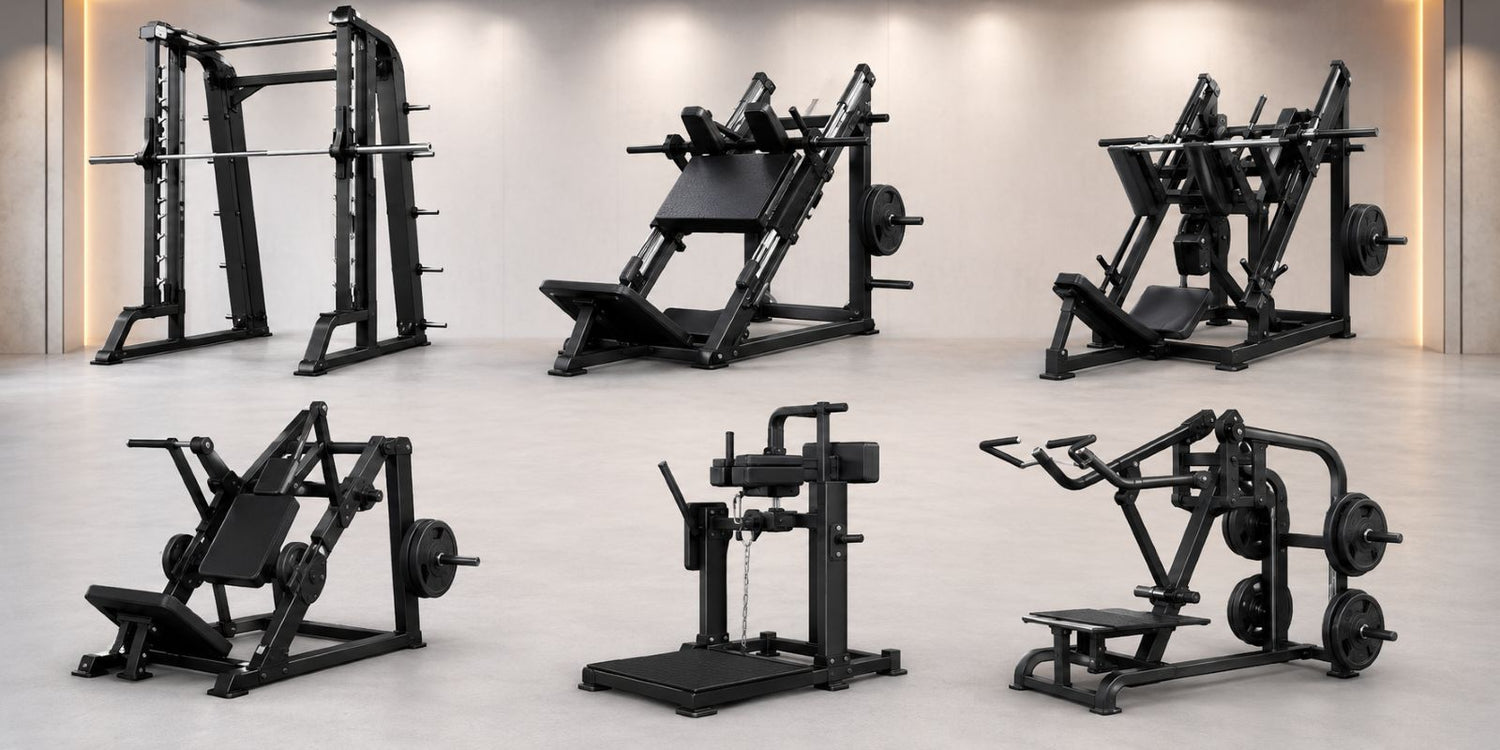
The fastest way to choose a squat machine is to match the equipment to your main training goal. Use the comparison below as a practical starting point before looking at space, budget, and exercise variety.
| Machine Type | Best For | Main Training Feel | Home Gym Fit |
|---|---|---|---|
| Smith Machine | Beginners, solo lifters, full body training | Guided bar path with high exercise variety | Excellent |
| Hack Squat Machine | Quad growth and bodybuilding | Supported, knee dominant leg training | Good if space allows |
| V Squat Machine | Natural squat pattern and athletic carryover | Supported arc with more hip involvement | Moderate |
| Pendulum Squat Machine | Deep range of motion and advanced leg training | Smooth arc with strong quad and glute demand | Limited |
| Belt Squat Machine | Reducing shoulder and spine loading | Hip loaded squat pattern | Good with compact attachments |
| Leverage Squat Machine | Compact plate loaded lower body work | Pivoting resistance with supported setup | Good |
Smith Machine
What It Is
A Smith machine uses a barbell fixed within rails, creating a guided vertical or near vertical path. It is one of the most versatile squat machine options because it supports squats, presses, rows, lunges, calf raises, and many other exercises.
- Best for: Beginners, home gym users, solo lifters, full body training, and controlled squat practice.
- Main muscles: Quads, glutes, hamstrings, calves, spinal erectors, and core depending on stance and movement.
- Home gym value: A Smith machine for home gym training can replace several separate stations when space is limited.
- Key limitation: The fixed path may not match every lifter’s natural bar path, so foot position matters.
How to Use a Smith Machine Squat
Set the bar across your upper back, place your feet slightly forward, unlock the hooks, and squat under control. Keep your knees tracking over your toes, brace your core, and rerack the bar only after fully regaining balance.
- Step 1: Adjust the bar height so it sits just below shoulder level before you step under it.
- Step 2: Place your feet slightly ahead of the bar to avoid forcing your knees too far forward.
- Step 3: Lower with control until you reach a comfortable depth with stable knee tracking.
- Step 4: Drive through the midfoot and heel, then rotate the bar back into the hooks.
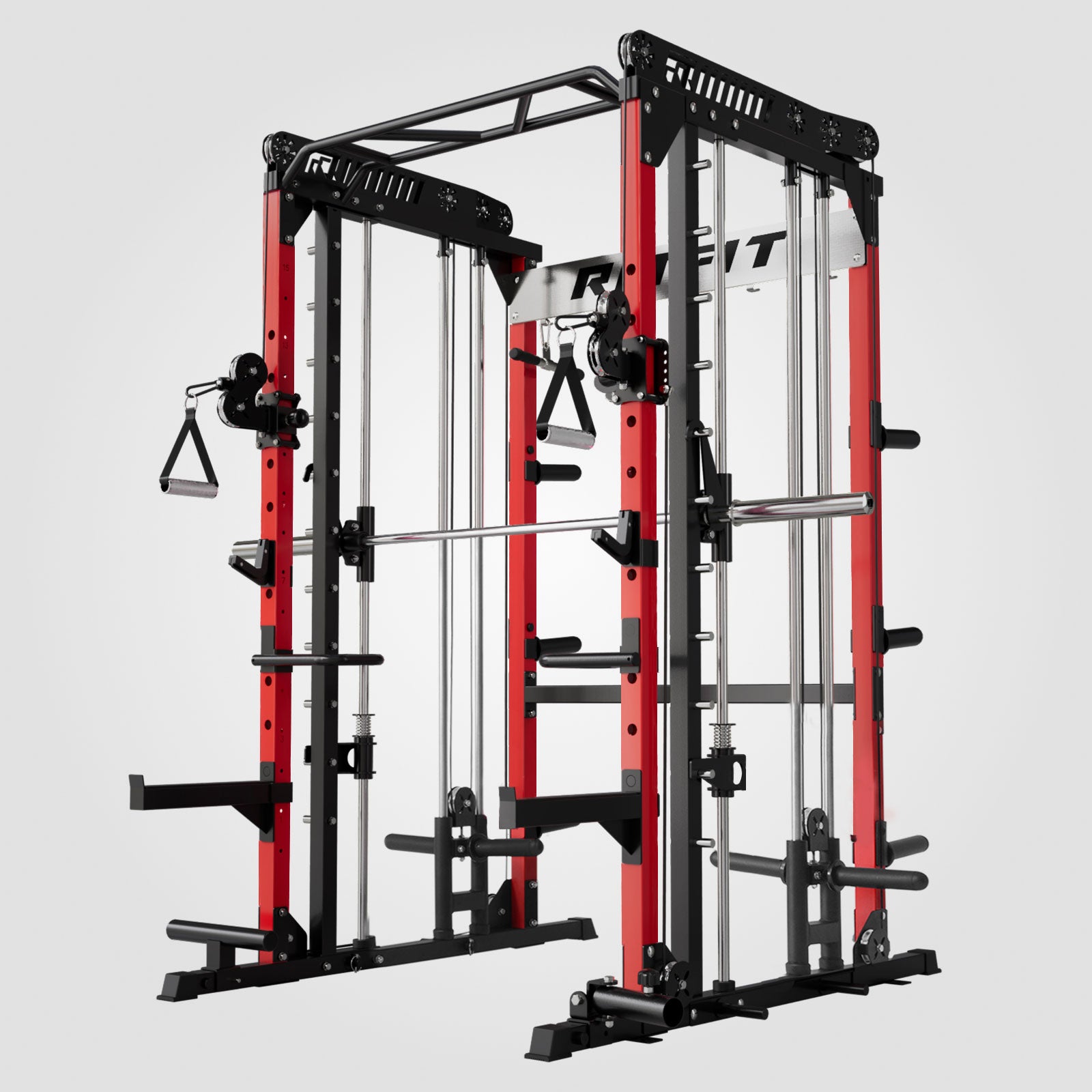
For a complete setup built around guided bar training, cable work, and home strength training, the RitFit M1 Smith Machine home gym package is a practical option for compact spaces.
Hack Squat Machine
What It Is
A hack squat machine places your back against a pad while your shoulders sit under pads and your feet press against an angled platform. It is popular for quad focused training because the machine supports the torso and encourages strong knee flexion.
- Best for: Bodybuilders, quad development, high rep leg training, and lifters who want more support than barbell squats.
- Main muscles: Quads, glutes, adductors, and calves depending on stance and platform position.
- Home gym value: A leg press and hack squat machine can combine multiple lower body patterns in one station.
- Key limitation: It can still stress the knees if depth, load, or foot placement is poorly controlled.
How to Use a Hack Squat Machine
Place your back flat against the pad, set your feet about shoulder width, release the safety handles, and lower under control. Stop at a depth you can control without heel lift, knee collapse, or hip shifting.
- Step 1: Keep your shoulders and back fully supported before unlocking the machine.
- Step 2: Place your feet high enough to keep your heels down throughout the rep.
- Step 3: Lower smoothly and avoid bouncing out of the bottom position.
- Step 4: Press upward without snapping the knees into a hard lockout.
Leg press variants can strongly target the quadriceps, and research on leg press exercise shows high quadriceps activity depending on setup and execution.[4]
V Squat Machine
What It Is
A V squat machine uses angled foot platforms and shoulder support to create a more natural squat style path than many linear machines. It often feels closer to a supported back squat because the hips and knees both contribute strongly.
- Best for: Lifters who want machine support without losing too much natural squat feel.
- Main muscles: Quads, glutes, adductors, hamstrings, and calves depending on stance.
- Home gym value: It is useful but usually less space efficient than a multi function Smith machine.
- Key limitation: V squat machines are less common and often require more floor space.
How to Use a V Squat Machine
Step onto the platforms, position your shoulders under the pads, unlock the handles, and squat down with a controlled torso angle. Drive through the midfoot and keep the knees aligned with the toes throughout the lift.
- Step 1: Start with a moderate stance that feels balanced across the whole foot.
- Step 2: Keep your chest tall and avoid letting the hips shift unevenly.
- Step 3: Use a depth that lets you stay controlled without pelvic tuck or heel lift.
Pendulum Squat Machine
What It Is
A pendulum squat machine uses an arcing arm that lets the body move through a smooth curved path. It can allow deep range of motion with strong quad and glute tension, but it is usually more common in commercial gyms than home gyms.
- Best for: Advanced lifters, bodybuilders, deep range of motion training, and commercial gym leg days.
- Main muscles: Quads, glutes, adductors, and hamstrings depending on stance and depth.
- Home gym value: It is effective but often too large or specialized for small home gyms.
- Key limitation: The deep arc can be demanding, so start light and progress slowly.
How to Use a Pendulum Squat Machine
Set your shoulders and back into the pads, place your feet firmly on the platform, unlock the machine, and descend slowly. Use a depth that matches your mobility and keep the movement smooth rather than forcing the bottom position.
- Step 1: Begin with conservative loading because the bottom range can feel intense.
- Step 2: Keep your feet fully planted to avoid shifting stress into the knees.
- Step 3: Control the eccentric phase and avoid bouncing out of deep flexion.
Deeper squat and lunge variations can change lower limb joint demands, so range of motion should match strength, control, and comfort.[5]
Belt Squat Machine
What It Is
A belt squat machine loads weight through a belt around the hips instead of across the shoulders. This makes it useful for lifters who want heavy leg training while reducing shoulder loading and axial loading compared with traditional back squats.
- Best for: Lifters with shoulder limitations, back sensitivity, high volume leg work, and lower body focused training.
- Main muscles: Quads, glutes, adductors, hamstrings, and calves depending on stance and depth.
- Home gym value: A compact belt squat attachment can add hip loaded squats without requiring a full standalone machine.
- Key limitation: The setup takes practice, and the belt position must feel secure before loading heavy.
How to Use a Belt Squat Machine
Secure the belt around your hips, attach it to the loading point, stand tall on the platform, and squat with a controlled trunk. Keep your ribs stacked over your pelvis and avoid letting the weight pull you forward.
- Step 1: Attach the belt before stepping into your working stance.
- Step 2: Start with a light load to test belt comfort and balance.
- Step 3: Squat through a comfortable range while keeping the torso controlled.
- Step 4: Finish the set only after the load is safely supported by the machine.
Leverage Squat Machine
What It Is
A leverage squat machine uses a pivoting arm and plate loaded resistance to guide the squat through an arc. It can feel smoother than a fully vertical machine while still offering support and simple loading.
- Best for: Compact lower body training, plate loaded home gyms, and users who want a simple guided squat station.
- Main muscles: Quads, glutes, adductors, calves, and hamstrings depending on stance.
- Home gym value: It can work well when the user wants a dedicated leg station without a full commercial machine.
- Key limitation: It usually offers less total exercise variety than an all in one Smith machine system.
How to Use a Leverage Squat Machine
Load the weight horns evenly, place your back and shoulders into position, release the safety mechanism, and squat through a controlled arc. Keep the movement steady and avoid letting the machine pull you out of your natural stance.
- Step 1: Load plates evenly on both sides before entering the machine.
- Step 2: Confirm the safety stop and handles are within easy reach.
- Step 3: Use smooth reps instead of fast drops or hard lockouts.
Choosing the Right Squat Machine
The right squat machine is the one that matches your goal, space, body mechanics, and training style. A machine that fits your room and supports consistent training is usually more valuable than a more specialized machine you rarely use.
- For beginners: Choose a Smith machine if you want guided movement, easy reracking, and a simpler learning curve.
- For quad growth: Choose a hack squat machine or a leg press and hack squat machine if your main goal is thigh development.
- For back comfort: Choose a belt squat option if you want to reduce shoulder loading and axial loading.
- For home gym versatility: Choose an all in one Smith machine system if you want squats plus upper body and cable training.
- For lower body specialization: Choose a dedicated leg press and hack squat machine if leg day is your top priority.
Heavy loads are useful for maximal strength, while hypertrophy can be trained across a range of loads when sets are challenging and technique is consistent.[2]
Best Squat Machine for a Home Gym
A Smith machine is usually the best squat machine for a home gym when versatility matters more than single exercise specialization. It can support lower body training, pressing, rowing, cable work, and safer solo lifting in one footprint.
If your priority is only leg training, a dedicated leg press and hack squat unit may be the better choice. For users who already own a rack, the hack squat rack attachment can add a focused lower body option without buying a full standalone machine.
For users comparing full equipment categories, the RitFit strength machines collection is a better starting point than choosing from isolated product pages.
Common Mistakes to Avoid
The most common squat machine mistakes come from poor setup, excessive load, and treating the machine as if it removes all technique requirements. A guided path can help stability, but it does not replace bracing, foot pressure, knee control, and safe progression.
- Knees caving inward: Keep the knees tracking in line with the toes to reduce joint stress and improve force transfer.
- Heels lifting: Keep pressure through the midfoot and heel so the movement stays controlled.
- Too much load too soon: Add weight gradually and stop when form changes noticeably.
- Forcing depth: Use a range of motion you can control without pain, bouncing, or hip shifting.
- Ignoring machine setup: Adjust bar height, foot position, pad position, and safety stops before adding heavy weight.
For additional technique guidance, review Smith machine squat exercises and safe Smith machine training at home before progressing to heavy sets.
Programming Tips for Squat Machines
Use squat machines to add controlled leg volume, not to hide poor movement quality. Most lifters can start with 2 to 4 working sets per exercise and adjust based on recovery, soreness, and performance.
- For strength: Use heavier loads, lower reps, longer rest, and strict control.
- For hypertrophy: Use moderate to high effort sets in the 6 to 15 rep range for most machine squat work.
- For beginners: Use lighter loads until setup, bracing, and knee tracking feel consistent.
- For joint comfort: Shorten the range of motion only when needed and increase it gradually as control improves.
Research on resistance training load suggests that muscle growth can occur across different loading ranges when sets are performed with sufficient effort and progression.[3]
FAQs
What type of squat machine is best for beginners?
A Smith machine is usually the easiest squat machine for beginners because the guided bar path reduces balance demands. New lifters can practice squat depth, foot placement, and controlled tempo while still learning how to brace, track the knees, and load the legs gradually.
Is a Smith machine good for squats at home?
Yes. A Smith machine is good for home squats when you want guided bar movement, easy reracking, and solo training confidence. It also supports presses, rows, lunges, calf raises, and cable movements when paired with the right home gym setup.
Which squat machine is best for quad growth?
A hack squat machine is often the best squat machine for quad growth because it supports the torso and encourages deep knee flexion. A leg press and hack squat machine can also target the quadriceps strongly when foot placement, range of motion, and load are controlled.
Can squat machines replace barbell squats?
No. Squat machines should not fully replace barbell squats for every lifter, because free weight squats train more balance and trunk control. Machines are best used as complementary tools for safer volume, focused muscle tension, and leg training when barbell squats feel limiting.
Are belt squat machines better for back comfort?
Yes. Belt squat machines can be better for back comfort because the load is attached near the hips instead of resting across the shoulders. They may reduce axial loading, but users still need good posture, controlled depth, and careful load selection.
How should I choose between a hack squat and a leg press hack squat machine?
Choose a hack squat if you mainly want quad focused training with a fixed path. Choose a leg press hack squat machine if you want more lower body variety, because it can support pressing, hack squats, and calf raises in one station.
Do squat machines work glutes and hamstrings?
Yes. Squat machines can work glutes and hamstrings, but the emphasis depends on machine type, stance, depth, and foot placement. Higher or wider foot positions usually shift more work toward the hips, while lower positions often increase quad demand.
Conclusion
Squat machines are valuable tools for building stronger legs with more control, stability, and exercise variety. The best choice depends on whether you need beginner friendly guidance, quad focused training, reduced axial loading, or a complete home gym solution.
For most home gym users, a Smith machine offers the best balance of space efficiency and versatility, while leg press, hack squat, and belt squat options are excellent for more specialized lower body training.
Disclaimer
This content is for general fitness education only and is not medical advice. Stop any exercise that causes sharp pain, dizziness, numbness, or unusual discomfort, and consult a qualified coach or healthcare professional before training with injuries, medical conditions, or heavy loads.
References
- Schoenfeld BJ, Contreras B, Krieger J, Grgic J, Delcastillo K, Belliard R, Alto A. Resistance Training Volume Enhances Muscle Hypertrophy but Not Strength in Trained Men. Med Sci Sports Exerc. 2019;51(1):94-103. doi:10.1249/MSS.0000000000001764
- Schoenfeld BJ, Grgic J, Van Every DW, Plotkin DL. Loading Recommendations for Muscle Strength, Hypertrophy, and Local Endurance: A Re-Examination of the Repetition Continuum. Sports (Basel). 2021;9(2):32. doi:10.3390/sports9020032
- Lopez P, Radaelli R, Taaffe DR, Newton RU, Galvão DA, Trajano GS, et al. Resistance Training Load Effects on Muscle Hypertrophy and Strength Gain: Systematic Review and Network Meta-analysis. Med Sci Sports Exerc. 2021;53(6):1206-1216. doi:10.1249/MSS.0000000000002585
- Martín-Fuentes I, Oliva-Lozano JM, Muyor JM. Evaluation of the Lower Limb Muscles’ Electromyographic Activity during the Leg Press Exercise and Its Variants: A Systematic Review. Int J Environ Res Public Health. 2020;17(13):4626. doi:10.3390/ijerph17134626
- De Roeck J, Van Houcke J, Almeida D, Galibarov P, De Roeck L, Audenaert EA. Statistical Modeling of Lower Limb Kinetics During Deep Squat and Forward Lunge. Front Bioeng Biotechnol. 2020;8:233. doi:10.3389/fbioe.2020.00233