The USMNT 2026 World Cup roster is official, and Mauricio Pochettino has selected a 26 player squad built around experience, athleticism, and home soil pressure. This guide breaks down the full roster, the biggest tactical questions, the Group D path, and what the squad means for American soccer.
For roster accuracy, this article uses the official U.S. Soccer announcement and FIFA tournament format information as the foundation for all player and group stage details.
Key Takeaways
- Official roster confirmed: Mauricio Pochettino named 26 players for the USMNT 2026 World Cup roster on May 26, 2026.
- Balanced experience profile: The squad includes 13 players from the 2022 World Cup roster and 13 players going to their first World Cup.
- Group D path: The United States will face Paraguay, Australia, and Türkiye from June 12 to June 25.
- Main tactical question: The midfield has only six selected players, making Tyler Adams, Weston McKennie, Gio Reyna, and Malik Tillman especially important.
- Fitness angle: Soccer performance depends on speed, repeated sprint ability, lower body strength, core control, and recovery across a congested tournament.
Table of Contents
The Official USMNT 2026 World Cup Roster
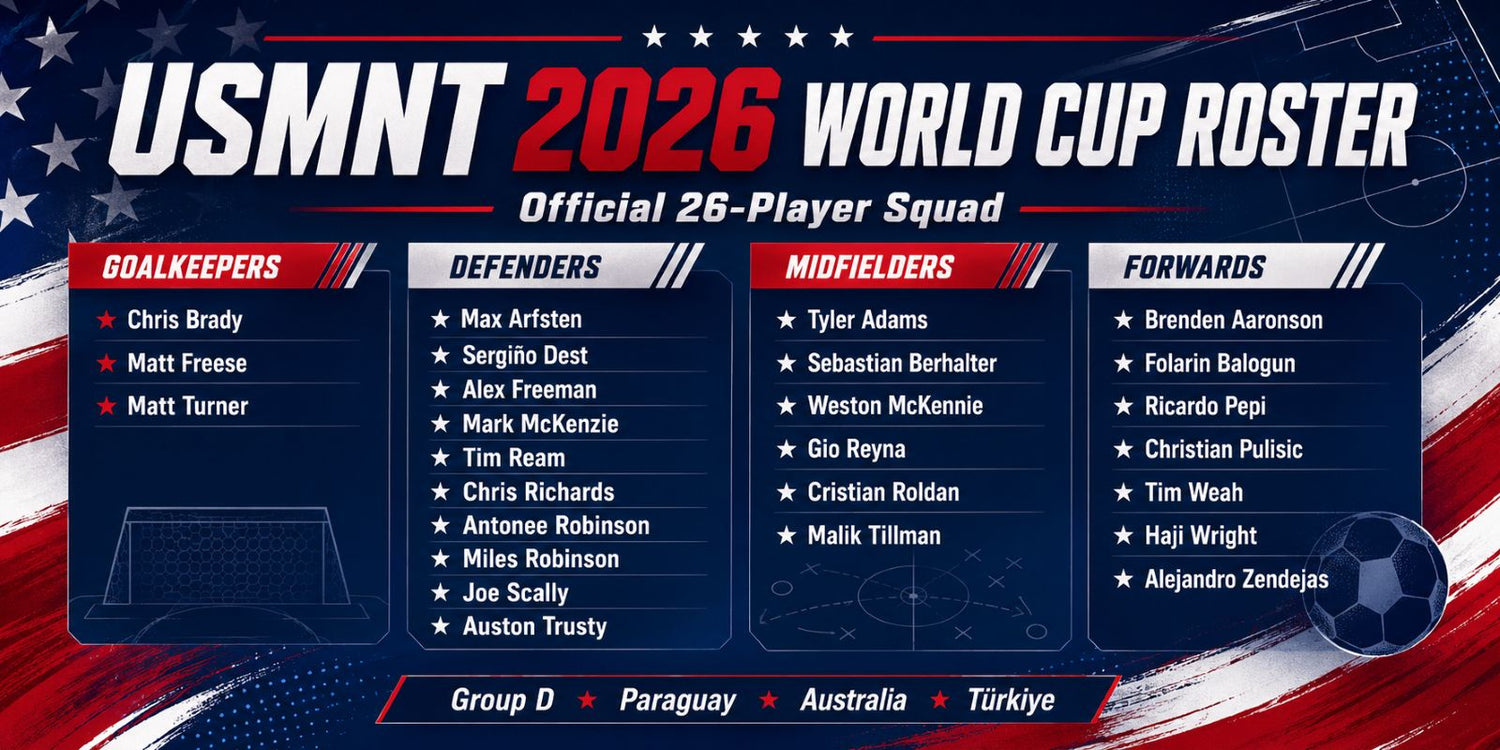
The official USMNT 2026 World Cup roster features 26 players across four position groups. The squad mixes established 2022 returners with new players who earned trust during Pochettino's cycle.
| Position | Players |
|---|---|
| Goalkeepers | Chris Brady, Matt Freese, Matt Turner |
| Defenders | Max Arfsten, Sergiño Dest, Alex Freeman, Mark McKenzie, Tim Ream, Chris Richards, Antonee Robinson, Miles Robinson, Joe Scally, Auston Trusty |
| Midfielders | Tyler Adams, Sebastian Berhalter, Weston McKennie, Gio Reyna, Cristian Roldan, Malik Tillman |
| Forwards | Brenden Aaronson, Folarin Balogun, Ricardo Pepi, Christian Pulisic, Tim Weah, Haji Wright, Alejandro Zendejas |
Roster Composition and Fast Facts
The roster is built with a defensive heavy structure and a compact midfield. That makes player availability, rotation control, and tactical flexibility central to the U.S. tournament plan.
- Position split: The squad includes 3 goalkeepers, 10 defenders, 6 midfielders, and 7 forwards.
- World Cup experience: Thirteen players were part of the 2022 U.S. World Cup roster.
- First timers: Thirteen players will go to their first World Cup, including Folarin Balogun, Ricardo Pepi, Chris Richards, Malik Tillman, and Alex Zendejas.
- Age profile: The squad will have an average age of 26 years and 332 days for the opening match against Paraguay.
- Caps profile: The roster has 505 total caps, making it one of the more experienced U.S. World Cup squads.
- Club footprint: Players represent clubs across 10 countries, with 8 players from MLS clubs in the United States and Canada.
Projected USMNT Starting XI
The most likely USMNT starting XI depends on player fitness, opponent profile, and how Pochettino balances ball progression with defensive protection. A strong version of the team could use a 4 2 3 1 shape with Pulisic, Reyna, and Weah supporting a central striker.
| Role | Projected Player |
|---|---|
| GK | Matt Turner |
| RB | Sergiño Dest |
| CB | Chris Richards |
| CB | Tim Ream |
| LB | Antonee Robinson |
| DM | Tyler Adams |
| CM | Weston McKennie |
| RW | Tim Weah |
| AM | Gio Reyna |
| LW | Christian Pulisic |
| ST | Folarin Balogun |
This projected lineup is not an official starting team. It reflects the most natural balance between tournament experience, technical quality, wide speed, and central defensive stability.
Tactical Outlook Under Mauricio Pochettino
Pochettino's USMNT should be judged by how well it presses, protects central spaces, and creates high quality chances for Pulisic, Balogun, Pepi, and Weah. The squad has enough athletic range to press, but the midfield numbers make game management especially important.
Pressing and Defensive Shape
The United States can press high when Adams and McKennie are available to cover central lanes. Aaronson, Weah, Pulisic, and Zendejas also give Pochettino wide pressing energy and recovery speed.
Midfield Control
The biggest tactical question is whether six midfielders can carry the tournament workload. Adams brings defensive balance, McKennie brings box to box power, Reyna brings creativity, and Tillman brings a final third scoring profile.
Wide Attacking Patterns
The strongest attacking pattern should come from fullback and winger combinations. Antonee Robinson can overlap Pulisic on the left, while Dest can create overloads with Weah or Zendejas on the right.
Striker Rotation
Balogun, Pepi, and Wright give the United States three different striker profiles. Balogun stretches back lines, Pepi attacks penalty box spaces, and Wright adds physicality plus wide forward flexibility.
Group D Schedule and Opponent Breakdown
The United States is in Group D with Paraguay, Australia, and Türkiye. The 2026 World Cup group format sends the top two teams from each group and the eight best third placed teams into the Round of 32.
| Match | Date | Venue | Main Challenge |
|---|---|---|---|
| USA vs Paraguay | June 12, 2026 | Los Angeles Stadium, Inglewood | Breaking down a compact, physical South American side |
| USA vs Australia | June 19, 2026 | Seattle Stadium, Seattle | Matching direct play, duels, set pieces, and transition intensity |
| USA vs Türkiye | June 25, 2026 | Los Angeles Stadium, Inglewood | Managing technical midfield play and dangerous final third quality |
Paraguay
Paraguay will likely test the U.S. with defensive discipline, physical duels, and counter attacking patience. The opening match is a pressure test because a strong start can shape the entire Group D path.
Australia
Australia brings tournament experience, aerial strength, and a direct competitive style. The U.S. must avoid letting the match become a loose contest built only on second balls and set pieces.
Türkiye
Türkiye may be the most technically dangerous opponent in the group. This match could decide whether the United States finishes first, second, or enters knockout qualification calculations from a more uncertain position.
USMNT Players to Watch
The U.S. roster has several players who can define the tournament with one elite performance. These are the names most likely to swing matches through chance creation, defensive control, finishing, or transition speed.
- Christian Pulisic: Pulisic is the attacking reference point and the most experienced player on the roster. His one versus one ability, final ball, and finishing will shape the U.S. ceiling.
- Tyler Adams: Adams is the central defensive organizer when healthy. His pressing reads and ability to protect the back line are vital against transition teams.
- Weston McKennie: McKennie gives the team aerial presence, duel strength, and late box runs. His role becomes even larger because the midfield group is smaller than the defensive and forward groups.
- Folarin Balogun: Balogun gives the U.S. a natural striker who can attack space behind the back line. His movement can create room for Pulisic and Reyna between the lines.
- Gio Reyna: Reyna is the most natural creative connector in the squad. His ability to receive under pressure and play through compact defenses could be decisive against Paraguay and Türkiye.
What Success Looks Like for the USMNT
Success for the USMNT starts with advancing from Group D and grows from there. Because the tournament now uses a Round of 32, the first benchmark is reaching the knockout stage, not jumping straight to the Round of 16.
- Minimum target: Advance from Group D into the Round of 32.
- Solid tournament: Win a knockout match and reach the Round of 16.
- Strong tournament: Reach the quarterfinals and show clear progress from 2022.
- Dream outcome: Use home advantage, elite attacking form, and defensive resilience to push toward the semifinals.
Soccer Strength and Conditioning Lessons
World Cup soccer demands repeated sprint ability, lower body power, core stability, and the durability to recover between intense match windows. Strength training has been linked with neuromuscular performance qualities that matter in soccer, including sprinting, acceleration, and power expression.[1]
Research on highly trained youth soccer players also suggests that strength, plyometric, and combined training can improve strength, jumping, acceleration, sprint speed, and change of direction performance.[2] Core training can further support power, speed, balance, and agility in soccer players when programmed consistently.[3]
For athletes inspired by the World Cup, a home training setup should support squats, lunges, hip thrusts, presses, rows, jumps, core work, and recovery friendly accessory movements. RitFit offers home gym equipment that can help build a practical strength base for soccer and general athletic performance.
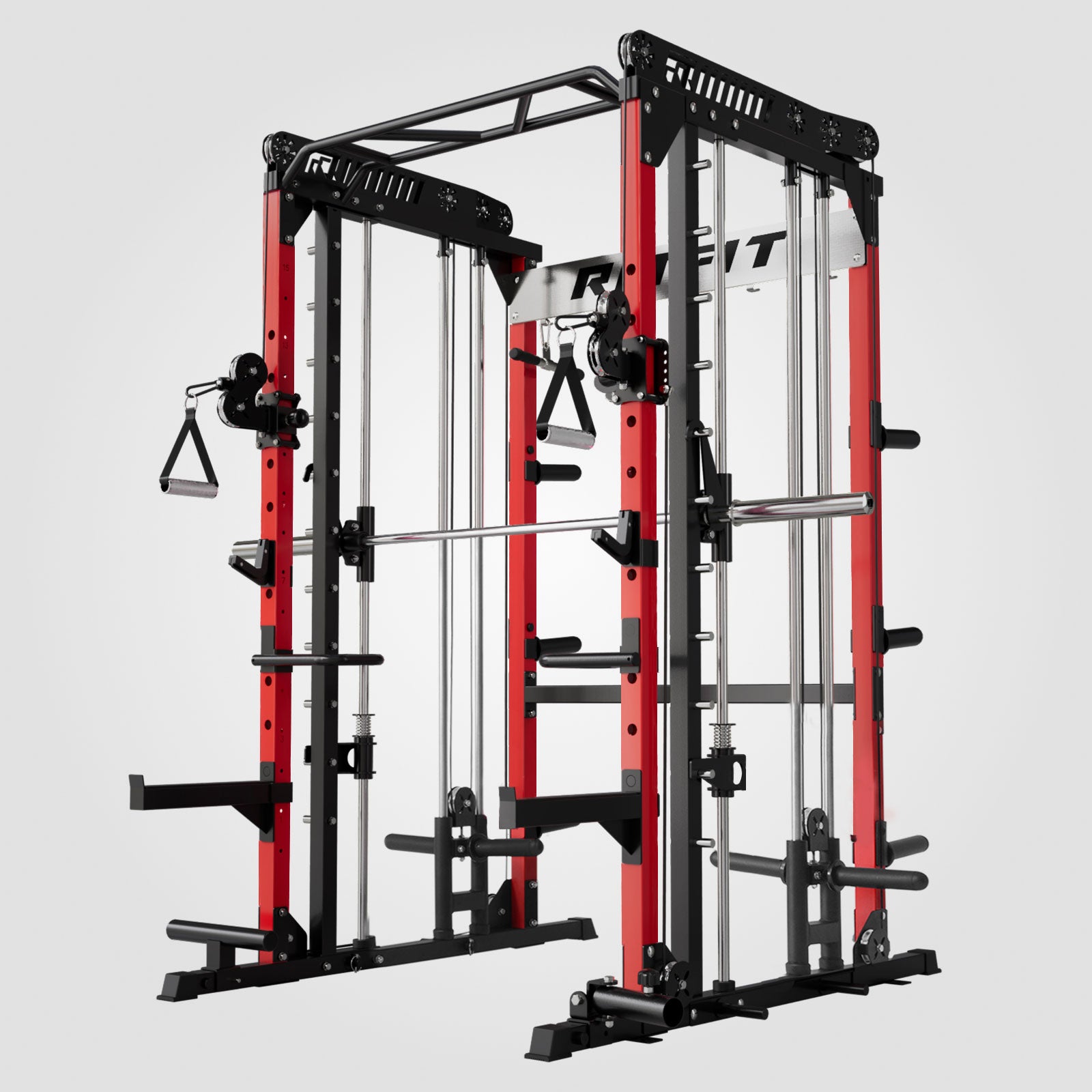
Lower body strength work can be performed with a Smith machine for home strength training, while upper body and core accessory work can be supported by RitFit dumbbells. A stable bench, such as the RitFit GATOR adjustable weight bench, can also support presses, split squats, step ups, and trunk control drills.
Explosive training should be scaled carefully and matched to the athlete's ability. Tools like RitFit 3 in 1 soft foam plyo box, RitFit hex rubber dumbbells, and barbells and weight plates can support progressive training when used with sound technique.
Frequently Asked Questions
Who made the USMNT 2026 World Cup roster?
Mauricio Pochettino selected the USMNT 2026 World Cup roster. The official 26 player squad includes three goalkeepers, ten defenders, six midfielders, and seven forwards, with Christian Pulisic, Tyler Adams, Weston McKennie, Gio Reyna, Matt Turner, and Folarin Balogun among the most important names.
What group is the United States in for the 2026 World Cup?
The United States is in Group D for the 2026 World Cup. The USMNT will face Paraguay, Australia, and Türkiye, making the group a mix of physical defending, direct play, and technical attacking quality across three very different matchups.
How many USMNT players are returning from the 2022 World Cup?
Thirteen USMNT players are returning from the 2022 World Cup roster. That group includes Christian Pulisic, Tyler Adams, Sergiño Dest, Weston McKennie, Tim Ream, Gio Reyna, Antonee Robinson, Matt Turner, Tim Weah, Haji Wright, Brenden Aaronson, Cristian Roldan, and Joe Scally.
Which USMNT players are going to their first World Cup?
Thirteen USMNT players are going to their first World Cup. The debut group includes Max Arfsten, Folarin Balogun, Sebastian Berhalter, Chris Brady, Alex Freeman, Matt Freese, Mark McKenzie, Ricardo Pepi, Chris Richards, Miles Robinson, Malik Tillman, Auston Trusty, and Alex Zendejas.
What is the biggest tactical question for the USMNT?
The biggest tactical question is midfield control. Pochettino selected only six midfielders, so the health and form of Tyler Adams, Weston McKennie, Gio Reyna, and Malik Tillman will strongly affect pressing balance, buildup play, and late match substitutions.
Can the USMNT win Group D?
Yes. The USMNT can win Group D if it starts well against Paraguay and manages the Türkiye match with discipline. Australia will also test the U.S. physically, so set piece defending, midfield control, and efficient finishing will matter in every game.
How does the 2026 World Cup knockout format work?
The 2026 World Cup uses a Round of 32 after the group stage. The top two teams in each of the 12 groups advance, and the eight best third placed teams also qualify for the first knockout round.
What fitness qualities matter most for soccer players?
Soccer players need repeated sprint ability, lower body strength, acceleration, agility, core stability, and recovery capacity. A balanced program should include strength training, plyometrics, sprint work, mobility, and controlled conditioning that matches the player's age, experience, and competitive level.
Conclusion
The USMNT 2026 World Cup roster is a high pressure blend of 2022 veterans, first time World Cup players, and attacking talent built for a home tournament. If Pochettino can keep the midfield stable, unlock Pulisic and Reyna, and rotate the striker group effectively, the United States has a realistic path to a strong knockout run.
Disclaimer: This article is for general sports commentary and educational fitness information only. It is not medical advice, coaching certification, or a substitute for individualized guidance from a qualified coach, physician, or physical therapist. Always train within your ability, use proper equipment, and seek professional support if you have injuries, medical conditions, or performance specific needs.
References
- Silva JR Nassis GP Rebelo A. Strength training in soccer with a specific focus on highly trained players. Sports Med Open. 2015;1:17. doi:10.1186/s40798-015-0006-z
- Oliver JL Ramachandran AK Singh U Ramirez-Campillo R Lloyd RS. The effects of strength, plyometric and combined training on strength, power and speed characteristics in high level, highly trained male youth soccer players: a systematic review and meta-analysis. Sports Med. 2024;54(3):623-643. doi:10.1007/s40279-023-01944-8
- Luo S Soh KG Zhang L Zhai X Sunardi J Gao Y Sun H. Effect of core training on skill-related physical fitness performance among soccer players: a systematic review. Front Public Health. 2023;10:1046456. doi:10.3389/fpubh.2022.1046456
- Osses-Rivera A Yáñez-Sepúlveda R Jannas-Vela S Vigh-Larsen JF Monsalves-Álvarez M. Effects of strength training on repeated sprint ability in team sports players: a systematic review. PeerJ. 2024;12:e17756. doi:10.7717/peerj.17756